This commentary is part of a series on “The new geopolitics of Asia and the prospects of North Korea diplomacy” produced by the Brookings Institution.
Russia is a nation at war. Its western frontier is a mixture of high-intensity combat zones, porous and dangerous buffer and grey zones, hostile territories, and small, allied land. Its southern neighborhood feels the heat from the armed conflict between two nuclear powers and a nuclear wannabe. Moscow maintains a military advantage over its neighbors in the Arctic, but geopolitical competition is rising. The eastern frontier, secured by Russia’s strategic partnership with China, treaty alliance with Kazakhstan, and friendship treaty with Mongolia, is the only border that remains stable and peaceful. In the Far East, Russia feels threatened by two “unfriendly states,” Japan and South Korea, aligned with its main adversary, the United States, all of whom seek to isolate, pressure, and denuclearize Russia’s ally the Democratic People’s Republic of Korea (DPRK) and contend with its most important strategic partner, the People’s Republic of China (PRC).
Confrontation with the West in Ukraine
Since 2022, Moscow has been waging hybrid warfare against the U.S.-led NATO alliance on the European theater and the bloody war of attrition against its proxy anti-Russian regime in Ukraine. What was meant to be a quick regime change operation to reverse the undesirable consequences of an anti-Russian coup d’etat in Kyiv didn’t go as planned and, instead, turned into a four-year-plus quagmire with no end in sight. It cost Moscow between hundreds of thousands and over a million lives in dead and wounded; led to partial international isolation; disrupted foreign trade, critical supply chains, and energy flows; drained the treasury; stifled economic development; and eroded social cohesion. The war in Ukraine put Russian foreign relationships to the test and revealed who was a true friend, a difficult partner, or an enemy.
The DPRK is the only country that formally recognized Russia’s reunification with Crimea and annexation of eastern Ukraine, unequivocally supported Moscow’s stance in confrontation against the West, and proved to be a loyal military ally that Moscow could rely on in combat. Hence, Russian President Vladimir Putin’s government forged a mutual defense alliance with Pyongyang, altered Russia’s long-held position by accepting the DPRK’s nuclear weapons state status, condemned existing international sanctions against the DPRK and vowed to block new U.N. sanctions, and backed Kim Jong Un’s new policy toward the South. Moscow resumed economic, technical, financial, and military-technical assistance to Pyongyang to compensate for its all-out support of Russia in the Ukraine war, ignoring the international sanctions regimes.
Despite the Russian-Chinese strategic partnership, Beijing balked at openly supporting Moscow’s claims and actions in Ukraine. Japan and South Korea condemned Moscow’s actions in Ukraine and joined the U.S.-led Western coalition in isolating and sanctioning Russia. Despite official denials, Seoul indirectly (via the Prioritized Ukraine Requirements List, known as the PURL initiative, and third countries) provided Kyiv with ammunition and armaments used to kill Russian soldiers in Ukraine. Consequently, Russia’s bilateral relations with Tokyo and Seoul deteriorated, giving the Kremlin sufficient reasons to discount their traditional concerns (such as signing a peace treaty with Japan or addressing the North Korean nuclear issue with the South).
Forging an “axis of resistance” in Northeast Asia
From Moscow’s vantage point, Northeast Asia is not as critically important to Russian national security as the post-Soviet space, especially Ukraine, the Baltic Sea region, or the Middle East, which borders the Black Sea and Caspian Sea regions. That said, Russians are convinced that the United States is gearing up for an eventual showdown with China over Taiwan or the South China Sea. For the moment, the Iran war distracts the United States from keeping its focus on the Indo-Pacific region. But sooner or later, Washington will turn its attention back to Beijing, and the Korean Peninsula might become a major battleground in their global fight.
To better prepare for this eventuality, Moscow promotes the idea of institutionalizing the Eurasian “axis of resistance” to Western hegemony, made up of Russia, Belarus, the DPRK, and the PRC. The so-called “new security architecture in Eurasia” should be built on the basis of the mutual defense obligations and security guarantees binding Moscow, Pyongyang, and Minsk in accordance with the June 2024 Russia-DPRK treaty on comprehensive strategic partnership; the March 2025 Russia-Belarus treaty on security guarantees; and the March 2026 DPRK-Belarus treaty on friendship and cooperation. The Shanghai Cooperation Organization, Collective Security Treaty Organization, and Eurasian Economic Union are also key to this effort. In addition, Pyongyang and Beijing are bound by their time-tested July 1961 mutual defense treaty. The 2001 Russian-Chinese Treaty on Good-Neighborliness and Friendly Cooperation is due to expire in 2026. It is likely to be replaced later this year with a more robust bilateral treaty designed to elevate their comprehensive strategic partnership of coordination to a higher level, with enhanced strategic communication, closer diplomatic coordination, deeper cooperation on all fronts, greater strategic resolve, mutual trust, and support “without limits.”
Low expectations from high-level diplomacy
From Moscow’s perspective, recent high-level diplomacy in Northeast Asia has reinforced existing trends and offered no strategic surprises. Despite high expectations, the Putin-Trump summit held in Alaska on August 15, 2025, failed to deliver either peace in Ukraine or normalization of Russian-U.S. relations. Although Russian diplomats want to believe that the “spirit of Anchorage” still lives on, new U.S. anti-Russian sanctions and U.S. military actions against Caracas and Tehran work hard to extinguish it from their memories.
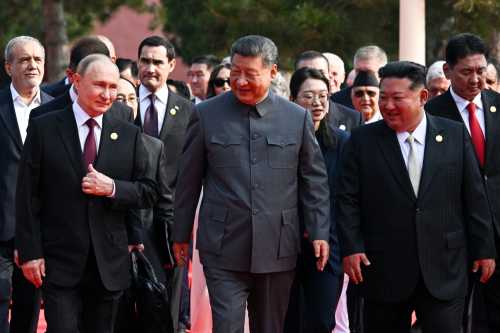
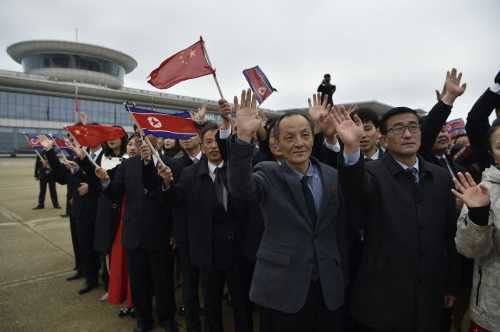
The much-expected summit between Trump and Chinese President Xi Jinping in May 2026 is unlikely to succeed in reversing the current negative trends in the U.S.-PRC relations. The summits between Putin, Xi, and Kim, held in Beijing in early September 2025, deepened the Russia-PRC strategic partnership, tightened the Russia-DPRK alliance, and reinvigorated the DPRK-PRC alliance. Kim’s planned visit to Russia in 2026 is expected to further strengthen military ties between Moscow and Pyongyang. In contrast, Russians expect Kim to continue to downplay the U.S. signals about Washington’s openness to “dialogue without preconditions” and ignore Trump’s invitations for a quick meeting on the sidelines of Trump’s summit with Xi in Beijing—just like Kim dismissed invitations from the U.S. president to meet during the latter’s travel to Asia in October 2025.
Trump’s summits with Japanese Prime Minister Sanae Takaichi, held in October 2025 and March 2026, confirmed Japan’s humiliating dependence on the United States for military security, the United States’ continued use of Japan as a go-to ATM for its investment and military needs, and Tokyo’s reluctance to get directly involved in the U.S. wars outside the Indo-Pacific region. Trump’s summits with South Korean President Lee Jae Myung in August and October 2025 once again demonstrated Seoul’s subservient status in the alliance and subordination to U.S. military security requirements and domestic political needs.
Siding with a nuclear North to prevent nuclearization in the South
At present, the Russian government recognizes the DPRK as a de facto nuclear weapons state. It insists that Pyongyang has the sovereign right to defend itself with all means available against the military threats posed by the United States and its allies, as evidenced by the U.S.-Republic of Korea (ROK) joint operational plans and “defensive military exercises.” Russia vows to defend its North Korean ally if requested, even with strategic arms, and asserts that the issue of DPRK denuclearization is now moot and has no place on the agenda of any talks on peace and security on the Korean Peninsula. The DPRK’s expanded and enhanced weapons of mass destruction arsenal serves as a much more reliable and durable deterrent against possible U.S.-South Korean aggression than any feeble and illusory international security guarantees it might have obtained as a result of denuclearization talks with the international community. The unenviable fate of the Joint Comprehensive Plan of Action, also known as the Iran nuclear deal, and that of Iran’s supreme leadership offer convincing proof of the wisdom of Kim’s nuclear decisions.
What worries Moscow in terms of nuclear dynamics on the Korean Peninsula is the Trump administration’s recent support for Seoul’s pursuit of nuclear-powered submarines, along with its push to secure the rights to develop uranium enrichment and plutonium reprocessing capabilities, against the background of its growing nuclear ambitions. It is seen as the outgrowth of the Biden administration’s “dangerous decision” in April 2023 to create the U.S.-ROK Nuclear Consultative Group, and Washington’s commitment to discuss with Seoul the possible return of tactical nuclear weapons to South Korea. Moscow is concerned that the Trump administration might have opened the door to an indigenous South Korean nuclear weapons program. Such a development would destabilize the security equilibrium in Northeast Asia, undermine the global nuclear non-proliferation regime, spur Japan and Taiwan to explore their own nuclear options, and fundamentally contradict the goal of “denuclearization of the Korean Peninsula.”
Peaceful coexistence is a mirage
From Moscow’s perspective, peaceful coexistence between the two Koreas appears illusory and unlikely, given the acute trust deficit and heavy historical baggage. The North and South find themselves in a new multipolar and fragmented world, where might is right, security is scarce, and international law is blatantly violated. The probable scenario is that the present status quo of neither armistice nor peace will continue indefinitely. Moscow would support that.
The risk is that Kim, who calls South Korea the “most hostile state” and may be emboldened by renewed Russian and Chinese security assurances, might decide to follow Trump’s example and take radical action against South Korea’s emerging nuclear threat, much as Trump did with Iran. The nuclear-armed North’s surprise preemptive strike against the perceived nuclear wannabe South would be the worst-case scenario, which can no longer be ruled out on the Korean Peninsula.
Author

Related Content
The Brookings Institution is committed to quality, independence, and impact.
We are supported by a diverse array of funders. In line with our values and policies, each Brookings publication represents the sole views of its author(s).

Commentary
Russia’s approach to Northeast Asia in wartime
April 30, 2026