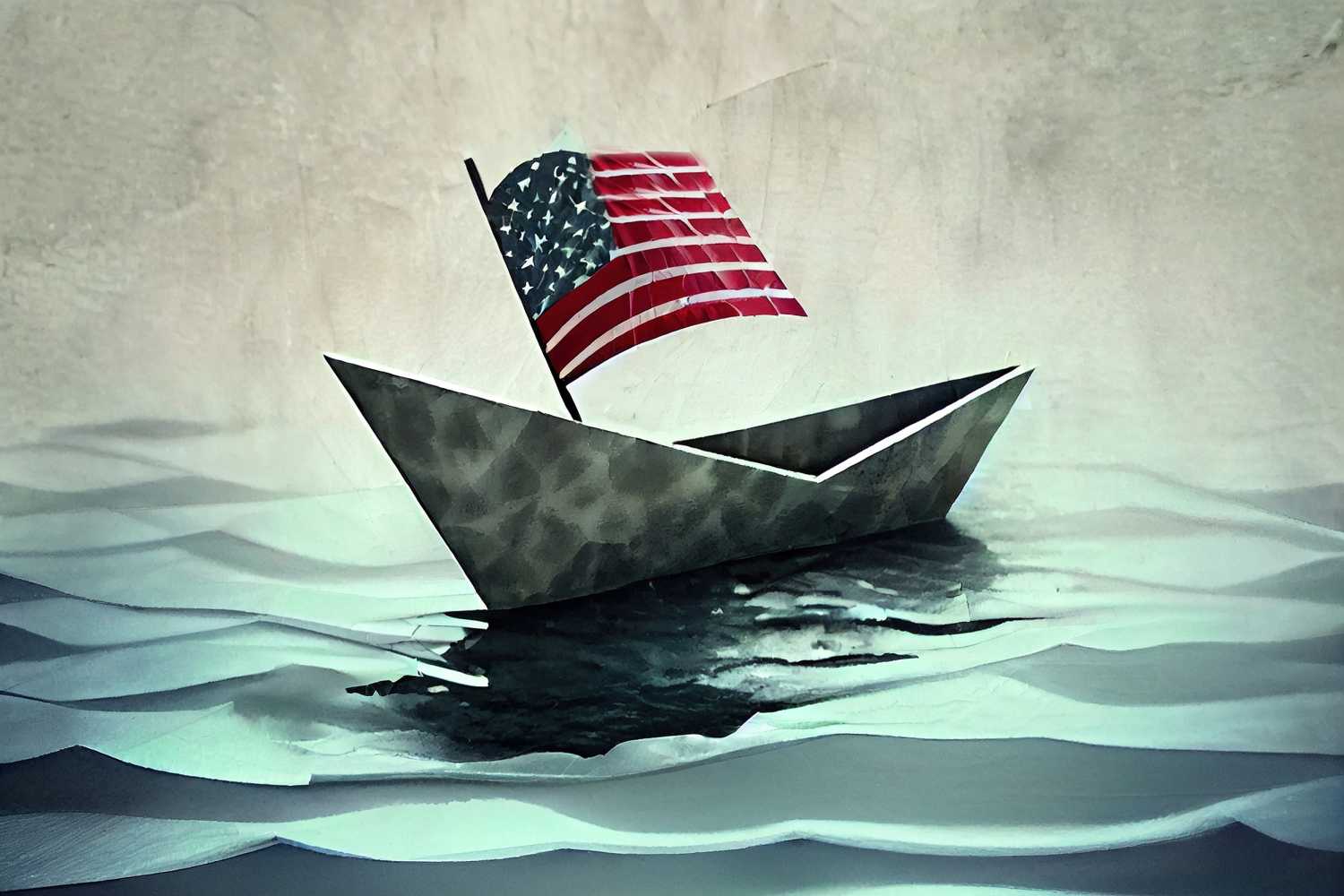
America’s China policy is stuck. We have gone too far down the path of competition with China to return to the earlier era of comity and commerce, which had always been tenuous and troubled anyway. Yet the path forward for competing with China is strewn with a thorny thicket of challenges. Most notably, future administrations will not be able to rely on the old pillars of U.S. preeminence: alliances, soft power, and a favorable balance of military and technological hard power. As the United States copes with a painful political reckoning at home and crises abroad, it risks falling behind in the competition with China—both in the Indo-Pacific and in a growing number of crucial domains.
Already, it is obsolete to call China a “rising power.” While China has not yet overtaken the United States, it has definitively arrived as a great power—a reality with which decisionmakers must already contend. And in this moment of geopolitical competition, the United States does not enjoy the preponderance of power that it did at the outset of the Cold War. At the end of World War II, the Soviet Union was a superpower but was far more bloodied and depleted than the United States, which faced only limited conflict on its territory and thus retained its formidable industrial capacity. Today, it is the U.S. military that is more bloodied and depleted after a quarter century of nearly continuous conflict. China, meanwhile, is a manufacturing powerhouse that has avoided military conflict for more than four decades. And unlike the Soviet Union, China is not spending an outsized proportion of its GDP on defense.
The challenge of strategic discipline
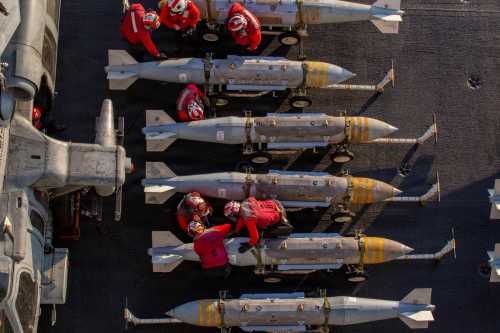
After 25 years of war in the Middle East, U.S. military preeminence in the Indo-Pacific is receding. Over the past decade, the Pentagon has rolled out a series of initiatives to cope with the deteriorating military balance with China, but they have amounted to little more than slogans that have failed to reverse the United States’ eroding military edge. The previous two U.S. National Defense Strategies identified China as the U.S. “pacing challenge.” Yet the commission tasked with assessing the strategy’s efficacy in 2024 concluded that China is actually outpacing the United States in many ways, including in defense production and force capability. The most recent National Defense Strategy, published in 2026, does not even designate China a pacing challenge. The net result is alarming: the U.S. capacity to prevail in a war is declining, which over time will degrade America’s ability and appetite to deter China.
Meanwhile, for a decade, the United States has lacked a coherent or effective economic strategy to persuade Beijing to adjust its economic model or to engage the economies around China. Punitive tools such as tariffs have not induced meaningful shifts in Beijing’s economic conduct at home or abroad. At best, sanctions have imposed a cost that China is willing and able to absorb. U.S. export controls arguably have been effective in achieving their more limited objectives, but even those have come under increasing strain. Overall, instead of bending to U.S. pressure, China has been immunizing itself against the punitive tools of U.S. economic statecraft while increasing its partners’ dependence on its market, manufactured goods, and technology—a dynamic that is only accelerating. And China’s growing technological prowess not only challenges U.S. advantages in particular technologies but also poses an even more profound challenge to the notion that America’s innovation and technological advances represent the future.
A core tenet of our open society is that we have the capacity to recognize our collective problems, address them, and correct course. However, over the past decade, our politics and policymaking have often prevented rather than enabled Washington to do just that. Since the first Obama administration, the United States has been proclaiming its intention to “pivot to Asia,” in part to contend with the challenges posed by China. The first Trump administration put competition with China at the center of its foreign policy, as did the Biden administration. But following through on these intentions has been difficult. The United States has had to focus on other crises in the Middle East and Europe, and rebuilding the institutional muscle memory for great power competition is expensive and challenging, particularly without a crisis forcing the issue. Since 9/11, an entire generation of senior policymakers has operated as metaphorical “firefighters,” spending most of its time managing crises. This dynamic often forces the president and senior policymakers to put a long-term challenge like China on the back burner.
Meanwhile, China generally tries to avoid provoking a crisis with the United States, its most powerful adversary, preferring instead to “bend but not break” the relationship while steadily accruing advantages. It has eschewed external distractions while acknowledging and devoting resources to remedying many—if not all—of its own challenges. As a result of China’s advances, the United States can no longer afford for its foreign policy to be everything, everywhere, all at once. For a sprawling challenge like China, Washington should be guided by a secularized version of the Serenity Prayer—accepting what cannot be changed, having the courage to change what we can, and having the wisdom to know the difference.
Strength abroad is born at home
The Brookings Institution has launched a new initiative—“Sharpening the edge: Positioning the United States for strategic competition with China”—to provide creative and novel policy recommendations to ensure that Washington maintains its edge over China. This initiative will be sober about assessing our weaknesses and offering sound prescriptions for the maladies that undermine our ability to compete with China. The goal is not to dwell on our shortcomings but to fortify ourselves for this contest in the years ahead. The United States retains formidable advantages—but we are at risk of frittering them away instead of cultivating them. Much is at stake here. For the lifetime of nearly every American, the United States has been the preeminent superpower. This feature of the geopolitical terrain has become encoded into our political DNA—which raises profound questions about what happens to our politics, our prosperity, and our security if and when the United States is no longer “number one.” If the United States has any hope of nurturing and growing its strengths, it must make headway on a number of key challenges abroad—and, more importantly, at home.
Brookings is uniquely positioned to address these challenges because it is home not only to the country’s leading China experts, but also its top strategists, economists, and budget experts. Thinking boldly and creatively about how to contend with China will require that diverse bench of expertise because dealing with the problem will involve more than just our China policy. It will involve a significant renovation of our military, our economic statecraft, our supply chains, and our approach to industrial policy. Those reforms will require a deeper political consensus and meaningful resources. Our strength abroad will be born at home.
The Brookings Institution has a long and storied history of advancing bold ideas for complex geopolitical challenges, such as playing a pivotal role in the development of the Marshall Plan to rebuild Europe after World War II. This initiative will be our effort to meet America’s foremost geopolitical challenge of this moment.
Author

Related Content
2026
The Brookings Institution is committed to quality, independence, and impact.
We are supported by a diverse array of funders. In line with our values and policies, each Brookings publication represents the sole views of its author(s).