This commentary is part of a series on “The new geopolitics of Asia and the prospects of North Korea diplomacy” produced by the Brookings Institution.
China’s view of the Korean Peninsula in 2026 can no longer be understood through the narrow lens of U.S.-North Korea diplomacy alone. It must be situated within a broader strategic framework shaped by systemic stability, risk management, and the need to prevent further regional deterioration. From Beijing’s perspective, the peninsula is not merely a nuclear issue or a bilateral diplomatic problem between Washington and Pyongyang. Multiple pressures and strategic issues have converged, including North Korea’s further consolidation of its nuclear status after the Ninth Party Congress, the further deepening of Russia-North Korea ties, intensifying U.S.-China competition, the growing institutionalization of U.S.-Japan-South Korean trilateral coordination, and the spillover effects of conflict in the Middle East.
For that reason, China’s policy thinking does not begin with the question of whether Donald Trump and Kim Jong Un will meet again, but whether the peninsula can be prevented from entering a more dangerous cycle of escalation and bloc confrontation. From Beijing’s standpoint, the central issue is whether diplomacy can still function as an instrument of risk reduction in a deteriorating security environment. Beijing’s position on the Korean Peninsula can be addressed in five points.
1. Denuclearization remains China’s formal principle, but it is no longer the immediate operational lever of policy.
China has not abandoned denuclearization of the Korean Peninsula in principle, and continues to link that objective to a transition from the armistice to a peace mechanism. However, China’s policy sequencing has clearly evolved.
North Korea’s nuclear capability is no longer merely a bargaining chip. It has become increasingly embedded in the regime’s legitimacy, national security, and long-term development strategy. As a result, China appears increasingly less convinced that rapid denuclearization can serve as the realistic point of departure for diplomacy. Instead, Beijing is gradually adopting a new sequence of priorities: stabilization first, then denuclearization later.
This does not amount to recognizing North Korea as a legitimate nuclear state. Rather, China is increasingly concluding that a rigid denuclearization-first approach is impractical and may worsen the regional security environment. In Beijing’s view, overemphasizing denuclearization at this stage would not only harden Pyongyang’s resistance but also raise the risk of escalation and further strengthen the logic of trilateral deterrence and alliance integration around China’s periphery.
It is useful to clarify the precise meaning of “denuclearization” in the Chinese policy context. China insists that denuclearization applies to the entire Korean Peninsula—not solely North Korea—which is different from how the issue is often framed in U.S., South Korean, and Japanese policy discourse. This includes U.S. extended nuclear deterrence commitments to South Korea, the periodic and open deployments of strategic nuclear assets, debates over nuclear submarines and nuclear fuel, and growing calls in South Korea for an indigenous nuclear capability.
In other words, in China’s policy understanding, the technical and strategic scope of denuclearization includes not only North Korea’s existing nuclear weapons and related capabilities, but also extended nuclear deterrence, the deployment or introduction of nuclear assets onto the peninsula, and the possibility of further nuclear proliferation. Precisely for that reason, Beijing has consistently opposed reducing denuclearization to a one-sided demand that North Korea alone disarm. Instead, it insists on placing the issue back within the broader context of the peninsula’s overall security structure and the larger regional strategic balance.
2. China does not welcome a nuclear-armed North Korea, but it fears instability more than a frozen nuclear reality.
China does not want North Korea’s nuclear status to be normalized by the international community. If that were to happen, the regional non-proliferation order would be weakened, debates in South Korea and Japan over indigenous nuclearization would intensify, U.S. extended deterrence would be strengthened further, and trilateral military coordination among the United States, Japan, and South Korea would become even tighter. This concern is consistent with recent South Korean strategic debates warning against any de facto acceptance of North Korea’s nuclear status.
Yet China does not support an uncompromising policy line that repeatedly drives the situation toward confrontation, military escalation, and hardened bloc politics. Beijing fundamentally opposes not merely North Korea’s possession of nuclear weapons, but the broader evolution of Northeast Asia’s security structure toward what may be called “deterrence normalization”: a situation in which North Korea’s nuclear status is increasingly accepted, while U.S. extended deterrence and regional military integration are continually reinforced.
3. Trump-Kim diplomacy as a variable of risk control.
China does not inherently oppose renewed contact between Trump and Kim, and it does not judge the value of engagement in terms of summit politics, leadership style, or diplomatic theater. Instead, what Beijing really cares about is whether such contact can create practical room for crisis management.
Accordingly, China would not define success as a dramatic diplomatic breakthrough, nor would it treat renewed rhetorical commitments to “complete denuclearization” as the sole objective. What is more realistic and valuable is the establishment of concrete mechanisms: reducing miscalculation, restoring communication, and putting in place phased freeze, restraint, and monitoring arrangements so as to reduce the risk of the situation on the peninsula spiraling out of control.
Put differently, when Beijing looks at the Korean Peninsula under the second Trump administration, it observes how the peninsula is embedded in Washington’s broader strategic priorities. If the Korean Peninsula is increasingly subordinated to the larger framework of U.S. Indo-Pacific strategy, alliance coordination, and competition with China, then even if Washington simultaneously pursues symbolic outreach to Pyongyang, Beijing will still regard U.S. efforts as a structural challenge.
4. The changing structure of bloc politics.
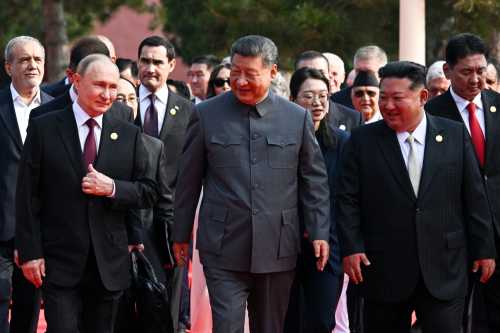
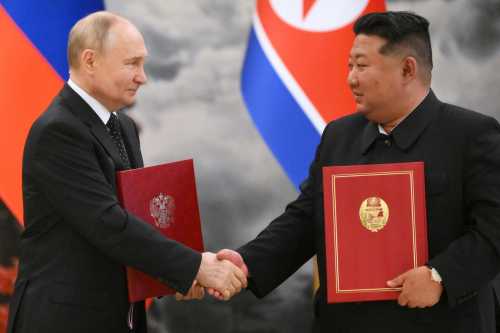
China regards the emerging China-North Korea-Russia alignment as having a dual character: while deepening Russia-North Korea ties can weaken the United States’ ability to diplomatically dominate the peninsula, they also increase regional uncertainty, expand North Korean strategic autonomy, and strengthen the rationale for tighter U.S.-Japan-South Korea trilateral coordination.
Accordingly, China’s primary concern is not bloc politics in the abstract, but the possibility that the Korean Peninsula becomes absorbed into a more rigid, institutionalized confrontation structure with a more explicit anti-China strategic logic. Beijing seeks to avoid being simplistically folded into a China-North Korea-Russia threat bloc narrative and to prevent the United States from using Russia-North Korea cooperation to justify intensified surveillance, technology restrictions, and alliance integration in Northeast Asia.
At the same time, Beijing does not interpret deeper China-North Korea or Russia-North Korea ties in purely zero-sum terms. The key question is whether these evolving relationships create additional strategic space for diplomacy or deepen regional division. This underlies China’s continued emphasis on high-level engagement with Seoul and its resistance to seeing South Korea fully consolidated into an explicitly anti-China strategic role. As China sees it, the current regional structural shift is one of simultaneous dual pressures: the strengthening of China-North Korea-Russia ties and the growing institutionalization of U.S.-Japan-South Korea coordination. These two sets of relationships reinforce one another, compress diplomatic flexibility, and increase the likelihood that the Korean issue will become tied to broader great-power competition.
5. Peaceful coexistence is meaningful only under three conditions.
China does not regard “peaceful coexistence” as a substitute for denuclearization, but as a realistic and workable starting point for dialogue. That is possible only if three conditions are met simultaneously. First, it cannot be completely detached from the long-term principle of denuclearization. Second, it must contain some notion of balanced security, rather than unilateral pressure. Third, it requires a certain degree of predictability in U.S. policy behavior. These three elements capture China’s thinking on peaceful coexistence more accurately than either a simple narrative of dialogue or deterrence.
This reflects China’s larger strategic logic. What Beijing truly worries about is not simply U.S. power, but the instability of U.S. strategic behavior. The more the United States exhibits volatility under the pressure of multiple fronts, the harder it becomes for peaceful coexistence to emerge as a realistic framework. Conversely, if U.S. behavior becomes more predictable, then there is greater space for reducing tensions through phased arrangements and preserving future diplomatic possibilities.
The same logic can also be extended, in modified form, to inter-Korean relations. From China’s perspective, under present conditions, peaceful coexistence is unlikely to become the ultimate political formula between North and South Korea. But it can still function as a practical starting point: lowering the risk of confrontation, restoring contact, building limited trust, and preventing crises from escalating into direct conflict.
Most recently, President Lee Jae-myung expressed regret over a drone incursion into the North, and North Korea responded positively. This suggests that even under conditions of sustained structural antagonism, some room remains for the two Koreas to lower tensions and resume limited interaction through calibrated political signaling. China would welcome such moves to ease tensions, because from Beijing’s perspective, any effort that helps reduce miscalculation, slow the accumulation of hostility, and prevent the peninsula from moving further toward institutionalized confrontation helps create the necessary strategic space for risk management, renewed dialogue, and longer-term regional stability. In that sense, what China means by peaceful coexistence is not a final settlement formula, but a buffering arrangement that can prevent the peninsula from sliding more deeply into a high-pressure confrontational order.
Conclusion
China’s policy toward the Korean Peninsula is to pursue controlled flexibility under structural constraints. Beijing has not abandoned denuclearization, but it no longer treats immediate denuclearization as the realistic starting point for diplomacy. It does not welcome a nuclear-armed North Korea, but its concern over regional instability is greater than its objection to a frozen nuclear reality. It does not oppose Trump-Kim engagement, but it judges such diplomacy by whether it reduces risk rather than whether it produces symbolic breakthroughs. It does not simply benefit from Russia-North Korea ties, because those ties also intensify the bloc dynamics Beijing most wants to restrain. And it does value peaceful coexistence, but only on the condition that the concept remains linked to long-term denuclearization, medium-term balanced security, and short-term U.S. predictability.
Most importantly, China has not shifted toward openly accepting a nuclearized Northeast Asian order. But it is moving ever more clearly toward a new policy logic: first stabilize a difficult reality, then continuously reduce the practical risks arising from that reality, address the broad range of concrete problems that reality repeatedly generates, and preserve denuclearization as a long-term principle without publicly abandoning it.
Author

Related Content
The Brookings Institution is committed to quality, independence, and impact.
We are supported by a diverse array of funders. In line with our values and policies, each Brookings publication represents the sole views of its author(s).


Commentary
China is confronting new realities on the Korean Peninsula
April 30, 2026