This commentary is part of a series on “The new geopolitics of Asia and the prospects of North Korea diplomacy” produced by the Brookings Institution.
North Korea’s contemporary diplomatic posture cannot be understood solely through the lens of U.S. relations with the Democratic People’s Republic of Korea (DPRK). Rather, Pyongyang’s foreign policy reflects a broader reassessment of the global order, the regional security environment, and its own position within what it increasingly perceives as an emerging multipolar order. This recalibration has produced a strategy that is less negotiation-driven and more opportunity-seeking. It prioritizes strategic autonomy, diversified partnerships, and long-term regime security over immediate engagement with Washington or Seoul.
At the core of Pyongyang’s strategic thinking lies a fundamental shift in its perception of global order. Unlike the 2018-2019 period, when it briefly entertained the possibility of a negotiated settlement with Washington, Kim Jong Un now appears to view the era of unipolar American dominance as effectively over. Instead, he frames the international system as moving toward a multipolar configuration characterized by intensifying competition among major powers. This perception is not merely rhetorical but provides the conceptual foundation for Pyongyang’s evolving diplomatic behavior.
The Ukraine war has reinforced this worldview. By openly supporting Russia and formalizing a new level of military cooperation—including troop deployments—Pyongyang has demonstrated both ideological alignment and strategic opportunism. The 2024 treaty with Moscow, which includes provisions for mutual military assistance, reflects an effort to situate itself within a countervailing axis to U.S.-led alliances. At the same time, Pyongyang appears mindful of the relationship’s limits. Given historical volatility in Russia-DPRK relations and the contingent nature of wartime cooperation, Moscow is best understood as a situational partner rather than as a permanent ally.
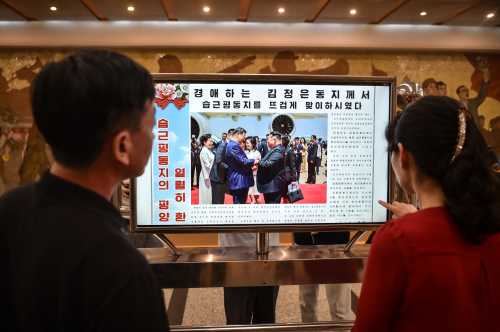
This recognition explains Pyongyang’s parallel effort to stabilize relations with Beijing. China remains North Korea’s most important economic lifeline and diplomatic buffer against international sanctions. Yet the relationship is marked by mutual ambivalence. China views North Korea as both a strategic asset and a liability, while Pyongyang remains wary of overdependence. Consequently, North Korea’s approach can be understood as calibrated engagement—seeking economic and political support while preserving strategic autonomy. The recent revival of high-level exchanges, including Kim’s participation in China’s Victory Day events and Chinese Foreign Minister Wang Yi’s visit to Pyongyang, reflects an attempt to secure a long-term safety net within the multipolar system.
Pyongyang’s new diplomatic initiative
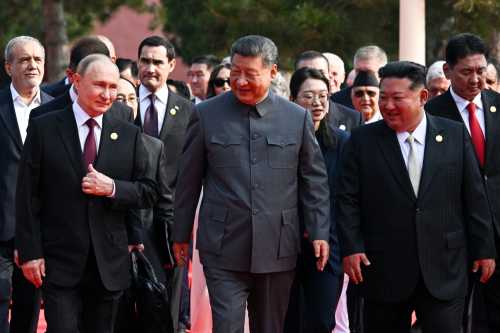
Taken together, these dynamics point to what might be described as a new North Korean diplomatic initiative. Rather than aligning exclusively with any single power, Pyongyang seeks to exploit the competition among the United States, China, and Russia to expand its strategic space. This approach echoes Pyongyang’s Cold War-era maneuvering between Moscow and Beijing, but it is adapted to a more fragmented global order and less cohesive U.S. alliance system. Importantly, North Korea may seek to institutionalize a more structured trilateral alignment with China and Russia. However, despite symbolic gestures—such as the simultaneous presence of Xi Jinping, Vladimir Putin, and Kim in Beijing—the absence of formalized trilateral mechanisms highlights the inherent limits of such coordination.
Within this broader geopolitical context, North Korea’s policy toward the United States has become increasingly constrained. The failure of the 2019 Hanoi summit marked a critical turning point. From Pyongyang’s perspective, it exposed the incompatibility between its preferred “action-for-action” approach and Washington’s demand for complete denuclearization—differences unlikely to be resolved in the near term. The experience deepened Pyongyang’s distrust of U.S. intentions and South Korea’s role as a mediator between the United States and North Korea. It also diminished the appeal of summit-driven diplomacy as a viable pathway.
Recent statements from Pyongyang suggest that this skepticism persists. Pyongyang has declared that negotiations with Washington have “gone as far as we can,” while insisting that any future dialogue must begin with U.S. recognition of the “changed reality” of its nuclear status. In effect, North Korea now treats de facto recognition as a nuclear state as a precondition for meaningful dialogue. Given the improbability of U.S. acceptance of such terms, the prospects for near-term diplomatic breakthroughs remain low.
Nevertheless, Pyongyang has not entirely foreclosed the possibility of diplomacy. At the Ninth Congress of the North Korean Workers’ Party held in February, it reframed the conditions under which dialogue might occur. By placing the burden of initiative on the United States—demanding the abandonment of “hostile policy” and acknowledgment of its constitutional nuclear status—Pyongyang maintained strategic flexibility while avoiding the appearance of concession. This posture allows North Korea to keep diplomatic options open without actively pursuing negotiations.
The evolving U.S. strategic posture has further complicated this equation. Recent U.S. policy documents indicate a relative deprioritization of the Indo-Pacific in favor of the Western Hemisphere, alongside a preference for managing competition with China through a form of “decent peace” rather than direct confrontation. From Pyongyang’s perspective, this shift presents both risks and opportunities. Reduced U.S. attention to the region may weaken deterrence and provide space to consolidate North Korea’s strategic gains. At the same time, deeper integration of the North Korean issue into U.S.-China relations could constrain Pyongyang’s autonomy, particularly if Beijing seeks to use the Korean Peninsula as leverage in its broader competition with Washington. Moreover, recent U.S. military action against Iran has further reinforced North Korea’s negative perception of U.S. foreign policy. Pyongyang characterizes the United States as a hegemonic and lawless actor that routinely violates state sovereignty under the pretext of maintaining order, using military force to advance its strategic interests. In this view, U.S. behavior reflects a persistent pattern of coercion and destabilization, thereby reinforcing North Korea’s justification for maintaining robust nuclear deterrence and resistance.
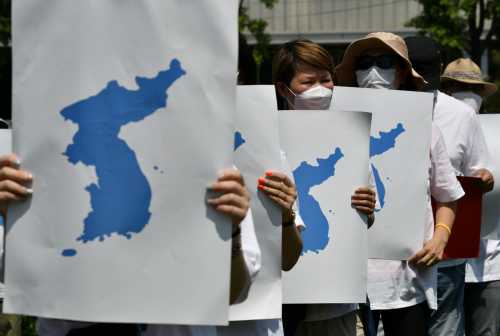
North Korea’s policy toward South Korea must also be understood within this framework. Its shift from viewing inter-Korean relations as a “special relationship” tied to unification to defining them as relations between “two hostile states” represents a profound conceptual change. Domestically, this reinforces regime legitimacy by framing South Korea as an external adversary rather than a national counterpart. Strategically, it eliminates the normative constraints associated with unification discourse, enabling a more flexible and assertive security posture. This shift is consistent with the broader trajectory of Kim’s strategy since the early 2010s. The progression from the Byungjin line—simultaneous economic and nuclear development—to the 2017 declaration of a completed nuclear deterrent, followed by the recent institutionalization of the “two hostile states” doctrine, reflects a coherent effort to normalize North Korea’s status as a nuclear-armed state in a confrontational environment. Its diplomatic orientation is no longer centered on engagement or reconciliation but on managing external threats and maximizing leverage in a multipolar world.
The implications for regional security are significant. As North Korea deepens ties with Russia and maintains a cautious relationship with China, the risk of polarization in Northeast Asia grows. Pyongyang continues to portray Japan as a reemerging militarist threat, criticizing Tokyo’s expanding defense posture as evidence of offensive intent rather than self-defense. However, this polarization is unlikely to take the form of a rigid “new Cold War.” Instead, the region appears to be moving toward an unstable multipolar order, characterized by fluid alignments, overlapping spheres of influence, and persistent uncertainty.
In this environment, North Korea’s diplomatic prospects are shaped not only by its bilateral relations but also by broader structural dynamics. Key variables include the trajectory of U.S.-China relations, the outcome of the Ukraine war, and the cohesion of regional alliances. Pyongyang’s optimal strategy is to maintain flexibility—avoiding over-commitment to any single power—while leveraging great power competition to secure economic and security benefits.
Looking ahead
Several scenarios follow. A resumption of high-level U.S.-DPRK diplomacy—particularly in the form of Trump-Kim summitry—cannot be ruled out but is unlikely to yield substantive agreements. Without prior working-level progress and convergence on core issues, such meetings would likely replicate the symbolic but inconclusive encounters in Hanoi and Panmunjom. A more plausible outcome is the gradual normalization of North Korea as a de facto nuclear state within a tense regional order, shifting the focus from complete denuclearization to nuclear disarmament and risk reduction, albeit without formal recognition. If the United States and South Korea fail to develop new strategies to respond to North Korea’s strategic initiatives, Pyongyang’s gradual normalization efforts are likely to generate new sources of regional instability.
Alternatively, the concept of “peaceful coexistence” may emerge as a limited but pragmatic framework for managing tensions, maintaining communication channels, and preventing escalation. While far from resolving the conflict, such an approach would align with North Korea’s core strategic objective of regime survival and strategic autonomy. Notably, this term has been used not only by Kim but also by the Lee Jae Myung administration in South Korea and by some U.S. experts. The key issue, however, is that peace must produce tangible—not merely rhetorical—outcomes; under conditions in which North Korea advances the notion of “two hostile states,” achieving meaningful peace on the Korean Peninsula remains highly challenging.
In sum, Pyongyang’s foreign policy reflects a calculated adaptation to a changing geopolitical landscape. By embracing multipolarity, diversifying partnerships, and redefining its relations with both adversaries and neighbors, it seeks to navigate uncertainty while preserving its core interests. For regional actors, the challenge is to understand this strategic logic—not as irrational defiance, but as a coherent response to perceived structural constraints—and to formulate policies that address the realities of an unstable multipolar order.
Author

Related Content
The Brookings Institution is committed to quality, independence, and impact.
We are supported by a diverse array of funders. In line with our values and policies, each Brookings publication represents the sole views of its author(s).
Commentary
Pyongyang’s diplomatic calculus in an unstable multipolar order
April 30, 2026