Executive summary
President Donald J. Trump has shown notable deference in his public comments to Chinese leader Xi Jinping’s priorities and concerns. Trump has been publicly praiseworthy of his Chinese counterpart and respectful of China’s rise under Xi. Rather than reciprocating with gestures to address Trump’s appetite for respect on the world stage, though, Xi has taken a more guarded approach to managing U.S.-China relations. This has included securing Trump’s acceptance of framing the relationship as one of “constructive strategic stability,” and maintaining consistent leader-level engagement. Beijing’s caution toward Trump may be rooted in several factors, including an expectation that time is on China’s side, an assumption that America will pursue a competitive posture toward China regardless of any rhetorical softening by Trump, and the fact that Xi is focused foremost on domestic priorities. As a result, Chinese leaders appear to be calculating the lowest cost they must pay to sustain an uneasy calm in the relationship. Beijing is focused on strengthening its long-term position for competing with the United States, not on securing breakthroughs with Trump.
Trump is delivering on Beijing’s aspirations
Since the founding of the People’s Republic of China (PRC) in 1949, China’s leaders have chafed at their perception of America’s ideological zeal. To varying degrees, American leaders since World War II have encouraged China to become more open, free, and democratic. Multiple American leaders have lent support to democratic movements to overthrow communist regimes around the world, both during the Cold War and since. China’s leaders from Mao Zedong onward have expressed frustration at American attempts to change China. In response, Chinese leaders consistently have vowed that one day China would surpass the United States and prove the superiority of its governance model.
Seen in this light, President Donald Trump and his administration embody many of the traits, instincts, and characteristics that Beijing has long sought in an American counterpart. Gone is any semblance of high-handedness in suggesting what reforms China should undertake. The Trump administration does not champion human rights, religious freedom, or liberal democratic governance, nor does it pressure China to reform its governance or economic models. It does not demand that China conform to Western civilizational traditions and ideals. Rather, it approaches China as a different civilization with its own customs and practices.
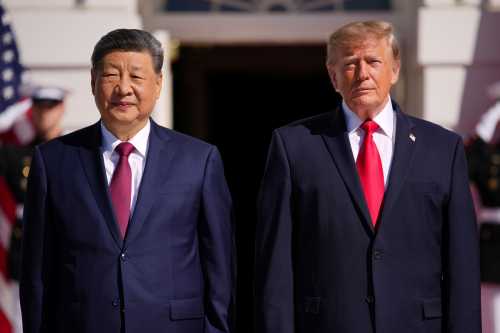
Trump has provided persistent public displays of respect for Chinese leader Xi Jinping. He has bestowed similar respect upon China as a peer of the United States, including by invoking the concept of the United States and China serving as a “G2” to offer joint leadership on the world stage.
America presently is not organizing to seek to impair China’s future development. To the contrary, Trump has watered down policies that were designed to impede China’s technological advances. He also has given a green light for U.S. companies to sell more advanced semiconductor chips to China, provided the United States government gets a cut of revenue from such sales.
Trump has no interest in organizing America’s allies to contain or constrain China’s expansion of influence in Asia or globally. In fact, Trump’s instinctual skepticism of the value of alliances dovetails with China’s preference for the attenuation and eventual dissolution of America’s alliance network.
The U.S. military’s shift in resources away from China’s periphery during the second Trump administration has relieved pressure on Beijing. By transferring carrier strike groups and missile defense systems from East Asia to the Middle East, Trump has removed a persistent thorn in China’s side.
Leaders at the Department of Defense similarly have relaxed pressure on China. Secretary of Defense Pete Hegseth did not mention Taiwan in his 2026 speech at the Shangri-La Dialogue. Undersecretary of Defense Elbridge Colby did not raise China during a speech on regional strategy in Manila in August. Deputy Assistant Secretary of Defense Alvaro Smith lauded warming U.S.-PRC military ties at a speech at the 99th anniversary of the founding of the People’s Liberation Army (PLA). These messages fit a pattern of prioritizing efforts to tamp down tensions with China.
Trump has led the way in this regard by embracing Beijing’s preferred framing on Taiwan. Instead of reciting America’s long-standing commitment to its “One China” policy based on the Taiwan Relations Act, the three U.S.-China joint communiques, and the Six Assurances, Trump has taken to blaming Taiwan for tensions in the Taiwan Strait, including by suggesting that Taiwan needs to “cool down a bit.” He has raised doubts about whether it makes sense for American forces to “travel 9,500 miles to fight a war” over Taiwan. He also has indicated he would consult with Xi on future arms sales to Taiwan.
Members of his administration counter that Trump’s comments do not reflect any change in America’s approach to cross-Strait issues. They stress that Trump has approved more arms sales to Taiwan than any president, and they maintain that U.S.-Taiwan ties remain robust. Even so, the net effect has been to signal that Trump wants to prevent Taiwan from becoming an obstacle to his broader goals with Xi.
Trump’s stated goals with Xi are largely transactional. His consistent refrain to American voters is that he has a uniquely strong relationship with Xi and that he can use that relationship to avoid war and instead deliver economic benefits. Trump also has vowed to narrow America’s trade deficit with China, which he has framed as an issue of fairness.
Alongside these conciliatory statements, the Trump administration has taken competitive actions, such as new restrictions on Chinese drones and robotics imports and pressure on third countries not to transship Chinese products. The Trump administration has issued sanctions and tariff threats against PRC entities, including Chinese companies doing business with Iran. The U.S. military is investing in new capabilities for use in a high-end contingency with China. Through its Pax Silica initiative, Washington is working with partners to reduce dependence on China’s chokehold over key inputs for high-technology supply chains, such as rare earths and magnets. The Trump administration is working to lock other countries into America’s artificial intelligence (AI) tech stack. The effect of such policies, many of which are directionally opposite to Trump’s more conciliatory gestures, is to increase Chinese skepticism about the coherence and goals of U.S. policy on China.
China not taking the bait
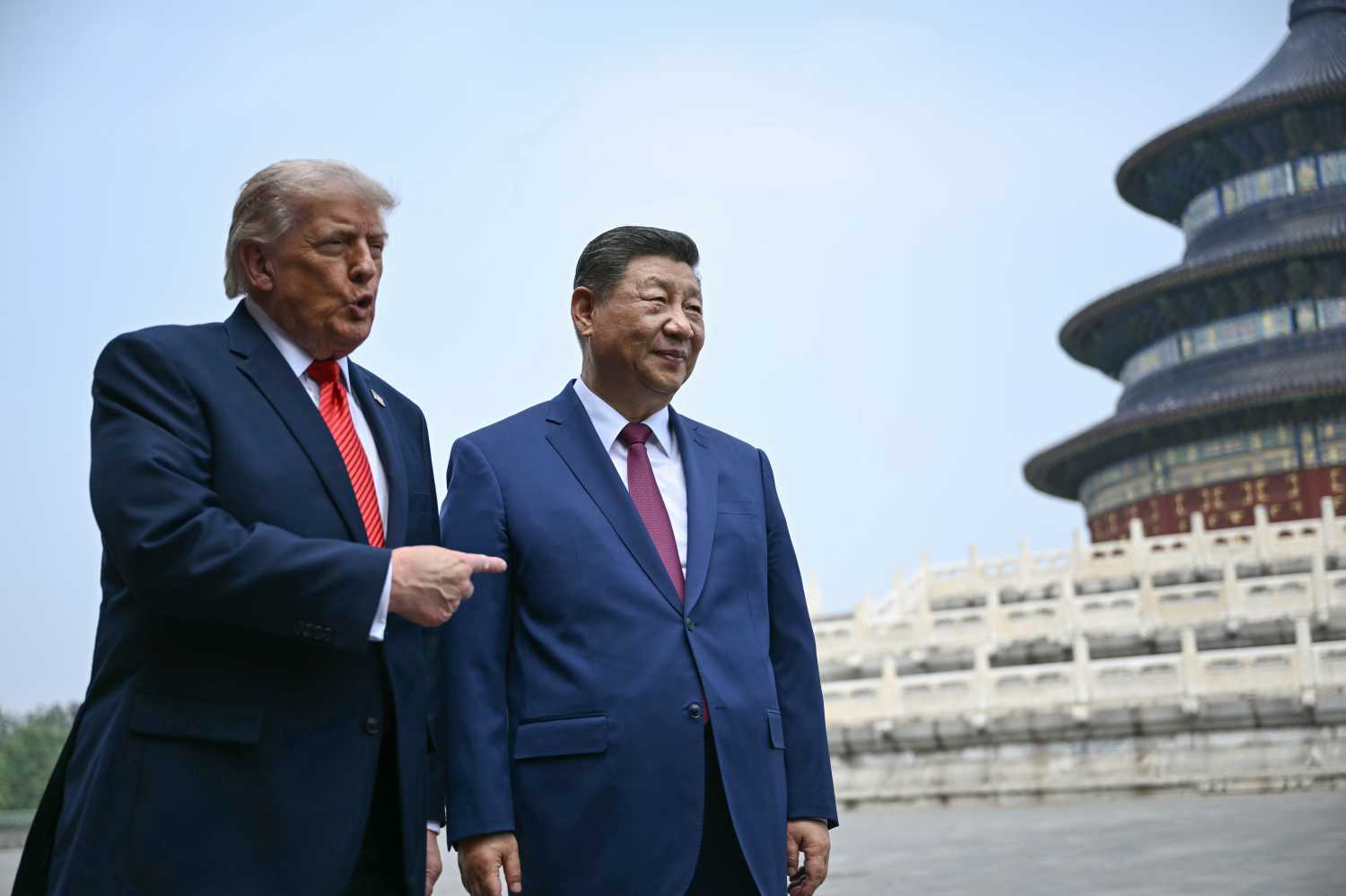
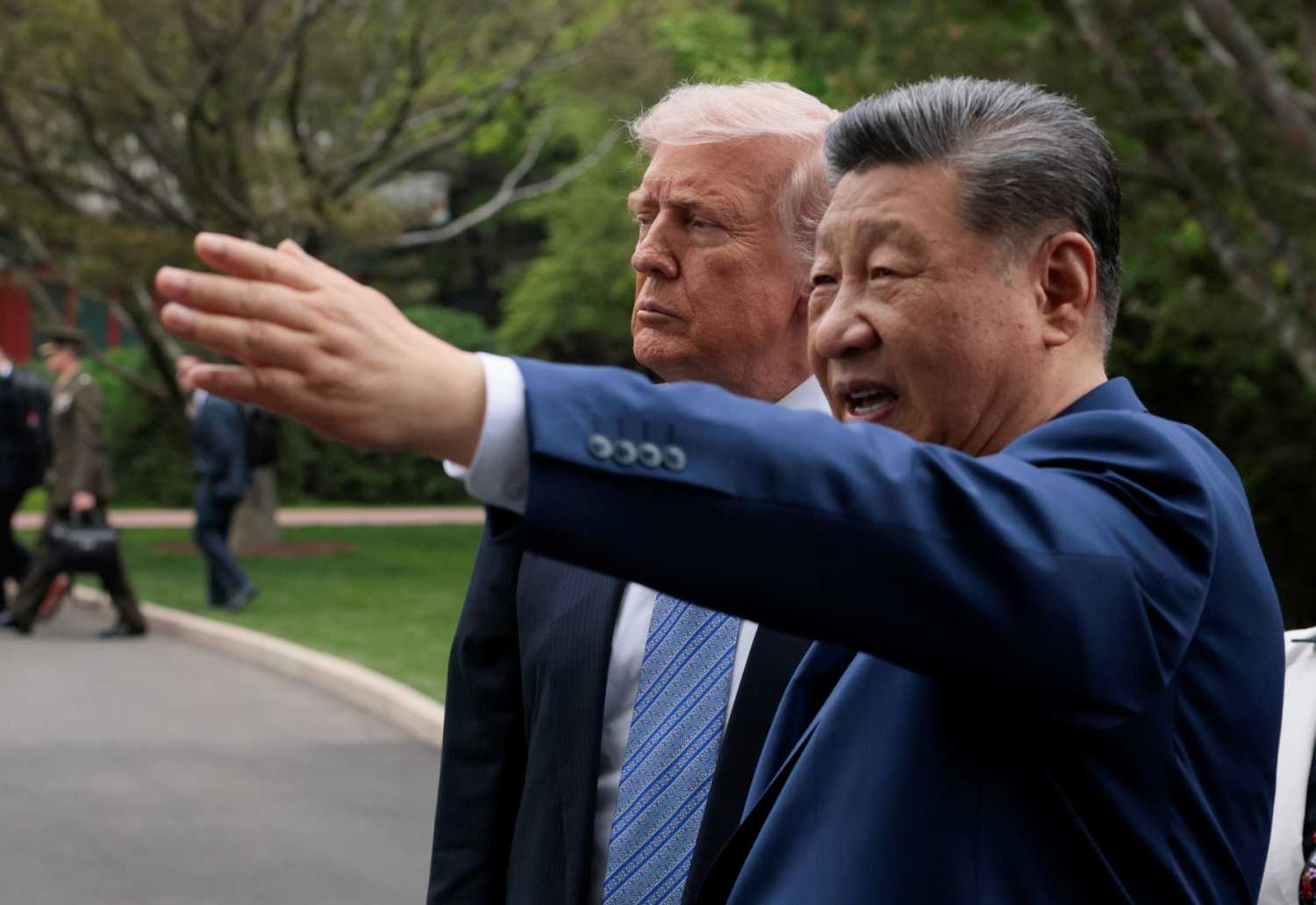
Even after Trump reduced pressure on several issues Beijing treats as sensitive matters, China’s leaders continue to behave as though strategic competition remains undiminished. During his visit to Beijing in May, Trump provided effusive praise to Xi in every setting where media was present. Xi hardly altered his facial expression during any of these encounters and never reciprocated with any flattering comment about Trump. The imagery provided by official Chinese media of the visit showed Xi pointing in the distance with Trump looking on over Xi’s shoulder, and Xi guiding Trump around various venues in Beijing and providing guidance to Trump on their significance.
During the visit, Chinese officials did not publicly affirm any understanding between the two leaders on one of Trump’s key priorities: Iran. Instead, they left it to the White House to characterize an understanding between both leaders that the Strait of Hormuz should remain open and Iran should never have a nuclear weapon. Likewise, Beijing did not arrange any signing ceremonies to highlight commercial deals reached during Trump’s visit, as it had done during Trump’s first state visit to Beijing in 2017. This deprived Trump of the main visual he would have used to show the American people that his relationship with Xi was delivering material benefits for them.
Rather than treating Trump’s visit as historic, Chinese official media framed it as one of a long line of visits by foreign heads of state. In fact, Beijing barely let the sheets cool in Trump’s presidential suite before welcoming Russian President Vladimir Putin for a state visit. China’s announcement of Putin’s impending arrival in Beijing hit news wires while Trump was still in flight on his return from Beijing to Washington.
When Trump invoked the concept of a U.S.-China “G2,” instead of acknowledging the idea or staying silent about it, Beijing publicly rejected it. Instead, Chinese state media trumpeted Trump’s assent to Xi’s suggested framing for the relationship of “constructive strategic stability.” Chinese state media rightly framed this outcome as a breakthrough for Xi. Since 2012, Xi had sought and failed to enlist support from successive American presidents for his framing of the relationship, first as a “new model of great power relations,” and later, a relationship based on “mutual respect, peaceful coexistence, and win-win cooperation.”
While the preponderance of China’s public statements and Xi’s gestures toward Trump have been guarded, Beijing has also been cautious not to personally insult Trump or be perceived as making him look bad. Chinese spokespeople generally have not directly criticized Trump for U.S. actions in Iran or elsewhere. When Trump requested to postpone his planned state visit to China from March to May due to the Iran war, Beijing obliged. When Trump blamed China for election interference in the 2020 election during a primetime address from the White House, Beijing responded with boilerplate recitations of its policy of “noninterference” in the internal political affairs of other countries. There has also been a significant reduction in articles on “American decline” in Chinese journals and academic journals since Trump took office in 2025.
The record is more mixed on Trump’s policy priorities. Trump has succeeded in reducing Chinese exports to the United States in furtherance of his pledge to secure a more balanced trade relationship with China. At the same time, America’s global trade deficit has continued to climb, as has China’s global export volume, and U.S. imports of Chinese-origin content. In other words, Trump’s tariffs seem to have had the effect of a stone in a stream, diverting flows of Chinese goods but not the end destination.
On Chinese purchases of American exports, Beijing has underperformed expectations. Rather than meeting the anticipated purchase of 500 Boeing commercial planes during Trump’s May state visit, Beijing signaled it would purchase 200 jets. Chinese authorities also lowballed their pledge to purchase American energy and agricultural products. And after Trump took political heat at home for greenlighting Nvidia to export H200 semiconductor chips, China did not approve any purchases during Trump’s trip or in its aftermath. In recent weeks, Beijing has quietly allowed several large technology firms to begin purchasing limited quantities of H200 chips.
On perhaps the most central aspect of the October 2025 trade truce between Trump and Xi, Chinese export of rare earths and magnets, American officials have complained publicly that China is “only partly meeting its obligations” on an issue entirely within the control of the Chinese government to solve. There has been progress in curbing the flow of fentanyl and fentanyl precursors. This has included new Chinese export control designations for precursor chemicals and joint law enforcement investigations and arrests of Chinese traffickers.
After Trump raised the case of detained Pastor Ezra Jin, Chinese authorities released him on humanitarian grounds. They did not, however, make any concession in terms of jail time or treatment for the primary individual Trump raised, Hong Kong media tycoon Jimmy Lai. Chinese authorities also wrongfully detained an American scholar after Trump’s May state visit.
Overall, the bilateral relationship is generally stable. Public discourse around the possibility of future U.S.-China conflict has receded. Meanwhile, both sides continue to take competitive actions against each other while also accelerating their own respective efforts to reduce dependencies on each other for critical inputs. Viewed holistically, though, even after Trump reduced pressure on a range of issues Beijing has prioritized, China’s leaders continue to treat strategic competition as an enduring and undiminished attribute of the relationship.
Beijing’s caution toward Trump
There are at least four reasons for Beijing’s lack of reciprocity for Trump’s public efforts to show attentiveness to China’s leaders’ long-standing concerns. These reasons are not mutually exclusive or necessarily internally consistent.
First, Chinese leaders have growing confidence in their country’s relative position to the United States. This confidence was bolstered by Beijing’s record of causing Trump to retreat from his 2025 trade war against China. It was further enhanced by China’s capacity to withstand the global energy shock from the 2026 Iran war. Beijing relied on its existing reserves, its growing renewable energy capacity, and its diversified sources of energy inputs to sustain economic growth while other countries suffered setbacks.
These and other events have given Beijing confidence that China’s relative position is improving while America’s relative position is weakening. Chinese commentators now describe America and China as being on an equal footing and entering a period of “strategic stalemate.” Like any good negotiator, Chinese leaders do not want to pay more than is necessary to sustain a period of bilateral stability. For China’s leaders, the goal is to buy time and space to strengthen self-reliance, not necessarily to improve relations with the United States.
Second, and relatedly, there is skepticism in Beijing that durable improvements to the U.S.-China relationship are available. Even as Trump represents a welcome reprieve from decades of American moralizing, in Beijing’s view, Trump does not represent a permanent shift in American strategy on China. China still views the United States as “the top strategic threat,” according to Tsinghua University scholars Yan Xuetong and Sun Xuefeng. Chinese officials and experts expect America to become more aggressive in seeking to protect its privileged position in the international system as global influence shifts from America to China. The Ministry of State Security-affiliated think tank China Institutes of Contemporary International Relations flagged this danger in a recent report, warning: “Historical experience shows that conflicts or even wars have often accompanied major transitions in the international order.”
Alert to these risks, Chinese officials have encouraged greater U.S.-China leader-level interaction and deeper bilateral efforts to give substance to Trump’s and Xi’s guidance to build a relationship of “constructive strategic stability.” These efforts are built on an assumption that the more actively engaged Trump is in the conduct of the bilateral relationship, the less risk there will be that Trump flips the script on China policy. Trump did just that in early 2020, when he went from hailing progress in reaching a “U.S.-China phase-1 trade agreement” to accusing China of unleashing COVID-19 upon the world and spoiling his reelection bid.
In other words, Chinese leaders have a living memory of Trump’s mercurial temperament. They also are alert to the fact that a majority of the American national security establishment favors a tougher China policy than the one Trump is pursuing. After Trump steps down from the presidency in January 2029, the next U.S. president may be less willing than Trump to heed China’s priorities and concerns. As a result, Beijing is unlikely to let its guard down so long as it lacks confidence in the durability of Trump’s China policy shift or in what Trump could tangibly deliver for China.
Third, Beijing may view Trump’s statements as symbolic gestures that do not offset the more substantive competitive measures his administration is taking. For example, Beijing may put relatively greater weight on published strategies such as the Trump administration’s July 2025 AI Action Plan than on Trump’s words. That plan frames AI competition as central to economic and military strength and geopolitical influence. The plan asserts that the United States must maintain “unquestioned and unchallenged global technological dominance.” In other words, from Beijing’s perspective, underneath Trump’s positive rhetoric, American strategy continues to be guided by a zero-sum logic that seeks to secure and sustain advantage over China.
Even if Trump is transactional and non-ideological, he cannot police every action and statement made by U.S. departments and agencies. The most China’s leaders have been able to do is urge Trump to be attentive to their top concerns, such as Taiwan and technology restrictions.
The fourth reason for Beijing’s caution in responding to Trump’s shift in posture is that Xi is preoccupied with challenges other than the United States. He is overseeing an anti-corruption campaign that is unprecedented in PRC history in terms of its scope and duration. In the military alone, 101 senior officers in the Central Military Commission, theater command, or theater deputy command have been dismissed or disappeared since 2022, marking roughly half of the PLA’s senior leadership, according to analysis by the Center for Strategic and International Studies in February 2026. The anti-corruption campaign also has cut deeply into the ranks of the cadre performing domestic, economic, and foreign policy work.
The net effect of this sweeping campaign has been to discourage cadre from exercising initiative in policy development, lest one expose oneself as holding views that diverge from the direction set by China’s “core leader.” Since China’s policymaking system often is driven by top-down policy direction, much like in the case of Trump in the United States, there have been periods of stasis in the relationship when one or both leaders have had their attention diverted elsewhere. When bureaucrats become cautious and leaders become preoccupied by domestic challenges, the likelihood of bold diplomatic gambits declines.
Additionally, Xi has been contending with a slowing and uneven economy, high youth unemployment, and rising debt, particularly at the local level. Importantly, Xi is also laying the groundwork for a fourth term as leader and ensuring that his preferred advisors secure positions supporting him. As Xi nears the 21st Party Congress in fall 2027, his attention increasingly will be drawn toward China’s domestic politics. In short, Beijing simultaneously feels more confident about its relative position vis-à-vis Washington and more concerned about some of its domestic challenges.
Implications for the U.S.-China relationship
The U.S.-China relationship now is characterized by an uneasy calm. There are real and growing points of friction between both countries around trade and economic issues as well as geopolitical challenges such as Iran. Even so, both sides see greater risk than reward in breaking from the fragile stability that both leaders have sustained since their in-person meeting in Busan last October. During that meeting, Trump agreed to pause further economic pressure and technological restrictions in exchange for Xi restoring the flow of rare earths and magnets. Both sides appear to be preserving their trade war truce out of self-interest and constrained choices. There has not been a resolution to any outstanding issues in the relationship. Nor have there been any observable efforts to develop a shared affirmative agenda for challenges that both countries could jointly address out of mutual self-interest, such as jointly leading on AI guardrails. Instead, there has been cautious avoidance of blowups.
Both countries have a shared interest in sustaining this uneasy calm because it works for both leaders’ political situations, and importantly, because neither side has “escalation dominance” over the other. As former Deputy National Security Advisor Daleep Singh has argued, economic escalation dominance requires two simultaneous features. First, one nation must produce or supply something the other needs and cannot replace at pace or scale. Second, that nation, when it weaponizes its chokepoint, must be able to neutralize or tolerate retaliation from the other. By this definition, according to Singh, neither side has dominance over the other.
Given these uncomfortable realities, both countries presently are focused foremost on shoring up their own vulnerabilities to expand future freedom of action for competing with the other. The United States is racing to reduce dependence on China for rare earths and other critical inputs, while China is working to build out its capacity to build airplanes and produce high-end semiconductors, among other items. To buy time and space for these efforts toward greater self-reliance, both countries are prioritizing bilateral stability. Chinese scholar Wu Xinbo refers to these efforts as a form of “process management” to guard against the relationship tipping into confrontation or conflict.
Rather than pursuing breakthroughs with Trump, Xi will continue looking for ways to manage his relationship with the American leader. Particularly given Trump’s negotiating track record, Beijing cannot have confidence that any deals reached with him will be permanent or lasting.
For Xi’s upcoming state visit in September, this likely means the Chinese leader will offer symbols of respect and will avoid any appearance of basking in America’s setbacks, whether in Iran or elsewhere. Xi likely will look to address some of the challenges in China’s business environment that American CEOs raised during Trump’s May state visit to Beijing. The Chinese side will almost surely also commit to future purchases of American products, and to processes for identifying products to be exempted from future tariffs. The two leaders could signal willingness to work toward addressing safety concerns around AI. A headline of the visit may be an agreement by Trump and Xi to extend their trade truce first reached in Busan last October. In return, Xi likely will request continuing forbearance from Trump on Taiwan, new tariffs, and technology-related restrictions.
It likely is beyond the reach of America’s and China’s leaders to negotiate AI principles to reduce risks, such as agreeing to partner in preventing nonstate actors from malicious use of AI to create bioweapons. It also likely will be beyond the reach of the two leaders to jointly advance any process toward cessation of hostilities in Iran, Ukraine, or elsewhere. There likely will not be progress in arms control or efforts to advance rules of behavior in under-governed domains, such as space and cyber. In a best-case scenario, the two leaders could agree to joint efforts to reduce the risk of U.S.-China confrontation, including through agreements around military exchanges, reaffirmation of rules of behavior when U.S. and PRC military platforms operate in proximity to each other, and maintenance of open bilateral channels of military-to-military communication.
Conclusion
In closing, even though Trump has taken observable steps to remove irritants in the bilateral relationship, obstacles remain. Beijing welcomes the current uneasy calm in the relationship but does not expect it will last.
It may be possible for the two leaders to extend their trade war truce beyond the state visit this September. Even so, it is unlikely that they would agree to concrete steps to durably improve relations or put the United States and China in a joint leadership role in addressing global challenges. Beijing is not chasing breakthroughs with Trump. Nor does China wish to court confrontation with the United States, a country that it views as declining but dangerous. Instead, Beijing is working to buy time to build greater capacity to withstand the pressure it expects to face from the United States and others as China accrues more power and influence on the world stage.
Author

Related Content


The Brookings Institution is committed to quality, independence, and impact.
We are supported by a diverse array of funders. In line with our values and policies, each Brookings publication represents the sole views of its author(s).