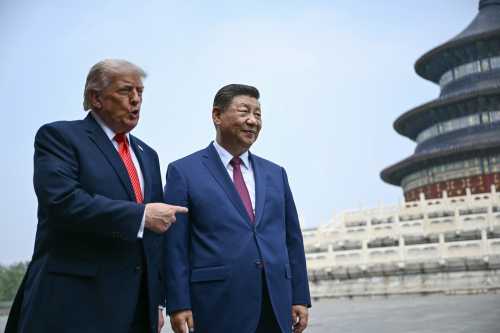
From September 23-25, 2026, President Donald J. Trump hosted Chinese President Xi Jinping for a state visit. Below, Brookings scholars comment on what the visit reveals about the future trajectory of U.S.-China relations.
America holds a weaker hand after state visit
During the state visit, Trump was simultaneously uninterested in the policy details of the U.S.-China relationship and attentive to the special touches of hospitality he wanted to extend to Xi. Xi, by contrast, appeared bemused and even entertained at times by Trump’s efforts to impress him.
Lost amidst the visit’s pomp, Trump failed to deliver on the business at hand. The White House summit readout offers no details or sense of movement on a principal objective of the visit—removing impediments to the regularized flow of critical minerals that China leveraged since Trump’s announcement of the Liberation Day tariffs.
Meanwhile, according to U.S. Ambassador to China David Perdue, Trump has offered to sell weapons to China while consulting with Xi over future arms sales to Taiwan. Such statements are too far from believable for anyone in Beijing to take them seriously. There is a risk the Chinese are concluding that Trump is so unprepared for summits that his statements lack credibility or lasting value.
Additionally, Trump’s performance has laid bare that he is not invested in viewing U.S.-China relations as a security competition. Any talk of the Trump administration playing five-dimensional chess with China through its actions in Greenland, Venezuela, or elsewhere falls apart when Trump is simultaneously offering to sell weapons to China.
Trump’s performance will raise fresh concerns among America’s allies about Washington’s continuing reliability. It also will raise eyebrows in Beijing about the Trump administration’s overall competence. Neither of these outcomes put America on a stronger footing for navigating future challenges with China, whether over security issues, trade imbalances, human rights, or artificial intelligence.
China benefits from Washington’s lack of strategic vision
Expectations for the Trump-Xi summit were low; nobody was let down. The visit also reinforced the impression that Beijing has a strategy for pursuing its interests, and Washington does not.
Trump is a man in perpetual pursuit of instant gratification, and the brief extension of the trade truce announced by Treasury Secretary Scott Bessent gave Trump enough of it that he could spend his time gleefully showing Xi all his new toys. Xi arrived prepared to indulge Trump’s showboating—and to use it to his advantage: Xi took every opportunity to forward the idea that the United States and China are great power equals; to present a vision of bilateral cooperation that might appeal to a Global South audience; and to further insinuate his preferred language on Taiwan into the bilateral narrative.
The good news is that the visit is another data point suggesting that Xi prefers anemic stability to no stability at all, and therefore he is not inclined to test limits and run risks. The bad news is that in the absence of Washington’s own strategic vision, incremental, short-term dealmaking does more for China’s interests than for America’s. If the two leaders again sideline security concerns—including artificial intelligence—in their scheduled November and December meetings, and their delegates agree in January to yet another trade-truce extension, it will be because China recognizes this imbalance and is quite content with it.
Détente amid political strains
Trump and Xi’s Washington summit reaffirms the positive trajectory the United States and China have been committed to following two prior summits in Busan last year and Beijing last May. The question is how sustainable this trajectory will be and whether it could withstand political changes, including the U.S. midterm elections next month, the 2028 presidential election, and a new administration in 2029. All of them could take U.S. policy toward China in a very different direction. The return of a more establishment-oriented administration could bring back a more competitive outlook and strategies toward China. There is also a rising “restrainer” school that advocates for more accommodation, tolerance, and peaceful coexistence with China.
The Chinese have argued that the new “constructive relationship of strategic stability,” or the détente, is the result of China’s enhanced comprehensive national power, especially its ability to impose “mutually assured disruption” vis-à-vis the United States. A more establishment-oriented U.S. administration could put this concept to a serious test, especially if it seeks to resume the competitive approach toward China through active competition in all domains, enhanced support of Taiwan, and strengthened ties with allies and partners to collectively suppress China’s influence. After all, other than with rare earths, China’s ability to disrupt the American economy without paying a significant cost itself is extremely limited, if not entirely nonexistent. And even with the Chinese ability to inflict damage, the United States could pursue an entirely different policy course other than the current one. There is still a deep conviction within the national security community that China remains the only great power with the capability and desire to challenge the U.S. supremacy. Future changes in U.S. politics will inevitably bring new uncertainties to the current narrative.
China and America need to keep talking
Many have called Xi’s recent state visit a summit long on pageantry and short on substance. Trump certainly gave the Chinese leader a lavish welcome, but at the end of the day, this is a meeting between the leaders of the world’s two biggest powers. The pageantry, honestly, was for both of them.
What was the signal in this noise and where are we headed? The visit produced substantive outcomes on much-needed institutionalization of the relationship. The two leaders committed to meeting twice more within the year, once at the Asia-Pacific Economic Cooperation forum in China and once at the G20 in Miami. The trade teams managed to launch the Board of Trade as an ongoing negotiating platform and will presumably continue their discussions with a view to another extension of the trade truce in the next several months. The AI dialogue has also launched and, according to Treasury Secretary Scott Bessent, will meet again in November. And the Chinese readout included language about reinstituting military-to-military dialogue channels and work on crisis management mechanisms, which are long overdue. These represent a much-needed start on restoring some regular connectivity between the two sides. As Secretary of State Marco Rubio has indicated on multiple occasions, the United States and China need to be talking to one another; not doing so is irresponsible.
Many differences remain and few issues were resolved, but statecraft is about mature management of problems. This summit moved us a step in that direction and signaled to Americans, Chinese, and the world that their leaders understand the importance of sustained engagement.
Don’t mistake bilateral activity for progress
Xi’s state visit may be both less and more consequential than it looks. The danger for Washington is that the machinery emerging across summits and negotiations creates the appearance of broader progress while leaving largely untouched the problems that prompted it to rethink the relationship. The summits keep Washington and Beijing talking, which may help contain disputes. Meanwhile, the accumulating deals and mechanisms could produce lasting changes in how the economic relationship operates.
In the immediate term, each deliverable will command attention: another extension of the trade truce, details of the new Board of Trade, an AI dialogue. The new trade arrangements do little to address concerns about structural excess capacity. Critical minerals and technology remain largely unsettled. These are not peripheral issues; they are central to the shift in China policy in Washington and other capitals.
Washington and Beijing can bargain bilaterally, but these challenges play out through trade, investment, technology, and supply chains that run through countries and firms around the world. Bilateral bargains therefore cannot by themselves resolve these challenges. If bilateral bargaining is how Washington manages its economic relationship with China, the rest of the world will increasingly be part of the bargain, whether it wants to be or not.
Trump and Xi have committed to attend the Asia-Pacific Economic Cooperation forum in China in November and the G20 in the United States in December, where the prospect of another bilateral meeting will inevitably command attention. Many of the countries around those tables have a major stake in these issues. If the next U.S.-China bargain again becomes the main event, managing the bilateral relationship may further substitute for addressing issues that cannot be solved bilaterally.
Little focus on fentanyl
A striking feature of the Trump-Xi summit was the lack of focus on fentanyl and other synthetic drugs and precursors originating in China. For weeks, the Trump administration has claimed that its post-October 2025 law enforcement cooperation with China produced great results, attributing declines in fentanyl drug overdoses to it that, in fact, began in May 2023. Since then, tens of thousands of lives in the United States have been saved. That’s a crucial accomplishment, but it did not start or accelerate during the Trump administration.
In fact, after Trump’s fentanyl tariff bluster in January 2025, China learned how to neutralize, outplay, and deflect U.S. pressure by restricting U.S. access to rare earths, boycotting politically sensitive U.S. goods such as soybeans, and occasionally scheduling drug precursors. Many of the precursors, as well as the potent synthetic opioids nitazines, that China scheduled in 2025 were already slated by China to be scheduled during the Biden administration. China simply double-counted its scheduling. After a slow year in 2025, U.S.-China law enforcement cooperation has also returned to where it was in the second half of 2024, to both countries’ satisfaction. To placate Washington, China adds a few new precursors or novel substances, such as orphines, to its scheduled list before Trump-Xi meetings. It did so again in September 2026.
But major issues remain unaddressed—exactly the same ones the Biden administration grappled with. When China schedules precursors or finished drugs, Chinese traders move to nonscheduled ones and knowingly peddle them to drug trafficking organizations with recipes for their conversion into illegal products. New dangerous drugs such as cychlorphine, xylazine, and medetomidine emerge in China and flow to illicit markets. Smuggling untested and counterfeit peptides (GLP-1 drugs) to the United States is a new venture for Chinese trafficking networks. Chinese money laundering services for Mexican cartels and other criminal groups are also burgeoning.
Scheduling is useful, but its effectiveness is limited. What is most needed is for China to develop reliable law enforcement mechanisms to prosecute traders who knowingly sell nonscheduled chemicals to criminal organizations—the equivalent of U.S. material support statutes. Chinese traders must also be obligated to do due diligence on their customers. Intensifying global efforts against Chinese money laundering networks is also imperative.
Hopefully, the suspension of the administration’s histrionic fentanyl rhetoric will provide a productive atmosphere for a serious bilateral effort to tackle these tough law enforcement challenges, rather than lead the Trump administration to simply give up on dealing with them.
A missed opportunity for America and Europe
Xi’s state visit to Washington marked a momentous missed opportunity for American foreign policy. Instead of feting Xi, Washington policymakers could have been tag-teaming with European allies on the trade issues that animated Trump’s first and second trade wars with China. European leaders are seriously considering moving ahead in October with measures to deal with China Shock 2.0. The current frailties in China’s domestic economy—especially its growing reliance on exports—could afford the United States and its allies an unusual degree of leverage with Beijing, given how dependent China remains on the European and U.S. markets.
Alas, even if European leaders do move forward—still a big “if”—they will be doing so alone, as the Trump administration is already focusing on Trump’s next two meetings with Xi. That’s unfortunate. At best, these encounters are likely to be “meetings about meetings” as the two sides struggle to get the dialogue mechanisms underway that they already agreed to at Trump and Xi’s previous tête-à-tête. At worst, these meetings may be punctuated by a “Big Three” meeting among Trump, Xi, and Russian President Vladimir Putin—a photo op that would evoke the Yalta Summit of World War II. While those encounters are likely to be more stunt than substance, the choreography would underscore that Trump remains more focused on courting than countering these two leaders who are working together to undermine U.S. power.
Bad news for Japan and Asian allies
By most accounts, the Trump-Xi meeting was heavy on pageantry and light on substance. Coming into the summit, expectations of major results were already low. The United States and China are far apart on the major international conflicts of the day—Ukraine and Iran. They remain at odds over structural economic irritants. And despite pledges of “constructive stability,” tit-for-tat defensive economic measures and Chinese grey zone activities in the First Island Chain are ongoing.
On cue, the meeting’s outcomes were modest: an extension of the Busan compromise (suspending Chinese export controls on rare earths and American tariffs), a forthcoming dialogue on artificial intelligence, and the operationalization of a Board of Trade to lower tariffs on nonsensitive bilateral trade.
Nevertheless, thin fact sheets should not be mistaken for a “nothing-burger” event. This summit spoke volumes, in ways that undercut U.S. partners and allies—for its intangible elements: optics, narratives, and signaling. Beijing is keenly aware of the importance of diplomatic protocol. When Trump chose to give Xi an unprecedented welcome by meeting him at the tarmac of Joint Base Andrews, it became clear that Xi has the upper hand over an American president saddled with low approval ratings and a no-exit Iran conflict. More concerning for Tokyo were Trump’s scripted remarks on the wartime alliance between the United States and China just when Beijing is pressuring Japan on all fronts and trying to discredit its defense buildup as the return of militarism. Trump’s failure to grasp that the United States had allied with a different China and fought a different Japan will only invite more Chinese coercion. Perhaps the bitterest bit to swallow was the revelation by U.S. Ambassador to China David Purdue that Trump asked Xi if he would be interested in buying American weapons. Such a blasé comment telegraphs to foe and friend alike that the president is not taking seriously the growing Chinese squeeze U.S. partners are experiencing in the region.
Japanese Prime Minister Sanae Takaichi pulled out all the stops to meet first with Trump and impress on him the complexities of the China challenge. The vibes at the U.S.-China meeting show she came up short as the United States regaled Xi with summit atmospherics that benefit China with little tangible deliverables in return.
A bargain on Taiwan?
Reportedly, in Washington last week, Xi asked Trump to oppose even the possibility that Taiwan could someday gain its independence. (Right now, U.S. policy does not endorse that outcome, but nor does it exclude the possibility.) Thankfully, Trump appears to have declined; acceding to Xi’s request would have been a unilateral American concession.
But is there a deal to be made that could gain something from Beijing as well? One possibility to consider: Washington would formally and publicly oppose the option of Taiwanese independence in exchange for Beijing promising to never use force against Taiwan. These would both be big changes to existing policy. By this concept, if Beijing ever saw the need to punish or pressure Taiwan (over the independence issue in particular), it would do so using only economic and diplomatic means. The overarching goal would be to prod Beijing and Taipei toward a mutually acceptable form of permanent autonomy for Taiwan within a broader Chinese nation or commonwealth centered on Beijing—though achieving that result might take many years, quite probably beyond Xi’s tenure in office.
Initial negotiations to pursue these kinds of reciprocal pledges—categorical and permanent U.S. opposition to Taiwan independence, with a Chinese promise never to use force to settle the Taiwan issue—should be highly discreet and noncommittal at first. It would be important that the United States not give China the idea that its interest in protecting Taiwan had weakened. But then again, Washington would be making a very big ask of Beijing with this proposal—a long-shot idea, to be sure—so floating the idea might not be so risky. After all, it would not be tantamount to saying that the United States would no longer protect Taiwan.
Even if agreed to, these reciprocal pledges would only mean so much. They would not produce verifiable changes in military capability and would also be reversible. Still, there could be benefits. Were Beijing sincere, one could expect to see a dramatic reduction in People’s Liberation Army military activity around Taiwan right away. And for its part, China could expect to see at least some reduction in U.S. military planning focused on the Taiwan Strait. In the short term, however, Taiwan itself should continue to maintain, even strengthen, its military defenses with American help, since they have been too weak for too long.
Nothing in this plan would provide definitive proof that the bargain would endure. Nor would it require complete trust by either side in the other; both would continue military planning and sustain military capabilities for a range of contingencies.
It is also important to note that nothing about the deal would be permanent if Beijing were to breach its terms. Specifically, were China to attack Taiwan, the United States could reverse its position on opposing Taiwan independence. It could also come to Taiwan’s aid in the event of a Chinese attack, either militarily or through economic warfare. American military planning would not have to change so fundamentally as to eliminate any hypothetical capacity to help protect Taiwan. But over time, the goal would be to demilitarize the issue to the point where force would no longer be seen as the way to resolve any Taiwan crisis that might emerge, and competition over Taiwan would no longer be the central organizing concept in the military force planning of China or the United States.
Pageantry over progress
The September 24 state visit underscored that the Trump administration has little apparent desire to reshape the fundamentals of U.S.-China relations. There was no clear progress on the core issues, including the ongoing Iran war and its associated energy crisis, artificial intelligence, trade, or security. The summit was driven by optics rather than outcomes. More telling was the latest Chicago Council polling released the same week. American views of China have warmed from their 2024 low, and support for committing U.S. troops to defend Taiwan against a Chinese invasion has fallen to 38% from 52% in 2021. The shift is sharpest among younger Americans, especially Generation Z. Some of this moderation likely reflects partisans taking cues from the White House. But if the generational shift is sustained, it will shape the future of U.S.-China relations more than anything staged in Washington this week.
Authors










Related Content
2026
The Brookings Institution is committed to quality, independence, and impact.
We are supported by a diverse array of funders. In line with our values and policies, each Brookings publication represents the sole views of its author(s).

Commentary
What did the Trump-Xi summit actually accomplish?
Brookings experts weigh in
Updated: September 30, 2026
Originally published: September 29, 2026