This is the 17th essay of Assessing China’s “Lost in translation: Decoding Chinese strategic narratives” series. The full collection of essays can be found here.
Several striking statements about China’s maritime agenda have recently emerged from think tanks directly connected to the government of the People’s Republic of China (PRC). Along with a wave of other official and semi-official Chinese statements, they signal that China’s leaders see a window of opportunity to advance China’s maritime and security interests, accelerate its maritime pressure on rival claimants, and assert greater leadership over international law of the sea, both regionally and globally.
China signals a more assertive maritime agenda
In June, for instance, the China Institute for Marine Affairs (CIMA), an internal think tank of China’s Ministry of Natural Resources, produced a report. CIMA is long known for its active involvement in China’s South China Sea policy, and the report celebrates some of the successes of the United Nations Convention on the Law of the Sea (UNCLOS) while also laying out in detail China’s many complaints. The report states China’s time of passivity regarding the law of the sea is over.
Citing “momentous changes unseen in a century” and a shift in the global balance of power, the report calls for “reform and improvement” of the laws that govern the maritime domain. It appeals for “adapting the legal order of the seas to evolving realities,” and suggests the changes in global power dynamics have created “space for the further development of the international law of the sea.” The report’s tenor makes clear this further development must better account for China’s interests, since its newfound power has given it the right to more actively make the rules. In an unsubtle pushback to American naval operations in East Asia, for example, the report calls out “certain states [that] deliberately misinterpret the doctrine of ‘freedom of the seas,’ [and] abuse the concept of ‘freedom of navigation.’” It concludes that international law “entails not merely the existence of rules but requires that such rules must conform to higher principles and values.” These higher principles and values will be China’s principles and values, of course. And the report enlists the support of developing states and those interested in “true multilateralism” to help advance China’s efforts.
In July, similarly notable statements were made by Wu Shicun in a South China Morning Post interview. The interview is remarkable in that it suggests Beijing’s South China Sea policy is about to take a more confrontational turn. Wu is well-positioned to know. He is a member of the Foreign Policy Advisory Group of China’s Foreign Ministry and leads a Hainan-based think tank sponsored by the Ministry of Foreign Affairs.
Wu portrays Beijing as having been “passive” and attributes any past muscularity on China’s part only as a response to Philippine and American provocations. Now, however, he says Beijing has moved to “adjust its counter-strategy” to become “even more proactive in the future” because “rival claimants”—he points to the Philippines and Vietnam, with the assistance of Japan and the United States—”are attempting to join forces to counter China.” In return, he says, “Beijing has a comprehensive suite of countermeasures at its disposal,” and “the era when China had its hands tied is gone.” He specifically threatens that “if future challenges make our law enforcement difficult,” Beijing may construct permanent facilities at Scarborough Shoal, the South China Sea feature that triggered the 2013 arbitration case brought by the Philippines and still claimed by it. This is perceived in Manila as a direct threat to Philippine security, since a Chinese construction on the feature could base China’s maritime power about 120 nautical miles off Luzon and just over 200 nautical miles from the Philippine capital. Tensions between the Philippines and China repeatedly spike at Scarborough Shoal as well as further south in the Spratly Islands, where China already has military facilities that lie just over 120 nautical miles from the Philippine island of Palawan. Beijing’s “suite of countermeasures” clearly involves both operational and legal elements.
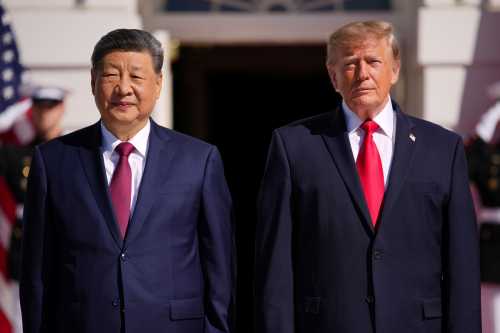
In addition to being about international law of the sea, the CIMA report and Wu’s interview have at least three things in common. First, they convey a sense of imminent activism to bend international rules toward China’s maritime interests and to put in place forward-leaning legal policies that support China’s interests. Second, they indicate that at least some in China perceive the current state of global politics, perhaps accelerated by the recent agreement between Presidents Donald Trump and Chinese President Xi Jinping to build “a constructive strategic stability relationship,” as giving China an opportunity to make maritime gains at low cost. Third, they suggest China will continue to employ, and may even accelerate, its operational activism at sea to accompany its legal activism in the sphere of international politics.
Domestic institutional responsiveness?
There are multiple possibilities for why this legal activism has accelerated in recent months. One possibility is that the timing is simply a matter of bureaucratic responsiveness to broad policies laid out by China’s top leaders over the past few years. The timing of these statements may reflect the slow gear-turning of bureaucracies as much as Beijing’s assessment of the current state of global power and political opportunities.
One of the first relevant policies to which current events might be traced is the Foreign Related Rule of Law (FRRL) initiative. Although much of the FRRL focuses on revising China’s domestic legal system to better achieve its development goals, Xi gave a speech in a December 2021 Politburo study session that made clear it is also designed to advance China’s national security and sovereignty. Xi expressed the view that “The world has entered a period of turbulence and transformation, where international competition increasingly manifests as a contest of institutions, rules, and laws.” More recently, Xi’s Global Security (GSI) and Global Governance (GGI) Initiatives observe that “the current international landscape is undergoing changes and turbulence,” with “multiple risks and challenges rarely seen before,” and promise “to promote the building of a more just and equitable global governance system.” Wu and the CIMA report both explicitly referenced these initiatives, which reinforces the possibility that the recent legal activism from China’s ministries and think tanks is the eventual institutional response to previously announced top-level policies.
Or a window of opportunity?
A much more likely explanation, however, is that China’s leaders do in fact see the current period as a window of opportunity for Beijing’s legal activism to be more successful than in the past. One reason could be their assessment that among the “momentous changes unseen in a century” is a shift of the global and regional power balances in China’s favor. Once again, American military power appears to be mired in a lengthening Middle East conflict, which has worn down critical U.S. Navy ships, compounded the Navy’s long-standing readiness issues, and significantly drawn down the American weapon stocks needed to deter Chinese activism in the South China Sea.
China’s thought leaders observe this weakness clearly. Their views are in line with top-level strategic guidance that the power shifts underway give China a window to advance its views of the application of international law in the maritime domain. They have long complained that the current state of international law does little more than protect the interests of Western hegemony. This, for instance, is the root of the frequent complaint by Chinese officials and thought leaders about the American view of freedom of the sea and the right to operate a navy unhindered anywhere beyond other countries’ narrow band of territorial seas. These Chinese commentators portray China as having to adapt to international law of the sea as it is, rather than having a real opportunity to establish law that suits its interests. But a May report from an internal think tank of China’s Ministry of State Security argues now is the time for Beijing to assert itself.
The report, from the Chinese Institutes for Contemporary International Relations (CICIR), describes the state of global affairs as “undergoing accelerated transformations” where “the old order is disintegrating while the new one has yet to be established.” This, the report concludes, is due to two factors. On the one hand, “the United States … has begun to turn away from the system it created,” and that U.S. hard and soft power have declined. Specifically, the report depicts China as having made progress in its economy, science and technical innovation, and military power, which led to a “change in relative strength” between the world’s two most powerful countries and “a new stage of strategic stalemate.” In this period, China’s thought leaders believe that neither country can dominate the other and that both must now regard the other as a “respected rival” with which it must cooperate to achieve its objectives. In other words, they believe China’s power now stands eye-to-eye with that of the West, and a window of opportunity has opened to advance China’s maritime interests.
China’s normative offensive
Given the significance of the FRRL initiative, the GSI, and the GGI, perhaps it was inevitable that China’s bureaucratic wheels would have resulted in increased Chinese legal activism. However, the clarity of the CICIR report strongly suggests China’s leaders also see the current period as the window of opportunity they needed for increased legal activism to be successful. Another official Chinese white paper strongly supports this interpretation. Released by the State Council in June, this paper proposes to counter Western “unilateralism, protectionism, and hegemonism” with a new set of principles to achieve “a model of global governance that is more inclusive, equitable, and sustainable.” The paper portrays China as “a defender of the international order,” promoting “a unique Chinese approach to addressing international flashpoints” to achieve the more just international society Beijing promises. Such lofty ideals may be nothing more than an attempt to persuade others to see the United States as operating outside the bounds of international law and to position China in a comparatively better light.
Yet, at the same time, China has done little to clean up its own reputation, which remains deeply tarnished by its wildly excessive claims in the South China Sea and its use of force against its neighbors. Its failure to submit to international arbitration with the Philippines, as UNCLOS requires it to do, means China will almost certainly fail to convince many of its Southeast Asian neighbors to willingly follow its lead. Beijing appears to understand this. As Lynn Kuok recently pointed out, China is asserting its power against its southern neighbors in ways that “could alter the strategic landscape,” since they are incapable of curbing China’s maritime appetites without the help of a strong maritime power and China’s recent actions have “elicited only a minor response from Washington.” Kuok suggests this may require Southeast Asian claimants to “adopt a more pragmatic approach” to their disputes with China and find some form of accommodation. In other words, China appears to be betting that with its Southeast Asia neighbors, power will prevail.
On a global basis, however, if China’s campaign is to be successful, China’s leaders will need to articulate a vision of international maritime law that is consistent, fair, and repeatable by other countries, rather than one that appears to allow China to stand as an exception to the rules it expects others to follow. China will need to articulate a theory of how historic rights might be claimed by other countries and still be consistent with the provisions of UNCLOS. It will need to rationalize its approach to the baselines from which maritime zones are derived, given China’s baselines are among the most abusive violations of the rules of international law of the sea by any country. It might at one time have had some success convincing weak coastal states that foreign warships should have limited rights off of other states’ coasts. But since China’s navy has been acting more like that of a traditional naval power in recent years, China’s leaders may want to quietly reduce focus on that aspect of international law. Notwithstanding these inconsistencies, the steady drumbeat of white papers, reports, and public statements makes clear that China’s thought leaders, and perhaps its leaders as well, want to take advantage of the current international moment to go on the normative offensive.
The little-noticed Supreme People’s Court (SPC) stands as a good example of a state institution that is translating top-level directives into policies and practices to advance China’s maritime interests. After the announcement of the FRRL and Xi’s various global initiatives, the SPC leadership rapidly expanded the number of China’s maritime courts. By 2025, the Supreme People’s Court had developed new capacity to hear maritime cases focused on “safeguarding national maritime rights and interests and participating in global ocean governance.” This included establishing a branch of the court in the South China Sea on a disputed island in the Paracels and prosecuting “10 defendants from a neighboring country,” most likely Vietnam, who came there to assert their right to fish. The enforcement of Chinese domestic law in a disputed maritime space solidifies China’s sovereignty over the Paracel Islands and its jurisdiction over the surrounding waters and weakens Vietnam’s claims. In doing so, it serves as an example of the institutional activism and legal advancements China’s leaders have called for.
Implications
In total, the official and semi-official statements are significant in at least three ways. First, China’s thought leaders are more actively engaging the international community with a vision of a future world order, including a future maritime order, that reflects Chinese interests. There has long been a tension in international law of the sea between the rights of coastal states to exercise power over the waters off their coasts and the traditional right of all states to operate with maximum freedom. China is clearly using its newly acquired power to try to tip the balance toward the security and resource interests of coastal states. Many powerful maritime states, including the United States, will continue to resist these efforts. But rather than being a domain of well-settled law, the world’s oceans are once again a zone of active legal contestation. The outcome of this contest is not inconsequential. Recent events in the Baltic Sea, the Black Sea, the Eastern Mediterranean, the Red Sea, the Strait of Hormuz, the Gulf of Aden, and the Strait of Malacca demonstrate that navies must have the right to defend maritime commerce and other interests anywhere at sea. The global economy and the security of all states depend on it.
Second, China’s legal activism already sits alongside its increased operational maritime activism, especially in the South China Sea. China’s increasingly powerful navy, large and capable coast guard, and enormous fleet of civilian vessels work together to put tremendous pressure on regional claimants to give way to China’s claims. China’s accelerated legal activism suggests it seeks to justify and legitimize this increased assertiveness in the South China Sea while keeping other states on the sidelines of these disputes.
Finally, and more broadly, China’s calls to make room for its views about international law are in essence a claim of right to exercise leadership in its region and an announcement that it will assert global leadership where it can. Legal activism is about building rules of interaction among a given set of states. Toward Southeast Asia, these “rules” are fundamentally an assertion by China that, as the most powerful state in the region, it, not the West, will establish the regional order. Globally, it may soon be the West that is on the defensive when it comes to rule setting. All states must therefore be prepared to actively deal with China’s newfound sense of entitlement to assert influence over international law.
Author

Related Content
The Brookings Institution is committed to quality, independence, and impact.
We are supported by a diverse array of funders. In line with our values and policies, each Brookings publication represents the sole views of its author(s).

Commentary
Turning the tide: China seeks to set the rules at sea
September 2, 2026