On June 8, Chinese President Xi Jinping traveled to Pyongyang for a two-day summit with North Korean leader Kim Jong Un. Below, Brookings Senior Fellows Andrew Yeo and Patricia Kim talk with Senior Research Assistant Hanna Foreman about what their visit means for both countries, U.S. regional allies, and the United States itself.
Hanna Foreman
What did North Korea and China stand to gain from the visit?
Andrew Yeo
Although on the surface, the meeting may not have produced any significant new policy initiatives, both leaders benefited from the summit in different ways. For Kim, the meeting underscored North Korea’s growing relevance in regional affairs. The regime entered the summit from a position of greater security and diplomatic confidence than in previous years. Xi’s visit to North Korea, his first overseas trip of 2026, reflects Pyongyang’s increasing strategic importance within Northeast Asia and reinforces Kim’s standing as a leader courted by both China and Russia.
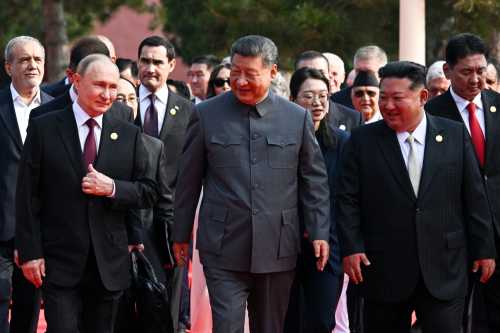
For Xi, the visit provided an opportunity to reassert China’s influence over a treaty ally that has moved closer to Russia in recent years. Moreover, Xi’s summit with Kim, coming on the heels of a series of high-level meetings with U.S. President Donald Trump and Russian President Vladimir Putin last month, reinforces Beijing’s message that China remains a central actor in shaping the regional order in Northeast Asia amid intensifying geopolitical competition.
Notably, the two leaders made no reference to denuclearization or other major geopolitical issues, suggesting that the summit was primarily focused on strengthening bilateral ties and practical cooperation. A readout from Chinese state media reported that the two sides discussed expanding cross-border cooperation in various areas, including trade, tourism, and transportation, among others, while also enhancing exchanges in diplomacy, law enforcement, and military affairs.
Patricia M. Kim
Xi’s visit signaled that the China-North Korea relationship remains strategically important to both sides. For Xi, the visit was an opportunity to reaffirm that Beijing remains Pyongyang’s most important strategic partner, despite North Korea’s growing ties with Russia.
For Kim, the visit delivered both symbolic and practical benefits. The fact that Xi chose North Korea as his first overseas destination of 2026 represents a significant endorsement of the Kim regime and reinforces Kim’s legitimacy both domestically and internationally.
Just as important, Xi did not publicly mention denuclearization. While Chinese officials, when pressed privately, continue to maintain that denuclearization of the Korean Peninsula remains official policy, they have largely stopped emphasizing the issue publicly because they recognize that Pyongyang has firmly rejected it and that repeated emphasis on the issue serves little practical purpose. Instead, it risks alienating the Kim regime at a time when Beijing is wary of Pyongyang’s deepening ties with Moscow.
For the Kim regime, the absence of any public emphasis on denuclearization underscores a broader reality: Beijing is not prepared to make its relationship with North Korea contingent on progress toward denuclearization. That is a major strategic win for Pyongyang.
Hanna Foreman
How does Russia factor into Kim’s calculations behind the visit, and how does Moscow fit into the North Korea-China relationship more broadly?
Patricia M. Kim
Russia is a major factor behind this visit. Since North Korea and Russia began rapidly deepening their relationship in 2024, Beijing has made a concerted effort to strengthen ties with Pyongyang. China does not want Moscow to displace it as North Korea’s primary strategic partner, and that concern has helped drive a noticeable increase in high-level exchanges and economic engagement between Beijing and Pyongyang.
In many respects, North Korea is the biggest beneficiary of this evolving strategic triangle. Kim has been able to deepen ties with Putin without sacrificing his relationship with Xi, giving Pyongyang greater diplomatic flexibility than it has enjoyed in years. Russia provides North Korea with military cooperation, technical assistance, and diplomatic support, while China remains North Korea’s largest trading partner and most important economic partner.
Both Moscow and Beijing have strong incentives to maintain close ties with Pyongyang. Russia values North Korea’s support for its war effort in Ukraine, while China wants to preserve its influence on the Korean Peninsula and prevent North Korea from drifting too far into Russia’s orbit. The result is a situation in which Kim enjoys greater leverage with both countries than at any point in recent years.
Hanna Foreman
As U.S. allies in the region become more concerned about Beijing’s military buildup and Washington’s ability to uphold defense commitments, how will South Korea and Japan perceive the renewed North Korea-China engagement on display?
Andrew Yeo
In Washington, the Xi-Kim meeting may have been viewed as somewhat anticlimactic, as the two leaders focused primarily on practical bilateral cooperation. Nevertheless, Seoul and Tokyo are likely to view the warming relationship between Beijing and Pyongyang with some concern, particularly if closer ties reinforce the China-Russia-North Korea alignment and indirectly contribute to enhancing North Korea’s military capabilities. On the same day of the Xi-Kim summit, President Lee Jae Myung emphasized the need to halt North Korea’s nuclear progress and stated that inaction would further increase the risk of proliferation.
Seoul had pinned some hope that a Xi-Kim meeting might generate momentum for Northeast Asian diplomacy. However, Kim has indicated no desire to engage with Seoul or Tokyo—or Washington, for that matter.
Hanna Foreman
Can this summit improve or diminish the chances for renewed U.S.-North Korea diplomacy or even limited inter-Korean engagement?
Andrew Yeo
On the surface, the answer seems to be no. Although South Korea’s Minister of Unification Chung Dong-young appeared optimistic last month that a Kim-Trump summit “will surely” be discussed if Xi travels to Pyongyang, neither Chinese nor North Korean state media reported on U.S.-North Korea relations, instead focusing on China-North Korea bilateral relations.
However, given Xi’s recent summit with Trump, and Beijing’s interest in preserving influence over developments on the Korean Peninsula, it is possible that the two leaders may have at least exchanged views about Trump and the prospect of U.S.-North Korea diplomacy. For now, Kim appears to be keeping his options open, with little public evidence suggesting that Pyongyang is preparing to return to formal negotiations. Nevertheless, the recent flurry of high-level diplomacy involving Xi, Putin, Kim, and Trump raises the possibility that conditions for renewed U.S.-North Korea engagement may gradually be taking shape.
Patricia M. Kim
At this stage, that appears unlikely. Xi likely briefed Kim on the outcomes of his recent discussions with Trump, but there is little evidence that Beijing is actively encouraging a return to U.S.-North Korea diplomacy. China has generally shown limited interest in serving as an intermediary between Washington and Pyongyang and does not appear to view that role as a strategic priority.
More importantly, North Korea currently has little incentive to reengage either the United States or South Korea. Compared to previous periods of diplomacy, Pyongyang is operating from a much stronger position. It is receiving significant political, economic, and military support from both Russia and China, reducing the urgency of seeking diplomatic openings elsewhere.
That could change if direct talks between Washington and Pyongyang begin to gain momentum. Historically, Beijing has been reluctant to be sidelined in major diplomatic initiatives involving North Korea and has often become more active when it fears being excluded from negotiations. But unless Pyongyang itself decides that engagement with the Trump administration serves its interests, Beijing is unlikely to invest significant effort in pushing for a new diplomatic process.
Authors



Related Content
The Brookings Institution is committed to quality, independence, and impact.
We are supported by a diverse array of funders. In line with our values and policies, each Brookings publication represents the sole views of its author(s).
Commentary
China, North Korea, and the Xi-Kim summit
June 12, 2026