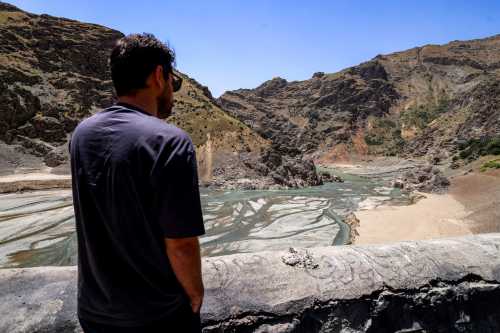
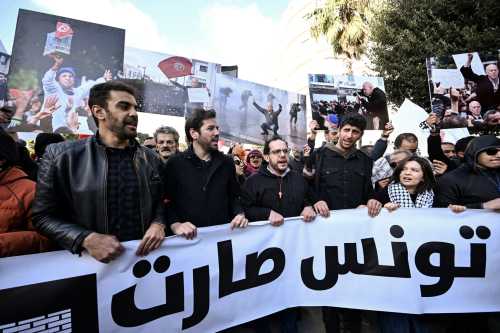
Five years after his power grab, Tunisian President Kais Saied is facing his most serious challenge yet. Water and electricity shortages during a record-hot summer (in some regions nearing 120 degrees Fahrenheit) are producing growing discontent with his rule. July 25, the anniversary of Saied’s takeover, witnessed some of the largest protests against him thus far. Continued water and power cuts again sparked protests on August 4 and 5 in several areas across the country, and another protest in Tunis is scheduled for August 20.
Water and power cuts expose Saied’s failures
For years, Saied had been able to weather economic challenges by scapegoating the political parties, businessmen, migrants, and foreign powers, among others. But today, these populist narratives are no longer working—partly because it has now been five years since his takeover, and at that point, people expect him to deliver. But what’s more, the water and electricity shortages are objectively worse than during the democratic era. And they are visceral: Tunisians can literally feel that things are not working. Power cuts, including to hospitals, have even led hundreds to die. Worse yet, Saied has been largely absent, simply vowing to target the conspirators behind the shortages—the same tired, populist speech that few people are buying anymore.
Adding to the mix has been perceived infringements on Tunisia’s sovereignty by neighboring Algeria, which has been one of Saied’s strongest backers and signed a controversial defense cooperation agreement last year. In response to the protests, Algerian President Abdelmadjid Tebboune threatened to intervene in Tunisia to take out the supposed “terrorists” (protesters), prompting nationalist pushback even from some of Saied’s early supporters.
Discontent reaches inside the regime
Perhaps most surprising, Saied is facing criticism from within the regime, as insiders seem to see the writing on the wall. The parliament, which had widely been viewed as a rubber stamp, now has members openly and pointedly criticizing the government and even Saied directly. Member of parliament (MP) Hamdi Ben Salah has asked for Saied to appear before parliament to be questioned; MP Ammar Al-Aidoudi has said Saied’s second term (in which he won a supposed 91% of the vote) is illegitimate; and MP Ali Zaghdoud has begun preparing a motion of censure against the government. It is as if some MPs are trying to jump ship in anticipation of the regime falling. Amid rumors of Saied’s health problems, even his brother and wife are allegedly jostling to determine who might replace him.
Saied, for his part, has deployed the army and national guard to provide water, and later secured electricity from Algeria, but these are not long-term solutions to the shortages. He may try to blame the prime minister and reshuffle the government—but having already shuffled through four prime ministers since his takeover, it is not clear that such a move will ease public anger.
Experts suggest that the shortages are due to years of government underinvestment in the state-owned water and electricity companies (SONEDE and STEG, respectively), which are too deeply in debt to undertake infrastructural improvements. This is not the first summer of power and water cuts, leaving Tunisians wondering why the government did not do more to anticipate the heat and plan in advance. But admittedly, having snubbed the International Monetary Fund and many foreign allies, the government has few funds left to invest. As former Prime Minister Hichem Mechichi (who Saied ousted in his takeover) recently noted, “Saied is totally opposed to international donors, but he doesn’t give any alternative. He has populist ideas, but they have no impact on the ground.”
The limits of populist promises
Rached Ghannouchi, the 85-year-old head of Ennahda and former parliamentary speaker who today languishes in prison, his health deteriorating, was already optimistic back in 2022 that Tunisians would soon realize populism is just empty promises. “Populism is like a drug,” he told me in an interview. “It sedates you; it takes you high, but then you wake up to the ugly truth. People are now seeing the ugly truth. They are seeing the inflation of prices, they are seeing the absence of essential commodities, they are seeing unemployment and the infringement of human rights, and how bloggers are being detained, etc.”
Ghazi Chaouachi, the former head of the Democratic Current party who Saied has likewise thrown in prison, told me the same. “Kais Saied uses populist speech similar to Donald Trump,” Chaouachi said in 2022. “And Tunisians will learn with time that all his promises are void, and will lead to the destruction of Tunisia and not its success … I believe that after what Kais Saied did, the people will be traumatized. After this, populism will decrease, and it will lose popularity.”
Five years later, Tunisians may finally be waking up to the ugly truth. Saied’s populist allegations about conspiracies, corrupt elites, and foreign plots ring increasingly hollow when the faucets run dry and the air conditioning goes out. Whether today’s crisis becomes a democratic opening remains uncertain. But if it helps to finally delegitimize populism in Tunisia, that will ease the country’s return to democracy when that transition eventually occurs.
Author

Related Content
The Brookings Institution is committed to quality, independence, and impact.
We are supported by a diverse array of funders. In line with our values and policies, each Brookings publication represents the sole views of its author(s).
Commentary
Tunisia’s summer of discontent
Severe water and power cuts are leading Tunisians to sour on populism
August 10, 2026