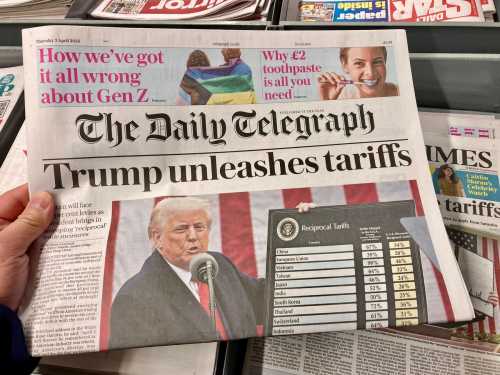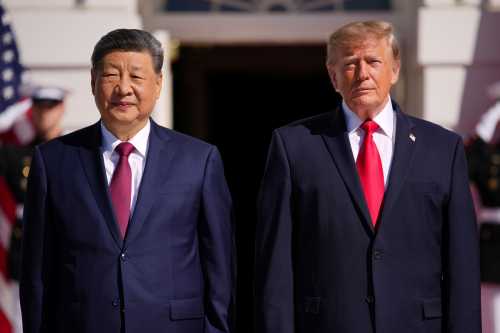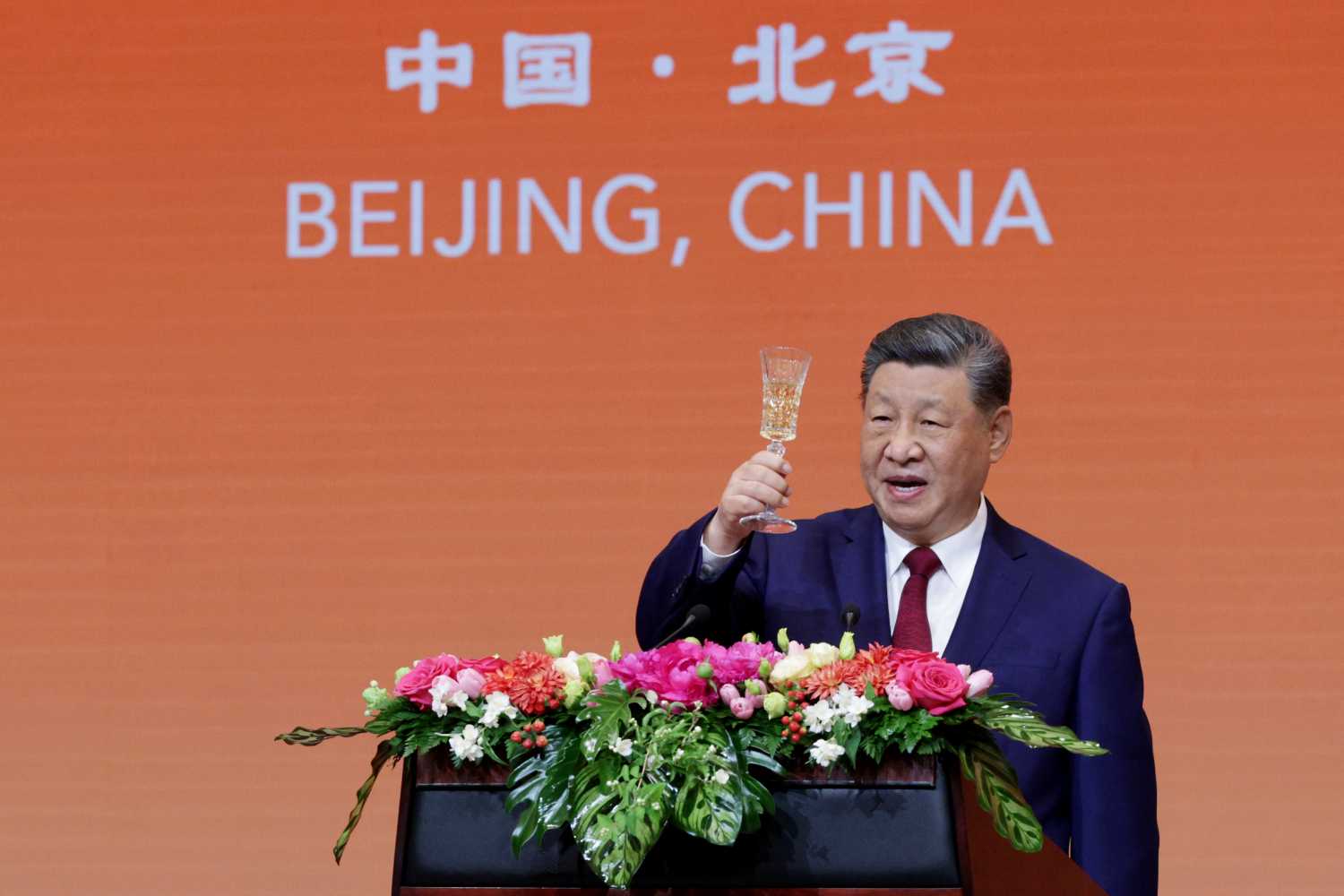
This piece is part of the “Blowback: How the Iran war may change the world” series, which features original analyses and policy recommendations by experts on the immediate and prospective long-term fallout from the 2026 Iran war.
The United States and Israel fought Iran, and China won. America’s setback with Iran has widened a lane for China to assert greater influence and leadership on the world stage. The conflict has ratified Beijing’s judgment that it need not confront Washington in a climactic showdown for global leadership. Instead, China’s leaders can afford to steadily accrue power and influence while Washington flounders. The more America depletes itself dealing with Iran and deepening its own political divisions at home, so the thinking in Beijing goes, the quicker China will arrive at the center of the world stage.
China’s ascent is not what America’s architects and advocates for striking Iran had in mind. Rather, they argued that America would emerge from victory over Iran stronger while China would be weakened. In this telling, if Iran’s government fell, then China’s anti-West coalition of partners would be diminished. China would lose access to discounted Iranian oil, which accounted for roughly 13% of its overall oil imports. More intangibly, China would be exposed as a bystander, stuck reacting to U.S. President Donald Trump’s bold gambits rather than a shaper of global events itself.
Events of the past several months have disproven such blinkered assumptions. To the contrary, as Robert Kagan has argued, Iran will emerge stronger and more influential from the conflict. This is because Tehran will enjoy leverage over every major economy in the world through its control of the Strait of Hormuz.
China also will gain on a relative basis from America’s setback against Iran. Beijing sees the United States wearing itself down while China preserves its strength and keeps its resources concentrated on what it views as the defining geopolitical contest: the battle for technological leadership. For China, hegemony in the Persian Gulf region would carry more burdens than benefits. China is content to remain a friend to all and an enemy to none without having to assume the burdens of becoming a security guarantor in the region.
To be clear, not all aspects of the Iran war will redound to China’s benefit. Disruptions to shipping through the Strait of Hormuz, higher energy prices, and a broader global economic downturn would impose real costs on China’s economy. Yet, on balance, the strategic ledger tilts in Beijing’s favor. The conflict has opened opportunities for China to strengthen its economic centrality and displace America as a provider of public goods to countries in need.
China’s accrual of influence
Already, Beijing is assisting American allies such as Thailand and the Philippines in meeting shortfalls for jet fuel and other energy imports. By coming to the aid of countries in crisis, China is filling a role that America long had used to its own advantage. Longer term, Beijing will profit from the war-induced demand destruction for oil. China is in pole position to cement global market share for the renewable energy technologies it dominates, such as solar, wind, electric vehicles, and batteries.
Beijing also will take relief from the toll the Iran war has taken on America’s relationships with its allies, particularly in Europe and the Middle East. The open divergences between Washington and its partners over the war’s legitimacy, execution, and fallout have exposed fissures that risk metastasizing to other issue areas over time.
For China, these fissures offer comfort. Beijing has long viewed America’s alliance network as a risk point for its rise. Any weakening of alliance cohesion reduces the possibility of coordinated pushback on Chinese advances, whether in Asia, technological competition, or global governance.
China also will relish the visible reminder of America’s difficulties in securing strategic objectives in Iran. Chinese officials will ask their counterparts across Asia, foremost in Taiwan: If America cannot handle a second-rate regional military power like Iran, do you really think the United States will risk war with China to come to your defense? China also will seek to build a narrative contrast between itself as a reliable steward of the international order versus America as a violent and reckless pursuer of its own interests.
Psychological risks for Taiwan
Partly for these reasons, Beijing is unlikely to alter its approach toward Taiwan as a result of the Iran war. Any arguments that China may quickly strike Taiwan during a moment of American distraction rest on a superficial understanding of China’s strategic thinking. China has not been deterred from invading Taiwan because of America’s missile inventories. Rather, Beijing’s aim is to compel the Taiwan people to accept that their best bet for security and prosperity is to integrate with the mainland.
China’s strategy for Taiwan relies upon creating a sense of inevitability. To foster this feeling, China’s propaganda efforts in Taiwan will dial up narratives about a worn-out America lacking the appetite for a struggle with China. Chinese officials will urge Taiwan’s leaders to adjust to America’s decline by becoming more positive about cross-Strait collaboration. At the same time, Beijing will continue its massive military buildup to ensure options if its project of persuasion fails.
Restoring discipline
As troubling as the trendlines for American global leadership feel in the current moment, it is essential that American policymakers maintain composure. The United States has a greater margin for error in its foreign policy than any other power, particularly given its energy abundance, deep and liquid capital markets, unique technological ecosystem, dollar dominance, and its democratic institutions, which enable course correction. America has rebounded from dire setbacks before, notably Vietnam. The American people also have shown resilience in healing political wounds throughout their history.
By a similar measure, it would be a failure of imagination to project China’s strategic moment into an indefinite future. Sparkling news headlines about China’s dominance of emerging technologies such as solar and electric vehicles obscure the fact that the country remains beset with economic challenges. Among the myriad challenges, China’s leaders confront record youth unemployment, sagging domestic demand, and mounting debt. None of this is intended to whitewash America’s own challenges, which are profound, but rather to observe that China will need to cross many hurdles of its own in the years ahead. The future does not belong to China any more than it does to America. Global leadership will be contested.
If America is serious about contesting China’s vision of global leadership, it will need to rediscover strategic discipline, reinvest in alliances, and concentrate on technological advancement as the principal measure of national power.
Strategic discipline will require a combination of process and prioritization. It will not be achievable so long as America’s foreign policy remains an extension of Trump’s whims. Trump is the most manipulable and incurious president of the modern era. Discipline only will return if senior advisors muster courage to insist on conducting a policy process that rigorously examines options and weighs second- and third-order effects before presenting choices for presidential decision. Congress also will need to claw back its constitutional prerogative to exercise oversight of foreign policy. The House of Representatives’ June passage of a resolution to limit U.S. military involvement in hostilities with Iran was a positive initial step, but much more oversight will be needed to fulfil the role the Founding Fathers envisioned for Congress as the Article I branch of the U.S. government. If the current cohort of congressional leaders is uncomfortable performing their duties, they should get out of the way for others to step forward. And if this proves infeasible, then candidates to succeed Trump in 2028 should be measured in part by their discipline and capacity to correct for Trump’s erraticism.
Overall, the Iran war has exposed the limits of American power, sharpened divisions between America and its allies, and created an opening for China to assume a more central role in the international order. Whether these Chinese gains become permanent or prove illusory will depend in no small measure on whether America learns lessons and regains discipline, or whether it doubles down on dysfunction.
Author

Related Content

The Brookings Institution is committed to quality, independence, and impact.
We are supported by a diverse array of funders. In line with our values and policies, each Brookings publication represents the sole views of its author(s).