If we’ve all learned one thing in 2020, it’s that the world was not on a sustainable path in 2019. The great reveal began through a microscopic imbalance between humans and nature in a single community. The imbalance quickly turned to upheaval, permeating every society around the globe. On the starkest scorecard of life and death, the COVID-19 pandemic is still winning, having led to 1.1 million deaths and counting.
The pandemic’s broader consequences are equally telling. The virus has generated fresh appreciation for our collective dependence on the ecosystems of the natural world. It has prompted new recognition about how unequally life’s burdens are often shared—across families, communities, and countries. People with the least resources to confront a crisis have often been those most called upon to serve their society’s essential needs throughout the crisis. And the pandemic has underscored the networked forms of societal cooperation that are essential in conquering a problem that will thrive anywhere, until it is defeated everywhere. COVID-19 didn’t cause the world’s interwoven economic, social, and environmental challenges of sustainable development, but it certainly brings their importance to new light.
In that context, despite the daily stresses that so many of us continue to experience amid the crisis, I’ve always been proud to be part of a group of Brookings scholars—eminent academics, former practitioners, and policymakers alike—who have been working for many years to tackle the underlying challenges of sustainable development, within and across all countries. The 17 Sustainable Development Goals (SDGs), as agreed by all countries in 2015, are the world’s common policy framework for tackling these issues, articulated around a basic set of underpinning priorities. To leave no one behind. To end extreme poverty. To ensure the sustainability of the planet. To promote cooperation and prosperity for everyone.
It’s an even greater source of pride that Brookings has committed to elevate its long-term institutional commitment to these issues through the launch of a new Center for Sustainable Development. With special thanks for all their support to Brookings President John R. Allen and Brahima S. Coulibaly, the new vice president of the Global Economy and Development program, I’m honored to be the center’s first director. But if there ever were a case of servant leadership then this is it, since the center has such an extraordinary inaugural roster of scholars, each of whom is a distinguished leader in their own domain:
- Amar Bhattacharya is a global leader in promoting sustainable infrastructure and tackling climate change, building on his many years of distinguished service at the World Bank and as director of the Group of 24 developing country finance ministers and central bank governors.
- Marcela Escobari is pioneering new empirical approaches to advancing U.S. workforce opportunities, drawing from her extensive international experience, including as former assistant administrator for Latin America and the Caribbean at the U.S. Agency for International Development (USAID) and former executive director of Harvard’s Center for International Development.
- George Ingram is a highly seasoned voice in mobilizing bipartisan U.S. leadership for global development, having spent many years working across Congress, the executive branch, and the nonprofit sector. He is co-founder of the U.S. Global Leadership Coalition and co-chair of the Modernizing Foreign Assistance Network.
- Homi Kharas is one of the most prolific and impactful researchers on issues of extreme poverty, the global middle class, sustainable development finance, and international cooperation. Among Homi’s countless contributions to everything being taken on by the new center, he played a pivotal role as executive secretary of the U.N. secretary-general’s High-Level Panel on the Post-2015 Development Agenda, which helped pave the way for what we now know as the SDGs.
- Anthony F. Pipa is leading new forms of international cooperation to advance sustainable development at the local levels, around the world, and within the U.S. itself. He builds on an extraordinary career spanning public and nonprofit sectors, including his work as the U.S. special envoy to the U.N. during the intergovernmental negotiations on the SDGs, and as former chief strategy officer at USAID.
This world-class team’s broad range of work is emblematic of the broad range of issues and geographies that add up to the global sustainable development agenda. I hope that we will only continue to broaden the team’s diversity of membership and research topics over the days ahead—a focus on gender equity being paramount on all fronts. Nonetheless, amid the potential vastness of the sustainable development landscape, and needing to build from our strengths, we have decided to prioritize five issue areas to start:
- Defining the challenge: sustainable development economics and empirics;
- Identifying mechanisms and instruments to advance SDG implementation across all countries, including within advanced economies;
- Advancing sustainable development at local and other subnational levels;
- Advancing effective financing for sustainable development; and
- Advancing U.S. official and American societal leadership for global sustainable development.
Themes of networked leadership and “leave no one behind” will be core to the center’s work. For my own part, I will also continue to pay special attention to how both the U.N. system and Canada, my home country, are confronting the relevant challenges at hand—both as topics of deep personal interest and as bellwethers for international cooperation writ large.
Related Books
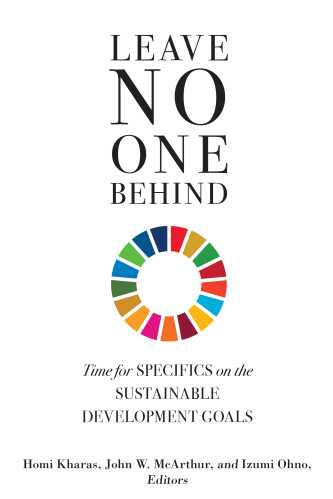
Ultimately, despite our strengths, we are mindful that we are only a small starting team looking at huge global challenges, so we will use our scarce resources both to inform other stakeholders and to help convene them. The more we can serve as a helpful node supporting a global network of cooperation, the better we are doing our job. Our SDG-focused 17 Rooms partnership with The Rockefeller Foundation represents a flagship effort in this direction.
Finally, as with everything at Brookings, our work is only made possible by a remarkable team of research analysts, project coordinators, and project managers who drive the agenda forward every day, alongside an army of supporting business units spread around Brookings. We are fortunate to be part of a century-old institution that is so committed to independence and impact. Through the new Center for Sustainable Development, we strive to help the world chart a newly sustainable path over the course of 2021 and far beyond.
Related Content
2020
Author
The Brookings Institution is committed to quality, independence, and impact.
We are supported by a diverse array of funders. In line with our values and policies, each Brookings publication represents the sole views of its author(s).

Commentary
Heeding the call to action: A sustainable path for humanity
October 21, 2020