Executive summary
Turkey is reemerging as a central actor in the Middle East—but not as the neo-Ottoman power its domestic rhetoric suggests. Surrounded by wars and regional fault lines, Ankara is trying to manage disorder, not dominate it. Based on year-long interviews with senior Turkish diplomats and decisionmakers, this paper argues that Turkey’s leadership cadres are far more restrained and realistic than the country’s public messaging implies.
The second Trump administration has opened space for a U.S.-Turkey reset, but Washington’s volatility makes long-term planning difficult. The Iran war both vindicated Turkey’s hedging instinct and exposed its limits—when Iranian ballistic missiles entered Turkish airspace, NATO intercepted them, serving as a reminder that strategic autonomy remains an aspiration more than a reality. The war also raised the stakes of Turkey’s Kurdish peace process, as U.S. and Israeli plans to arm Kurdish groups threatened to unravel a fragile domestic settlement that Ankara increasingly sees as inseparable from its ability to manage regional disorder.
Turkey’s rivalry with Israel has become a structural constraint, shaping nearly every regional file—Syria, the Eastern Mediterranean, Washington lobbying, and the Red Sea-Horn of Africa corridor. Israel is trying to limit a greater Turkish footprint in Syria, and a new Greece-Cyprus-Israel alignment is tightening around Ankara in the Mediterranean.
Syria remains the central test of Turkey’s regional influence. Turkey has achieved its core objectives in the post-Assad era, but big reconstruction gains, security-sector reform, and Kurdish integration remain unresolved.
While Turkey’s defense exports, military, and connectivity agenda offer real geopolitical openings for regional influence, the country’s economic fragility and domestic governance problems set the ceiling.
For Washington, Turkey is neither model nor spoiler—it is a consequential middle power whose interests partly overlap with U.S. priorities in theaters where America wants to reduce its involvement. U.S. policy should anchor Turkey in NATO, manage the Turkish-Israeli rivalry before it turns kinetic, and cooperate on Syria, connectivity, and regional stabilization.
Introduction
No book offers better insight into the mindset of Turkey’s founding generation than “Zeytindağı” (Mount of Olives), Falih Rıfkı Atay’s firsthand account of his service as an Ottoman officer on the Middle East front during World War I. Serving under Cemal Pasha, and later emerging as one of Mustafa Kemal Atatürk’s confidants, Atay became one of the key narrators of the republic’s break with its imperial past. “Zeytindağı” was compulsory reading for generations of Turkish students, diplomats, and bureaucrats. From the dusty trenches in Gaza and Hejaz to the war rooms in Aleppo and Jerusalem, it chronicled the unravelling of an empire, portraying the Arab territories not as lost homelands but as the stage—and the cause—on which Ottoman decline was exposed. Ultimately, the book suggested, the Middle East was more trouble than it was worth.
Today, no book feels more ill-suited to capturing Turkey’s geopolitical priorities.
A century after the collapse of the Ottoman Empire, Turkey is reemerging as a central player in the Middle East. At home, President Recep Tayyip Erdoğan’s government has cultivated a nationalist narrative with neo-Ottomanist undertones—invoking pride in Turkey’s renewed ties with the region and highlighting civilizational continuity as a step toward Turkey’s natural leadership in its neighborhood. That narrative plays well domestically, especially in Erdoğan’s conservative base, and feeds a sense of manifest destiny among Turkey’s conservative elites. But it is largely an instrument of domestic propaganda—with little evidence of Turkish domination in the Middle East.
The Middle East is on fire, and Turkey is not ready to go it alone, despite decades of lip service to strategic autonomy.
On the ground, however, Turkey is not constructing a regional order so much as trying to manage regional disorder in ways that protect its core interests. Over the past few years, Turkey has been busy preparing for what its leaders increasingly see as a coming post-American world by fending off threats to its periphery and building political and economic influence in its neighborhood. The Middle East is on fire, and Turkey is not ready to go it alone, despite decades of lip service to strategic autonomy. From Syria and Iraq to Libya and Somalia, Turkey’s influence is there, but that influence hasn’t exactly translated into a Turkish empire.
More importantly, the country’s leading cadres today, based on a series of interviews with senior officials over the past year, are more realistic about Turkey’s power projection than the political sermons in Ankara suggest. This paper is an attempt to understand Turkey’s strategies and challenges in managing regional disorder.
Part of why outside observers misread Turkey is the confusion between the country’s domestic debate and its real external posturing. The messaging at home is braggadocious—where things like the “Century of Turkey” framing or endless obsession with the Ottoman Empire cast Ankara as the dominant power in a post-American world. From sitcoms to weekly parliamentary speeches, Erdoğan and other Turkish leaders like to depict an ascendant Turkey with full strategic autonomy and on the verge of regional domination. This is far from reality. Yes, Turkey did expand its regional reach through a series of external military deployments between 2016 and 2021, from the Caucasus to Libya. The regime change in Syria has also extended Turkey’s influence. But Turkey is also experiencing significant challenges in the region, from its own economic problems to the volatility of U.S. decisionmaking and opposition from Israel.
Ankara’s response to these limits has been shaped by a surprising level of pragmatism. Its diplomacy and policies on the ground have been far more restrained and disciplined than the domestic bragging suggests. When Erdoğan visited the White House on September 25, 2025, U.S. President Donald Trump credited him with President Bashar al-Assad’s downfall: “I think President Erdoğan is the one responsible for Syria, for the successful fight in ridding Syria of its past leader. … He doesn’t take the responsibility, but it’s actually a great achievement.”
While Turkey was indeed key to Assad’s collapse, and remains influential, it is only one of a number of players in Syria—not a colonial overlord. To this day, Erdoğan and every Turkish official have kept quiet about Turkey’s role in the rebel offensive that led to Assad’s downfall. The restraint is deliberate. Foreign Minister Hakan Fidan had already spelled out why in a December 2024 interview, when he called it “a grave mistake” to characterize events in Syria as a Turkish takeover: “Our solidarity with Syrian people shouldn’t be characterised or defined today as if … we are actually ruling Syria. I think that would be wrong,” he said, “Not Turkish domination, not Iranian domination, not Arab domination, but cooperation should be essential.” Fidan knew that publicly taking credit for Assad’s fall would have confirmed every Arab fear about Turkish neo-Ottoman ambitions, undermining the very influence Turkey was trying to consolidate.
This is not to say Ankara does not have long-term aspirations for regional power projection. It has strong allies like Qatar, Syria, and Libya and a set of countries with which it either has transactional ties or security partnerships. But Turkish leaders are far more realistic today than the transformative agenda they pursued during the Arab Spring, when Turkey hoped the region might be reshaped in its image. While today’s ruling cadres do not have the same disdain toward the Middle East as Turkey’s founding leaders, like Falih Rıfkı Atay, interviews with senior officials conducted over the past year for this paper suggest they are neither starry-eyed about the region nor do they have an inflated sense of what Turkey can—and cannot—do. They are focused on staving off perceived threats, as opposed to conquering former Ottoman lands.
Central to that balancing act is Turkey’s management of the great powers still active in the region. First and foremost, this includes the United States under Trump, whose personal rapport with Erdoğan has given Ankara leverage, but whose improvisational style has also become a constraint. Russia, once Turkey’s unavoidable interlocutor in Syria, is a diminished presence; China remains an economic actor without security weight. Turkey navigates among all of them—but it has not emerged as a pole of its own. It is not yet prepared to manage a post-American Middle East on its own.
For Turkey, the Middle East certainly remains a canvas for opportunities, but the region also presents economic and political risks that Ankara cannot fully absorb today. Caught between multiple wars on its borders and in its broader neighborhood, Turkey’s current ruling cadres seem determined—for now—to stay out of the region’s hot conflicts. The question is, in an era of American retrenchment, when there will likely be less U.S. presence across the region, can Ankara transform that cautious neutrality into an advantage, eventually building a new regional order with Turkey at the center?
The Trump opening—and its limits
No relationship matters more to Turkey’s regional position today than the one between Erdoğan and Trump. After a decade in which Ankara’s standing in Washington was defined by sanctions, the dispute over the S-400 air defense system, and U.S. congressional hostility, the second Trump administration has treated Turkey as a partner rather than a problem— much to the delight of Turkish decisionmakers. Trump has used every opportunity to publicly praise Erdoğan. Meanwhile, Ankara has cultivated a productive working relationship with the U.S. president’s inner circle, including Special Envoy Steve Witkoff, Jared Kushner, Secretary of State Marco Rubio, and Tom Barrack, the U.S. ambassador to Turkey—figures who deal with Ankara directly and without the bureaucratic baggage of the past.
The relationship has delivered, most visibly on Syria. Trump’s embrace of the government led by Ahmed al-Sharaa, his decision to lift sanctions, and his public crediting of Erdoğan for Assad’s downfall have all expanded Turkey’s room for maneuver on its most important regional file. Trump has acknowledged Erdoğan’s role in convincing him to decide to drop sanctions on Syria. The two leaders’ rapport has also opened conversations on defense trade and Turkey’s possible return to Western weapons programs like F-35 Joint Strike Fighter that would have been unthinkable a few years ago.
But the Trump opening comes with its own problems. The first is structural, with a U.S. president whose foreign policy is personal, rather than institutional. Washington’s deals are struck at the leader level, on the back of an envelope, and often without the bureaucratic machinery to implement or sustain them. This is different from how Ankara functions, where, despite Erdoğan’s immense consolidation of power, there is a state apparatus that is active in every part of the bilateral relationship. Trump’s informal style works for episodic breakthroughs—a sanctions waiver here, a summit there—but it makes it hard to solve bilateral problems or convert his self-declared peace agenda into real regional stability. For a country like Turkey, whose regional bets in Syria, the Mediterranean, and the South Caucasus depend on long-term stabilization, an American partner that improvises and doesn’t follow through can be a problem in its own right—as big as one that walks away.
Ankara can learn to live with most American policies. What it cannot plan around is American unpredictability.
Another problem is U.S. volatility. The same president who hails Erdoğan as the man who toppled Assad can, within days, encourage Kurdish groups to take up arms against Iran, float tariffs, or muse about American commitments to NATO—the alliance on which Turkey’s hardest layer of defense still depends. Ankara can learn to live with most American policies. What it cannot plan around is American unpredictability.
Trump’s golden touch is also not without other suitors. Turkey is not Trump’s only privileged partner in the region; Saudi Arabia, the Gulf states, and Israel are in that league. The president’s personal and financial ties to Gulf capitals, and his administration’s closeness to Israel, mean that when Turkish interests collide with theirs—as they can over Syria, the Eastern Mediterranean, and regional security architecture—Ankara cannot assume the White House will take its side. The Trump relationship gives Turkey access, but not priority over Israel and the Gulf.
Nor do the other great powers offer an alternative. Turkey’s ties with Russia—for years a carefully compartmentalized mix of competition and cooperation, from the Astana process in Syria to TurkStream gas and the Russian-built Akkuyu nuclear plant—have tilted in Ankara’s favor, as the war in Ukraine and Assad’s collapse eroded Moscow’s regional position. Turkey still talks to Russia, but it no longer needs to defer to it. The relationship is more balanced in Ankara’s favor. China is deliberately avoiding any entanglement in the Middle East. Neither Moscow nor Beijing can underwrite Turkish security or anchor its economy the way the West still does. For all the talk of strategic autonomy, Turkey hedges from inside the Western system.
The Iran war: The vindication of hedging
The Iran war offers the clearest example of the dangers the Middle East poses for Turkey today. Turkey and Iran are historic rivals that fought repeatedly for centuries before the 1639 Qasr‑e Shirin agreement drew their border and helped establish a tacit framework: no direct war and no interference in each other’s internal affairs.
Ankara opposed a regime change war against Iran from the start—though it has no love lost for Iran. While Turkey has long resented Iran’s proxy network and nuclear ambitions, it also feared the fallout from a prolonged U.S.-Israel military campaign, from trade disruption to refugee inflows or renewed Kurdish aspirations for independence. Early on, it adopted a posture of “active neutrality,” similar to its position in World War II, participating in mediation efforts, including with Pakistan, to prevent the conflict and later, once it started, to find a way to end it.
This position was highly popular: A MetroPoll survey conducted in March 2026 found that 68.1% of Turkish respondents said Turkey should remain neutral in the conflict, with only 2.1% supporting alignment with the United States and Israel.
But the war did something else. It shook Turkey’s confidence in the idea of strategic autonomy that it had been pursuing for a good part of the last decade. The same leadership that insisted at home that Turkey was now a regional leader has been reminded that Ankara needed NATO air defenses to down the Iranian ballistic missiles that entered Turkish airspace. This was also a reminder that NATO remained an indispensable part of Turkey’s defense architecture, and the government has tried hard to improve its ties with the alliance ahead of the summit in Ankara in July.
The Kurdish corollary
The war in Iran has also exposed how central the Kurdish file remains to Turkey’s capacity to manage regional disorder. A slow-paced peace process launched in 2025 between the Turkish government and the Kurdistan Workers’ Party (PKK) opened a rare window for a historic settlement. What motivated Turkey more than anything else was the fear of regional disorder and the need to shore up the homefront, as opposed to strengthening Turkey’s beleaguered democracy.
During the war, the strategic urgency of the Kurdish process became more obvious to Turkey’s decisionmakers, when reports emerged of U.S. and Israeli plans to use Kurdish groups in Iran, including those affiliated with the PKK, to start a rebellion inside Iran. Trump was an early and public proponent of having Iranian Kurdish forces based in Iraq attack the Iranian regime’s forces, but he changed course days later.
U.S.-Israeli plans to arm Kurds would not only have destabilized Iran but also poisoned the fragile peace track between the Turkish government and the PKK, and Ankara’s effort to fold PKK-linked Syrian Kurdish forces into Syria’s new government. More than anything else, the episode underscored how vulnerable the Kurdish peace process was to external meddling.
Ankara appears to have recognized that managing Middle East earthquakes requires simultaneously dealing with the Kurdish issue at home. Turkey has made modest moves toward providing a greater opening to the pro-Kurdish party in Turkey, while cracking down on Erdoğan’s secularist opponents. A law under consideration in the Turkish parliament aims to provide the legal basis for repatriation of PKK militants. Erdoğan’s autocratic governance makes it unlikely that Ankara would pursue democratization or widespread political reforms at home. But a Kurdish settlement and an agreement with the PKK would significantly reduce domestic tensions and ease the security burden across Iraq and Syria—mitigating long-held Turkish fears about the establishment of an independent Kurdish state in the region.
Strategic enmity with Israel
Of all the relationships that shape Turkey’s regional calculus, none is more consequential—or more corrosive—than its rivalry with Israel. What began as a political rupture over Gaza has evolved into a full-blown strategic competition, playing out across Syria, the Eastern Mediterranean’s maritime boundaries, and the corridors of Washington.
Ankara now views Israel as a key driver of regional instability—and a direct challenge to Turkish interests, especially in Syria and the Eastern Mediterranean. The rivalry also extends to the Red Sea-Horn of Africa corridor, where Turkey’s support for Somalia and Israel’s recognition of Somaliland—the first by any U.N. member state—pull both countries into a contest for influence.
In interviews, Turkish officials and diplomats consistently painted Israel as an irritant in nearly all of the regional files. One described Israel as pursuing a two-track strategy to contain Turkey: geographically, by strengthening partnerships with Greece and Cyprus in Syria and the Eastern Mediterranean; and politically, by leveraging its influence in the U.S. Congress to keep U.S.-Turkey ties strained. In their telling, Israel has become both the most immediate spoiler for Syria’s stabilization and the most effective veto holder on Ankara’s hope for a grand reset with the United States under the Trump administration.
The competition plays out in mutual insults by officials and bigger fights on social media, but it has also spilled into the military dimension. Israeli air dominance over Syria is one of the reasons Turkey has failed to expand its military presence in a post-Assad Syria beyond its outposts in northern Syria. In April 2025, Israel struck the T-4 and Palmyra air bases that Ankara had scoped as potential sites for Turkish deployment—signaling its determination to prevent a larger Turkish military footprint in Syria. While Turkey has a defense partnership with the al-Sharaa government and is training Syria’s new military, inside which it also has its own proxies, it has been unable to establish bases outside the north.
A new defense partnership between Israel, Greece, and Cyprus has also expanded recently in ways that—even publicly—challenge Turkey’s position in the Eastern Mediterranean, heightening Ankara’s sense of encirclement on the seas. This alliance means there is a new fault line in the Mediterranean, and the three powers have formalized plans to deepen defense ties and conduct joint air and naval exercises, bringing Israel into the heart of a decades-long frozen conflict around Cyprus. The June 2026 establishment of the U.S.-Greece-Cyprus-Israel Eastern Mediterranean Energy Center also sought to further institutionalize an energy partnership that cut across disputed maritime borders and hydrocarbon resources off Cyprus. That move effectively foreclosed Turkey’s long-standing demand to include the Turkish Cypriot community in decisions over Cyprus’s offshore resources. Cyprus has also strengthened its air defenses by obtaining Israeli-made systems.
Ankara reads all of these moves as part of a coordinated effort to limit Turkey’s room for maneuver in the Mediterranean. Erdoğan has recently said Israeli attacks on Lebanon and Syria directly threaten Turkey. He also warned about “pipe dreams in the Eastern Mediterranean,” adding, “Nobody should chase adventures… I want everyone to know that if the rights of Turkey and Turkish Cypriots are violated in the Eastern Mediterranean, our response will be very clear and very strong.”
There is similar psychology in Israel. Israel’s official security planning now treats Turkey as a potential adversary and a long-term threat: In January 2025, the Nagel Committee, a government-commissioned panel on defense strategy headed by a former acting national security adviser, recommended that Israel prepare for a possible direct confrontation with Turkey, warning that the threat from a Turkish-aligned Syria “could evolve into something even more dangerous than the Iranian threat.” In Israeli political discourse, the rhetoric has since escalated, with numerous social media commentators and former Prime Minister Naftali Bennett warning that “Turkey is the new Iran.” Commentators in the Israeli press have portrayed Ankara as an even greater danger than Tehran.
As U.S. Ambassador Tom Barrack noted, the perception of encirclement runs deep on both sides: “So if you wake up in Tel Aviv, you read the newspaper, what do you see? You see the diagram on the paper of The Ottoman Empire 2.0, which is Vienna to the Maldives … You wake up in Istanbul and read the paper and it’s Greater Israel.”
For Turkey, Israel creates a strategic dilemma. Ankara wants to present itself to the United States as a stabilizing partner as Washington hopes to reduce its regional involvement. But an open-ended rivalry and the risk of confrontation with Israel would make the case far harder to sustain or to operationalize.
Turkey’s answer: Building a counter-coalition
Ankara’s answer to the rivalry with Israel has been to build its own partnerships and diversify its security ties from the Mediterranean to the Horn of Africa. Its recent rapprochement with Saudi Arabia and Egypt has reduced the antagonism of the last decade with the Gulf states, and Turkish officials increasingly favor looser minilateral formats—up to and including exploratory talk of a Saudi-Turkish-Pakistani-Egyptian security understanding. Fidan has publicly confirmed that such discussions are underway—casting them as part of Erdoğan’s vision for an “inclusive platform”—and has said Ankara is exploring with Saudi Arabia, Pakistan, and others how to “combine our strengths to solve problems,” emphasizing regional ownership.
Ankara wants to break out of an adverse alignment on its periphery by building a wider coalition of capable states that can hedge Israel’s military dominance and resist Israeli diplomatic pressure.
Whether such a pact ever materializes, it is clear that Ankara wants to break out of an adverse alignment on its periphery by building a wider coalition of capable states that can hedge Israel’s military dominance and resist Israeli diplomatic pressure. The goal of Turkey’s recent normalization efforts with the Gulf states appears not to be full strategic alignment but preventing the emergence of an Israeli-led, anti-Turkey bloc in the Mediterranean or the Middle East. Ankara has pursued this objective by forming practical trade and security partnerships as Gulf states diversify their own trade and security partnerships.
Turkey’s efforts to deal with regional tumult do not stop at coalition-building. Ankara’s leaders have begun to articulate a more institutional vision for the region’s future. Since the beginning of the Iran crisis, Fidan has repeatedly argued that the Middle East needs its own security framework—a regional defense architecture built by Middle Eastern states themselves—to reduce dependence on outside guarantors and manage common threats collectively. To emphasize that this is less like Turkish primacy and more like shared capacity, he reached for a historical analogy: “Look at how European Union has managed to form itself from scratch to today. Why not us?”
Fidan has since sharpened this argument, recently describing the region’s potential for a new security framework that could, in principle, even include Israel in the future—but only after a political settlement in Palestine. “Israel can join this process if it recognizes a Palestinian state based on the 1967 borders,” he said, adding: “If that problem is solved, I think the security of Israel will be very much assisted by the regional countries, too.”
Today, such an architecture seems unrealistic—given the region’s fractured politics, Turkish-Israeli rivalry, and deep suspicion in Arab capitals of Iran, Israel, and even Turkey. But the fact that Ankara is thinking in institutional terms, not just operational ones, marks a significant evolution in how Turkey conceives of its regional role.
Syria first: A laboratory for Turkish influence
In interviews, Turkish interlocutors repeatedly returned to the idea that Turkey “needs to increase its friends and reduce its enemies.” Syria is where that test is most immediate—Turkey has more leverage there than anywhere else, and its claim to shaping a zone of stability on its periphery will be judged there first.
By its own measures, Ankara has achieved its core objectives since Assad’s fall. It has prevented the consolidation of a PKK-linked, U.S.-backed Kurdish statelet along its border, and it has deepened its leverage in Damascus by championing the al-Sharaa government diplomatically while helping it build institutional capacity and international legitimacy.
The next phase is harder. Syria faces institutional weakness, financial constraints, and a difficult security environment—compounded by Israel’s control of its airspace and territory in the south. And while al-Sharaa enjoys close ties with Ankara, he has been running his own balancing act, cultivating the United States, Qatar, and Saudi Arabia in ways that preclude Turkish dominance. Turkey has influence but is not running the country.
The economic returns are similarly real but modest. Turkish exports to Syria surged past $3 billion in 2025, yet the war-torn country remains a small market for Turkey, and the gains have flowed mostly to the ecosystem of traders, manufacturers, and logistics firms in Turkey’s southeast. (Gaziantep alone exported roughly $653 million worth of goods to Syria in 2025.) The larger reconstruction boon Turkish firms had hoped for has not materialized. Politically connected companies such as Kalyon and Cengiz have been linked to early consortium bids in power generation and airport modernization, but the big wave of infrastructure, energy, reconstruction, and manufacturing investments that would cement Turkey’s position as Syria’s top economic player has yet to arrive.
Turkey’s footprint: Hard power plus flexible alignment
Turkey’s efforts to manage disorder, as well as benefit from the region’s power vacuums, have led to a modest but strategically placed network of deployments and security partnerships that give Ankara political leverage disproportionate to its resources. Ankara has combined soft power with hard power to forge new, flexible partnerships from Pakistan to Somalia. Its military footprint is now visible in conflict zones where the modern republic rarely held sustained influence. But it is still very new to great power politics, with newly introduced soft-power instruments to augment its grand strategy. While it maintains dozens of forward positions inside Syria and Iraq, its true overseas basing is limited, and includes:
- Northern Syria: a network of forward bases, logistics hubs, and observation points built over a decade of operations—initially established as a way to protect refugee populations in Idlib and prevent the emergence of a contiguous PKK-linked Kurdish autonomous zone. While many of the armed opposition groups Turkey backed are now embedded in the new Syrian army, giving Turkey leverage in Damascus, Turkish forces still retain outposts that secure the border in a post-Assad order.
- Northern Iraq: a web of outposts and liaison points that has turned cross-border operations against the PKK into a permanent posture, giving Ankara persistent pressure against the Kurdish group and leverage with the Kurdistan Regional Government in Erbil.
- Libya (Tripoli and western corridor): While the political endgame in Libya remains unsettled, Turkish military advisors, training facilities, and access arrangements—most visibly around air facilities and coastal nodes—have preserved Ankara’s influence since the 2019 deployment in Tripoli.
- Qatar: a formal overseas base that anchors Turkey’s Gulf security role and signals a willingness to work with GCC countries as a security partner.
- Somalia and the Red Sea-Horn corridor: The TURKSOM military base in Mogadishu is Turkey’s flagship training platform, now paired with expanded maritime security cooperation—positioning Ankara in the wider Red Sea competition.
This footprint buys Ankara leverage and access and is useful for managing disorder in its neighborhood, but it is still far from the capacity required to ‘impose order.’
This footprint buys Ankara leverage and access and is useful for managing disorder in its neighborhood, but it is still far from the capacity required to “impose order.” In many of these locations, Turkey has to navigate complicated internal dynamics among different factions or deal with the presence of external actors—like Russia and France in Libya or Israel and the US in Syria.
Defense industrial diplomacy: An unfinished story
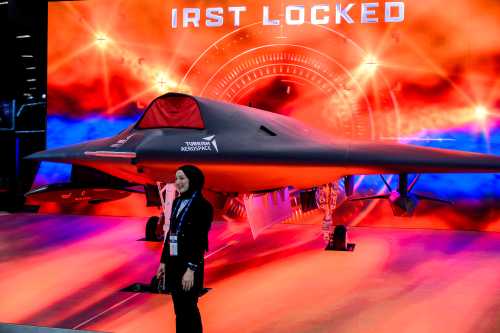
Outside of deployments in hot conflict zones, Turkey’s defense industry has become one of Ankara’s most effective tools for bolstering regional partnerships. Ankara has made impressive advances over the past two decades—helped in part by a policy that turned Turkey’s role in NATO supply chains into greater domestic production for its massive military. Turkey is now one of the leading countries in drones and has emerged as a leading supplier of 155mm artillery ammunition and production technology inside NATO. It also possesses a scalable military industrial base that produces other items, including explosives, armored vehicles, naval platforms, missiles, and training packages—delivered quickly and often with fewer political strings than Western suppliers. At a time when states are rearming and seeking to diversify suppliers, that mix has made Turkey an attractive security partner, even if it is no substitute for the United States at the high-end systems.
But the Turkish defense industry is not yet the answer to the region’s quest for a new security provider as American protection becomes less reliable, especially for the Arab Gulf states. Turkey’s defense diplomacy in the Middle East is constrained by the same vulnerabilities that shape its broader geopolitical aspirations. The long shadow of Ankara’s ill-fated decision to purchase the Russian S-400 system in 2019 means Turkey still faces U.S. export restrictions and remains disqualified from the F-35 Joint Strike Fighter program. This, along with active opposition from Israel, limits Turkey’s access to critical technologies and complicates cooperation with Western partners. An example is Turkey’s fifth-generation fighter jet program, the KAAN, which remains ambitious by design but faces delays because it is dependent on external inputs—precisely at a moment when Gulf states and others are looking for credible alternatives to Western platforms.
Much of Turkey’s defense industrial capacity is used for its own military. But exports still matter. Turkey’s defense and aviation exports surpassed $10 billion in 2025—up 48% from the year before and dramatically higher than the early 2000s—underscoring a fast-rising industry, especially in drones and munitions. That positions Turkey as a mid-tier exporter, ranking the world’s 11th-largest exporter—with critical parts often reliant on technology imports.
More important for its own needs, Ankara also lacks a credible, integrated air defense architecture—though it has NATO partners providing Patriots and other interceptors. The result is that it can sell drones and battlefield systems abroad while relying on NATO’s umbrella for the hardest layer of homeland defense. That gap does not reduce Turkey’s own deterrence capabilities and regional role as a security partner, but it limits how far Ankara can translate defense exports into strategic autonomy.
Reconstruction, trade, and Turkey’s economic bet
Turkey remains the region’s economic powerhouse, ranking as the world’s 16th-largest economy at roughly $1.6 trillion—and will no doubt maintain its position inside the Group of 20. But the Turkish economy suffers from perennial problems, including high inflation and low investor confidence. Turkish hopes of turning the moment of regional disorder into economic advantage for Turkish companies, with new energy and trade routes and mega reconstruction contracts in the neighborhood, have not yet materialized. Where Turkey’s economic story is more forward-looking is in its growing bid to become a transit country linking Europe, the Gulf, and Eurasia.
- Energy: Turkey wants to be the platform through which gas, liquefied natural gas (LNG), and oil flows are aggregated, traded, and reexported, turning geography into leverage. That ambition rests on the energy lines that already criss-cross the country: Russian gas via TurkStream and Blue Stream; Azerbaijani gas via the Trans-Anatolian Natural Gas Pipeline (linked to the Southern Gas Corridor/Trans Adriatic Pipeline); and Iraqi and Caspian crude carried through pipelines and ports to global markets—supplemented by LNG import terminals and floating storage and regasification units that give Turkey flexibility to blend pipeline gas with seaborne supply.
- Trade and connectivity: Ankara is promoting two major trade routes: Iraq’s Development Road, an artery connecting Gulf capital and Iraqi trade to Turkish ports and onward to Europe; and the Middle Corridor, running through the South Caucasus into Central Asia as an alternative Eurasian route.
These routes compete with the India-Middle East-Europe Economic Corridor and other proposed corridors, but they also underline Turkey’s indispensable geography as a natural trade, energy, and investment hub between Europe, the Gulf, and Eurasia. As companies rethink supply lines from China and the “Middle Corridor” through Armenia and Azerbaijan opens, this means more transit through Turkey. This can also boost Ankara’s plans to turn Istanbul into a bigger hub for investment and finance—especially as Gulf investment priorities are reshuffled in the wake of the Iran war.
But in order to capture more of the value chain, Ankara must avoid the overreach and political risks that would scare investors away.
But in order to capture more of the value chain, Ankara must avoid the overreach and political risks that would scare investors away. That means avoiding tensions with the West, its neighbors, and continuing to improve relations with the Gulf.
There is also the question of how much Turkey’s regional policies are supporting its economic bid. Turkey’s military operations in Libya, Syria, and Somalia have opened doors for trade and contracting, but they have not translated into a major payoff for Turkish companies. So far, Turkey’s gains largely depend on whether these places can have stable post-conflict governance—and on who funds reconstruction.
Libya remains the cautionary tale. Trade has rebounded since Turkey’s 2019 intervention, but the commercial recovery has been more modest than Turkish companies had hoped. Turkish contractors still have outstanding payments and unresolved claims from past and interrupted projects—often citing roughly $1 billion to $1.2 billion in unpaid receivables, alongside additional claims tied to letters of guarantee and damaged equipment—which continue to shadow the commercial relationship.
Bilateral trade was roughly $2.6 billion in 2019 (Libyan imports from Turkey of about $2.07 billion plus Libyan exports to Turkey of about $481 million) and reached about $4.4 billion in 2025, according to Turkish officials. But Libya’s divided institutions and rival patronage networks also limit Ankara’s ability to convert influence into an economic windfall—or into the larger prize of shaping Libya’s political order. Libya has not disintegrated, but it has not coalesced into a prosperous, unified state either.
Despite an appetite for doing more business with the Middle East, the West remains the top investor and export market for Turkish companies. The European Union (EU) accounted for 40.8% of Turkey’s exports in 2023 (rising to 41.4% in 2024), while the “Near and Middle East” took 16.7% in 2024. Ankara has also not brought its full economic force into the region because the mainstay of Turkey’s business community is still oriented primarily toward the EU, where it enjoys a customs union agreement, and it has stayed out of regional adventurism.
There is also a larger structural problem with the Turkish economy, where cronyism, political interference in markets, and persistent rule of law deficits have alienated a significant portion of Turkey’s pro-Western business community and urban professional class. While Turkey has the human capital and private sector dynamism to be a serious economic player in regional reconstruction in the Middle East, it has not deployed either at full capacity.
Limits and overreach
Turkey’s growing influence in the Middle East is real. But the constraints discussed above mean Ankara is still far from being able to shape a regional order, even if it wanted one.
In addition to external factors, there are also internal obstacles, such as Erdoğan’s hyper-personalized system of a small circle of decisionmakers, which has grown thinner than its geographic reach suggests.
Turkey’s ability to pair hard power with economic statecraft is also constrained by domestic fragility and the need for external, often Western, financing. The consolidation of power at the top has created a loyalist economy—one in which access and opportunity flow to politically connected firms rather than the most capable ones. Today, much of Turkey’s business community and formidable pool of human capital sit on the sidelines of regional diplomacy.
Another drawback for Turkey is the negative impact of its domestic propaganda machine on the Arab world. Ottoman nostalgia plays well at home but can alarm Arab capitals, especially in the Gulf, whose cooperation Turkey needs for financing and any lasting regional order. The further Turkish rhetoric leans into civilizational or neo-imperial registers, the harder it becomes to present Ankara as an equal partner for the Arab countries.
Implications for U.S. policy
For Washington, Turkey’s return to the Middle East has important implications. Turkey is one of the few actors with the capacity and intention to shape outcomes in the Middle East, from Syria to the Red Sea. Its goals overlap with U.S. policy on many—but not all—regional issues. A United States that wants to avoid open-ended regional commitments will inevitably have to work with capable middle powers. Turkey is among the most consequential of them.
Washington has still not made up its mind about where Turkey fits in its broader strategy.
But Washington has still not made up its mind about where Turkey fits in its broader strategy. For more than a decade, U.S. policy has oscillated between treating Turkey as a democratic model, a difficult NATO ally, a regional spoiler, and an indispensable security partner. None of these frames is sufficient on its own. Turkey under Erdoğan has undergone significant democratic backsliding and produced an illiberal system of governance. But it is also a NATO ally with growing influence in precisely the theaters where Washington wants to reduce its own burden.
A more rational U.S. approach should begin with practical alignment where interests overlap. In Syria, Washington and Ankara both have an interest in stability and preventing the country from becoming a platform for terrorism, refugee flows, Iran’s return, or Israeli-Turkish confrontation. That requires a more sustained state-to-state conversation on postwar governance, security sector reform, and reconstruction—not simply crisis management. In Libya, the Eastern Mediterranean, and the Red Sea, the United States should similarly seek issue-specific cooperation with Turkey without assuming broader strategic convergence.
Washington should also do what it can to keep Turkey anchored in NATO. The Iran war has demonstrated both Turkey’s desire for strategic autonomy and the continued importance of NATO’s deterrent umbrella. Starting with the upcoming NATO summit in Ankara in July, a more serious NATO-Turkey agenda should focus on air defense, defense-industrial cooperation, Black Sea security, and mechanisms that reduce mistrust among allies before it hardens into institutional policy. This does not require ignoring the sources of tension in the relationship, including S-400s and Turkey’s preference for stability with Iran and Russia. But it does require recognizing that a Turkey drifting away from NATO would make the Middle East and the Black Sea more difficult for Washington to manage.
The United States should also pay far more attention to the Turkey-Israel rivalry. Left unmanaged, the rivalry could move from online spats and lobbying battles in Washington to kinetic risk on the ground, especially in Syria and the Eastern Mediterranean. The existing deconfliction channel in Syria is useful but insufficient. Washington should encourage a broader strategic dialogue between Turkey and Israel when political conditions allow, after Israeli elections, while preventing this rivalry from becoming a structural obstacle to Syria’s stabilization.
Finally, Washington should treat Turkey as an economic and connectivity partner, not only as a security actor. Turkey-Armenia normalization and the opening of the Turkish-Armenian border would create a new economic compact in the South Caucasus and strengthen the Middle Corridor at relatively low diplomatic cost. More broadly, cooperation on corridors, energy security, reconstruction, and regional trade would give the U.S.-Turkey relationship a foundation that could survive leadership changes on both sides. If Turkey’s regional influence is to contribute to order rather than permanent crisis management, it will have to be tied to infrastructure and institutional arrangements—not only drones, bases, and tactical bargains.
Conclusion
Turkey’s return to the Middle East is no longer a metaphor. It is a posture built on the belief that regional disorder cannot be kept outside Turkey’s borders. The harder question is whether Ankara can turn this into something resembling order.
A decade ago, Erdoğan and his circle saw the region as a blank canvas for power projection. Today’s outlook is more sober.
“Zeytindağı” was written as a warning—an account of how imperial ambition in the Arab provinces ended in exhaustion. Today’s Turkey is betting it can succeed where the empire failed: that it can interact with the neighborhood and shape its own periphery without being consumed by it. That bet will not be decided by the number of outposts Turkey maintains in Syria or Libya. It will be decided by whether Ankara can build economic power, manage the rivalry with Israel, and build new alliances that make influence durable. If these efforts fall short, Turkey’s leaders could find themselves in a moment of disappointment with the Middle East not unlike Atay’s. A decade ago, Erdoğan and his circle saw the region as a blank canvas for power projection. Today’s outlook is more sober. But if Ankara cannot address its existing economic and governance problems, it can just as easily become a trap.
In the immediate term, Turkey can and should build pockets of stability around itself—helping Syria’s postwar evolution; anchoring trade and investment on its borders; deepening its defense industrial partnership with Ukraine and Gulf states; and expanding its trade relations with the European Union. That is Turkey’s immediate periphery. It can position itself as a hub for connectivity between Europe, the Middle East, and Eurasia. But each of these opportunities depends on restraint. Overreach, neo-Ottoman bragging, rivalry with Israel, and Turkey’s own domestic governance challenges could all limit Ankara’s ability to convert influence into order.
History rhymes. Turkey has been remade by great-power wars before. World War I cost it an empire; World War II anchored it to the West and set it on the path to NATO. The Iran war and the ongoing turmoil in the Middle East may prove no less consequential. But these have also exposed the central tension in Turkey’s regional strategy: Ankara wants strategic autonomy, but still depends on NATO for its core defense capabilities. It wants to shape regional outcomes but must avoid being dragged into the region’s wars. It wants to become a hub for trade and connectivity, but needs financing and rule-bound economic confidence to do so.
Turkey cannot change the course of events in the broader Middle East, even as it prepares for an era of reduced American engagement. What it can do now is to develop a consistent rhythm to secure the Kurdish peace, stabilize its immediate borders, and position itself as the hub of a postwar regional order built on trade and connectivity, rather than permanent crisis. If Turkey can do that, it may emerge as a key regional heavyweight in a post-American Middle East. If it cannot, it risks a familiar outcome: permanent entanglement, periodic escalation, and influence that looks impressive but doesn’t translate into a new regional order.
Author

Related Content
2026
-
Acknowledgements and disclosures
This paper evolved significantly over the course of several months, as the Middle East entered another period of turmoil. The author is especially grateful to Adam Lammon for his excellent editing and Alex Dimsdale for her encouragement. The author would also like to thank Jeremy Shapiro and Jeff Feltman for their thoughtful comments on an earlier draft; Mathilda Silbiger, Ted Reinert, and Constanze Stelzenmüller for their suggestions; and Suzanne Maloney for her ideas. She is also deeply grateful to the many current and former officials, diplomats, analysts, and regional experts who shared their insights in interviews over the past year.
The Brookings Institution is committed to quality, independence, and impact.
We are supported by a diverse array of funders. In line with our values and policies, each Brookings publication represents the sole views of its author(s).