This paper was written for a May 28, 2026 workshop on defense and defense industrial cooperation between Turkey and its NATO allies, organized by the Turkey Project at the Center on the United States and Europe at Brookings, along with Serhat Güvenç’s “Can Turkey’s defense industry deliver strategic autonomy for Ankara?” and Aaron Stein’s “Low-tech cash cows and high-tech bottlenecks: Turkey’s defense industry matures.”
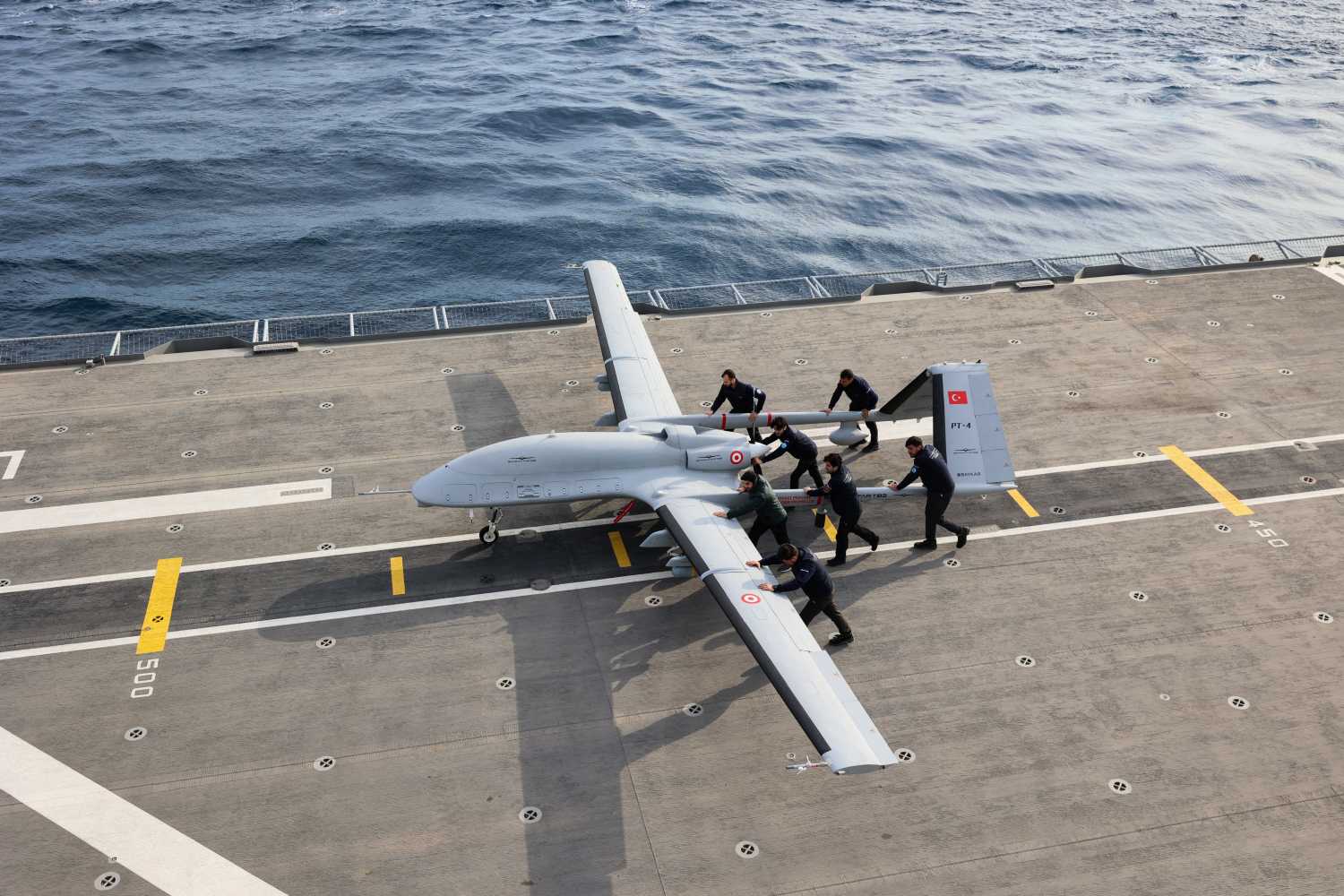
On March 25, 2026, Italian navy Chief of Staff Admiral Giuseppe Berutti Bergotto announced that the Italian navy intends to deploy the Bayraktar TB3 unmanned aerial vehicle from the aircraft carrier Cavour. The statement was technical, almost routine. Yet it captured something larger than a procurement decision: a major European NATO power is preparing to operate a Turkish-designed unmanned aircraft from one of its most important naval platforms.
The expected TB3 acquisition is tied to LBA Systems, the 50-50 joint venture between Leonardo and Baykar formalized in 2025. Through this framework, the Turkish platform is expected to move through an Italian and European industrial ecosystem that includes production, integration, certification, mission systems, and support. Baykar is no longer only an external supplier to Europe’s defense market. It is becoming a partner of one of Europe’s largest defense companies.
This development raises a broader policy question. NATO remains the primary framework through which Turkey’s role as an ally and military actor is addressed. But when Turkish platforms enter European supply chains, procurement systems, certification processes, and export regimes, the issue also becomes relevant for the European Union (EU). Brussels still lacks a coherent political or institutional framework for managing Turkey’s growing role in Europe’s defense-industrial base.
Turkey is becoming functionally embedded in parts of Europe’s defense-industrial base while remaining outside the EU’s emerging defense architecture.
Italy is the most advanced example of a broader trend. Several European NATO allies increasingly see Turkish defense companies as useful partners in unmanned systems, naval drones, trainer aircraft, manned-unmanned teaming, electronic warfare, and battlefield autonomy. Yet this cooperation is moving through bilateral deals, corporate partnerships, and ad hoc procurement arrangements rather than through a structured Euro-Atlantic framework. Turkey is becoming functionally embedded in parts of Europe’s defense-industrial base while remaining outside the EU’s emerging defense architecture.
This is the dilemma Europe faces as NATO prepares to meet in Ankara in July 2026. Turkey’s role inside the alliance is often discussed through the language of difficulty: democratic backsliding, sanctions compliance, relations with Russia, disputes with Greece and Cyprus, and Ankara’s autonomous foreign policy. These issues are real and cannot be ignored. But European rearmament, doubts about long-term U.S. security commitments, and the centrality of unmanned systems are pushing European actors toward a more pragmatic engagement with Turkey’s defense industry. The result is not strategic convergence. It is strategic pragmatism, shaped by urgency, capability gaps, and industrial need.
Italy as the test case
Italy matters because it is not simply buying a Turkish system. When Poland, Albania, and Romania acquired Bayraktar TB2 drones, they largely bought them off the shelf. Italy is doing something different. Through LBA Systems, Leonardo and Baykar are building a joint industrial vehicle that can adapt Turkish unmanned platforms to European requirements, certification standards, and market conditions. The TB3 case is therefore not only about the Italian navy acquiring a new drone. It is about integrating a Turkish platform into a European defense-industrial structure.
That distinction matters. Industrially, it links Leonardo’s engineering, certification, mission systems, and European market access to Baykar’s drone portfolio. Politically, it makes it harder to reduce the relationship to a single contract. A future Italian government could review a purchase, but it would inherit an industrial partnership involving one of Italy’s strategic defense firms. The cooperation is becoming embedded not only in military planning, but also in industrial policy.
The TB3 also answers an operational need that European militaries can no longer treat as secondary. The war in Ukraine has shown the value of unmanned systems for surveillance, strike, maritime awareness, and saturation tactics. At sea, long-range precision strike, anti-ship missiles, drones, and loitering munitions have changed the risk calculus around concentrated naval power. Smaller carriers paired with capable unmanned systems offer a more distributed and scalable model of airpower. For Italy, the Cavour-TB3 combination could provide additional reach and persistence without relying only on high-cost crewed platforms.
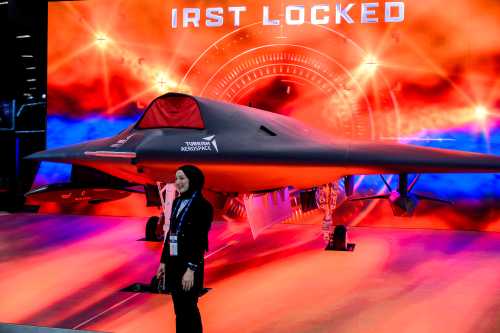
The Italian-Turkish relationship also extends beyond the maritime domain. Leonardo is planning a mid-2026 demonstration in which an M-346 light combat aircraft will control two Baykar-built Kızılelma unmanned combat aircraft. If successful, this would offer an early European experiment in crewed-uncrewed combat aviation before sixth-generation programs fully mature. It should not be presented as a substitute for programs such as the Global Combat Air Program. But it gives Italy a way to test operational concepts that European cooperation often takes years to develop and implement.
Italy is becoming the main laboratory for testing whether Turkish defense-industrial capacity can be integrated into Europe without first resolving the broader political contradictions of EU-Turkey relations.
Rome is well placed for this role. Italy and Turkey share overlapping interests in the Mediterranean, including Libya, energy corridors, migration, and maritime security. Unlike Germany, Italy is less constrained by Turkish diaspora politics. Unlike Greece and Cyprus, Italy does not view Turkey mainly through direct territorial disputes. Its defense-industrial sector, led by companies such as Leonardo, Fincantieri, and Iveco, has also shown an interest in flexible partnerships that can expand markets and accelerate capability development. Italy is therefore becoming the main laboratory for testing whether Turkish defense-industrial capacity can be integrated into Europe without first resolving the broader political contradictions of EU-Turkey relations.
A broader European pattern
The Italian case is the most institutionalized, but it is not isolated. Spain’s cooperation with Turkey on the Hürjet advanced trainer aircraft points in a similar direction. Here too, Turkish defense firms are entering a European capability-development pathway through a national partnership rather than through an EU-wide framework.
Poland offers another version of the same trend. Warsaw was one of the first NATO members to acquire the Bayraktar TB2 unmanned combat vehicle, and its engagement with Turkish firms in electronic warfare and counter-drone systems reflects a wider eastern flank interest in Turkish capabilities. Romania has deepened cooperation with Turkish defense companies in naval and armored vehicle programs. Portugal has acquired Turkish naval platforms. The United Kingdom remains relevant through the Eurofighter Typhoon discussions with Turkey and its broader interest in maintaining defense-industrial ties with Ankara.
These cases should not be overstated. With the partial exception of the Baykar-Leonardo partnership in Italy, they are not mega-projects comparable to a fighter-aircraft consortium. Their significance lies in the fact that Turkey is entering specific capability niches that European militaries increasingly need, especially in unmanned systems, naval support, electronic warfare, and cost-effective production.
The pattern has also reached France. The May 2026 strategic partnership between Safran Electronics & Defense and Baykar is significant precisely because French-Turkish relations have often been politically difficult, especially in the Eastern Mediterranean, Libya, and the wider Middle East. Yet cooperation on optronic sensors, navigation systems, guided munitions, and the integration of Safran’s Euroflir systems into Baykar platforms shows that the emerging relationship is not simply about Europe buying Turkish drones. Turkish platforms can also become carriers for European sensors, electronics, and weapons systems, while European firms gain access to platforms that are cheaper, exportable, and already tested in demanding operational environments.
Germany and Sweden illustrate the same adjustment from another angle. Both had maintained restrictive arms-export postures toward Turkey after the tensions of the late 2010s. Yet over the years, Germany has increased its military exports to Ankara, while Sweden lifted its arms embargo as part of its NATO accession process in 2022. These shifts are not a political reset. They show that European governments are adapting, unevenly and cautiously, to Turkey’s role as a NATO defense-industrial actor.
Ukraine occupies a particular place in this network. Baykar’s TB2 became iconic in the early phase of the war against Russia, and the company has been developing a production facility in Ukraine. This combines Turkish drone manufacturing with Ukrainian operational learning from years of high-intensity drone warfare. It also shows how quickly cooperation with Turkish industry can move when political conditions allow.
Turkey is becoming a form of defense near-shoring for Europe: close enough to strengthen supply-chain resilience, but politically distant enough to keep raising questions of trust and control.
Taken together, these cases point to the emergence of a Euro-Turkish defense-industrial space. It is not an EU-led framework or a formal alliance inside the alliance. Instead, it is a network of partnerships, coproduction arrangements, procurement contracts, technology transfers, and platform-specific deals. Its logic is pragmatic. European states need capabilities quickly, and Turkish companies can offer cost-effective systems, near-shore production potential, battlefield experience, and increasing openness to coproduction. In this sense, Turkey is becoming a form of defense near-shoring for Europe: close enough to strengthen supply-chain resilience, but politically distant enough to keep raising questions of trust and control.
This is why the pattern is more interesting than a new procurement cycle. Turkey is entering Europe’s defense ecosystem less through political Europe than through industrial Europe: factories, prime contractors, certification processes, joint ventures, and supply chains. Its search for strategic autonomy intersects with Europe’s own attempt to build autonomy through coordination, joint procurement, and industrial consolidation. The two projects are not the same, but they now overlap in practice because industrial capacity has become a strategic asset.
Why Brussels cannot catch up
The EU’s Security Action for Europe (SAFE) financial instrument exposes the contradiction. SAFE is designed to support large-scale investment in the European defense technological and industrial base. It reflects the EU’s effort to increase common procurement, close capability gaps, support Ukraine, and reduce excessive dependence on external suppliers. In principle, SAFE does not entirely exclude third-country participation. Non-EU components can be included within limits, and deeper participation may be possible for countries that conclude specific security and defense partnerships with the EU.
In practice, Turkey remains outside the privileged partnership track. It is not formally barred from every SAFE-relevant supply chain, especially if Turkish components enter through European prime contractors or joint ventures. But it lacks the political agreement that would allow structured participation in the EU’s emerging defense-industrial architecture. Greece and Cyprus remain major obstacles. Concerns over Turkey’s foreign policy alignment, sanctions compliance, export controls, rule of law, and domestic political trajectory reinforce the hesitation.
The risk is not only that Brussels excludes Turkey. It is also that member states integrate Turkey unevenly and then discover that Europe’s defense-industrial base has become more connected to Turkey than its political institutions are prepared to manage.
This creates an unusual asymmetry. Turkish companies may enter European defense supply chains indirectly through Leonardo, Safran, or other European partners, while Turkey as a political actor remains largely outside the EU’s defense architecture. Bilateral and corporate channels move faster than Brussels because they solve immediate problems. The risk is not only that Brussels excludes Turkey. It is also that member states integrate Turkey unevenly, without common rules, and then discover that Europe’s defense-industrial base has become more connected to Turkey than its political institutions are prepared to manage.
There are advantages to this model. It allows willing states to move quickly, avoids paralysis at the EU level, and creates room for experimentation in fast-moving sectors such as drones, counter-drone systems, autonomous platforms, and manned-unmanned teaming. It can also build trust from below through concrete projects rather than abstract declarations. But the risks are equally clear. Without shared rules, Europe may produce overlapping partnerships, fragmented supply chains, and competing approaches to certification, technology transfer, procurement standards, data security, export controls, and intellectual property. Fragmented bilateralism could end up reproducing some of the inefficiencies that EU defense initiatives are meant to overcome.
The problem, therefore, is not only whether Turkey should be included or excluded. It is whether Europe can design selective mechanisms that reflect both Turkey’s defense-industrial relevance and the political constraints that continue to shape the relationship. Ignoring Turkey is no longer realistic. Unconditional integration is not politically credible.
Beyond ad hoc pragmatism
The relevant question is no longer whether Europe will engage Turkey on defense. That decision is already being made platform by platform, site by site, and joint venture by joint venture. The real question is whether this engagement can move beyond ad hoc strategic pragmatism and become part of a more predictable Euro-Atlantic framework.
Italy shows what is possible. The Leonardo-Baykar partnership demonstrates that Turkish and European firms can build serious industrial cooperation when there is technological complementarity, commercial logic, and political will. The TB3 case shows that Turkish platforms can be adapted to European operational needs. The M-346 Kızılelma concept points toward cooperation in future air combat, not only in today’s drone market.
But Italy also shows the limits of the current model. If this pattern remains purely bilateral, it may deepen Turkey’s functional role in Europe’s defense ecosystem without producing a common European policy toward Turkey. That would leave unresolved the hardest questions: how to manage political trust, how to protect sensitive technologies, how to align export controls, how to handle sanctions compliance, how to address Greek and Cypriot concerns, and how to prevent industrial cooperation from drifting away from strategic governance.
Europe does not need to choose between ignoring Turkey’s political problems and ignoring Turkey’s defense-industrial relevance. Both would be strategically inadequate. The more realistic challenge is to design selective, transparent, and conditional mechanisms that allow cooperation when interests converge, while reducing the risks of fragmented bilateralism.
Such mechanisms do not need to solve everything at once. A Turkey-EU defense-industrial dialogue with clearer commitments on technology transfer, end-use guarantees, and reexport rules would not require resolving the Cyprus question. A NATO-anchored framework for certification and interoperability in unmanned systems could give member states a multilateral umbrella for what is currently bilateral. These steps would not remove the deeper problem of political trust. But they would narrow the gap between functional integration and political architecture.
NATO’s Ankara summit will not resolve the wider EU-Turkey dilemma, but it will make it harder to avoid. Turkey is becoming more important to European security at the same time as Europe is trying to build a stronger defense-industrial base. Italy’s cooperation with Turkey shows the promise of this new reality. The EU’s hesitation shows what is missing.
The Cavour will probably deploy Turkish drones whether or not Europe develops a framework for understanding that decision. The question is whether the next phase of Turkey-Europe defense cooperation will be built by design or by default.
Author

Related Content

The Brookings Institution is committed to quality, independence, and impact.
We are supported by a diverse array of funders. In line with our values and policies, each Brookings publication represents the sole views of its author(s).