This paper was written for a May 28, 2026 workshop on defense and defense industrial cooperation between Turkey and its NATO allies, organized by the Turkey Project at the Center on the United States and Europe at Brookings, along with Serhat Güvenç’s “Can Turkey’s defense industry deliver strategic autonomy for Ankara?” and Riccardo Gasco’s “Turkey, Italy, and Europe’s defense-industrial future.”
The Turkish defense industry has made rapid strides over the past decade, a result of sound government policy, competitive products, and significant investment. Turkish defense primes are innovative and are investing in products to sell both internally and to the international market. But Turkey still faces problems in its defense industrial cooperation with Western allies—notably the United States. Ankara’s overarching goal today is to overcome or find workarounds for the U.S. export and import restrictions on defense products, services, and technology.
Turkey is not entirely unaccustomed to U.S. sanctions. The birth of the modern Turkish defense industry began with an embargo: Following the 1974 invasion of Cyprus, Congress—over the objection of the Ford administration—placed an embargo on defense sales to Turkey. The embargo, coupled with the Turgut Özal-era economic reforms, helped spur investment in the major domestic Turkish defense firms that now dominate the internal market. These early investments were anchored around a policy of industrial offsets, using the purchasing power of the Turkish economy to force U.S. defense primes to produce components or manufacture equipment in the country.
To this day, the policy of encouraging domestic production remains in effect; however, a second U.S. embargo has catalyzed further Turkish investment in the defense industry.
In 2019, Congress imposed a “shadow embargo” on Ankara following its incursion into northern Syria. Ankara has responded by doubling down on its efforts to create a “made in Turkey” brand and has made significant investments in key technologies to remove U.S. origin products from the Turkish supply chain. The result has been mixed, but there is notable progress. In the minds of Turkish leaders, U.S. export restrictions are to blame for the decline in its attack helicopter exports and have hindered the sale of Turkish drone maker Baykar’s TB2, the now ubiquitous drone that has carved out a dominant position in the global drone export market.
The question now is whether Turkey’s defense industry is poised to compete for European contracts, especially given the uptick in European defense spending since the Russian invasion of Ukraine. The media hype would say yes. The reality is, probably not—at least not in the near future.
Early successes and industrial constraints
Ankara has already benefited from the “Ukraine war stimulus.” Turkey is among the top players in artillery shell production and has developed an innovative process to build 155mm artillery shells. These shells are in considerable demand, in both the United States and Europe, and Turkish producers have been able to benefit from the need for rapid investments in production.
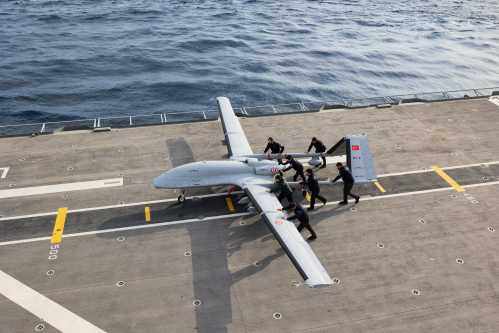
Ankara has also managed to increase its export of missiles, most certainly a result of the success of Baykar’s TB2. The company’s business model is, in many ways, premised on leveraging its position in the market to sell customers a complete weapon system, from drone to missile. It has done so by partnering with Roketsan and others and selling this product to basically any customer that wants it at competitive prices. The result, of course, is a surge in demand in both the drone and the weapon, increasing Turkish market share.
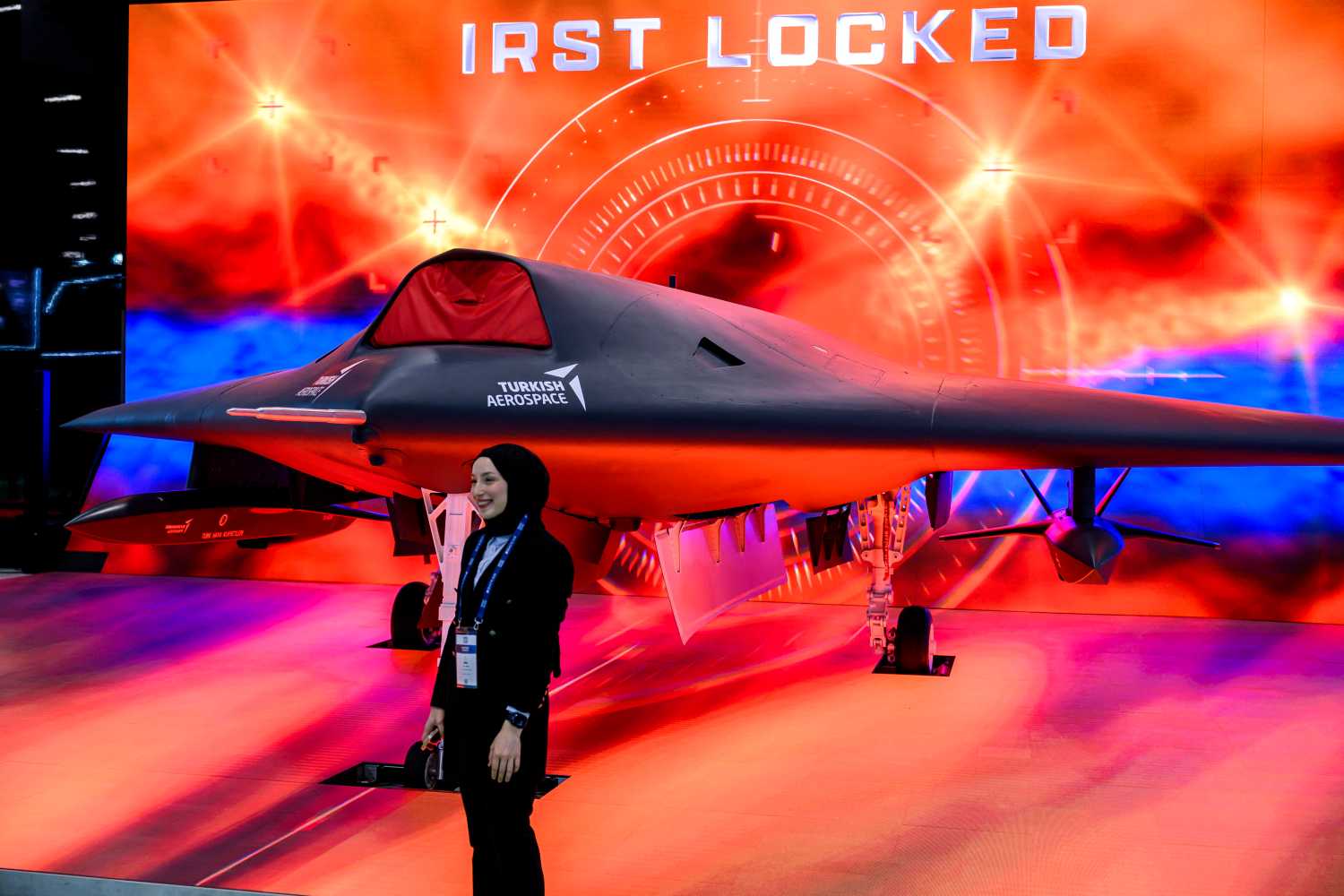
Turkish drone producers are also making serious and innovative investments in larger unmanned platforms, Baykar’s Akinci being the most mature. There are signs that Baykar and Turkish Aerospace Industries (TAI) want to compete with General Atomics and to add weapons and sensors to their larger drones to compete for market share in the anti-submarine and surface warfare markets. We will likely see Baykar and TAI offerings with more advanced radar and a different complement of weapons, both to augment Turkey’s Blue Homeland doctrine of naval dominance on its own perimeter, but also to compete for the MQ-9B/Sea Guardian market.
The issue that Turkish suppliers are now faced with is that they still have a nascent and fragile industrial base.
The issue that Turkish suppliers are now faced with, however, is that they still have a nascent and fragile industrial base. Specifically, there are bottlenecks in production, particularly around high-precision manufacturing for jet engines and other specialized components needed for advanced manufacturing—despite notable strides. The issue for Turkey will now be turning single prototypes into certified and tested machines, with a demonstrated safety record, and that can withstand the rigor of actual use.
That is a goal Ankara has not yet achieved. Turkey also has a brittle supply chain, often with state-owned or recently formed industrial suppliers that represent a single point of failure. The Turkish industrial base is prone to extreme centralization for components. This must change if Ankara wants to scale and export into a larger market. Turkey’s current production model has worked to rapidly scale prototypes, but could struggle if large orders were to come in for more advanced offerings.
A difficult European market
For this reason, Ankara may face difficulty in breaking out of its niche role in Europe, which presents a fragmented and highly bureaucratic market. For advanced aerospace, European governments often turn to production consortiums, like Airbus or the Eurofighter. That comes with advantages: larger buys, distributed and redundant suppliers, and deep expertise in critical technologies. However, the negatives are that a consortium slows down decisionmaking and comes with a bureaucratic layer that needs to be navigated.
This helps to explain why Ankara will have trouble breaking into more advanced partnerships with Europe. Outside of the saturated fighter trainer market, the inroads for Turkish suppliers into European consortia are harder to forecast. First, Turkey is not—and probably never will be—a member of the European Union. It simply is not a democratic state anymore, but an authoritarian one, with dim prospects for a return to democratic governance soon. Second, European procurement is very political, with finite resources often devoted to internal suppliers to keep legacy firms and aerospace providers producing at the required levels.
Finally, Turkish products—in many cases—have a European analogue. This is especially true in aerospace. But this is not always the case. Ankara has clear advantages in drones and small missiles and bombs, as well as 155mm artillery shells. It has also grabbed a slice of the jet trainer market, exporting the TAI Hürjet trainer with very enticing offsets for Spain. The trainer market is very saturated, with competitors from Europe, the United States, and South Korea. It will be challenging to scale Turkish exports in such a competitive market.
Hürjet and the limits of Turkey’s aerospace ambitions
The Hürjet deal is worth explaining in a bit more depth. On the Spanish side, Airbus is acting as the prime contractor and 60% of the total work is mandated to remain inside Spain. The trainers will be modified with Spanish avionics and sub-systems, along with the simulators and the maintenance. Spain/Airbus worked this arrangement out precisely because they will not rely upon Turkey for maintenance or upgrades for the platform.
Ankara is attempting to break into a very mature market dominated by two established players with a significant head start.
The benefit for Ankara is that the order injects cash into the program and, as a result, will decrease the per-unit cost for local purchase. This is also an issue worth considering. Without export markets, the cost per copy of Turkey’s planned jet fleet will remain high and, likely, not cost-competitive with European or American analogues. (This is certainly the case for TAI’s Kaan fighter jet, which is currently under development.) Another often-overlooked issue is that Ankara’s pursuit of autonomy may create a small, highly brittle Air Force whose limited production makes each aircraft hugely expensive. This is why many countries prefer to buy American, or to form a consortium, as is the case in Europe: Higher numbers of purchases leverage economies of scale for both jet production and, perhaps more importantly, spare parts production. Ankara is attempting to break into a very mature market dominated by two established players with a significant head start, and it will have to prove it can produce both jets and spare parts at scale.
Yet, even with these challenges, the vision is there: Ankara will sell the jet and the weapons and work with the buyer on offsets and local production. It can then take the injection of cash to decrease the per-unit cost and then invest in production. The Hürjet’s challenge, however, is that it lacks a demonstrated safety record. Unlike its competitors, it does not have thousands of hours behind it, putting it at a disadvantage when competing on that metric for foreign customers.
Low-tech strength, high-tech constraints
The scaling of the Turkish defense industry has been considerable. Yet, for all the flashy videos online, many of the main moneymakers over the past half-decade have been in low-tech products: 155mm artillery shells, fuses, and explosives. The TB2 drones and their associated weapons have also captured a hungry market, carving out a niche that the more expensive and export-limited MQ-9 Reaper did not. Baykar and other Turkish drone producers want to compete for market share with the MQ-9B, and the former is clearly moving in that direction. Hürjet’s introduction into the Spanish Air Force is a major test for Turkish aerospace, but it’s unclear if success will guarantee more market share for the Turkish product. It is also unclear how Ankara can scale advanced aerospace exports. Thus, I would expect Turkey to double down on drones and compete for the growing unmanned market. Ankara is a very competitive actor in this space and has a dominant market share in certain areas.
Ankara’s place in Europe’s defense market is clear: It is a competitor in most cases, producing products that directly compete with major European primes while benefitting from clear advantages. For now, however, Turkey’s defense industrial base for higher technology items is brittle, making the calls for Ankara to become a major supplier of European higher technology products more fiction than fact, at least for the near future.
Author

Related Content
The Brookings Institution is committed to quality, independence, and impact.
We are supported by a diverse array of funders. In line with our values and policies, each Brookings publication represents the sole views of its author(s).