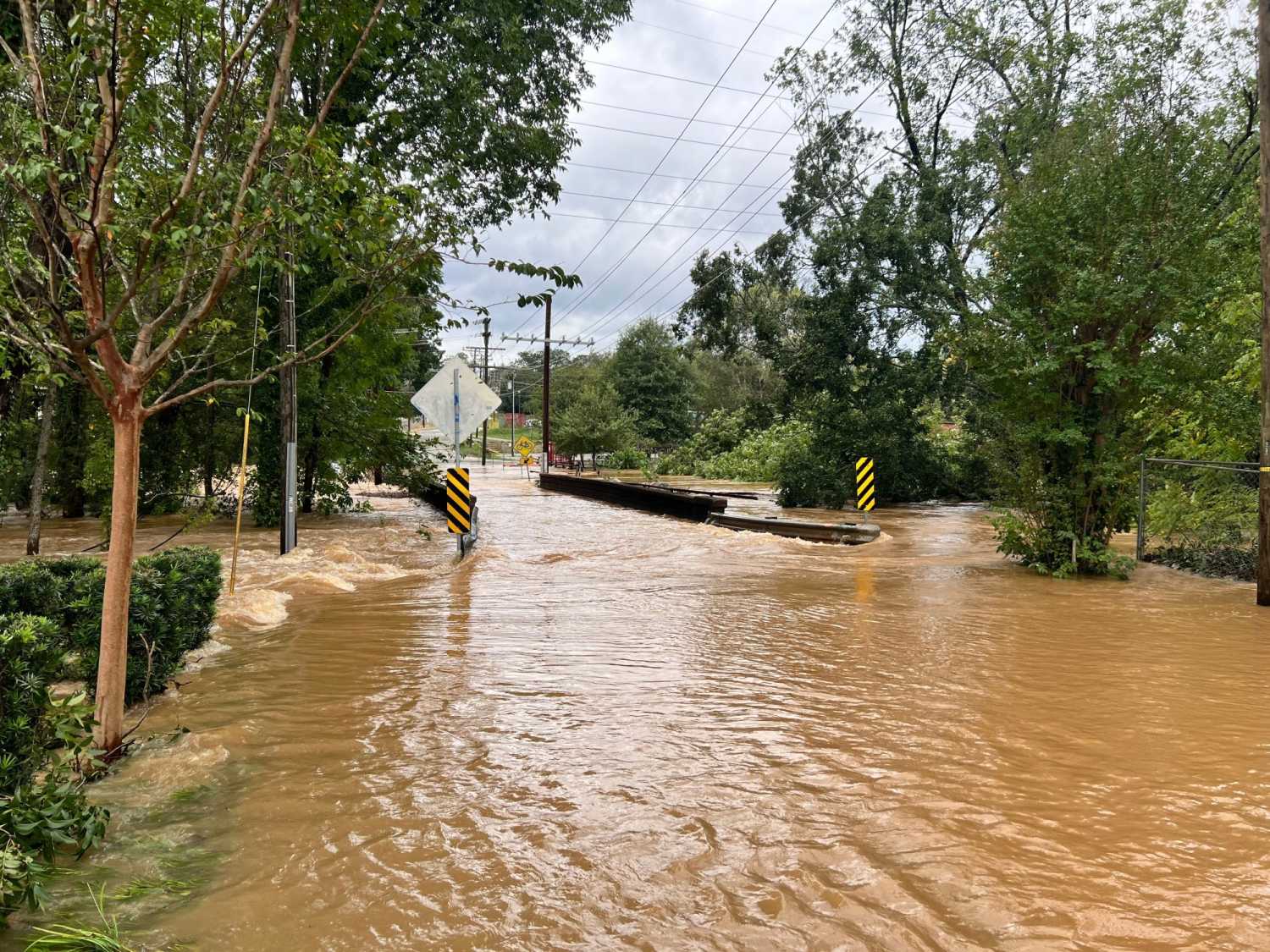
In 2024, Hurricane Helene caused nearly $60 billion in damage in a predominantly rural region of western North Carolina. The extent of that damage came close to doubling the state’s entire budget for the year. For the state’s leaders, it was quite clear that helping those rural towns achieve a full recovery would require the resources and support of the Federal Emergency Management Agency (FEMA).
This is not unusual. Over the last decade, our analysis shows that rural nonmetro counties made up 58% of counties included in FEMA disaster declarations, while being home to 14% of the U.S. population.1 In fact, between 2016 and 2025, rural counties made up almost two-thirds of counties included in major disaster declarations in the U.S.
In this era of increasing disasters, who bears the burden of recovery, and the extent to which it is effectively managed, will determine the survival and ongoing viability of rural towns that experience disasters. FEMA serves a predominantly rural constituency—yet as the Trump administration makes headlines by suggesting reforms to FEMA, and its staffing changes and seesawing policies affect the agency’s programming, rural communities struggle to benefit from the agency’s resources. This analysis highlights the characteristics of relief and recovery that are unique to rural areas, the extent to which FEMA’s resources have been supporting rural areas, and recommendations as Congress and the administration consider changes to FEMA’s role and processes.
Rural communities face unique vulnerabilities in disaster response and recovery
The National Oceanic and Atmospheric Administration (NOAA) estimates that the value of the damage from natural disasters in the United States since 1980 exceeds $2.9 trillion. Between 2020 and 2024, disaster damages averaged over $149 billion annually.2 As disasters become more frequent, severe, and costly, managing disaster response, recovery, and preparedness is a greater priority. But the burdens of these events are not shared evenly across rural and urban communities.
Nor are the experiences the same: Rural governments often face greater challenges in accessing and managing federal funding, and they experience fiscal limitations, as well as staffing and administrative capacity constraints, at higher rates than other local governments. They also encounter distinct geographic obstacles that complicate response and recovery efforts.
Taken together, the risk factors for a full recovery from a disaster are different for rural communities.
Geographic considerations: The larger geographic areas of rural communities and lower population densities, for example, translate into longer evacuation times and longer distances for emergency personnel to travel to reach affected individuals. There are rural places that rely on a single egress or ingress route; if damaged, all transit to and from the community is interrupted. Aging housing stock, substandard and poorly maintained infrastructure, and certain types of rural economies—such as agriculture, tourism, and recreation—that are particularly vulnerable to extreme weather events can heighten impacts on local rural communities and complicate response and recovery.
Demographics: Population characteristics also add to rural vulnerability to disasters. In general, rural places have a greater proportion of their population who are elderly, have disabilities, or are low-income. These populations often require specific support to withstand and recover from extreme weather events.
Capacity constraints: Managing long-term disaster recovery presents additional challenges, especially considering that rural governments have lower capacity and fewer resources than their urban counterparts. With local rural governments often stretched thin, emergency management departments can go underfunded and understaffed. Emergency management directors may also serve as the police chief or fire chief and cannot focus solely on disaster response and recovery. While emergency response services often make up a large portion of local rural budgets, disaster preparedness, pre-disaster recovery planning, and mitigation programming are often underfunded, resulting in low levels of protection and substandard organizational structures. Community groups and organizations are often relied upon to fill critical gaps in managing disaster response and recovery efforts.
Costs: Disaster recovery in rural places can be especially expensive for rural communities, as construction projects require additional costs to transport materials to more remote locations. Projects themselves may be larger and more expansive because they need to reach a wider geographical area. Additionally, FEMA reimbursement for disaster recovery resources requires specific documentation that might incur added costs, especially for those with limited administrative capacity or access to data.
Chronic displacement: All of these considerations compound perhaps one of the greatest risks to a full and resilient recovery from disasters in rural places: It takes far fewer people choosing not to return to undermine the future of a recovering rural town. Slow or inconsistent repopulation imperils key institutions—schools, hospitals, key retail such as grocery stores, and potentially even governance. The fragility of smaller population bases increases the risk of a post-disaster downward spiral in rural communities, underscoring the importance of swiftly restoring essential services to support returning residents and prevent further erosion of the local tax base, as well as civic and social infrastructure.
The role of disaster declarations in federal disaster recovery resources
Enter FEMA to help rural communities manage these vulnerabilities. As the nation’s primary disaster agency, FEMA administers a variety of federal grants and programs to help communities prepare for, respond to, recover from, and mitigate disasters.
Other federal agencies also offer key assistance, such as the Small Business Administration’s disaster loans program, the Department of Housing and Urban Development’s Community Development Block Grant Disaster Recovery (CDBG-DR) Grant funds and Community Development Block Grant Mitigation (CDBG-MIT) funds, and the Economic Development Administration’s Disaster Supplemental Grant Program. Additionally, FEMA manages a wide suite of programs that are critical to disaster recovery and resilience, including the Individual Assistance (IA) program, Hazard Mitigation Grant Program (HMGP), and Building Resilient Infrastructure and Communities (BRIC) program. For the purposes of this research, we focused on how the Public Assistance (PA) program supports disaster recovery, as it is one of the primary programs that provides funding to rural communities.
Many programs rely on an official federal disaster declaration as the activation mechanism to allow communities to access funding. A disaster declaration is a formal process that indicates a disaster’s impacts are beyond what is manageable by local and state resources.
There are three types of disaster declarations, each of which is associated with a set of recovery programs:
- Major Disaster Declaration (DR) for the most catastrophic disasters. DR declarations authorize use of the greatest number of federal disaster recovery funding programs.3
- Emergency Declaration (EM) for significant disaster events whose damages do not meet the DR threshold. EM declarations authorize specific FEMA funding programs for immediate needs.4
- Fire Management Assistance Declaration (FM) for wildfire events whose damages do not meet the EM threshold. FM declarations authorize fire recovery programs.5
Some disasters may first be declared at the EM level and later graduated to a DR level as more data regarding disaster damages are collected. This delay in declaration status can also delay access to the funding programs that require a DR-level declaration. (Additional details regarding the disaster declaration process are included as an appendix at the end of this document.)
Achieving a disaster declaration may be particularly difficult for rural communities. The local town, city, or county is responsible for conducting an initial damage assessment to quantify the physical and economic losses; states verify those losses as the governor sends forward a request for the declaration. Although state and federal resources may support this damage assessment process, it is still resource-intensive for local governments. Rural governments may have financial or human capital limitations that restrict their ability to develop and submit a request that meets the requirements in a timely manner.
Damages are also based on the estimated pre-disaster value of assets, an oft-criticized feature of FEMA’s process. The implications are significant for rural communities; since they have sparser or lesser-valued physical assets, their damage assessment may not adequately capture the full impact of the disaster. Basing thresholds and funding solely on the valuation of preexisting assets without considering preexisting vulnerabilities can disadvantage rural places—and even prevent affected rural counties from being included in a declaration.
Rural communities are heavily represented in disaster declarations and FEMA funding
FEMA disaster declarations between 2016 and 2025 show that rural communities account for a substantial share of affected counties, underscoring the extent to which FEMA is predominantly serving rural places. Nearly 1,700 rural counties, or 86% of all rural counties in the U.S., were designated for assistance under a disaster declaration in the past decade.6
On average, rural regions accounted for more county-level designations under disaster declarations annually than metro counties and represent a meaningful contingent of FEMA’s programming beneficiaries, as shown in the figure below. Between 2016 and 2025, rural counties home to nearly 42 million people were included in disaster declarations.7
Between 2016 and 2025, rural counties accounted for more than 58% of all county-level designations associated with disaster declarations. When disaggregating the different types of declarations, rural counties represented 63% of county-level designations under major disaster declarations, 51% under emergency declarations, and nearly 44% under fire management assistance declarations, as shown in the figure below.
Rural counties account for nearly two-thirds of the counties designated under major disaster declarations, the category reserved for the most severe disaster events. Rural communities thus make up a disproportionate share of the local jurisdictions affected by major disasters that were approved for FEMA assistance.
The Public Assistance program is one of the primary funding sources approved by DR and EM declarations. The PA Program offers operational support and funding to governments and private nonprofits for community-level efforts to perform response and recovery activities, including debris removal, roadway and utility repairs, and other public infrastructure restoration.
Between 2016 and 2025, the PA program allocated over $48 billion overall to support disaster response and recovery efforts (excluding U.S. territories). FEMA obligated over $7 billion in PA grants directly to rural counties, as visualized in the map below.8
This does not encompass the full breadth of PA funds supporting rural communities, as it only visualizes funds directly granted to and managed by rural county governments. Nearly $20 billion in funds has been allocated to states, which may then allocate some portion of that funding to support recovery in rural areas. For example, PA funding received by a state may be used to repair a state-owned roadway or other infrastructure that can benefit a rural community in its disaster recovery. Those funds would not be captured in the map above as the funds are managed by state agencies rather than local county government.
Rural challenges in managing recovery resources
Even after being included in a declaration, rural communities are often challenged to use and access resources. As noted previously, agencies other than FEMA offer disaster-related funding assistance to communities and individuals through various programs.9 Navigating the complex web of programs often presents a barrier for rural communities seeking to rebuild, given limited staffing and experience with the complexity of this landscape. Agencies often use separate activation mechanisms and eligibility frameworks for their programs, increasing the administrative burden and complexity of the requirements for rural communities to access recovery funding.
Federal funds do not bear the whole cost for these disaster recovery expenses—the applicant must share a portion of the cost with FEMA to qualify for assistance. This federal match requirement can burden disadvantaged rural communities that cannot afford the required contributions. Many rural jurisdictions do not have the tax base, existing financial resources, or access to philanthropic funding to cover a match requirement.
In addition, FEMA typically works on a reimbursement basis with local governments through their PA program. This means that rural jurisdictions must complete and pay for the work, then wait on FEMA’s reimbursement to recover their costs. This comes with its own requirements and can be delayed by internal processes—like former Secretary Noem’s decision to personally review Public Assistance grants over $100,000—or even lack of administrative capacity at FEMA, which might be exacerbated by recent staffing cuts. Maintaining sufficient cash flow can be an enormous burden for rural communities faced with these policies.
Another common requirement from other programs is that applicants must have an active FEMA-approved Hazard Mitigation Plan and projects must meet FEMA’s “cost-effective” and “feasible” requirements. Demonstrating that a project is both cost-effective and feasible can require intensive monetary resources and technical knowledge that creates a barrier for rural communities, although FEMA has made some efforts to ease the process with streamlined tools or waivers for smaller projects.
Recommended changes to improve FEMA’s effectiveness in rural areas
The scope and depth of FEMA’s involvement in rural America’s disaster response and recovery process make it a critical federal agency for rural development. In the last 10 years, nearly 1,700 rural counties—or 86% of all rural counties in the U.S.—have been affected severely enough by a disaster to be included in a disaster declaration. This role reinforces the importance of the agency’s continued existence, while highlighting room for reform efforts to improve its efficiency and effectiveness.
The following considerations must remain at the forefront to meaningfully ensure sensitivity to rural realities:
- Ensure new policies and their implementation improve—and do not worsen—the rural communities’ ability to respond to and recover from disasters. Any major reforms should be rigorously analyzed to assess the potential impact on rural communities, both during the acute phase of an emergency and throughout the recovery process. FEMA would benefit from engaging rural governments, along with the rural community organizations, local businesses, regional coalitions, and other community stakeholders that often play a large role in rural disaster recovery, to ground-truth proposed changes. FEMA should also examine whether Public Assistance rules and processes are workable for eligible rural-serving private nonprofit organizations, many of which operate essential community facilities that are important to local response and recovery. More broadly, FEMA could more effectively rely upon community organizations, nonprofit partners, and state emergency management agencies to expand rural capacity by helping manage some of the technical requirements of funding programs, better positioning these groups to complement the disaster assistance of local and state governments.
- Update the disaster declaration process to better account for rural assets. Rural communities may be disadvantaged in the damage assessment process because their less dense development and lower-valued physical assets can produce lower damage estimates. Yet lesser-valued assets do not necessarily translate into lower costs for recovery, given distance, limitations on available services and expertise, and other cost factors. In addition, in rural places, damage to a single essential facility or infrastructure asset can create severe community-wide consequences, even when the asset itself is not highly valued in monetary terms. The disaster declaration process should be modified to ensure that the impacts of disasters on rural communities are appropriately calculated and accounted for by more fully considering the functional importance of damaged assets, the consequences of service disruptions, and the added recovery costs created by remoteness and limited local capacity.
- Adjust cost-share and reimbursement systems to better reflect rural fiscal and administrative capacity. Cost-sharing and reimbursement-based aid systems are documented barriers for rural places and may inhibit communities from taking advantage of the full extent of resources available to them. Rural communities often lack the cash flow, staffing capacity, and tax base to front recovery costs while waiting months or years for federal repayment. Previous changes to improve the Individual Assistance program and the prioritization of economically disadvantaged rural communities (EDRCs) are great examples of how program rules can be adapted to better reflect local capacity. Additional changes to cost-share requirements, including waivers or sliding-scale adjustments tied to fiscal and administrative capacity, will also enable rural communities to use resources available to them.
- Provide additional technical assistance for rural-specific recovery needs. Although rural communities make up a major portion of FEMA’s program constituents, rural communities have fewer resources to help displaced residents than their urban counterparts. FEMA currently offers wide-ranging technical assistance for grants management, but not project implementation. The former Building Resilient Infrastructure and Communities Direct Technical Assistance program uniquely offered project design assistance to local communities.10 Similar technical assistance for other disaster funding programs should be put in place to assist in designing rural-specific recovery projects. Similarly, state emergency management agencies can coordinate their technical assistance resources so that they are explicitly designed to match the needs of rural communities.
- Streamline grants and reporting requirements and improve the efficiency of management processes. Navigating the landscape of post-disaster funding resources, the array of different funding timelines and application requirements, and then keeping up with the individualized grant management processes is complex and difficult for rural places to manage.11 FEMA has significant space to reduce duplicative applications and submissions of similar information, standardize core data requirements, and ensure that the data being collected are absolutely necessary. If reimbursement-based systems are to remain, significantly improving the efficiency and time lapse of application review, obligation, and reimbursement would strengthen the ability of rural communities to maximize the public benefit of these investments.
- Get staffing levels right to ensure rural communities can effectively access and take advantage of the support FEMA makes available. The sudden changes and back-and-forth regarding FEMA’s staffing have caused confusion and are especially difficult for rural communities to navigate, given the limits on their administrative capacity. In 2023, a GAO analysis found significant staffing gaps remained in FEMA’s workforce; the agency subsequently experienced staffing reductions at the beginning of the Trump administration, with Secretary Mullin now reportedly hiring back previous staff. Staffing levels must be adequate, and any changes must be aligned with changes to operational processes, to ensure the agency can continue to process requests, administer programs, and provide timely support to rural communities as they undertake disaster response and recovery. Efforts to improve efficiency should not reduce staffing to the point of weakening FEMA’s ability to deliver assistance effectively: Being able to engage rural communities directly and build consistent, trusted, personal relationships is critical to creating an effective partnership in less densely populated and more remote areas.
- Increase research and data transparency related to rural participation in FEMA programs. Data related to the impact of disasters on rural communities are difficult to identify and analyze. Understanding the intersections of programs and rural places will help contextualize how FEMA is serving these communities and where more help is needed in the long path toward recovery.
Rural places rely on FEMA for operational support, technical assistance, and—most importantly—funding, since emergency response, effective recovery, and disaster preparedness often significantly outstrip the financial ability of local rural governments. That makes FEMA an indispensable agency for rural vitality, showcasing the importance of its continued existence. Yet there is widespread agreement that reforms are necessary to improve FEMA’s effectiveness. What’s important is that any reform agenda improves FEMA’s ability to serve and support the rural communities that make up such a large part of its current service constituency.
APPENDIX I: The disaster declaration process
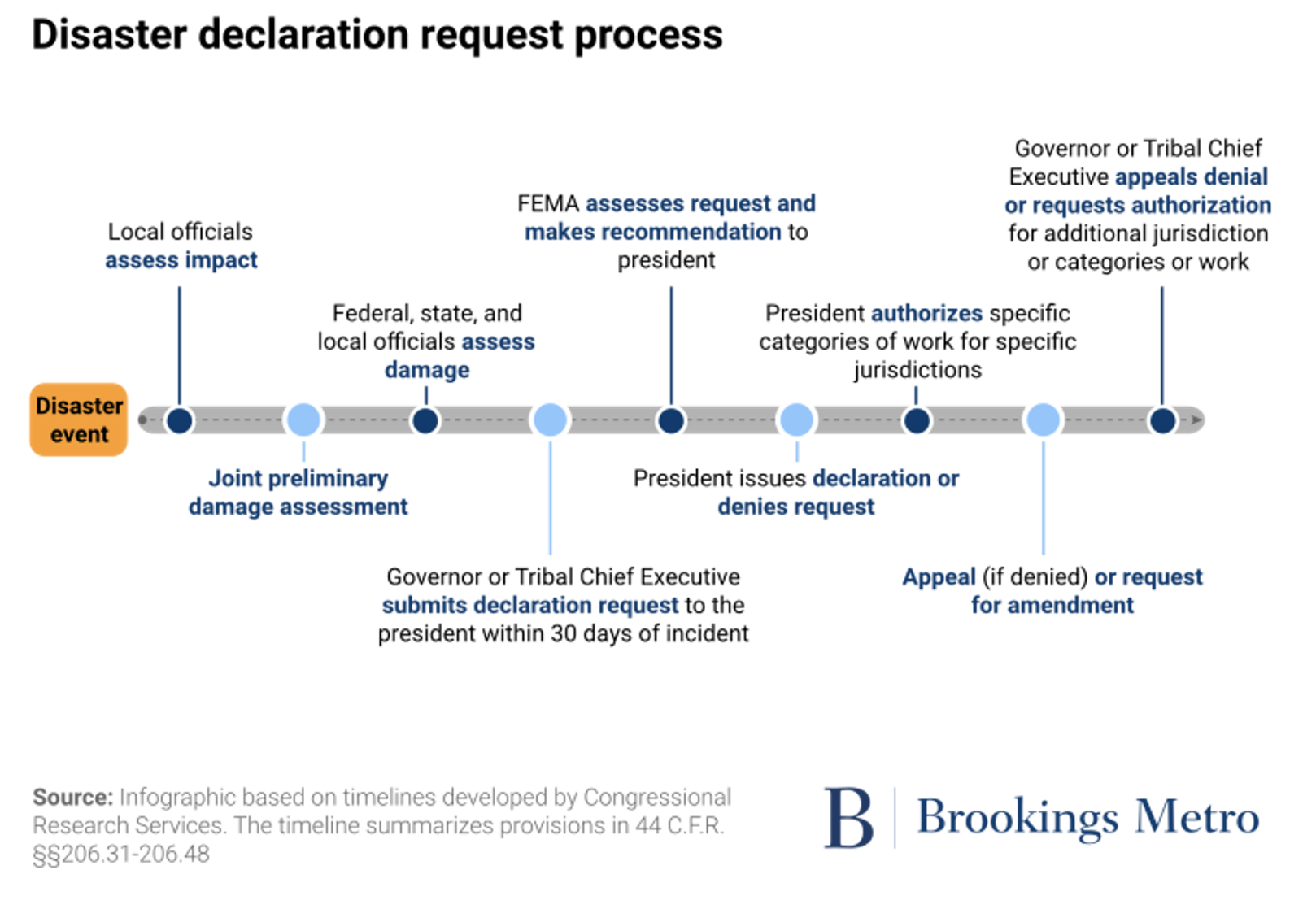
The disaster declaration process typically begins following a natural disaster event. The local town, city, or county will activate a local declaration of emergency and conduct an initial damage assessment to quantify the physical losses (e.g., household damages, infrastructure damages) and economic losses (e.g., employment impacts, anticipated tourism losses) of the disaster.
Then, state and federal resources conduct a preliminary damage assessment (PDA) with local communities to verify the losses. The governor submits a request for a disaster declaration, with the results of the PDA, to their FEMA Region. The FEMA Region and FEMA Headquarters review the request and consider six key declaration eligibility criteria: cost of assistance, insurance coverage, other federal agency programs available, local impacts, hazard mitigation needs, and compounding factors of other recent disasters. FEMA then makes a recommendation regarding the disaster declaration status to the president, who may make a federal disaster declaration to approve various systems of funding and assistance.
The figure below visualizes the disaster declaration process.
 Note that the disaster declaration process for federally recognized tribal governments has an important distinction: Tribes can choose to apply for disaster declarations as part of a state declaration or as an independent entity directly to the FEMA Regional Administrator, as authorized by the Sandy Recovery Improvement Act. Disaster declarations and PA funding for tribal nations were not included in our analysis because their jurisdictional structures and disaster assistance processes are not directly comparable to county-level records.
APPENDIX II: Research methodology
The disaster declaration and Public Assistance funding data used in this analysis come from FEMA’s OpenFEMA datasets, specifically “Disaster Declarations Summaries” and “Public Assistance Funded Projects Summaries.” Both datasets were filtered by declaration date to include records from calendar years 2016 through 2025. This means that disasters that occurred in 2015 but were declared in 2016 are included in the dataset, and similarly, disasters that occurred in 2025 but were declared in 2026 are excluded. The declaration date was used because it was the common date field available across both datasets. The analysis was limited to records from the 50 states and Washington, D.C.; U.S. territories and tribal governments were excluded because their jurisdictional structures and disaster assistance processes are not directly comparable to county-level records in the states and Washington, D.C. Declarations with an incident type of “Biological” were also removed, as that category exclusively applied to COVID-19-related declarations during the period analyzed.
For the disaster declaration analysis, the unit of analysis is a county-level designation under a presidential disaster declaration. Counties do not independently apply for or receive presidential disaster declarations. Rather, a governor requests a declaration through FEMA, identifies the affected areas and types of assistance being sought, and FEMA makes a recommendation to the president based on its review. Counties qualify for FEMA assistance by being included among the areas designated under a presidential declaration. Records without county-specific designations—including declarations for townships, cities, school districts, or other non-county jurisdictions—were not included in the county-level totals.
Each county was assigned a metropolitan or nonmetropolitan designation using the Office of Management and Budget’s 2023 county delineations. Counties in metropolitan statistical areas were classified as metro, while nonmetropolitan counties, including micropolitan counties and counties outside core-based statistical areas, were classified as rural.
For disaster declarations, county-level designations were grouped by declaration type, year, and rural or metro status. The analysis includes three FEMA declaration types: major disaster declarations, emergency declarations, and fire management assistance declarations. Figures reporting total county-level designations count each county-declaration pairing, so the same county may appear more than once if it was included in multiple declarations during the decade. The figure of nearly 1,700 rural counties refers to unique rural counties that had at least one non-COVID county-level disaster declaration between 2016 and 2025.
For Public Assistance funding, the analysis uses the “Number of Projects” and “Federal Obligated Amount” fields from FEMA’s Public Assistance Funded Projects Summaries dataset. Public Assistance obligations were grouped by county and assigned the same rural or metro designation used in the disaster declaration analysis. The analysis also separately identifies Public Assistance obligations made directly to states, which may support recovery in rural communities but are not attributed to rural counties in the county-level funding totals.12
Authors

-
Acknowledgements and disclosures
The authors wish to thank and acknowledge the research and visualization contributions provided by Adam Aley.
-
Footnotes
- Counties do not independently apply for or receive presidential disaster declarations. Rather, a governor requests a declaration through FEMA, identifying the affected areas and assistance sought, and FEMA makes a recommendation to the president based in its review. Counties thus qualify for FEMA assistance by being included in the areas designated under a presidential declaration.
- NOAA’s estimates “do not take into account losses to: natural capital or environmental degradation; mental or physical healthcare related costs, the value of a statistical life (VSL); or supply chain, contingent business interruption costs.” NOAA NCEI (2023). See: https://www.ncei.noaa.gov/access/billions/.
- DR declarations authorize all Public Assistance programs (Categories A – G), all Individual Assistance programs, and the Hazard Mitigation Grant Program.
- EM declarations authorize Public Assistance Emergency Work programs (Categories A – B), and the Individual Assistance: Individual and Households Program.
-
FM declarations authorize the Fire Management Assistance Grants program.
- This does not include disaster declarations from the COVID-19 pandemic or disaster declarations for U.S. territories.
- Population estimate based on 2020 Census data.
- It should be noted that U.S. territories are not included in this analysis because it is structured around county-level designations and funding patterns, which are not directly comparable to territorial jurisdictions. At the same time, the territories receive substantial PA funding and disaster declarations. Between 2016 and 2025, the U.S. territories of American Samoa, Guam, the Northern Mariana Islands, Puerto Rico, and the U.S. Virgin Islands accounted for 916 designations under disaster declarations, 92% of which were in Puerto Rico, and received nearly $60 billion in PA funding, of which 62.6% went to Puerto Rico and 36.8% to the U.S. Virgin Islands. These figures do not include COVID-19-related emergencies.
- Federal disaster relief programs outside of FEMA include but are not limited to those managed by the Economic Development Administration (e.g., Disaster Supplemental Funding), Department of Housing and Urban Development (e.g., Community Development Block Grant – Disaster Recovery), the Department of Agriculture (e.g., Disaster – Supplemental Nutrition Assistance Program, Rural Disaster Home Repair Grants), and the Small Business Administration (e.g., Disaster Physical Damage Loan, Economic Injury Disaster Loans).
- FEMA announced in April 2025 that it was ending the broader BRIC program, but federal court orders in late 2025 and early 2026 required the agency to reverse that action and resume implementation. FEMA has since issued a combined FY2024/FY2025 funding notice and appears to be restoring the program, however, now without non-financial direct technical assistance provisions.
- https://www.brookings.edu/articles/federal-disaster-management-is-a-confusing-patchwork-reforming-fema-and-improving-interagency-coordination-can-fix-it/.
- PA funding is distributed to recipients over a long period of time. This analysis provides a point-in-time snapshot of funds that have been dispersed to communities for disasters that were declared in 2016-2025. This does not include funds for disasters that were declared before 2016, but are continuing to disperse funds in the time period, nor does it describe the full amount of funding that a community may receive for a disaster that was declared from 2016-2025.
The Brookings Institution is committed to quality, independence, and impact.
We are supported by a diverse array of funders. In line with our values and policies, each Brookings publication represents the sole views of its author(s).