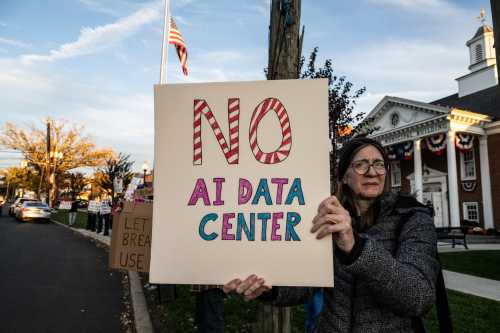
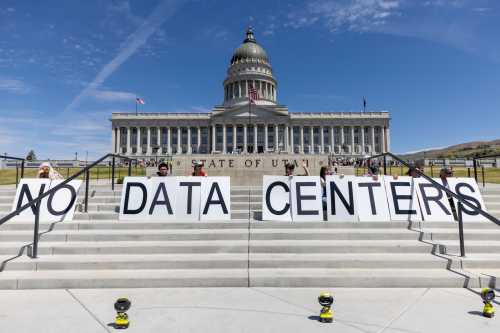
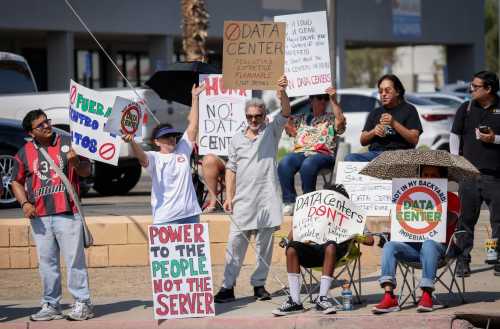
Bipartisan public concern about artificial intelligence (AI) data centers has reached the point where the new Congress must be prepared to act when they take office in January. As Rep. Greg Casar (D-Texas), chair of the Congressional Progressive Caucus, noted, the revolt against data centers was “one of the top issues of the 2026 election,” which saw Democrats take control of both the House and the Senate. This political backlash is driven by concerns over electricity rate increases, water, noise, and air pollution that have stalled some projects.
In many respects, the backlash over data centers is also a proxy for larger concerns about AI. Many now regard AI as an intrinsically dangerous technology, with recent incidents of autonomous hacking and the clear potential to allow hackers to identify software vulnerabilities and turbocharge assaults on critical infrastructure. Experts are also concerned that AI can enable terrorists to build bioweapons and spin out of human control to cause unintended but catastrophic death and destruction. Even if it can be managed safely, it’s still unclear if it will create large-scale technological unemployment, drive down wages, permanently reduce the demand for human labor, and allow a small technological elite to flourish. Even the pope seems concerned that AI is not a gift to solve the problems facing humanity but an exacerbator of division and inequality.
Policymakers in the new Congress need multiple responses to the many challenges posed by AI data centers and larger concerns about the technology itself. But one essential element of a comprehensive response to public concern involves ensuring that residential and small business customers do not foot the bill for energy infrastructure expansions driven by massive AI data centers.
As discussed in a recent post for Tech Policy Press, a key fact policymakers need to consider is that current shortages of compute capacity are likely temporary. As investors and speculators flock to the market for AI data centers, more of them will be built than will be needed to satisfy future AI compute demand. The industry is in the throes of a familiar bubble, where more investment flows to meet the demands of a new technology than can be supported by customer demand. This has happened before with railroads and internet communications facilities and is happening again now with AI data centers.
Policymakers must design ratepayer protection policies around this future. If many of the planned data centers will ultimately become obsolete, the electricity infrastructure built to serve them will be stranded.
Electricity ratepayer protection is feasible
As we argued in an earlier commentary for Brookings, policymakers largely know how to protect residential and small business electricity ratepayers from paying the costs of AI data centers. The policy has two parts: One is making sure that they do not pay for the costs of infrastructure built to service AI data centers, and the other is to ensure they do not foot the bill for stranded investment when AI data centers need less power than constructed to meet their needs.
Proper cost allocation for generation, transmission, and distribution facilities can identify those investments made to serve AI data centers, and an equitable and efficient rate structure can require data centers to pay these costs. Residential and small business customers will not have to pay these data center costs if this rate-design job is done properly.
The responsibility for designing these cost-allocation studies and developing rate structures that protect ordinary electric utilities rests largely with state regulators. Many of them have stepped up to the plate with adequate payer-protection programs. Regulators at the Federal Energy Regulatory Commission (FERC) can encourage this process, but under current law they cannot mandate these measures.
Stranded investment poses a different set of issues. Here, the ratepayer protections involve long-term contracts with obligations to pay even if data centers want less energy in the future. Some combination of upfront payments from the data centers to the utilities and a requirement by regulators or the utility that guarantees payment by its customers will be needed to guard against the risk that the data center developers will not be able to pay in the future because they have gone out of business.
The measures just described are matters of consensus that the AI industry itself has signed off on as part of the administration’s ratepayer protection pledge. But voluntary agreements are just hopes without effective implementation and enforcement.
The current Congress is already engaged on ratepayer protection issues
In early September, the House passed the Ratepayer Protection Act of 2026 on a lopsided bipartisan vote of 417–3, but the Senate rejected it on the grounds that it was “optional” since it only required state regulators to “consider” ratepayer protections.
But the Bipartisan American Affordability and Jobs Act of 2026, a bill designed to streamline the permitting process for new energy projects, appears to contain mandatory ratepayer protections. Section 2107 of the bill instructs FERC to require public utilities to charge AI data center customers “the embedded cost and the incremental cost of transmission service.” It further provides that no portion of the incremental cost of facilities serving AI data centers “may be allocated to, or recovered in the rates of, any customer other than” an AI data center. And to deal with the stranded investment issue, it provides that cost recovery from AI data centers “shall continue” notwithstanding an AI data center’s cessation of the purchase of power. Unlike current law and the Ratepayer Protection Act, these measures give the force of federal law to ratepayer protections that otherwise would be largely up to state regulatory agencies.
The bill is likely to be considered in the Senate in the lame-duck session and might pass. House consideration is less likely now that Democrats have taken control of the House.
These ratepayer protection provisions are embedded in a bill that is opposed by a coalition of environmental, consumer protection, and public interest groups, and this weakens its chances of passing. But as a free-standing bill, it could provide a starting point for congressional action in the next Congress.
Unresolved issues
Four issues still seem unresolved, outside the consensus that supports the ratepayer protections described above. One is how to treat AI data centers that want to bring their own power independent of the electricity grid that serves other customers. On the one hand, this seems to be the surest way to protect ratepayers. If the companies overbuild, they alone pay the price. On the other hand, these “behind the meter” projects are rarely completely off grid. Most still require a grid connection for backup, peak loads, and stability, and other ratepayers might pay for this standby grid capacity. Moreover, locking up energy supplies for off-grid projects increases wholesale energy prices that filter through the system and ultimately have to be paid for by other ratepayers.
A second problem is the nature of the energy supplies AI data centers consume. Because AI data center customers need service right away, AI data centers want power right away. As a result, they tend to use the most available source of power generation, which is often natural gas, rather than clean energy sources such as wind and solar power that take longer to build but are more protective of the environment. Ireland and other European countries are now requiring new data centers to use renewable power. However, policies requiring new AI data centers to use renewable energy sources would delay data center construction and slow the roll out of the new technology.
The third issue is that the ratepayer protections described so far might not be effective against rate increases generated purely by the rising cost of generating so much additional power. Electricity bills contain several elements, including charges for how much energy consumers use and separate charges to cover the costs associated with long-distance transmission and local distribution infrastructure. The protections described so far can protect ratepayers from paying transmission and distribution costs incurred to benefit AI data centers and can also ensure that AI data centers pay for the energy they actually use. But AI data centers require enormous amounts of new power generation and, absent some regulatory intervention, this wholesale demand drives up retail energy usage charges for everyone. Indeed, there is some evidence from a Federal Reserve study and an analysis by the PJM monitor that this is already happening. There is no consensus on how to address this issue.
A fourth issue is whether a moratorium on data centers makes sense now to buy time to put in place essential protections. Sen. Bernie Sanders (I–Vt.) and Rep. Alexandria Ocasio-Cortez (D–N.Y.) think so, and an increasing number of states are imposing moratoria or considering doing so. This delay complicates efforts to meet the current shortage of compute capacity and might not be prudent if the goal is to diffuse the benefits of the technology as fast as possible. On the other hand, getting ratepayer protections right—not to mention responding to other concerns involving noise, pollution, and water—will take some time. If data center construction proceeds apace, it might be too late to put needed protections in place.
The way forward
According to a recent Brookings report, AI investment will total an enormous $10.3 trillion between 2025 and 2032. At an average of 3.63% of U.S. gross domestic product per year, this projected buildout would be larger than “the major U.S. canal, railroad, electrification, highway, and telecommunications investment booms.” Gartner thinks the industry will spend $7 trillion on infrastructure through 2030 but will generate only $3.6 trillion in related revenue over that same period. The shortfall could be the measure of the size of the coming economic crash.
The uncomfortable truth is that policymakers lack the tools to prevent this coming contraction or to mitigate the widespread macroeconomic consequences that could follow if the bubble bursts. But policymakers should not ignore the damage that is already happening to the residential and small business customers of electric utilities. Without immediate government action, they will be asked to pay for an overexpansion of AI data centers and then potentially pick up the tab for the stranded infrastructure facilities left behind when the AI data center investors go on to the next new thing. A new Congress creates the opportunity for real action. The way forward is for the next Congress to consider what must be done to provide real ratepayer protection.
Related Content


Authors


The Brookings Institution is committed to quality, independence, and impact.
We are supported by a diverse array of funders. In line with our values and policies, each Brookings publication represents the sole views of its author(s).
Commentary
What the new Congress needs to do now on AI data centers
November 17, 2026