It is amazing how in less than a year a consensus is emerging on the need and potential methods to protect residential and other electric utility ratepayers from increases driven by unprecedented data center demand on the electric grid. A year ago, there was not even agreement that a problem existed. Despite news reports of rising electric rates across the country, data center advocates were asserting that rates would go down—not up—as more large data centers came online. Yet today, it is widely agreed that electric rates for non-data center customers are likely to go up if left unchecked. And a consensus has emerged on a series of actions that could moderate or prevent these increases, with the largest AI data companies now having pledged their commitment to ratepayer protection.
Yet the debate is not over, and more lies ahead as policymakers consider what needs to happen next to translate words of commitment into action.
The problem
It is important to clearly identify the problem’s two core elements. First, unless new tariff structures are put in place, hundreds of billions of dollars in new costs necessary to meet the explosive growth in data center demand for power will be broadly shared among all customers of the grid, raising rates for residential and other non-data center users beyond the point of affordability. Meeting that demand will require new and costly additions to all components of the electric grid—generation, transmission, and distribution. An ICF report projects that, absent new tariff structures, residential electric rates will increase by between 15% to 40% by 2030—and that rates could double for some utilities by 2050. Second, there is the potential problem of “stranded investment.” What will happen if electric utilities invest in new capacity to meet data center demand that never materializes or disappears in a few years? This could happen if the AI “bubble” bursts, high electric costs drive chipmakers and data center developers to implement new energy-saving efficiencies, or competitive factors realign market participants. A recent report by the market intelligence firm Sightline Climate estimates that as much as 50% of the 2026 announced pipeline for large data centers might not materialize. This is consistent with data from Wood Mackenzie that new data center announcements fell by half from the third to the fourth quarter of 2025.
The emerging consensus
The outlines of the new consensus on how to address these problems is embodied in the “Ratepayer Protection Pledge” that President Donald Trump announced on March 4, 2026. Pursuant to the pledge, the large AI data companies (“hyperscalers”) driving the development of massive data centers—Amazon, Google, Meta, Microsoft, OpenAI, Oracle, and xAI— committed to:
- Build, bring, or buy new generation resources and cover the cost of all power delivery infrastructure upgrades required for their data center.
- Negotiate separate rate structures with utilities and State governments.
- Pay these rates for the power and related infrastructure brought online to service their data centers, whether they use the electricity or not.
- Coordinate with grid operators to make backup generation resources available, contributing to a more reliable grid and preventing blackouts and power shortages in times of emergency.
As a measure of how quickly the data center issue is moving, less than six months earlier, U.S. Department of Energy Secretary Chris White never mentioned the word “ratepayer” in a 16-page directive to the Federal Energy Regulatory Commission (FERC) to accelerate the interconnection of data centers to the electric utility grid.
Although written in general terms, the pledge has the potential to address the two core elements of the problem. New tariff structures that separate out the additional cost of generating and supplying power to new data centers are fundamental to any program to protect non-data center ratepayers from these costs. Unless these costs are isolated and paid by the data center developers pursuant to a separate tariff, the bills for non-data center ratepayers will rise. The other core element of the pledge—the commitment by data center developers to pay for the power “whether they use the electricity or not”—is crucial to protecting ratepayers from the potential for stranded investment.
The changing political landscape
Perhaps as important as its terms, the pledge sought to alter the political landscape of the issue. The signatories clearly hoped to make it politically safe for politicians at the federal, state, and local levels to endorse electric utility ratepayer protections while continuing to support the growth and development of AI. The AI industry’s leading companies have doubled down on their public commitment to protect ratepayers, led by Microsoft President Brad Smith who announced his company’s “Building Community-First AI Infrastructure” five-part plan earlier this year. The commitment has since been repeated in public announcements by all of the companies that signed the pledge.
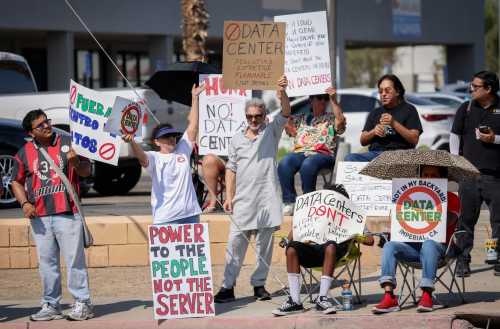
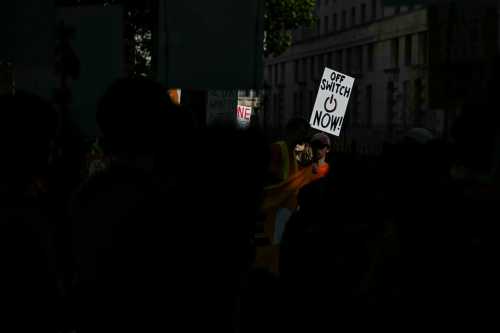
The pledge and industry’s public commitment to ratepayer protection are important steps in shaping the new consensus, but it is far from clear whether they will blunt the rapidly growing public opposition to the construction of massive data centers. A February 2026 poll of Wisconsin voters by the Marquette University Law School found that 70% of voters believe that the costs of new data centers outweigh the benefits—a dramatic increase from six months earlier when the same poll found that 55% of voters held that view. Thirty-five percent of voters agreed with the statement that data center development “drives up the cost of electricity for everyone else.” In Virginia, the location of “data center alley,” only 35% of voters said in 2026 that they would be “comfortable” if a new data center was built in their community—a drop from the 69% in 2023. The New York Times quoted comedian Charlie Berens characterizing opposition to data centers as “the most bipartisan issue since beer.”
The concerns of the public about AI and data centers go far beyond ratepayer protection. A recent Gallup poll found that 7 in 10 Americans oppose constructing data centers. But only 15% of those opposed even mention higher utility bills or increased energy costs as one of the reasons for their opposition. In contrast, 50% of those opposed mentioned the effect on resources, 22% mentioned quality-of-life issues, and 16% mentioned environmental issues like noise and air or water contamination. Opposition to AI data centers might very well be serving as a proxy for larger concerns about AI. In the same Gallup poll, 14% said they opposed AI data centers because they had negative views on AI. According to a recent Quinnipiac poll, 80% of Americans are concerned or very concerned about AI. And only 31% of Americans trust the government to regulate AI responsibly, putting the U.S. dead last among countries surveyed by Ipsos in 2025.
It is in this context of overwhelming public opposition that legislative proposals and actions at the federal, state, and local level to impose a moratorium on data center construction become understandable. In March 2026, Sen. Bernie Sanders (I-Vt.) and Rep. Alexandria Ocasio-Cortez (D-N.Y.) announced legislation to impose a federal moratorium on data center construction, for the explicit purpose of pausing “the development of AI.” This bill is almost certainly going nowhere in today’s Congress, but state-level efforts have made more progress. As of March, 11 states had introduced legislation that would temporarily ban data centers. A Maine bill would have imposed the country’s first statewide moratorium on new data center construction but for the veto by outgoing Gov. Janet Mills, who shortly thereafter suspended her campaign for Senate. Local opposition has been even more effective. At least 48 data center projects representing $156 billion in potential investment were blocked or stalled by local opposition in 2025.
It is unlikely that resolving ratepayer issues involving AI data centers will shift the public from opposition to support. However, it is still a crucial element of the public controversy and must be part of a larger effort by government and industry to address the broader concerns that are driving public opposition to data centers and AI itself.
Federal and state actions
Not surprisingly, members of Congress and elected officials at the state and local level have moved to address ratepayer concerns. In the U.S. Senate, Sens. Josh Hawley (R-Mo.) and Elizabeth Warren (D-Mass.) sent a joint letter on March 25 to the Energy Information Administration asking for annual reporting on data center energy usage, following the introduction of the “Guaranteeing Rate Insulation from Data Centers Act,” or GRID Act, that was introduced on Feb. 11 by Sens. Hawley and Richard Blumenthal (D-Conn.). More recently, Sen. Adam Schiff (D-Calif.) introduced the “Energy Cost Fairness and Reliability Act,” which would require large loads such as data centers to meet provisions similar to those in the ratepayer protection pledge as a condition for priority grid connection.
On the House side, the House Energy and Commerce Subcommittee on Energy held an April 29, 2026, hearing on seven bills to address the data center energy demand issue, including the yet to be introduced “Ratepayer Protection Act” that received bipartisan support at the hearing. Committee Chairman Brett Guthrie (R-Ky.) recently said at an energy conference in Washington, “We have the ratepayer protection pledge, which we want to put into statute.” In June, Reps. Kathy Castor (D-Fla.) and Gabe Evans (R-Colo.) introduced the legislation.
This congressional interest in ratepayer protection is a positive sign, but it will not resolve the ratepayer issues because the authority to regulate electric utilities rests at the state level—not federal. State public utility commissions set the terms for power generation, local distribution, and rates. The federal government has authority over the costs and reliability of interstate power markets, which can have a significant impact on retail rates in areas such as the PJM Interconnection power pool where dramatic spikes in wholesale power purchase prices are driving up rates across the 13-state area that it serves. However, wholesale power rates are but one of many factors driving the rates paid by residential and other non-data center customers overall in Virginia, Ohio, and other states with significant data center development.
In addition to congressional interest, the FERC, as directed by the Trump administration, issued a show cause order to PJM and the other five regional grid operators designed to enhance the ability of data centers and other large loads to interconnect to the grid. The order gives them 60 days to “either defend or revise their tariffs … to ensure that Americans have reliable, affordable power—even as electricity demand and technology accelerates.” This approach is consistent with FERC Chair Laura Swett’s earlier statements that the commission will be mindful of the states’ historic role but will “push right up to [the] edge” of federal authority to achieve the “unprecedented and extraordinary quantities of electricity and substantial investment in the nation’s interstate transmission system” that massive data centers will require.
The past year has seen a surge in the consideration of ratepayer protection actions by state legislators and public utility commissioners, driven by the pressure of requests for utility rate increases and questions about the future reliability of the grid. In Virginia, the State Corporation Commission in November 2025 created a separate utility rate tier for energy users demanding 25 megawatts or more, targeting Virginia’s data centers. These users must pay at least 85% of contracted transmission and distribution costs, along with 60% of generation costs, regardless of whether that energy is fully used. In addition, they must sign contracts for a minimum of 14 years and provide millions of dollars in financial collateral per megawatt. This idea is to protect everyday consumers if a data center vacates the area before infrastructure costs are paid off. Similarly, the Public Utilities Commission of Ohio is now requiring potential large load customers to pay up-front costs and reimburse the utility for 100% of “build-out” costs. However, as noted by Travis Kavulla, head of policy for Base Power Company and former chairman of the Montana Public Service Commission, the Virginia regulation might need to be adjusted further so that data center rates fully reflect the costs imposed on the system.
Virginia and Ohio are leading the way among the states in establishing ratepayer protections. To date, however, only elements of the ratepayer protection pledge have been enacted into state law or regulation and only in select states. Several state legislatures have considered but not passed more comprehensive legislation. For example, this year the Georgia legislature considered—but did not pass—a bill that would prohibit electric utilities from passing on the electricity costs of large commercial data centers to regular customers. The bill included both provisions to control the rates paid by non-data center customers and protections against stranded investment. In 2025, California enacted a law that directs its utility commission to “assess the extent to which electrical corporation costs associated with new loads from data centers result in cost shifts to other electrical corporation customers” but did not enact ratepayer protections. Texas enacted legislation that requires data centers and other large loads to pay the up-front costs of interconnection but rejected provisions to require separate tariffs for large loads. In June, Pennsylvania Gov. Josh Shapiro announced the “Governor’s Responsible Infrastructure Development (GRID) Standards” that include a provision requiring data center developers to bear the full cost of new generation capacity built to serve their needs as well as provisions intended to address a range of environmental and other concerns related to data centers. The Shapiro administration is now seeking to codify the GRID standards through legislation, including a provision that would tie Pennsylvania’s existing data center sales and use tax exemption—projected to cost more than $517 million annually by fiscal year 2030-31—directly to GRID certification requirements.
Next steps: Translating words of commitment into action
On one level, the ratepayer protection pledge sounds simple—have data centers pay the full cost of the power they consume, require them to cover up-front interconnection costs, mandate that they agree to “take-or-pay” contracts, and “bring, build, or buy” the generation capacity required to meet their demand. Translating these words of commitment into enforceable ratepayer protections is not so simple.
The starting point for action rests with utility commissions, state legislatures, and governors. The political groundwork has been established to take regulatory steps and to enact legislation implementing the pledge. The public is demanding action to minimize the impact of large data center development on electric utility rates, and the largest AI data companies are now committed to policies that can help achieve this objective. As of Feb. 20, more than 300 data center bills have been filed in 30 states, including 18 that would require the establishment of a separate rate class for large energy users. While state utility commissions can often act on their own, it is time to enact legislation that establishes ratepayer protection policies and directs implementation by state utility regulatory commissions.
From a regulatory perspective, it will require detailed work to fairly allocate the generation, transmission, and distribution elements of the grid in a way that assures that data center users pay the full costs that they impose on the system. The Searchlight Institute, a public policy think tank, has proposed that an independent entity develop and publish a “standardized participation agreement” that would address the FERC interconnection issues and facilitate an expedited interconnection track. Along similar lines, a standardized model large-load state tariff could be developed by the National Association of Regulatory Utility Commissioners (NARUC) or an independent entity to guide state commissions in the allocation of costs. Commissions should also consider ways to better manage the disparity between the high levels of demand for power from data center developers and the inability of the grid to meet demand. For example, Kavulla, the former Montana state regulatory commissioner, has proposed an “open season” that allocates power on the basis of efficiency and cost rather than the order in which requests for power are received.
The challenge of protecting non-data center electric ratepayers from rate increases because of data center development is an issue that has exploded at the national, state, and local levels over the past year. Unlike many other political issues, a consensus is emerging on actions that can protect ratepayers into the future. It is now time to move forward on that consensus.
Related Content
Authors

-
Acknowledgements and disclosures
Amazon, Google, Meta, and Microsoft are general, unrestricted donors to the Brookings Institution. The findings, interpretations, and conclusions posted in this piece are solely those of the authors and are not influenced by any donation.
The Brookings Institution is committed to quality, independence, and impact.
We are supported by a diverse array of funders. In line with our values and policies, each Brookings publication represents the sole views of its author(s).


Commentary
The pledge to protect ratepayers from AI data center costs needs enforcement
July 9, 2026