This commentary is part of a series on “The new geopolitics of Asia and the prospects of North Korea diplomacy” produced by the Brookings Institution.
The Trump administration’s strike against Venezuela and its war in Iran have drawn the spotlight away from the Korean Peninsula and Northeast Asia for much of 2026. Although North Korea remains relatively low on the administration’s list of foreign policy priorities, Korea watchers continue to speculate about a possible meeting between President Donald Trump and North Korean leader Kim Jong Un, driven in part by Trump’s own expressed interest. Travelling to Asia in October 2025, Trump stated, “If he’d like to meet, I’m around … I’ll be in South Korea, so I could be right over there.” In March 2026, Trump reportedly informed South Korea’s prime minister during a White House meeting, “I maintain a good relationship with Kim Jong Un. I am curious whether the chairman wants to engage in dialogue with the U.S. or with me.”
Beyond the immediate question of a Trump-Kim summit, a more consequential issue is how shifting geopolitics in Northeast Asia are shaping peace and instability on the Korean Peninsula. Recent signals from both Trump and Kim indicate openness to a meeting, pointing to a potential pathway to renewed diplomatic engagement. Paradoxically, however, such signals may also complicate the long-standing objective of North Korean denuclearization. The central question, then, is whether a resumption of diplomacy can meaningfully advance stability and peace on the Korean Peninsula and across Northeast Asia.
The complex geopolitics of Northeast Asia
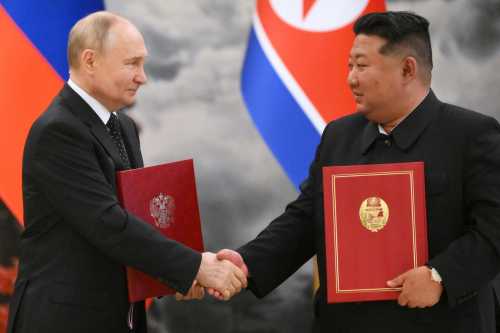
Although U.S.-North Korea diplomacy has been dormant since the October 2019 talks in Stockholm, North Korea has reinvigorated its diplomatic engagement with Moscow and Beijing. The deepening Russia-North Korea relationship is notable: South Korean estimates suggest that Pyongyang has received between $7 billion and $14 billion in weapons, military technology, fuel, and food in exchange for providing troops and munitions to support Russia’s war effort in Ukraine. The strength of these ties is reflected not only in both governments’ official statements but also in newly crafted state narratives and symbolic gestures, such as the construction of memorials and monuments in Russia honoring fallen North Korean soldiers.
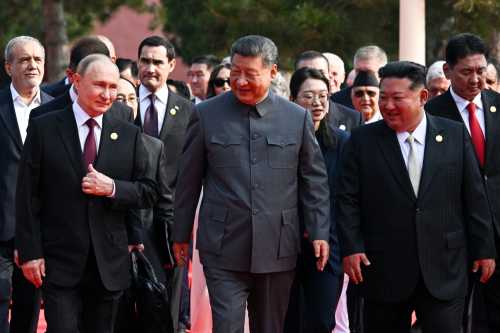
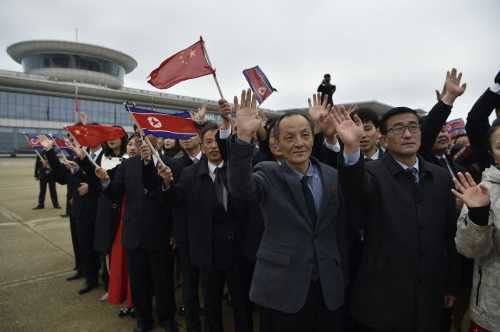
Wary of ceding influence to Moscow, Beijing has also moved to reinvigorate its relationship with Pyongyang. In 2025, Chinese President Xi Jinping invited Kim to attend a military parade commemorating the 80th anniversary of the end of World War II. Seated alongside Xi and Russian President Vladimir Putin, Kim’s presence projected an air of confidence for North Korea on the international stage. Chinese Foreign Minister Wang Yi also traveled to Pyongyang in April 2026 to meet with Kim and North Korean Foreign Minister Choe Son Hui.
Since Pyongyang has bolstered ties with both Moscow and Beijing, it is now far less motivated to engage Washington than it was during the first Trump administration. It has also shown little appetite for inter-Korean engagement, disavowing unification and flatly rejecting diplomatic overtures from Seoul. On the other side, the Trump administration continues to support U.S.-Japan-South Korea trilateral cooperation in response to North Korean and broader Indo-Pacific threats. However, the bifurcation of Northeast Asian politics between different trilateral blocs creates major obstacles for multilateral diplomacy, much less headway on denuclearization.
Giving up on the Holy Grail of denuclearization?
Beijing and especially Moscow have grown increasingly permissive of North Korea’s nuclear weapons program. Russia now openly defends North Korea’s nuclear status while deepening military support through a 2024 bilateral defense pact. Beijing still professes to support denuclearization, but China has refrained from publicly calling for it.
At the same time, the goal posts for denuclearization have shifted. During the seven-year hiatus in U.S.-North Korea diplomacy, North Korea’s nuclear and weapons capabilities have greatly accelerated. The regime is estimated to have assembled 40-50 nuclear warheads and possesses sufficient fissile material to fully weaponize 70-90 warheads. North Korea’s nuclear status is now fully institutionalized in its constitution and deeply embedded in the regime’s strategic calculus and mindset. Furthermore, the new five-year defense plan, announced at the Ninth Party Congress in February 2026, directed the military to further develop its ground- and sea-launched intercontinental ballistic missile programs and refine its nuclear command-and-control systems.
Policy analysts in Washington appear increasingly cognizant of this reality. Compared to the first Trump administration’s emphasis on complete, verifiable, and irreversible denuclearization, current discussions focus more on pragmatic steps to reduce tensions and manage risk on the Korean Peninsula. Notably, official U.S. strategy documents released in 2026 omit the term “denuclearization” altogether, although this step may reflect a signal for dialogue more than any change in official policy. Regional actors may also be adapting to Washington’s rhetorical shift, at least at the tactical level, with South Korea’s Ministry of Unification now using the language of a “nuclear-free Korea” rather than “denuclearization.”
The shift away from denuclearization may ostensibly draw Kim out to meet Trump. As Kim declared in September 2025, “If the U.S. drops its hollow obsession with denuclearization and wants to pursue peaceful coexistence with North Korea based on the recognition of reality, there is no reason for us not to sit down with the U.S. Personally, I still have good memories of U.S. President Trump.” In other words, Kim might be willing to meet with Trump or engage with Washington so long as denuclearization is not a precondition.
Implications of a Trump-Kim summit
Under current geopolitical circumstances, and despite long odds, a Trump-Kim summit may still offer the best chance at jumpstarting dialogue between Washington and Pyongyang to build trust and establish greater strategic stability on the peninsula. Seoul is especially banking on a Trump-Kim meeting to help facilitate inter-Korea relations.
There are legitimate concerns surrounding a leader-level U.S.-North Korea meeting. For example, Trump would need to set aside denuclearization as an immediate agenda item per Kim’s condition for engagement. Doing so could place the United States on a trajectory toward acknowledging North Korea as a permanent nuclear weapons state. A Trump-Kim meeting also could sow division between Washington and its allies in Seoul and Tokyo if little is achieved in the way of improved regional security. The risk would be greater if Trump were to offer reductions in the U.S. military presence without consultation, as he suggested during his first term.
Although there is no guarantee, renewed dialogue between the United States and North Korea could help restart a process that at least pauses the expansion of Pyongyang’s nuclear and weapons programs. It may also foster an environment more conducive to improved inter-Korean relations. Of course, Kim may meet Trump and afterward continue to proliferate without shifting any behavior. But there would be relatively little cost to Trump, and the region would be no worse off than the existing status quo.
It is unclear to what extent Xi will encourage Kim to meet Trump, either in May or at a future date. If and when the two leaders meet, the summit should, at a minimum, adhere to a “do no harm” principle to safeguard U.S. and allied interests. This approach should be guided by four key steps.
First, the United States should publicly reaffirm its commitment to extended nuclear deterrence for allies in the region.
Second, the United States must avoid actions that could be interpreted by regional actors as signaling a reduced commitment to the Korean Peninsula—particularly if Washington is seen as tacitly acknowledging North Korea’s status as a nuclear weapons state.
Third, the United States should underscore its long-term commitment to non-proliferation principles and, if necessary, privately signal to allies that denuclearization remains a longer-term objective.
Fourth, if a Trump-Kim summit evolves beyond a symbolic meeting into a more substantive process, broader security concerns—including arms and technology transfers from Russia, cyber activities, and human rights issues—could be introduced gradually. In parallel, the United States might consider calibrated steps toward rapprochement, such as partial sanctions relief, expanded people-to-people exchanges, and exploration of longer-term economic engagement.
Conclusion
There is no guarantee that renewed engagement will reduce tensions, much less halt or reverse North Korea’s nuclear ambitions. In the absence of dialogue, however, North Korea’s weapons capabilities will almost certainly continue to expand, further undermining regional security. Northeast Asia’s complex geopolitics make any diplomatic breakthrough on the Korean Peninsula inherently difficult. Nevertheless, given Trump’s and potentially Kim’s interest in rekindling their earlier bromance, the Trump administration should take steps to establish a diplomatic process with North Korea not only at the leaders’ level but, equally important, at the working level to sustain dialogue.
Author

Related Content
-
Acknowledgements and disclosures
The author would like to thank Hanna Foreman for research assistance, Adam Lammon for editing, and Rachel Slattery for layout.
The Brookings Institution is committed to quality, independence, and impact.
We are supported by a diverse array of funders. In line with our values and policies, each Brookings publication represents the sole views of its author(s).
Commentary
Rethinking North Korea diplomacy
April 30, 2026