Introduction
With some ballots yet to be counted, it is already clear that the 2026 midterm election was a historic victory for the Democrats and a devastating referendum on President Donald Trump and his party. Democrats reached deep into longtime Republican bastions to seize control of both the House and Senate. With the outcome of Senate races in Alaska and Mississippi yet to be determined, Democrats flipped at least seven Senate seats. Voters sent Democrats to the Senate in Texas and South Carolina for the first time in decades, and in Kansas, for the first time since 1932. Democrats racked up gains throughout the agricultural Midwest, which had been hard hit by President Trump’s policies. Maine’s Troy Jackson sent Sen. Susan Collins (R-Maine) into retirement after 30 years in office. In the House, Democrats won the national popular vote by 13 points and will end up with a larger majority than anyone expected. In the Texas governor contest, Gina Hinojosa defeated three-term Republican Gov. Greg Abbott, putting a Democrat in the governor’s mansion for the first time since 1995. In Georgia, former Atlanta Mayor Keisha Lance Bottoms became the first Black woman governor in the nation’s history, while Michigan’s Abdul El-Sayed became the first Muslim senator.
Key factors behind the blue wave
Turnout
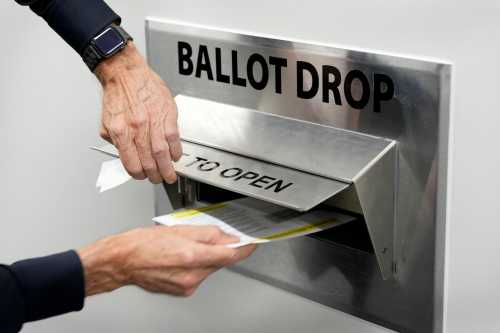
Turnout in midterm elections is always lower than in presidential contests, but the party that wins the midterms enjoys the smallest falloff from the previous presidential election. Throughout 2026, Democrats enjoyed a substantial lead in polls measuring the likelihood of voting, and the actual votes reflected this edge. As election season progressed, expectations increased that turnout would be high. As of the end of October, early voting totals had surpassed the totals seen in 2018 and 2022. The all-time highs for the 21st century midterms were 2018 (53.4%), when Democrats took over the House of Representatives, and 2022 (52.2%) when Republicans took over the House.
Although national turnout numbers are not yet available, the results from three large red states are suggestive. Compared to the 2024 presidential election, votes cast for Texas Republican Gov. Greg Abbott fell 30% from President Trump’s total while his challenger, Democrat Gina Hinojosa, exceeded Kamala Harris’ vote by 8%.1 Republican Byron Donalds fell short of Trump’s total by 32%, while Democrat David Jolly finished 14% behind Harris. And in Ohio, Democrat Amy Action received 5% fewer votes than Harris while Vivek Ramaswamy’s total fell short of Trump’s by 36%. Meanwhile, only 6% of Republicans crossed over to support Democrats in races for the House of Representatives. Discontented Republicans didn’t abandon their party in 2026; they stayed home, opening the door for highly motivated Democrats to score massive gains.
Demography and geography
In 2024, Donald Trump scored historic gains among Hispanics, Black voters (especially men), independents, and young adults, leading commentators to speculate about a pro-Republican realignment into a multiethnic working-class party. The midterm results will likely end this conversation. In 2024, President Trump received 48% of the Hispanic vote (up from 36% in 2020), 15% of the Black vote (up from 8%), 48% of Independents (up from 43%), and 39% of young adults (up from 35%). In this year’s national vote for the House, by contrast, Republican candidates received only 29% of the Hispanic vote, 8% of the Black vote, 38% of Independents, and 28% of young adults.
The substantial decrease in the Black vote for Republicans is attributable to two big changes that affected these voters. The first was the Supreme Court’s Callais decision which significantly weakened the Voting Rights Act, and the second, related to the first, was the Republican-led mid-decade redistricting which wiped out many formerly majority-minority districts represented by African Americans. Politico predicted this would lead to increased turnout and named it “blacklash.”
There were also signs of erosion in the heart of the Republican base—white voters without college degrees. In 2024, Trump received 64% of their vote. This year, Republicans garnered only 60%.
The shifts in Latino voting had a substantial impact on key House and Senate races. Talarico’s historic win in Texas was fueled by predominantly Hispanic counties in South Texas. Nationwide, in the House districts with the heaviest concentration of Hispanic voters, Democrats won 30 seats, for a net gain of 12, with the results still incomplete in two contests.2 Democrats also scored gains in rural areas. Of the 20 swing rural House districts, Democrats have netted a gain of at least seven seats, with one still too close to call. 3
Mid-decade redistricting
In the summer of 2025, Texas broke from tradition, drawing new congressional lines in the middle of the decade and setting off a series of redistricting efforts across the country. But the effects of this strategy fell dramatically short of Republicans’ hopes.
Republican-led redistricting in Florida and Texas rested on the assumption that this year’s Hispanic vote would echo Republican gains in 2024, which it did not, leading to disappointing results for the GOP. In Texas, Republicans picked up just one of the seats they targeted—the open seat in the 32nd Congressional District which was flipped to Republican by Jace Yarbrough—while the other four remained in Democratic control. In Florida, Republicans hoped to pick up four seats by drawing new lines, but Democrats held on to three of them. The fourth (Florida’s 9th Congressional District) is still to be called, with the incumbent Democrat Darren Soto in the lead as of this writing. Of the 19 seats identified by the New York Times as most affected by redistricting, Democrats actually netted three additional seats.
Pennsylvania
In recent cycles, Pennsylvania has emerged as the largest swing state and as a microcosm of the country. Although the state had no Senate race this year, it featured some noteworthy developments. Not only did Gov. Josh Shapiro win reelection in a 22-point landslide, garnering 60% of the popular vote, but also Democrats flipped all four swing House districts and won a majority in the state Senate while expanding its majority in the House.
Democratic socialist candidates
Beginning with the 2025 election of Mayor Zohran Mamdani in New York City, and continuing with the rise of Abdul El-Sayed as the 2026 Democratic nominee for Senate in Michigan, attention turned to the Democratic Socialists of America (DSA). Republicans rejoiced as they publicized the DSA platform and sought to portray the Democratic Party as out-of-touch communists. Some Democrats responded by reiterating that they were, in fact, capitalists.
Earlier this year, Kamarck and co-authors identified all the congressional candidates that were either endorsed or recommended by the DSA. These included those endorsed or recommended by the national organization or state and local chapters. All told, 16 DSA candidates won their Democratic primaries. Nine of these candidates were from California; the remainder were from other states. Four were incumbents.4
Only two of these candidates came from Republican districts—Tessa Lynn Hodge from California’s 23rd District, which has a PVI score of R+9, and Justin Pearson of Tennessee’s 9th District, which also has a PVI score of R+9. Hodge is behind in her district, but the race has yet to be called. Pearson ultimately lost but only by 1 point. The remaining DSA candidates were in solidly Democratic congressional districts with PVI scores averaging D+22. The outlier was Randy Villegas whose district (California’s 22nd District) had a PVI score of D+1. Villegas won. Of the DSA nominees, four were incumbents and will be returning to Congress. One other candidate is William Lawrence, the Democratic nominee for Michigan’s 7th District, who left the DSA in summer 2026 but until then was an active member. That district had a PVI of 0—meaning that it was evenly split. Lawrence won his district, flipping it from Republican to Democratic.
The bottom line: With all votes counted and races called, there could be as many as nine new DSA-backed candidates in the Democratic caucus. However, there likely will be more than twice as many “blue dog” or conservative Democrats joining the caucus as well. Potential new Speaker Hakeem Jeffries will have to balance these new voices against the influx of newly elected moderates, just as in the Senate Abdul El-Sayed’s voice will be balanced by the likes of North Carolina’s Roy Cooper and other newly elected senators.5
The Republican weak spots voters punished
Trump’s job approval
It is axiomatic among political scientists that the president’s job approval does more than any other factor to shape midterm elections, and 2026 is no exception. As voters streamed to the polls, President Trump’s job approval averaged just 39%, compared to 59% disapproval. Of the 11 Senate races that remained competitive on Election Day, Trump’s job disapproval exceeded his approval in all of them, despite the fact that he had carried 10 of these states in 2024, most by double digits.
Post-election polls mostly confirmed what preelection polls had been saying for months: Voters were deeply dissatisfied with the president’s handling of the issue they cared most about—high prices. Making things worse, they saw a direct connection between high prices and two of the president’s signature policies during his second term—tariffs and the war in Iran. Large majorities of voters concluded that his tariffs had raised costs for U.S. consumers, and they saw for themselves what happened to gas prices after the president initiated hostilities in the Persian Gulf.6
Rural America
Rural America was particularly hard hit: As other nations retaliated against U.S. tariffs, agricultural exports were slammed, and the war jacked up the prices of key agricultural inputs, including diesel fuel and fertilizer. This is why Democrats were competitive in so many rural districts this year, and why they won statewide races in Iowa, Ohio, and Kansas that appeared out of reach a year ago.
Immigration
Immigration was one of President Trump’s strongest issues in the 2024 election, but his handling of the issue once he reentered the Oval Office ended up neutralizing its political impact. While voters gave him high marks for shutting down the southern border, a majority concluded that the conduct of ICE agents, especially in big city raids, had gone too far. During the election, Trump had focused on deporting hardened criminals (“the worse of the worst”), but immigration enforcement has swept up large numbers of law-abiding immigrants and even citizens who were making economic contributions to their communities in sectors such as agriculture, homebuilding, hospitality, and child care. Hispanic voters, many of whom supported stronger enforcement at the border, objected strongly to the administration’s policies in the interior of the country.
Corruption
Beginning in 2025, a series of reports raised questions about President Trump’s cryptocurrency business and its financial dealings with foreign representatives. In summer 2026, Trump’s financial disclosure forms showed that he had made roughly $2.2 billion during 2025, with more than half coming from cryptocurrency ventures. These revelations coincided with a sharp increase in public perceptions of corruption. According to Gallup, the share of Americans who believe government corruption is widespread jumped from 73% in 2024 to 89% in 2026—a striking increase after more than a decade of relatively little movement on this topic.
In one much-discussed poll, worries about corruption had, to the surprise of many, eclipsed worries about the cost of living and the price of gas. A CNBC poll found that 36% of voters put government corruption at the top of a list of the most important issues facing the country right now. Other polls found that Trump was using the presidency to enrich himself and that Trump’s businesses influenced his presidential decisions. By the end of the campaign, candidates on both sides (but especially Democrats) were regularly tying corruption to voters’ complaints about their own economic struggles. These concerns coincided with an outpouring of anger and suspicion toward AI and data centers.
The Trump factor
Despite the powerful Democratic tide, the Republicans could have held on to the Senate—if President Trump had not put his thumb on the scales during the Republican primaries. He intervened decisively in four Senate races—Texas, Georgia, North Carolina, and South Carolina—pushing candidates loyal to him over the finish line for the nomination. All four lost, including shocking defeats in South Carolina and Texas.
Conclusion
Despite the dramatic results of the 2026 midterm election, Democrats would be well advised to curb their enthusiasm and Republicans to restrain their despair. The reason: History shows that the midterms do not predict the results of the ensuing presidential election. For example, Democrats lost more than 50 House seats in 1994, but Bill Clinton went on to win reelection easily in 1996. Democrats lost more than 60 seats in 2010, but Barack Obama’s standing rose in 2011-2012, and he won a comfortable reelection in 2012. On the other hand, after large Democratic gains in 2006 and 2018, Obama and Joe Biden both won the presidency by significant margins.
While the 2026 midterms have at best limited predictive value for 2028, they do point to the challenges both major parties face as the race for their presidential nominations begins and the country awaits its first presidential contest since 2016 with neither an incumbent president nor a former president on the ballot. After the crushing rebuke their party received in the midterms, Republicans must decide whether to keep their party on the course Donald Trump has charted over the past decade or to head in a different direction.
For their part, Democrats face an embarrassment of riches. Moderates won numerous statewide races, but so did progressives in Maine, Michigan, and Minnesota. The midterm results do not conclusively show which kind of Democrat would be more electable at the national level in 2028. The outcome of the party’s primaries will reflect the voters’ judgment not only on electability, but also about the agenda that is most likely to successfully address the country’s most important problems. One thing is clear: In both parties, the intraparty debate that was deferred in 2024 can be delayed no longer.
Related Content



Authors


-
Footnotes
- Authors’ calculation, based on U.S. Governor Midterm Elections 2026: Live Results – The New York Times
- Note that some of the 30 districts Democrats won have not been called by the NYT/AP as of this writing, but have been called by other sources.
- Again, some of these races in rural districts have not yet been called by AP or the New York Times but have been called by other sources.
- Sometimes candidates are endorsed by a state or local DSA chapter but not by the national organization. These candidates were: Rep. Lateefah Simon (California incumbent), Angela Gonzales-Torres (California); Rep. Ro Khanna (California incumbent), Aisha Wahab (California incumbent), Angelica Duenas (California), Hilda Solis (California), Mai Vang (California), Randy Villegas (California), Tessa Lynn Hodge (California), Melat Kiros (Colorado), Donavan McKinney (Michigan), Rep. Rashida Tlaib (Michigan incumbent), Darializa Avila Chevalier (New York), Claire Valdez (New York), Christopher Rabb (Pennsylvania), and Justin Pearson (Tennessee).
- El Sayed was not formerly endorsed by the DSA but he stands out as the most far left of the newly elected Democrats.
- Political scientists and economists have shown that gas prices have an outsized influence on both voters’ inflation expectations and presidential job approval.
The Brookings Institution is committed to quality, independence, and impact.
We are supported by a diverse array of funders. In line with our values and policies, each Brookings publication represents the sole views of its author(s).

Commentary
How Democrats won big, and why 2028 remains an open question
November 6, 2026