



For more than 60 years, the U.S. Agency for International Development (USAID) represented the best of America abroad alongside its diplomats and military, responding to disasters, fighting epidemics, and helping former aid recipients become strong U.S. allies and democracies. In early 2025, it was haphazardly dismantled by the Trump administration in a matter of weeks. In this episode of “Deep Cuts,” we tell the story of the agency’s far-reaching impact, how it was taken apart, and what its loss means: lives lost around the world, Americans left less safe and secure from pandemics, threats, and instability, and a dangerous vacuum that America’s adversaries, China and Russia, are rushing to fill.
- Listen to “Deep Cuts” on Apple, Spotify, or wherever you like to get podcasts.
- Learn about other Brookings podcasts from the Brookings Podcast Network.
- Sign up for the podcasts newsletter for occasional updates on featured episodes and new shows.
- Send feedback email to [email protected].
TRANSCRIPT
MARK WARD: [00:00:00] When the earthquake and tsunami hit Indonesia, I mean, it was bad. And the first thing after an earthquake that you ask when you’re in the disaster business is, “How are the runways?” You know, “Can we land a plane?”
CO-HOST SCOTT ANDERSON: Mark Ward spent 31 years in the Foreign Service with the U.S. Agency for International Development, also known as USAID.
He represented the agency in 2004 when he was deployed to Indonesia. An earthquake and the resulting tsunami had struck 14 countries, affecting over 1.7 million people. It was one of the deadliest natural disasters in recorded history. In the days that followed, it was a global mad dash to save the lives of those who remained in danger.
For the United States, that meant deploying USAID with Ward at the helm.
MARK WARD: The province that the earthquake had hit and the tsunami had hit again were otherwise cut off. The runway was badly cracked. The roads were a mess.
CO-HOST SCOTT ANDERSON: With no option to land a plane on solid ground or drive in trucks of life-saving supplies, USAID called on other U.S. resources. The Navy deployed an aircraft carrier, the USS Abraham Lincoln. Ward was on deck watching a flurry of organized chaos. People loaded rice and cooking oil into helicopters, which would fly the supplies out, then come back for more in an endless loop.
MARK WARD: What made me very proud was that it was USAID who was directing the show.
These were U.S. Navy helicopters. These were U.S. Navy pilots. But we knew where to go, we knew what to bring, and we knew when. I went over and chatted with some of these, uh, pilots that were loading these supplies, and I asked them, “Well, what do you guys do? You know, what’s your normal job?” They said, “Sir, do you see those planes parked over there?”
And I looked at the end of the deck, and of course, there were F-16s lined up with their wings folded up. [00:02:00] “So we fly those.” And then they asked, “Sir, what, what do you do?” And I pointed to some patch on my hat or on the vest I was wearing and said, “Well, I, I work for USAID. You’re delivering all this for us.
This is what we do for a living.” And these guys looked at me and they said, “Sir, we wanna work for, for you. What we’re doing today, sir, we’ve never been so proud to be Americans.”
CO-HOST SCOTT ANDERSON: For over 60 years, the United States was represented abroad not only by its military and its diplomats, but by the people who made up the U.S. Agency for International Development. Under 12 presidents, USAID reached at least 175 countries and territories. Their work served two inseparable purposes. First, American national security, and second, American values.
JEREMY KONYNDYK: As a rich and powerful state, we have a moral and ethical obligation to lift up others, not just ourselves. USAID was a material representation of that.
FATMA TANIS: People were very much aware of the generosity of the U.S. USAID was there to help them, whether it was providing food packages, tents, clothes, these items that refugees need as they’re starting from scratch in a new country.
ANDREW NATSIOS: You know, in refugee camps and displaced camps in Africa, they name their kids USAID. They name their kids after AID.
PAIGE ALEXANDER: We have saved so many lives. We’ve prevented 91 million deaths globally over 20 years, and that’s a fact.1
CO-HOST SCOTT ANDERSON: USAID was the indispensable part of the U.S. government that showed up after the disaster, the conflict, the epidemic, and helped people rebuild.
In doing so, it made America more powerful, more trusted, and more safe.
And then, in the weeks following President Trump’s inauguration for [00:04:00] his second term, USAID was dismantled. It was the first agency Elon Musk’s Department of Government Efficiency attacked via an email to staff on a Sunday afternoon. Although it still exists in statute, functionally, USAID was demolished.
It was abruptly stripped of its people, its funding, its building, and in ways that many argue were illegal.2 Employees in Washington were locked out of their offices. Those who were abroad suddenly found themselves abandoned by their employer, all based on unsubstantiated charges by Trump and Musk that the agency was rife with waste, fraud, and corruption.
And U.S. foreign assistance was first frozen, then canceled.
ANDREW NATSIOS: The consequence is that there’s no medicines, and people are dying.
CHRIS MILLIGAN: The withdrawal of USAID funds could cause over fourteen million preventable deaths in low-income countries, uh, including 4.5 million children by 2030.3
CO-HOST SCOTT ANDERSON: Over its lifetime, USAID helped create the system that supported nations in need.
When aid disappeared overnight, vulnerable nations simply couldn’t fill the gap on their own, and the rest of the world was watching.
FATMA TANIS: Many countries around the world, they seem to be aware of what the U.S. gained through its foreign aid. So you see those countries stepping up in that space where the U.S. is pulling back.4
CHRIS MILLIGAN: Foreign assistance is not just about helping others. It’s about shaping the world where we live. The dismantling of USAID has not only had a devastating impact on lives and communities overseas, we’ve weakened our international leadership, and we’ve done that at considerable risk to ourselves.
CO-HOST SCOTT ANDERSON: For the Brookings Institution, this is Deep Cuts: USAID.
NEWS ANCHOR (1961): And the following day, stepped up foreign aid is among proposals put before Congress by President Kennedy.
CO-HOST SCOTT ANDERSON: In an extraordinary- In May 1961, months after his inauguration, [00:06:00] President Kennedy made a proposal to Congress and the American people.
PRESIDENT JOHN F. KENNEDY: We stand ready now, as we have in the past, to provide generously of our skills and our capital and our food to assist the peoples of the less developed nations to reach their goals and freedom.
This is also our great opportunity in 1961.
CO-HOST SCOTT ANDERSON: The great panic of 1961 was nuclear. It was the height of the Cold War, and the United States was concerned about Soviet influence in the Global South. It was also the height of decolonization. During this time, more than 30 new independent nations emerged, primarily across Africa and Asia.
Kennedy’s vice president, Lyndon Baines Johnson, had recently returned from a fact-finding tour of many of those nations,5 and what Johnson saw was clear: none of the countries he visited wanted American military manpower, but they all needed economic aid.
PRESIDENT JOHN F. KENNEDY: The most skillful counter-guerrilla efforts cannot succeed where the local population is too caught up in its own misery to be concerned about the advance of communism.
CO-HOST SCOTT ANDERSON: Kennedy’s idea was to bring the government’s various disparate foreign assistance programs into one coordinated agency, the U.S. Agency for International Development, USAID, or USAID. Congress agreed to fund it,6 and there began the decade of development.
CHRIS MILLIGAN: And when USAID was established in 1961, the vision was simple and bold.
Helping other nations build stability and prosperity was not only a moral imperative, but a strategic one.
CO-HOST SCOTT ANDERSON: This is Chris Milligan.
CHRIS MILLIGAN: I have more than three decades of experience at USAID advancing development and humanitarian goals, particularly in crisis and political transition settings.
CO-HOST SCOTT ANDERSON: Milligan has had many roles within the agency.
He was one of the first American civilians in Baghdad during the second Iraq War. He oversaw earthquake relief in Haiti. He ran an airlift in Rwanda. He served [00:08:00] in Ecuador, Indonesia, Zimbabwe, Myanmar, and Madagascar.
CHRIS MILLIGAN: Development is one of our biggest puzzles. We know more about outer space than we do on why some countries develop and others appear not to, and how to create social and economic change.
CO-HOST SCOTT ANDERSON: When people talk about USAID, they often talk about aid or foreign assistance. But the more precise word for what the agency did, the word the agency itself used, is development. Aid is emergency response. It’s food after a famine, shelter after an earthquake, medicine after an outbreak. Development is more enduring.
It’s creating the conditions so, for example, an epidemic is less likely to happen. It’s not merely sending in American doctors, it’s training the local clinics. It’s the type of work that can take generations to pay off. But if done right, it can pay off in a multitude of ways.
CHRIS MILLIGAN: We had a health program, and I told my health officer, “If all you’re getting is better health outcomes, then you’ve failed.
But if you’re getting better health outcomes while reinforcing democratic principles of accountability and transparency by empowering a next generation of leaders, by having citizens hold their local governments accountable for better services, now you’re doing your job.”
CO-HOST SCOTT ANDERSON: USAID’s work was strategic from the beginning. Across six decades, it centered on the idea that helping other nations develop would make America safer, stronger, and more prosperous.
CHRIS MILLIGAN: Development is a frontline tool of national security because it helps prevent pandemics and reduce instability. It helps contain deadly outbreaks, it creates jobs for Americans, and it stabilizes countries in conflict.
And time and time again, countries that were once aid recipients have become strong U.S. allies and strategic partners. South Korea, Poland, Indonesia. This is the long game of foreign policy, turning [00:10:00] instability into partnership.
CO-HOST SCOTT ANDERSON: In February 2022, that long game of foreign policy was tested.
SAMANTHA POWER: When Vladimir Putin invaded Ukraine, the broad expectation was that the Ukrainian government could not survive in the face of this superpower trampling the rights and the independence of its neighbor.
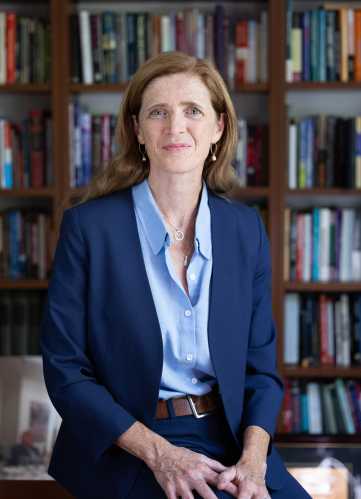
CO-HOST SCOTT ANDERSON: Ambassador Samantha Power led USAID from 2021 to the end of the Biden administration.
SAMANTHA POWER: Much has rightly been made on the way the U.S. Congress, the American people, came together in support of military assistance to Ukrainian soldiers, but far less attention has been paid to the incredible work that USAID staff did on the ground to take away two of Putin’s weapons in this war, the weapon of winter and the blockade of the Black Sea ports.7
CO-HOST SCOTT ANDERSON: Russia planned to freeze Ukrainians through the winter.
SAMANTHA POWER: But USAID came in with congressional and taxpayer support to partner with Ukrainians to repair energy infrastructure almost as soon as it went down.
CO-HOST SCOTT ANDERSON: Putin also attempted to cripple Ukraine’s economy by cutting off its grain and other agricultural exports, exports that the rest of the world depends on as well.
SAMANTHA POWER: Not only would that have deprived the world’s farmers of their livelihoods, but it had the effect of driving up global food prices, including here in the United States. Ukrainian farmers sat down with USAID and said, “We can’t get the grains out the way that just six months ago we were able to get them out.
Okay, what about rail? What about road? How do we streamline the customs process so that the commodities can move across the border?” [00:12:00] With this support, Ukraine was in a position to meet many of its pre full-scale invasion numbers in terms of agricultural exports. The effect on averting starvation in Sub-Saharan Africa was profound.
The effect on inflation in the United States and across the world was profound. This is what USAID did at its best. MacGyver-like ingenuity, problem-solving.
CO-HOST SCOTT ANDERSON: What USAID did for Ukraine, and had done decades earlier for South Korea or Poland, delivered on President Kennedy’s vision. Stability in the world is good for American national security, and its economy, too.
JEREMY KONYNDYK: You know, historically, there are some huge wins that USAID has been a part of that have been good for the world and good for American security and American prosperity.
CO-HOST SCOTT ANDERSON: This is Jeremy Konyndyk. He worked at USAID under two administrations. His career has centered on humanitarian policy.
JEREMY KONYNDYK: If you go back to the first decade of USAID, you could point to the Green Revolution, which lifted agricultural yields in many chronically food insecure countries around the world to such a degree that something like famine, which had been a constant scourge in South Asia for decades, was largely eliminated.
CO-HOST SCOTT ANDERSON: When the world was in desperate need of food, USAID centered agriculture. The agency was the principal funder of a research center which would go on to develop life-saving agricultural innovations, doubling or even tripling grain production.
JEREMY KONYNDYK: You know, it was an aid program, but it operated at a geopolitical level.
It was so important and so successful that it reverberated in geopolitics. Kind of the
smart money was betting on resource scarcity and overcame that. If you zoom forward 30, 40 years, late ’90s, there is a similar doom and gloom around the global HIV [00:14:00] crisis.
CO-HOST SCOTT ANDERSON: At the time, reports from Africa were grim.
UNKNOWN: She says that she has lost, uh, three sons and, uh, three- and four daughters. Yeah. And,
CO-HOST SCOTT ANDERSON: and what about their spouses?
UNKNOWN: They also died. Mm-hmm. Yeah.
Out of 165 pupils in the school, 87 of them are orphans.
JEREMY KONYNDYK: HIV is becoming so devastating in much of sub-Saharan Africa that it is having region-wide economic impact because it is affecting so many people that it is actually devastating the labor pool of entire countries.
President Bush then launches the PEPFAR program, the President’s Emergency Plan for AIDS Relief.
CO-HOST SCOTT ANDERSON: PEPFAR was a commitment to address AIDS by a Republican president and a bipartisan Congress. While overseen by the State Department, it was largely executed on the ground by USAID.8
JEREMY KONYNDYK: And within 20 years, this amazing partnership, so it really turns around the global HIV epidemic.
One estimate is it saved something north of 20 million lives, and it stabilized the economies of entire regions of the world.
CO-HOST SCOTT ANDERSON: The State Department and USAID estimate that PEPFAR has saved over 26 million lives since it started.9
CHRIS MILLIGAN: U.S. assistance has had an extraordinary impact. Americans should be proud of this.
CO-HOST SCOTT ANDERSON: Chris Milligan says the results of USAID’s 60 years in operation, the simple facts, speak for themselves.
CHRIS MILLIGAN: Since 1990, one billion people have been lifted out of extreme poverty.10 2.2 billion malaria cases prevented, saving 12.7 million lives.11 USAID helped contribute to a reduction in child mortality globally.
It has been cut in half.12 USAID has helped educate more than 100 million children,13 and humanitarian [00:16:00] assistance reaches over 100 million people annually.14 But these aren’t just humanitarian results. They’re in our national interest.
CO-HOST SCOTT ANDERSON: USAID’s work to create stability overseas, ending famines and fighting pandemics, helped protect American lives at home as well.
It represented how a small, well-placed US investment could pay dividends for US national security and for Americans. The amount the United States spent on US foreign assistance amounted to less than one penny of every dollar the US government spends each year,15 and it was able to do all of this. That is, until January 2025.
On Inauguration Day in January 2025, one of President Trump’s first acts was an executive order freezing nearly all US foreign assistance for 90 days. A week later, USAID’s 60 most senior career officials were abruptly put on administrative leave, effective immediately, for continuing to work on foreign assistance programs in alleged violation of the president’s order.16
USAID staff watched as security escorted those senior officials out of the building.
NICK ENRICH: All of our programs were frozen.
CO-HOST SCOTT ANDERSON: This is Nicholas Enrich. He was at USAID’s headquarters when the news came in.
NICHOLAS ENRICH: There was a communications ban, so we couldn’t talk to other agencies, we couldn’t talk to international organizations, we couldn’t talk to partner countries, and we couldn’t talk to our contractors.
CO-HOST SCOTT ANDERSON: Enrich had been with USAID for over a decade, but this change was unlike anything he’d experienced before.
NICHOLAS ENRICH: We didn’t know really who was in charge of our agency, and we were starting to get the sense that they were tearing it down before they even spent the time to figure out what it was.
CO-HOST SCOTT ANDERSON: In the days that followed, Enrich received a text from a colleague.
NICHOLAS ENRICH: She had sent me a message that said, “Congrats,” with an upside down, uh, smiley face, and then I went and checked my email and saw that I was now the acting assistant administrator for global health. [00:18:00] That was the atmosphere that I came into as I, uh, took the reins for the bureau that’s responsible for saving lives around the world and keeping Americans safe from infectious diseases.
CO-HOST SCOTT ANDERSON: Enrich wrote a series of memos for USAID’s remaining leadership, detailing some of the massive humanitarian costs of the freeze on U.S. foreign assistance.17 His memos were quickly leaked to the public. Within an hour, Enrich was himself removed from office and put on administrative leave. Within weeks, nearly all USAID personnel would lose their jobs.18
Federal employees were locked out of their offices,19 then formally fired through reductions in force. Contractors, a huge share of the agency’s actual workforce, got even less warning. Some were left stranded overseas in conflict zones without the government resources they needed to return home. Lawsuits temporarily slowed some of this down and helped mitigate some of the most dangerous situations.20
But some courts ultimately ruled that these sorts of labor and contract disputes had to go through special procedures set up by Congress, procedures that might eventually pay damages, but couldn’t stop what the administration was doing in real time. Many of those cases are still being litigated today.21
NICHOLAS ENRICH: And all the while, there was a team of demolition crews that was removing USAID’s name from the building, taking the pictures out of the picture frames, and we had the richest man in the world and the President of the United States saying horrible things about us, like that we were radical lunatics or criminals or evil or Marxist anti-Americans.22
CO-HOST SCOTT ANDERSON: On February 3rd, 2025, Elon Musk, the richest man in the world and head of the Department of Government Efficiency, or DOGE, took to X, the social media platform that he owns. He posted, “We spent the weekend feeding USAID into the wood chipper. Could have gone to some great parties. Did that instead.”23 There’s no congressional hearing, nor formal statement from the White House.24
JESSE WATERS: Angry Democrats throwing a hissy fit after Elon Musk dropped the
[00:20:00] DOGE hammer on USAID. The Trump administration argues it has become a clown car of corruption, and Musk sums it up this way, quote, “USAID is a criminal organization. Time for it to die.” Uh, so Musk had a busy weekend.
ANDREW NATSIOS: Took two weeks. They listened to the saying in Silicon Valley, move quickly and break things, and they broke AID.
CO-HOST SCOTT ANDERSON: Andrew Natsios was the head of USAID during the George W. Bush administration.
ANDREW NATSIOS: But I also served during Bush 41, the elder Bush, as the director of the Office of Foreign Disaster Assistance. So I’ve had about eight or nine years of experience in AID.
CO-HOST SCOTT ANDERSON: He is perhaps the first to admit USAID wasn’t perfect.
ANDREW NATSIOS: All human institutions are flawed, whether they’re in the government, the nonprofit sector, in business, or anywhere else. We are never going to create a perfect institution anywhere. You think the private sector always functions properly? Of course it doesn’t. Anybody knows that, including business people.
And I’m a Republican and a capitalist.
CO-HOST SCOTT ANDERSON: But, Natsios says, Elon Musk’s accusation that USAID was plagued by waste, fraud, and abuse just doesn’t hold water.
ANDREW NATSIOS: The basis is political ideology. It’s pandering to the base. He thinks he was fixing the federal budget deficit. Aid is 1% of the federal budget. 75% of the federal budget is mandatory spending or entitlement programs.
You can’t balance the budget by abolishing aid.
CO-HOST SCOTT ANDERSON: But those allegations did have lasting effects, no matter how baseless they were.
JEREMY KONYNDYK: They accused USAID of just being a giant slush fund. It’s completely false.
CO-HOST SCOTT ANDERSON: This is Jeremy Konyndyk again.
JEREMY KONYNDYK: It’s almost laughable how diametrically wrong that kind of accusation is.
CO-HOST SCOTT ANDERSON: According to the U.S. Global [00:22:00] Leadership Coalition, USAID’s inspectors general conducted nearly 3,000 audits between 2018 and 2024, covering more than $216 billion in funds. Only 0.3% were flagged for further investigation.25
JEREMY KONYNDYK: You know, by the time USAID spent a dollar that had gone through multiple rounds of congressional appropriations, congressional appropriations review, internal reviews at USAID, another round of congressional notification, to get any money out of USAID was a huge pain in the neck.
There were many, many layers of protection against that kind of waste, fraud, and abuse.
CO-HOST SCOTT ANDERSON: Running these oversight and accountability processes is a big part of what USAID did, which is why in February 2025, USAID’s inspector general issued a memorandum26 warning that the Trump administration’s pause in foreign assistance funding and dramatic cutting of USAID staff actually threatened to undermine those efforts.
The next day, President Trump fired him.27 In targeting USAID, the Trump administration wasn’t so much taking on waste, fraud, and abuse as it was taking on Congress.
JEREMY KONYNDYK: The existence of USAID is mandated in law. The programs that USAID implemented were mandated by Congress.
CO-HOST SCOTT ANDERSON: Since 1998, Congress had required by law that there be a USAID within the executive branch, and in 2024, it prohibited the executive branch from reorganizing USAID except in consultation with Congress.28
JEREMY KONYNDYK: Congress sets spending priorities, and the administration has to follow them.
CO-HOST SCOTT ANDERSON: But there was a loophole. The same 1998 law also put USAID under the direct authority of the Secretary of State29, and it didn’t say much about what USAID actually had to look like. In 2025, this allowed Secretary of State Marco Rubio to reassign many of USAID’s legal responsibilities to the State Department, emptying it of any real authority, even if it technically remained a legal entity, all while sending notices to [00:24:00] Congress in lieu of real consultation.30
And Congress, which was narrowly controlled by President Trump’s political allies, chose not to fight back. But the Trump administration didn’t stop there. In March 2025, Secretary Rubio announced that the administration had completed their review of US foreign assistance and was canceling 83% of USAID’s grants,31 including for some work groups had already completed.
Many grantees sued, and the resulting dispute went all the way to the Supreme Court twice. Some aid groups successfully won back pay for completed work.32 Other fights over specific programs are still ongoing, and that includes the fight over the biggest question of them all: Whether a president can simply refuse to spend money Congress has already appropriated.
Congress itself ended up clawing back some foreign assistance funding at President Trump’s request,33 while the administration agreed to release much of the rest. The White House did ultimately refuse to spend four billion dollars in foreign assistance funds that Congress had appropriated, withholding it past its statutory expiration date.
Lower courts held that the administration had to spend that money as Congress had intended before it expired.34 But the Supreme Court ultimately allowed the Trump administration to withhold the money while the issue is litigated, even past its expiration date. The merits of that dispute are still being debated, and the Trump administration may still lose on principle.
But practically, the administration was successful in withholding those funds, and it has suggested that it intends to try and do so again in the future.
JEREMY KONYNDYK: And that’s a constitutional issue. That’s not just a USAID issue. If an administration can unilaterally decide we can pass a budget and then at our discretion ignore what’s in it, we can have a congressionally mandated federal agency and just decide it doesn’t exist anymore.
Well, that doesn’t stay limited to USAID. And the balance of power and the separation of powers in the U.S. that is fundamental to the, the constitutional design of the U.S. [00:26:00] government, USAID was the first battlefield.
CO-HOST SCOTT ANDERSON: The consequences of all these cuts reached well beyond the federal government. Many USAID programs were carried out by a wide web of outside organizations, nonprofits, and contractors that depended on federal money to operate.35
When that money vanished, most had to shrink fast. According to one estimate, more than 20,000 American aid workers and 200,000 more overseas lost their jobs or went unpaid.36
JEREMY KONYNDYK: The heavy reliance on NGOs and contractors in USAID programming was not just because there was a sort of preference to support these big institutions.
It was because in places where the U.S. government can’t see eye to eye with a host government over X, Y, and Z issue, that’s not a reason to write off the health of that whole population.
CO-HOST SCOTT ANDERSON: The worst damage wasn’t to USAID or its implementing partners. It was to the people they worked to serve.
FATMA TANIS: One thing that we really don’t know is the death toll from this, the actual numbers.
CO-HOST SCOTT ANDERSON: Fatma Tanis is a correspondent at NPR who covers foreign aid policy, international development, and global health. Since USAID’s dismantling, she’s been reporting from the ground in Uganda, Rwanda, and Yemen.
FATMA TANIS: Countries, especially low-income countries, vulnerable countries, first of all, they are definitely still reeling from the impact of the aid cuts.
We’ve seen some of the emergency level impact, like mainly in the health sector, because those were just like daily stuff, right? Like one day you had drugs, the next day you didn’t have medicine.
CO-HOST SCOTT ANDERSON: Estimates indicate that the dismantling of USAID has already led to hundreds of thousands of deaths.
According to one model by Boston University epidemiologist Brooke Nichols, almost 800,000 people, about two-thirds of them children, may have already died in the first year of U.S. foreign assistance cuts.37 And that number [00:28:00] skyrockets when you consider the great aid recession. Germany, France, Canada, and the United Kingdom, among others, have also made cuts to their foreign aid programs that together contribute to a drastic reduction in total global aid.38
One study in the medical journal The Lancet estimates that by 2030, global aid cuts could lead to as many as 9.4 million deaths.39
NICHOLAS ENRICH: One of the things that kind of keeps me up all night is that we haven’t even started to really see the worst of it yet.
CO-HOST SCOTT ANDERSON: This is Nick Enrich again. He became, without warning, the acting head of USAID’s Global Health Bureau before he himself was terminated.
Like many of the issues USAID worked to solve in the world, preventing disease abroad has a direct impact on Americans at home.
NICHOLAS ENRICH: Cuts to foreign aid have resulted in direct national security threats, like, for example, the interruption of clinical trials for new tuberculosis drugs. Tuberculosis, it’s a airborne infectious disease.
Um, it’s a bacteria that is a- as far away as a plane flight to the United States. That’s a risk to Americans’ health directly.
CO-HOST SCOTT ANDERSON: USAID doctors and epidemiologists who had treated disease around the world were also collecting a ton of data.
ANDREW NATSIOS: Most of the data in the World Bank on health comes from the AID system.
CO-HOST SCOTT ANDERSON: This is Andrew Natsios again, former head of USAID under President George W. Bush.
ANDREW NATSIOS: They report on new diseases. That is the early warning system for pandemics. Diseases don’t need passports. If you don’t stop a disease at the source when it starts, it’s too late.
CO-HOST SCOTT ANDERSON: In summer 2026, Ebola started spreading fast across Africa.
Before USAID’s dismantling, outbreaks like this were contained through the agency’s collaboration with local communities and partners like the World Health Organization, or WHO.40 This approach was key to containing the Ebola outbreaks of 2014 [00:30:00] and 2018.41 But this new outbreak rapidly became a crisis.
According to WHO data, by August 1st, 2026, the Ebola outbreak was the largest ever reported in the Democratic Republic of Congo.42 And Ebola isn’t the only fast-spreading disease that poses significant risk to the world’s health.
ANDREW NATSIOS: I don’t believe the greatest threat to the world is a nuclear holocaust or global warming or a conventional war.
I think it is going to be a pandemic that gets so out of control that we have no drugs to treat it. That is the grave risk, and it’s, the risk is getting worse. We just destroyed the early warning system to protect us, not just the developing world, from new diseases. It’s madness to have done this.
CO-HOST SCOTT ANDERSON: It’s not just in global health where the world has yet to feel the full impact of USAID’s dismantling.
FATMA TANIS: There are things like development, governance, democracy, human rights, and we’re going to be seeing the impact on that for several years to come.
CO-HOST SCOTT ANDERSON: This is Fatma Tanis again. In addition to the clinics, clinical trials, hospitals, and emergency rooms USAID was forced to walk out of, it also ended longstanding support for civil society organizations, human rights groups, and independent media.43
FATMA TANIS: Governments who were dealing with the U.S., there are some who will be, you know, feel relief that they no longer have to show improvement in corruption, improvement in human rights, improvement in, you know, democracy in order to receive U.S. assistance.
CO-HOST SCOTT ANDERSON: Altogether, USAID’s absence around the world has been costly.
The humanitarian loss is the most immediate. The loss of health security may be the most insidious. The loss to democratic values, the decline in accountability for corruption, for human rights violations may be the hardest to track. But the loss of American standing in the world, how countries and other foreign partners think of us, their willingness to work with us, their trust in us may be the [00:32:00] hardest to repair.
Tanis saw this firsthand in her reporting.
FATMA TANIS: I did hear this from, like, officials in Uganda, in various districts, “We have to figure out a way to take care of ourselves. Clearly, we can no longer trust that American foreign aid is going to be consistent.” Several people described it to me as an eye-opening moment, that they need to figure out how to do it on their own.
There’s a sense that trust has been broken.
FORMER USAID RECIPIENT: We have about 3,200 patients. It is impossible for me to see all of them. It is very painful to lose someone, uh, of a treatable disease.
They used to give us family planning. That’s my anxiety right now. How do I protect myself from getting a child? I can’t access condoms.
The workers, a lot of the workers in HIV clinics were paid by Americans, and I think they have not recovered.
CO-HOST SCOTT ANDERSON: In April 2026, Secretary of State Marco Rubio sent a cable to every U.S. embassy in the world to promote America First values.44 The cable directed diplomats to press foreign governments to sign a joint declaration that called for, quote, “Trade over aid, opportunity over dependency, and investment over assistance.”45
Instead of promoting humanitarian aid, Rubio called for the creation of, quote, “Business opportunities for U.S. companies.”
SAMANTHA POWER: I think we are seeing more voices advocating for that transactional, immediate gratification.
CO-HOST SCOTT ANDERSON: This is Ambassador Samantha Power again. She ran USAID under President Biden.
SAMANTHA POWER: I understand the appeal of a more transactional approach.
What can we get from a developing country that will very immediately benefit the American people in the here and now? But you don’t have to be an [00:34:00] economist or a political scientist to see how short-sighted that is.
CO-HOST SCOTT ANDERSON: As we’ve learned, development is work that spans generations and sectors in its impact.
Power says effective trade that’s in the U.S. interest requires the very stability that foreign assistance underwrites.
SAMANTHA POWER: Because the U.S. economy is so integrated with that of other countries, because we have embassies and a presence in just about every part of the world, stability, economic stability, but also political stability is in the U.S. interest.
It is not in the U.S. interest for the United States to be standing on the other side of the world and saying, “Well, call us when we can have your critical minerals.” It’s not gonna work that way.
CO-HOST SCOTT ANDERSON: The United States is part of an integrated global system that functions best among stable, independent, effective nations.
Development, democracy, and accountability are all essential to that, the exact work USAID used to do.
SAMANTHA POWER: The United States has been by far the largest supporter of democracy, civil society, rule of law, work, training judges, court clerks, providing resources to independent media so that they can continue to be a check and balance within their societies, holding elected leaders accountable.
Without those checks and balances, it’s much more likely in non-democratic societies that those benefits be concentrated. It’s much more likely you will see also corruption channeling resources away from the public good to the interests of a few.
RAJ KUMAR: You know, the old aid model did deliver a lot of benefits, certainly in the case of HIV, in the case of humanitarian aid. It saved a lot of lives.
CO-HOST SCOTT ANDERSON: Raj Kumar has spent 25 years covering the aid sector as founding president of Devex, a prominent [00:36:00] platform for the global development community. He argues that the trade over aid fight is a distraction from a bigger shift that is already underway.
RAJ KUMAR: We think about development in this new world as something broader than just aid. It also includes foundations, individual giving. It includes private sector investment, impact investment. It includes the countries themselves and their own domestic spending. In many cases, that’s the biggest piece of the pie.
CO-HOST SCOTT ANDERSON: Kumar is charting the ripple effects of USAID’s dismantling across the global development landscape.
RAJ KUMAR: Ten years from now, there will be much more money spent on what we call global development, but much less of it will be traditional aid, and I think that’s the big transition we’re going through now from an aid model to an investment model.
CO-HOST SCOTT ANDERSON: Kumar points to a small nonprofit in Kenya as an example. Its founder grew up not knowing where her next meal would come from. Today, her organization feeds six hundred thousand Kenyan schoolchildren a day and is on track to reach three million by 2030.
RAJ KUMAR: She looks at those kids not as beneficiaries. She looks at those kids as customers.
She asks them, “Do you like the food I’m feeding you?” She gives them ratings just like a retail store would of their customers. Now, the kids who can’t afford that payment, well, their parents still have to pay something. It might be next to zero. The kids who can afford more, well, they have to pay more. So would you call that aid?
In my mind, this is the kind of new approach. Sure, there’s an aid component. There’s foundation money. There’s philanthropic giving that helps support this. There’s also a business happening here where the farmers and the middlemen are lowering their prices to sell at volume to now this school feeding program.
They’re thinking about the market.
CO-HOST SCOTT ANDERSON: Whatever model the United States settles on, NPR’s Fatma Tanis says the clock is already running.
FATMA TANIS: The U.S. loss is China’s gain by default, because when the U.S. is no longer in the room at the [00:38:00] WHO or other multilateral organizations, China is there, and experts say, you know, China’s able to posture as the adult in the room.
Pick any country, and particularly in Africa, and you’re likely driving on a Chinese road, going to a Chinese-built mall. It truly is everywhere. The infrastructure is mostly Chinese-built. People are definitely aware of it.
CO-HOST SCOTT ANDERSON: Tanis says that as the United States moves towards a more transactional model, China is strategically moving away from one, and towards an approach more like the one USAID pioneered for decades.
FATMA TANIS: In the past few years, what you’ve seen China doing is, you know, actually kind of emulating the US model, which they’ve actually called it small and beautiful projects. For example, refurbishing maternity ward in Zimbabwe, building a bridge in a Pacific island, but paying locals to build that bridge.
That’s very different from how they used to approach it, which, you know, in the past, a Chinese company would come, build the bridge, leave. Now, everyone’s asking the question, will China fill the U.S. shoes as the main global actor in foreign aid?
CO-HOST SCOTT ANDERSON: Today, USAID technically still exists, but largely in name only. The foreign assistance programs it once managed are now mostly run out of the Department of State. What shreds of the organization remain are overseen by the Office of Management and Budget.46 In theory, a future president might try to restore USAID, but building it back won’t be as easy as it was to tear down.
How do you recruit new staff when they know a future president might not just fire them, but abandon them overseas? Where do you find implementing partners when the specialized organizations that did this work for decades have had to shrink dramatically or even file for bankruptcy? The Trump administration is already feeling the effects of its own cuts.
Numerous USAID [00:40:00] programs that served President Trump’s stated priorities, from counter-narcotics47 to counter-terrorism48 to migration flows,49 were canceled or fell apart. When the United States took over humanitarian aid in Gaza in October 2025, the Trump administration’s efforts to use private contractors failed so badly that it had to hand responsibility over to UN agencies it had spent months criticizing.50
In June 2026, when an earthquake struck Venezuela, the State Department scrambled to rebuild the disaster response teams it had lost when USAID was dismantled.51 Even as it’s told the United Nations to, quote, “adapt, shrink, or die,” the Trump administration has had to channel three point eight billion dollars in humanitarian assistance through UN agencies because the United States can no longer distribute it on its own.
And this lack of capacity isn’t just a problem for the Trump administration. It’s a problem for Congress, too.
Congress continues to appropriate substantial money for foreign assistance, despite the Trump administration’s objections.52 For 2026, the Trump administration had initially proposed a 48% cut in foreign assistance, but Congress refused, and only cut it by about 16% from 2025 levels.53
ANDREW NATSIOS: Congress dumped the entire aid budget of the administration, which had massive cuts in it.
The budget that went through restored almost all the democracy and governance accounts, which are critically important to institution building. The administration had wiped out, and Congress restored all those accounts.
CO-HOST SCOTT ANDERSON: Andrew Natsios says it was largely a bipartisan effort.
ANDREW NATSIOS: Under heavy pressure, by the way, from the White House to vote against that budget.
CO-HOST SCOTT ANDERSON: Now the question is, how much of the available money will the Trump administration actually spend as directed, and how much will it withhold, at least until the Supreme Court says it can’t? The early signs aren’t good. In September 2026, the Trump administration announced that it intends to use $2.5 billion [00:42:00] originally allocated for global health programs and development assistance to pay for, quote, “USAID closeout costs.”54
And it requested that Congress rescind almost another $1 billion in unobligated funds for items like refugee resettlement just two days before the funds were set to expire, affecting yet another pocket rescission. This time, however, district courts hearing legal challenges to those actions took the extraordinary step of suspending the fund’s expiration date.
As of the time of recording, those challenges, and the validity of those suspensions, are still being actively litigated. Congress also can’t be as confident that any funds that are spent are going where they’re supposed to. Remember all those processes USAID used to try and curb waste, fraud, and abuse?
As of late 2025, the State Department was managing a foreign assistance portfolio about 62% the size of USAID’s with only 6% of the staff.55 If there is an upside to the Trump administration’s dismantling of USAID, it may be that it forces a long-simmering debate over how foreign aid should work in the 21st century.
There are lots of directions the United States could go, from the Trump administration’s transactional approach to Raj Kumar’s vision of aid as investment. The right answer may not be any of these approaches, but several side by side. That debate will fall to this administration, or more likely its successor, and to Congress.
That is, if Congress finds a way to ensure that what it decides to fund actually gets spent that way. If the executive branch can continue to choose not to follow Congress’s directions on how to provide foreign assistance, then Congress’s role may end up even more limited. And however Congress and the executive branch choose to proceed, whether by rebuilding USAID or replacing it or keeping its functions within the State Department, they will be hindered by the lingering legacy of how USAID was destroyed.
An inability to [00:44:00] attract experts into government, a devastated sector of implementing partners, and an increasingly distrustful world. In the interim, there are millions of people around the world whose lives may be changed forever depending on how the United States engages, including countless Americans.
SAMANTHA POWER: We are connected fundamentally to the fates of people in many parts of the world. To have a team of experts with so much experience in so many different kinds of crises deployed on the ground to brainstorm, to iterate, to invent on behalf of stability, prosperity, and America’s own interests, we lose that at our grave peril
CO-HOST SCOTT ANDERSON: Next time on Deep Cuts, the Internal Revenue Service.
TRACI DIMARTINI: I don’t think people will fully understand the damage that was done to the Internal Revenue Service until the Trump administration is out of office.
NINA OLSON: The IRS was being asked to make a taxpayer’s return information available government wide.
CHYE-CHING HUANG: Misuses of taxpayer data and the tax system are a crime.
REBECCA THOMPSON: While it starts with the immigrant populations and it starts with DHS, it opens the door for Big Brother to come in and just transfer data at will.
CO-HOST SCOTT ANDERSON: Deep Cuts is a production of the Brookings Institution and Goat Rodeo. You can follow the series on Apple, Spotify, or wherever you get your podcasts. For Goat Rodeo, the lead producer of this episode is Jay Venables, with production support from Cara Shillin and Ian Enright. Production assistance from Hazel Hoffman.
For the Brookings Institution, the lead producers are Molly Reynolds and me, Scott R. Anderson. Additional writing and research on this episode by George Ingram, Jonathan Katz, Eric Irby, and Robin Lewis. Fact [00:46:00] checking by Abby Ward. Series graphics and visuals by Adelle Patten. Additional thanks to Vanessa Williamson, Massi Colonna, Ellis Chen, and Nancy Lauffer. The communications director for the Governance Studies program at Brookings is Jenna Portnoy.
Music from Alibi and Blue Dot Sessions. A special thank you to all of the interviewees who made this show possible.
-
Resources
- Scott R. Anderson et al., “The Implications of a USAID Shutdown,” Brookings Institution, February 4, 2025, https://www.brookings.edu/articles/what-comes-after-a-usaid-shutdown/.
- Sam Vigersky, “The Great Aid Recession: 2025’s Humanitarian Crash in Nine Charts,” Council on Foreign Relations, December 23, 2025, https://www.cfr.org/articles/great-aid-recession-2025s-humanitarian-crash-nine-charts.
- Jory Heckman, “State Dept Is Looking to Rebuild after Major Staffing Cuts. Laid-Off Diplomats Say They’re Not Welcome Back,” Federal News Network, July 10, 2026, https://federalnewsnetwork.com/workforce/2026/07/state-dept-is-looking-to-rebuild-after-major-staffing-cuts-laid-off-diplomats-say-theyre-not-welcome-back/.
- Karen Feldscher, “USAID Shutdown Has Led to Hundreds of Thousands of Deaths,” Harvard T.H. Chan School of Public Health, November 20, 2025, https://hsph.harvard.edu/news/usaid-shutdown-has-led-to-hundreds-of-thousands-of-deaths/.
- OECD, “A Historic Decline in Foreign Aid: Preliminary 2025 ODA Data,” data explainer, April 2026, https://www.oecd.org/en/data/insights/data-explainers/2026/04/a-historic-decline-in-foreign-aid-preliminary-2025-oda-data.html.
- “U.S. Dismantling of USAID Is Undermining Ebola Response, Experts Warn,” Global Biodefense, June 15, 2026, https://globalbiodefense.com/2026/06/15/u-s-dismantling-of-usaid-is-undermining-ebola-response-experts-warn/.
- Jennifer Kates, Anna Rouw, and Stephanie Oum, “U.S. Foreign Aid Freeze & Dissolution of USAID: Timeline of Events,” KFF, updated October 7, 2026, https://www.kff.org/global-health-policy/u-s-foreign-aid-freeze-dissolution-of-usaid-timeline-of-events/.
Participants
Co-hosts

Participants
-
Footnotes
- https://www.thelancet.com/article/S0140-6736(25)01186-9/fulltext
- https://www.justsecurity.org/107267/can-president-dissolve-usaid-by-executive-order/
- https://ph.ucla.edu/news-events/news/research-finds-more-14-million-preventable-deaths-2030-if-usaid-defunding
- https://www.bloomberg.com/news/articles/2026-06-16/china-boosting-aid-to-poor-countries-the-us-abandoned
- https://www.youtube.com/watch?v=eV5WT6r089w
- https://www.govinfo.gov/content/pkg/COMPS-1071/pdf/COMPS-1071.pdf
- https://www.csis.org/analysis/keynote-remarks-assistant-administrator-erin-mckee-bureau-europe-and-eurasia-us-agency
- ttps://www.state.gov/about-us-pepfar
- https://www.kff.org/global-health-policy/the-u-s-presidents-emergency-plan-for-aids-relief-pepfar/
- https://www.brookings.edu/wp-content/uploads/2022/02/Evolution-of-global-poverty.pdf
- https://www.who.int/campaigns/world-malaria-day/2025
- https://data.unicef.org/topic/child-survival/under-five-mortality/
- https://files.eric.ed.gov/fulltext/ED615859.pdf
- https://bristoluniversitypressdigital.com/view/journals/jpsj/33/3/article-p347.xml
- https://carnegieendowment.org/emissary/2025/02/usaid-trump-foreign-aid-policy-why
- https://www.politico.com/news/2025/01/27/top-usaid-career-staff-ordered-leave-00200854
- https://www.nytimes.com/interactive/2025/03/03/health/usaid-memo.html
- https://www.npr.org/sections/goats-and-soda/2025/03/28/g-s1-56968/usaid-terminates-nearly-all-its-remaining-employees
- https://www.fedmanager.com/news/usaid-workers-put-on-leave-locked-out-as-agency-targeted-for-closure
- https://abcnews.com/US/judge-temporary-order-blocking-trumps-dismantling-usaid/story?id=118585005
- https://afsa.org/afsa-lawsuit-tracker
- https://www.cjr.org/the_media_today/usaid-and-the-media-in-a-time-of-monsters.php
- https://x.com/elonmusk/status/1886307316804263979?lang=en
- https://onlinelibrary.wiley.com/doi/10.1002/pad.70011
- www.usglc.org/media/2025/02/Myths-Facts-U.S-International-Assistance.pdf
- https://oig.usaid.gov/sites/default/files/2025-02/USAID%20OIG%20-%20Oversight%20of%20USAID-Funded%20Humanitarian%20Assistance%20Programming%20021025.pdf
- https://www.nbcnews.com/politics/politics-news/usaid-inspector-general-fired-releasing-report-trumps-downsizing-effor-rcna191790
- https://www.cfr.org/articles/what-usaid-and-why-it-risk
- https://www.congress.gov/bill/105th-congress/house-bill/4328/text
- https://www.washingtonpost.com/politics/2025/03/28/trump-usaid-abolish-earthquake-congress/
- ttps://www.theguardian.com/us-news/2025/mar/10/marco-rubio-usaid-funding
- https://www.nytimes.com/2025/03/10/us/politics/usaid-foreign-aid-freeze-release-deadline.html
- https://www.nytimes.com/2025/07/17/us/politics/senate-vote-trump-bill-pbs-npr-foreign-aid.html
- https://rollcall.com/2025/09/26/supreme-court-allows-us-to-cancel-4-billion-in-foreign-aid-funds/
- https://www.unlockaid.org/follow-the-money
- https://www.usaidstopwork.com/
- https://hsph.harvard.edu/news/usaid-shutdown-has-led-to-hundreds-of-thousands-of-deaths/#:~:text=The%20dismantling%20of%20USAID%2C%20according,them%20children%2C%E2%80%9D%20Gawande%20wrote
- https://www.usnews.com/news/world/articles/2026-09-22/climate-disasters-are-growing-so-are-cuts-to-programs-that-prepare-for-them
- https://www.cnn.com/2026/02/04/world/lancet-usaid-global-aid-cuts-intl
- https://hsph.harvard.edu/news/ebolas-spread-fueled-by-cuts-in-humanitarian-aid/
- https://globalbiodefense.com/2026/06/15/u-s-dismantling-of-usaid-is-undermining-ebola-response-experts-warn/
- https://www.who.int/emergencies/disease-outbreak-news/item/2026-DON615
- https://reliefweb.int/report/world/cessation-us-aid-has-hit-independent-civil-society-hard-activists-anti-corruption-organisations-and-independent-media-are-all-risk
- https://www.washingtonpost.com/national-security/2026/04/15/trump-un-trade-over-aid/
- https://statedept.substack.com/p/making-foreign-aid-great-again
- https://www.politico.com/news/2025/08/29/rubio-usaid-closeout-vought-00536088
- https://www.washingtonpost.com/world/2025/03/16/trump-aid-freeze-anti-narcotics-latin-america/
- https://thehill.com/homenews/ap/ap-international/ap-a-surge-in-violence-followed-trumps-cuts-to-usaid-programs-in-africa-a-study-finds/
- https://www.npr.org/2025/04/01/nx-s1-5327284/cuts-to-usaid-could-impact-trump-administration-efforts-to-curb-migration
- https://www.courthousenews.com/us-backed-aid-company-in-gaza-shutters-operations/
- https://www.theguardian.com/us-news/2026/jun/28/venezuelan-earthquakes-test-trumps-new-western-hemisphere-policy-after-gutting-of-usaid
- https://www.opb.org/article/2026/02/06/congress-passes-dollar50-billion-foreign-aid-bill-despite-the-trump-s-cuts-in-2025/
- https://www.devex.com/news/us-lawmakers-strike-50b-foreign-assistance-deal-surpassing-trump-s-plan-111671
- https://economictimes.indiatimes.com/news/international/us/a-3-2-billion-showdown-democrats-say-trump-is-redirecting-aid-and-letting-millions-expire/articleshow/134442960.cms
- https://www.cgdev.org/blog/fixing-spending-crisis-department-state
The Brookings Institution is committed to quality, independence, and impact.
We are supported by a diverse array of funders. In line with our values and policies, each Brookings publication represents the sole views of its author(s).
Commentary
PodcastThe US Agency for International Development (USAID) | The Deep Cuts Podcast, Episode 2
The story of the agency’s far-reaching impact, how it was taken apart, and what its loss means for the world
Listen on
November 17, 2026