The 2026 primary season has included a series of high-profile wins by candidates associated with the Democratic Socialists of America (DSA). Since its founding in 1982, DSA members have worked largely within the Democratic Party to move it to the left on issues they care about. For several decades, the DSA’s impact on American politics was minimal. Its most visible elected official, longtime Sen. Bernie Sanders (I-Vt.), has held his Senate seat since 2007, but his 2016 presidential run brought democratic socialism into the national conversation.
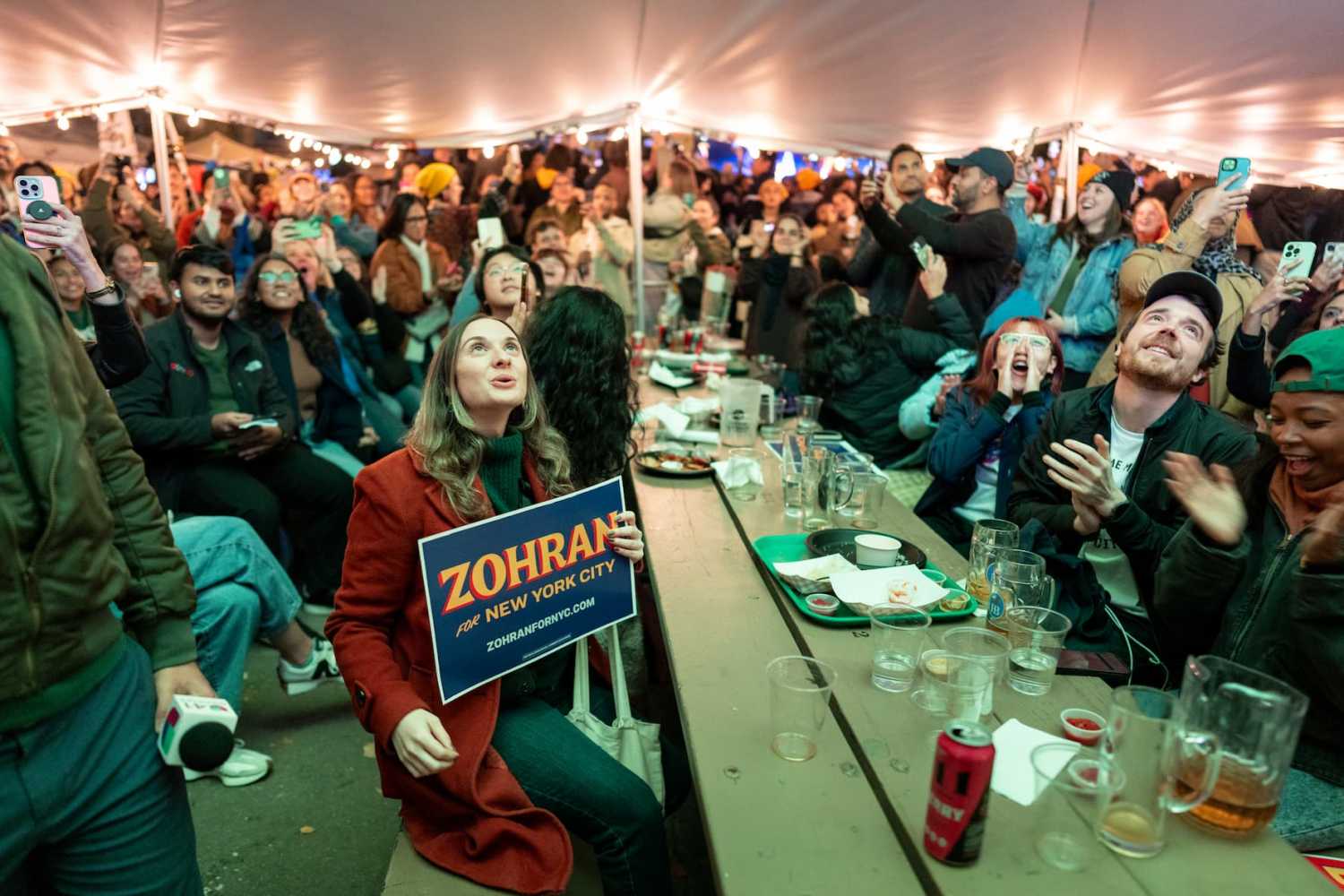
In 2026, DSA is having a moment. Its most important breakthrough came in late 2025 with the election of Zohran Mamdani as mayor of New York City. Then, in the 2026 primaries, candidates from the party’s insurgent left chalked up some high-profile wins in important swing states. The most prominent was Abdul El-Sayed, who won the Democratic nomination for Senate in Michigan. Even though he calls himself a capitalist, was never a member of DSA, and wasn’t formally endorsed by DSA, his win, along with several other congressional successes and Francesca Hong’s close second in the Democratic gubernatorial primary in Wisconsin, signaled the left’s growing reach.
Some Democrats have met the nomination of DSA-endorsed candidates with panic. Democratic control of the House and Senate is in sight because of the economy and President Donald Trump’s low approval ratings, but many party centrists fear nominating candidates whose backgrounds are out of step with mainstream voters could cost Democrats control of the House and especially the Senate. Others take a more optimistic view. They expect these candidates to moderate their views in a general election and bring new young voters with them. There is also this: as research by the Cook Political Report’s Erin Covey has shown, in House seats most likely to flip to the Democrats, Democratic primary voters have largely nominated more moderate candidates.
So how important is the DSA movement? Are we seeing the emergence of a powerful new faction in the Democratic Party’s big tent, or is this all hype? We set out to see where DSA candidates are running and how they are doing.
Most DSA candidates are for local offices or for state legislative offices
We identified 282 DSA-endorsed candidates. Because DSA is highly decentralized, most were endorsed by local DSA chapters; only 29 carried an endorsement by the national DSA organization. Beyond these, many more candidates self-identify as democratic socialists—a universe far too diffuse to capture in its entirety. We therefore limited our count to candidates with a confirmed endorsement from an official DSA chapter. This study is not intended to be an exhaustive census of DSA-affiliated candidates but merely a first attempt to gauge the movement’s success. (There are a few candidates who were endorsed by their local DSA chapter, but who do not, on further inspection, seem to share DSA ideology.)
As Table 1 shows, of the 282 DSA-endorsed candidates we identified, more than half were seeking local or state legislative offices (99 were seeking local office, and 104 were running in primaries for state legislatures).
To get a sense of how large this movement is, it is important to place some of these numbers in context. For instance, the League of Women Voters counted 76,902 local elections in the United States in 2024. Nationally, there are 7,386 legislative seats in the nation’s state legislatures, so the number of DSA candidates is a tiny percentage of the total. The number of DSA candidates who actually won a Democratic nomination is well under 1%. And, of course, we don’t yet know how many of these candidates will win the general election in November.
Moreover, DSA candidates for statewide office and Congress fared worse than local and state legislative candidates, winning fewer than half of their primary elections (As of this writing, a few primaries remain in September, but their number is too small to affect these conclusions.) 1
DSA candidates are largely winning in places that are already liberal and Democratic
Furthermore, as some journalists have suspected, many of these candidates come from places that are already quite liberal, meaning DSA-backed candidates are favored to win in districts that Republicans are unlikely to win. In our sample, 90 candidates came from California and 21 from New York, accounting for a large portion of the candidates identified. Table 2 groups the statewide and congressional candidates by their states and districts’ Cook Partisan Voter Index (PVI), which characterizes partisan lean. The largest number of candidates came from states or districts with a history of Democratic strength and where Cook calculates a PVI of D+10 or greater. Even in those districts, however, DSA candidates lost more primaries than they won.
As Table 2 illustrates, as a state or district becomes more competitive, fewer DSA-endorsed candidates run, and fewer win. Only 10 DSA-backed candidates prevailed in districts with a party leaning of less than D+10 in the Cook PVI.
So, what are we to make of the DSA summer? From one perspective, the story of DSA candidates’ influence is overblown. The scarcity of candidates and their lack of strong success rates overall make this look more like a skirmish than a war. Complicating the narrative is the fact that, in the post-Biden world, voters have turned against candidates they perceive as too old, such as Rep. John Larson (D-Conn.), 78, who lost in a race largely centered on his age, not ideology.
It is still true that, as the saying goes, politics is played on the 50-yard line. America is today, as it has been for many years, a center-right country. “Conservatives outnumbered liberals by 3 to 2 in 2024, just as they outnumbered liberals by 3 to 2 from 2004 to 2024,” according to an analysis by Jim Kessler of Third Way. Evidence of this is that the progressive congressional candidates who have won their primaries are busy trying to scrub social media of their more left-wing statements. For instance, Darializa Avila Chevalier, who beat incumbent Rep. Adriano Espaillat (D-N.Y.) in a primary in New York’s 13th Congressional District, recently removed comments from online accounts featuring statements praising communism and Marxism, saying, “I have grown considerably in the years since these tweets, and I am focused on our community and our community’s future.” El-Sayed, as we noted, emphasizes that he is not a DSA member, that he is not a socialist, and that he can build a big tent for the Democrats.
Come November, all eyes will be on these candidates. Trump and the Republicans will not let these candidates’ more radical statements go—no matter how many times they try to scrub their past social media accounts or how often they disavow them. If left-wing nominees manage to win in swing districts, their overall movement will be strengthened; if they lose districts deemed winnable and cost Democrats control of the House and Senate, their mainstream presence will likely be diminished.
Nonetheless, the high-profile wins, fueled by young, white, educated voters, represent a warning to the rest of the party. They signal that unhappiness with the Democratic establishment and, in the post-Biden world, opposition to elderly officeholders can be leveraged by young, charismatic DSA candidates—and reflect an impatience with party leadership that transcends ideology.
Methodology: 2026 DSA-endorsed candidate coding project
Sample definition
This dataset covers candidates for federal, statewide, state legislative, and local offices in the 2026 election cycle who received a formal endorsement or recommendation from a local, state, or national chapter of the DSA.
Inclusion criteria:
- A candidate was included if and only if an official DSA chapter (local, state, or national) publicly endorsed or recommended their candidacy, typically via a chapter voter guide, chapter website, or chapter social media announcement. National DSA and any named local or state chapter (e.g., Denver DSA, Winston-Salem DSA, Central Coast DSA, etc.) were treated as equally valid for inclusion, regardless of chapter size or formality.
- Chapters vary in the language they use to signal support; some chapters distinguish between “endorsing” a candidate (denoting closer alignment with DSA’s platform and/or membership) and “recommending” a candidate (denoting general support without full alignment). We counted both categories toward inclusion without distinguishing between them in the dataset, since chapters did not apply this distinction consistently.
- Candidates who self-identified as democratic socialists or who were widely described in media coverage as DSA-aligned were not included unless we could independently confirm an official chapter endorsement or recommendation. This excluded a number of prominent progressive candidates (e.g., Nithya Raman and Abdul El-Sayed) who lacked confirmed DSA chapter backing.
A note on sample heterogeneity: DSA chapters do not apply uniform endorsement standards. Some chapters endorse only candidates they determine to be closely aligned with DSA’s platform, while others endorse or recommend whichever candidate they judge to be strongest in a given race—including candidates who read as standard progressive or even moderate Democrats. As a result, the ideological composition of this sample is not uniform, and some coded candidates may not reflect “democratic socialist” politics in a substantive sense despite chapter backing.
Sample size and composition
The final sample includes 282 candidates, coded across four office-type categories.
Data collection
Collection window: Coding began on July 9, 2026, and concluded on Aug. 12, 2026. Election results (primary and general) reflect the status of each race as of Aug. 12, 2026. The dataset was coded by two coders and spot-checked for consistency across coders after initial coding was completed.
A note on primary election coding in top-two/nonpartisan primary states: In states with top-two or “jungle” primaries (e.g., California and Washington), there is no partisan primary; all candidates appear on one ballot regardless of party. For these states, we coded a candidate as having “lost” the primary if they did not advance to the top two vote-getters and as having “won” if they did advance, treating advancement to the general election as equivalent to winning a partisan primary. This is a judgment call made for consistency with the codebook’s binary won/lost structure and should be kept in mind when interpreting primary win/loss rates for candidates in these states.
Summary statistics
Summary statistics were compiled for the full sample of 282 candidates, breaking out primary and general election results by office type and, additionally, by state for California and New York, which had large enough subsamples for meaningful breakdowns. Statistics were also compiled by Cook PVI range for federal and statewide candidates, where PVI serves as a measure of district competitiveness.
Limitations
Endorsement inconsistency across chapters (discussed above) means that DSA endorsement is an imperfect proxy for ideological alignment; the sample may both over- and under-include candidates relative to a stricter definition of “democratic socialist.”
Related Content


Authors

-
Footnotes
- Data for this statement was collected during our 2026 Primaries Project research, the findings of which will be released in mid-September.
The Brookings Institution is committed to quality, independence, and impact.
We are supported by a diverse array of funders. In line with our values and policies, each Brookings publication represents the sole views of its author(s).