

Executive summary
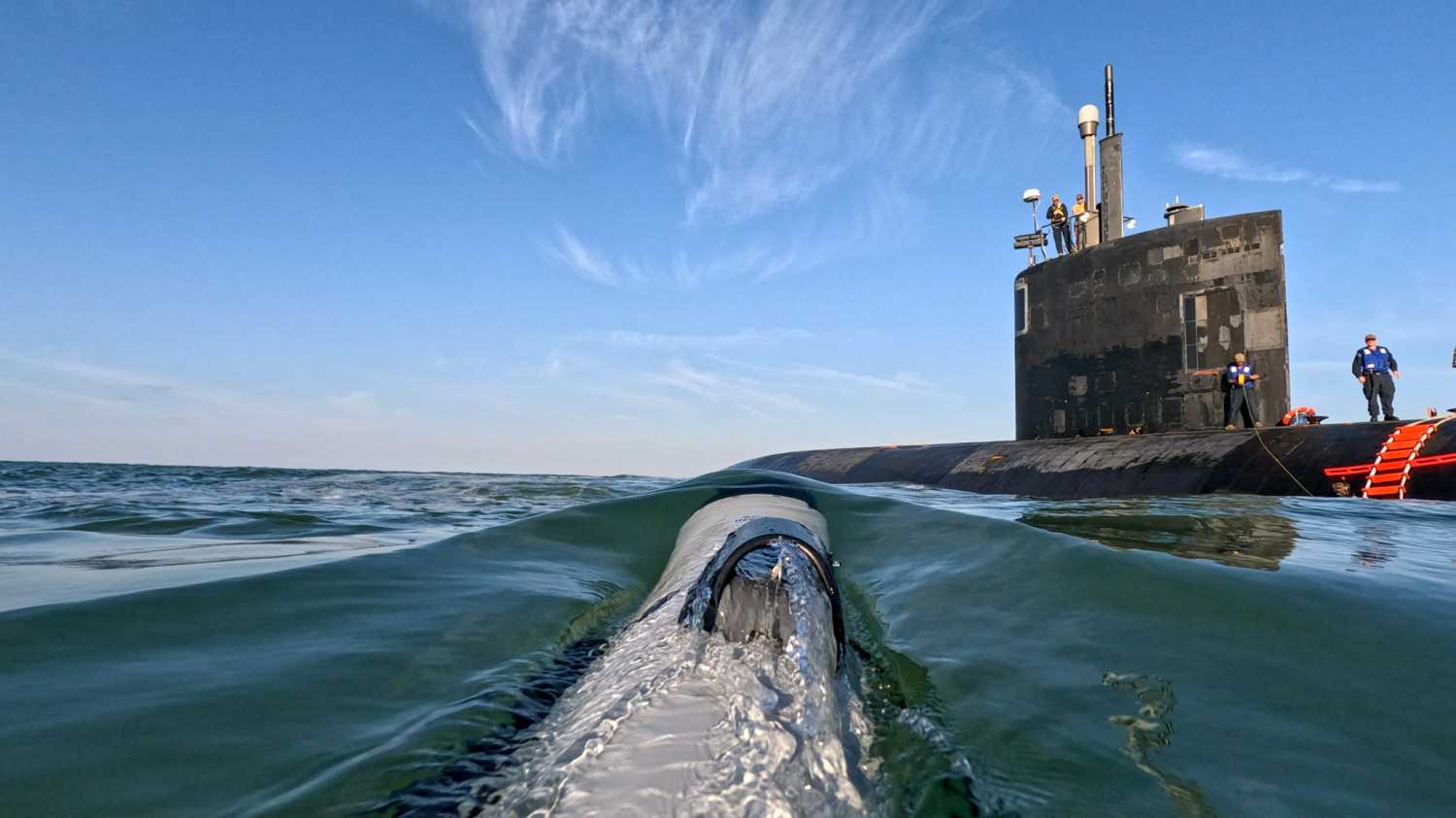
Undersea operations are vital to contemporary American strategies for power projection, sea control or denial, and for naval war against rivals. Undersea platforms also carry the majority of America’s deployed nuclear warheads, providing an essential, secure second-strike capacity. And as surveillance and precision-strike regimes have matured and globalized, the stealth advantages of the undersea realm have grown in salience. What’s more, seabed data cables now carry more than 90% of U.S. command-and-control communications, making a robust undersea presence essential for military operations, as well as for the digital economy—and increasingly for artificial intelligence (AI) itself.
The centrality of secure, capable subsurface forces is widely recognized by strategists.1 Much murkier, however, is whether and how the innovations of AI—and complementary technologies, such as robotics—could affect or even transform the subsurface environment. Most commentary about AI’s impacts on warfare reasons by analogy. Above the waterline, these innovations seem poised to enable “kill webs” of interconnected devices, with many automated functions that traditional, entirely human-controlled forces can’t match—changing the battlefield and the nature of threats. Much commentary postulates that similar AI-driven transformations will make the undersea realm increasingly “transparent” and permit system-wide awareness and AI-assisted or even automatic, highly skilled decisionmaking below the surface.
We are skeptical. Undersea information webs and autonomy are severely limited because communication and sensing at a distance are physically much more challenging underwater than above the waterline. We offer a different vision, anchored in those physical limitations and focused on the core missions of the undersea forces: survivability and force projection through stealth. Rather than global kill webs, AI-enhanced undersea platforms and sensors are much more likely to operate as a mosaic of loosely coupled local networks, constrained by the difficulty of seeing and communicating across long distances without revealing presence. Small pods of linked crewed and autonomous vehicles, supported by local AI and connected at the edges of wider networks, are the likely future of AI undersea. In some specific places, such as constrained waterways and chokepoints, rich networks of sensors and communications may allow for more web-like systems.
One implication is that solitary, stealthy submarines—both nuclear-armed and fast attack—will continue to have extremely high value for a survivable and capable underwater force. Another is that in assessment, physical proximity to the theatre of operations is more important than the traditional distinction between offense and defense. All else equal—a condition that is hard to measure and assess with precision in the middle of a technological revolution—AI will create an advantage near home shores and near a subset of allies who are physically proximate to the operating frontier and integrated into detection and communication systems compatible with those of the United States. For the United States, realizing the full potential of AI-assisted systems will require theatre-proximate allies able to lay and secure cables and offer secure communication.
AI will also transform oceanography, a field that the United States has long led, by improving pattern recognition, guiding underwater uncrewed vehicles in collecting ocean measurements, and integrating key insights from science and the environment into naval operations. U.S. advantages in this field are eroding as China rapidly invests in oceanographic science and, especially, data-collection platforms.
Finally, AI systems themselves are becoming highly dependent on seabed data cables. This infrastructure is vulnerable to disruption, and current U.S. doctrine and capacity for defending that infrastructure are insufficient, particularly as Russia and China build tools to detect, track, cut, or interfere with them.2
The AI revolution is real. But below the waterline, the laws of physics, for now, make the seas far from transparent, render undersea kill webs infeasible, and make planning for such webs dangerous. The uncertainty surrounding how these technological revolutions play out has big implications for force design and reinforces age-old insights about Pentagon procurement. Investments should emphasize shortened procurement cycles, rapid experimentation, and adaptation while being guided by a clear understanding of the difference between AI above and below the waterline.
Downloads
Authors
Related Content


-
Acknowledgements and disclosures
The authors would like to thank Peter Dombrowski, Michael O’Hanlon, and Margaret Leinen for their support in reviewing drafts of this paper. We would also like to thank the University of California Institute on Global Conflict and Cooperation, and specifically Tai Ming Cheung, for cohosting a preliminary meeting for this project. Additional thanks go to Ryan Beane for research support, Adam Lammon for editing, and Rachel Slattery for layout.
Feature image: The appearance of U.S. Department of War (DoW) visual information does not imply or constitute DoW endorsement.
-
Footnotes
- For a few examples that emphasize the importance of the undersea, see: Iain Ballantyne, The Deadly Trade: The Complete History of Submarine Warfare From Archimedes to the Present (London: Weidenfeld & Nicolson, 2019); Craig L. Symonds, World War II at Sea: A Global History (New York: Oxford University Press, 2018); James Hornfischer, Who Can Hold the Sea: The U.S. Navy in the Cold War 1945-1960 (New York: Bantam Books, 2022); Brendan Rittenhouse Green and Caitlin Talmadge, “Then what? Assessing the military implications of Chinese control of Taiwan,” International Security 47, no. 1 (July 2022), 28, https://doi.org/10.1162/isec_a_00437.
- Erin L. Murphy and Matt Pearl, “China’s underwater power play: The PRC’s new subsea cable-cutting ship spooks international security experts,” Center for Strategic and International Studies, April 2025, https://www.csis.org/analysis/chinas-underwater-power-play-prcs-new-subsea-cable-cutting-ship-spooks-international; Ihor Kabanenko, “Russian ‘hybrid war’ tactics at sea: Targeting underwater communications cables,” Jamestown, January 23, 2018, https://jamestown.org/russian-hybrid-war-tactics-sea-targeting-underwater-communications-cables/; Edward Stringer, “Putin knows that undersea cables are the west’s Achilles heel,” Financial Times, November 4, 2022, https://www.ft.com/content/0ddc5b48-b255-401b-8e9f-8660f4eab37b.
The Brookings Institution is committed to quality, independence, and impact.
We are supported by a diverse array of funders. In line with our values and policies, each Brookings publication represents the sole views of its author(s).