Artificial Intelligence
A summer of AI summits reveals a widening US-China divide
The Forum for Cooperation on Artificial Intelligence (FCAI) is a collaboration between the Brookings Institution and the Centre for European Policy Studies (CEPS). FCAI hosts regular AI dialogues among high-level officials from seven governments (Australia, Canada, the European Union, Japan, Singapore, the United Kingdom, and the United States) as well as experts from industry, civil society, and academia. FCAI dialogues identify opportunities for international cooperation on AI regulation, standards, and research and development, translating ideas and recommendations from these dialogues into reports and analysis that offer concrete, actionable solutions to shared global challenges.
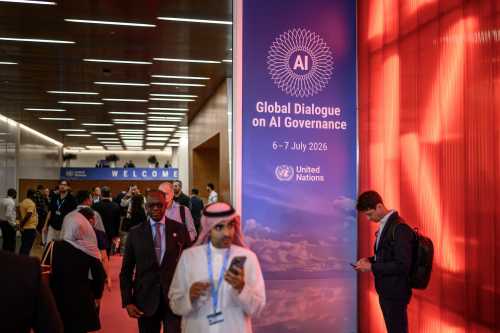
This dialogue focused on the various international summits on AI governance that took place during summer 2026, including the ITU’s AI for Good Global Summit and the World Artificial Intelligence Conference in China. These meetings illustrate broader trends in international governance: Corporate leaders are sitting at the table, the U.N.’s forum on AI is advancing, and China has ambitions to build an alternative institutional structure for AI governance. Participants generally agreed on a need for an independent evaluation ecosystem beyond AI safety institutes and for more real-world deployment data, while acknowledging structural and timing obstacles to collection.
Related Content
The dialogue centered around a report on decoding AI governance, the “Anchors and Hooks” framework it proposed, and the next steps for this effort. Participants agreed that without deliberate mapping and coordination, fragmentation in governance can create challenges. Transparency and disclosure were described as the foundation that makes voluntary frameworks work, and the emphasis going forward should be on building off of what already exists.
Related Content
The dialogue discussed how rapid advances in AI capability are not translating automatically into broad economic gains or meaningful adoption. Participants stressed that AI diffusion is highly uneven across sectors, firms, countries, and demographic groups, with stronger uptake in digitally mature settings. Participants discussed approaches to AI diffusion and current outcomes measurements and proposed that better metrics would be more comparable across economies and measure how AI technologies are integrated into production.
Related Content

The dialogue examined how rapid AI-driven growth in data centers is impacting increasing electricity and water consumption worldwide. Participants discussed how international governance efforts may help build out measurement, standards, and reporting tools, and explored energy policy and investment strategies for managing energy constraints in the context of hyperscaler expansion and sustainability goals.
Related Content

Participants discussed sovereign AI systems and strategies, open and proprietary models, and sovereignty strategies across the “AI Stack.”
Related Content

2025
Participants discussed the upcoming G7 Hiroshima AI Process reporting framework, including initial reactions and questions for the future. The dialogue also included a discussion of a recent UNESCO report on network of national AI supervision authorities.
Related Content

2026
The dialogue discussed national AI strategies across Latin America, including in Argentina, Brazil, Colombia, and Mexico and the relation with regional strategies and organizations.
This dialogue covered the network of international AI Safety Institutes (AISIs), including in the U.S., Canada, EU, and France ahead of the first AISI network meeting in San Francisco.
Related Content

Participants discussed the OECD-GPAI integrated partnership, the G7 Hiroshima AI Process, and UN developments, including the Summit for the Future and the Global Digital Compact.
FCAI leaders presented on a “recipe for global governance,” mapping the existing field of global AI governance institutions, and weighing the strengths of a networked iterative approach that works with and builds on existing international fora or a new international body to coordinate governance work. This discussion was followed by a conversation on the AI Safety Institutes.
This dialogue discussed national AI strategies across Africa, including in Nigeria, Senegal, Egypt, Rwanda, Kenya, and Tanzania, as well as the African Union’s AI strategy. Participants discussed global inclusion in international processes and how FCAI participants can include greater Global South participation in their development of AI policy and foster the UN Sustainable Development Goals.
Participants ranked areas where international cooperation is needed and discussed which initiatives, if any, they saw as the most promising avenues for progress on international governance. Following this discussion, there was a presentation on the G7 Hiroshima AI Process.
Related Content

The dialogue covered standards development and cooperation on AI standards in the Indo-Pacific, transatlantic cooperation on international standards, multinational perspectives on standard-setting, and a presentation and discussion on Brazil’s draft AI bill.
This dialogue discussed trends in generative AI development and deployment. Then, building on those trends, the participants discussed the implications for public policy and international governance, particularly in thinking through legislation that is technology neutral or AI specific.
This dialogue gave an overview of the UN Global Digital Compact. A common thread in feedback provided by FCAI participants was the challenge of inclusion and equity, particularly with respect to the Global South. The dialogue also discussed recent CEIMIA research on an AI regulatory policy comparative framework.
Related Content
The dialogue focused on AI value chains and general purpose AI. The discussion then turned to a review of the year, including discussion on developments in international AI cooperation, such as the G7, GPAI, and TTC. Lastly, the group discussed the FCAI interim report’s recommendations, went over progress, and previewed the next steps.
Participants discussed the U.S. AI Bill of Rights, the EU AI Act and conformity assessments, Canada’s AI legislation, and research on the AI compliance landscape.
Participants in the dialogue discussed the AI Act in the context of the new EU digital agenda, as well as how the EU AI Act might define and scope “artificial intelligence.” Participants also discussed the risk-based approach used in the AI Act.
Related Content

The dialogue provided an overview of the U.S. NIST AI Risk Management Framework (RMF), as well as how the RMF might contribute to a broader international framework for risk.
Participants discussed efforts to develop commitments supporting AI in trade agreements; export restrictions, investment screening, and AI; and what is next for AI in trade agreements.
Recommendation 15 of our October 2021 progress report called for development of “common criteria and governance arrangements for international large-scale R&D projects.” This roundtable discussed historical international large-scale R&D projects, and then discussed the potential for AI use in future projects, including in privacy-enhancing technologies, climate change, economic measurement, and healthcare.
Related Content

Participants discussed the risks and opportunities of engagement with China on AI, including an overview of China’s economic and political trajectory, China’s progress on AI and its implications, and next steps for FCAI participants.
Related Content

The dialogue overviewed the FCAI Progress Report, Strengthening International Cooperation on AI, and then discussed international cooperation through domestic AI policy, using Canada as a case study.
Related Content

2021
Participants discussed the rationale for international cooperation on AI, and then worked to develop recommendations for international cooperation on AI, including AI regulation and conformity assessments, AI standards, and AI projects.
Related Content

Participants compared U.S. and EU AI risk assessment frameworks and then discussed the larger challenge of assessing AI-related risks.
Participants discussed recent developments on AI regulations and standards, the economic and strategic importance of AI standards, and next steps for standard-setting.
This dialogue covered the strategic significance of AI, the EU Commission and Parliaments’ approach to data governance and AI, Japan’s approach to data governance and AI, and a discussion on health data and AI.
Participants discussed the frontiers of AI research and international cooperation on AI research and development, particularly on AI applications.
The dialogue included a presentation on IEEE standards, and an overview of global standards work, including the CEN-CENELEC AI Focus Group, and the IEC SEG 10.
Participants discussed transatlantic alignment on assessing AI risk, as well as expanding transatlantic research and innovation around AI.
The chairman of Brookings and chairman of the Board of CEPS provided introductory remarks, followed by comments from FCAI participants on the need for international AI cooperation.