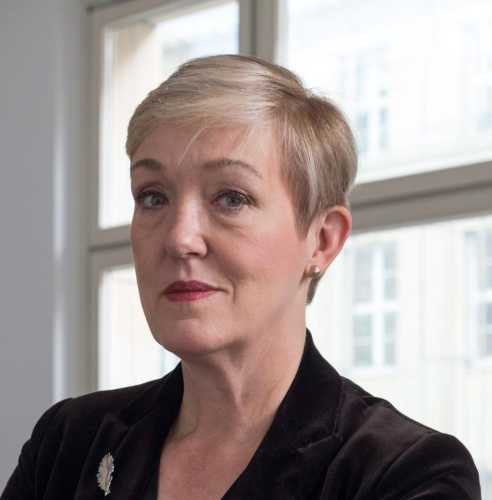
Constanze Stelzenmüller is an expert on German, European, U.S., and transatlantic foreign and security policy and strategy, as well as international law and human rights. She is the director of the Center on the United States and Europe and the inaugural holder of the Fritz Stern Chair on Germany and Transatlantic Relations at Brookings. She held the Kissinger Chair on Foreign Policy and International Relations at the Library of Congress from October 2019 to March 2020 and served as the inaugural Robert Bosch Senior Fellow at Brookings from 2014 to 2019.
Prior to working at Brookings, she was a senior transatlantic fellow (2009–2014) and Berlin office director (2005–2009) with the German Marshall Fund of the United States (GMF). At GMF, she directed the influential Transatlantic Trends survey program and co-managed the “New Power, New Responsibility” project.
From 1994 to 2005, Stelzenmüller was a reporter and editor in the political section of DIE ZEIT. From 1998, she was defense and international security editor; previously, she had covered human rights, war crimes tribunals, and humanitarian crises.
Stelzenmüller’s essays and articles, in both German and English, have appeared in a wide range of publications, including Foreign Affairs, Internationale Politik, and The Washington Post. She writes a monthly column in the Financial Times. Her dissertation, “Direkte Demokratie in den Vereinigten Staaten von Amerika,” was published in 1994 by Nomos. She is a frequent commentator on U.S. and European radio and television, including PBS News Hour, NPR, and the BBC.
Stelzenmüller is an honorary governor of the Ditchley Foundation, a fellow of the Royal Swedish Society for War Sciences, and a board member of the German Academic Scholarship Foundation (Studienstiftung). She delivered the Lennart Meri Lecture at the 2025 Lennart Meri Conference in Talinn, the John McCloy Lecture at the 2024 John McCloy Transatlantic Forum in Frankfurt, the 2022 Guido Goldman Memorial Lecture at Harvard University’s Minda de Gunzburg Center for European Studies.
She was honored in 2025 with the Estonian Ministry of Foreign Affairs’ Order of Merit, Second Class, for her contribution to transatlantic relations and for upholding European values and the rules-based international order. Stelzenmüller was also the recipient of the Deutsches Haus at NYU’s 2025 Volkmar and Margret Sander Prize.
She has worked in Germany and the United States and speaks English, French, German, and Spanish. Stelzenmüller holds a doctorate in law from the University of Bonn (1992), a master’s degree in public administration from the Harvard Kennedy School (1988), and a law degree from the University of Bonn (1985). From 1988 to 1989, she was a visiting researcher at Harvard Law School.
Photo by Marc Darchinger
Affiliations:
- Centre for European Reform, member, advisory board
- Ditchley Foundation, honorary governor
- European Policy Centre, strategic council, member
- German Council on Foreign Relations, member
- German Ministry of Defense, Advisory Council for Internal Leadership Issues, member
- International Institute for Strategic Studies, member
- Library of Congress John W. Kluge Center, member, alumni advisory group
- McCloy Fellowship Alumni Association, member
- Royal Swedish Academy for War Sciences, called lifetime fellow
- Women in International Security Germany, member
-
Past Positions
- Director, Transatlantic Trends, German Marshall Fund of the United States (2012-2014)
- Senior Transatlantic Fellow, German Marshall Fund of the United States, Berlin (2009-2014)
- Director, Berlin Office, German Marshall Fund of the United States (2005-2009)
- Defense and Security Editor, DIE ZEIT, Hamburg (1994-2005)
- Writer/Reporter, DIE ZEIT, Hamburg (1994-1998)
-
Education
- Ph.D., Law, University of Bonn
- M.A., Public Administration, Kennedy School of Government, Harvard University
- 1st State Exam in Law, University of Bonn