This piece is part of the Taiwan-U.S. Quarterly Analysis series, which features the original writings of experts with the goal of providing a range of perspectives on developments relating to Taiwan.
In our second piece on the meeting between Kuomintang (KMT) party leader Cheng Li-wun and Chinese President Xi Jinping, we examine one of its central themes: the “1992 Consensus” and its contested meaning in cross-Strait politics. The term refers to a supposed tacit understanding reached in 1992 that both sides of the Taiwan Strait belong to “One China,” despite reserving the right to interpret what “One China” means. The phrase has never been formally codified and thus is interpreted differently on both sides of the Strait.
For decades, the KMT framed the 1992 Consensus as “one China, different interpretations” (一中各表), arguing that the Republic of China and People’s Republic of China (PRC) are part of the same (ununified) country despite maintaining separate governments. Cheng has shifted away from that formulation by describing cross-Strait relations with the slogan “1992 Consensus, oppose Taiwanese independence” (九二共識,反對台獨). Her language closely mirrors Xi’s own rhetoric toward Taiwan, which has explicitly tied the 1992 Consensus to eventual national reunification. Xi has also said that Taiwan’s future would follow the “one country, two systems” framework that was previously applied to Hong Kong, before the island was largely assimilated into the PRC in 2020. He also affirmed that relations with Taiwan would be contingent upon the “1992 Consensus, oppose Taiwanese independence” (九二共識,反對台獨), the exact phrase Cheng would say seven years later.
Given the prominence of the 1992 Consensus in the Cheng-Xi meeting, we wanted to examine how Taiwanese voters view and interpret the slogan “1992 Consensus, oppose Taiwanese independence” as the foundation for cross-Strait relations, and the extent to which support is extended to the “one country, two systems” framework. We surveyed Taiwanese voters (n=1,195) from April 16-22, within one week of Cheng’s visit. Our polling reveals that almost half of Taiwanese voters (47%) say they are unclear about the meaning of the 1992 Consensus. Further, although voters who supported Cheng’s meeting with Xi are more receptive to the slogan “1992 Consensus, oppose Taiwanese independence,” the same voters also strongly reject the “one country, two systems” framework—which Beijing has directly linked to the 1992 Consensus. These findings suggest that the slogan’s political ambiguity allows some Taiwanese voters to see it as a way to stabilize relations with China without endorsing Beijing’s vision for Taiwan.
How do Taiwanese perceive the slogans “1992 Consensus, oppose Taiwanese independence” and “one country, two systems”?
On average, 41% of the respondents express support for “1992 Consensus, oppose Taiwanese independence,” but support levels vary greatly by partisan affiliation. Green voters include the Democratic Progressive Party (DPP) and pro-independence parties. Blue voters include the KMT and pro-unification parties. Eighty-two percent of KMT-aligned respondents (blue) and almost 60% of Taiwan People’s Party (TPP) voters support the phrase “1992 Consensus, oppose Taiwanese independence.” Only 12% of DPP-aligned supporters (green) expressed support for the idea. More than 60% of independent voters oppose the phrase, while about 36% of independent voters support it. Cheng’s slogan, however, is clearly most popular among KMT voters, who make up her biggest base of support. With such high levels of support from her base, the TPP, and a modest number of independents, Cheng’s slogan might have staying power for the time being.
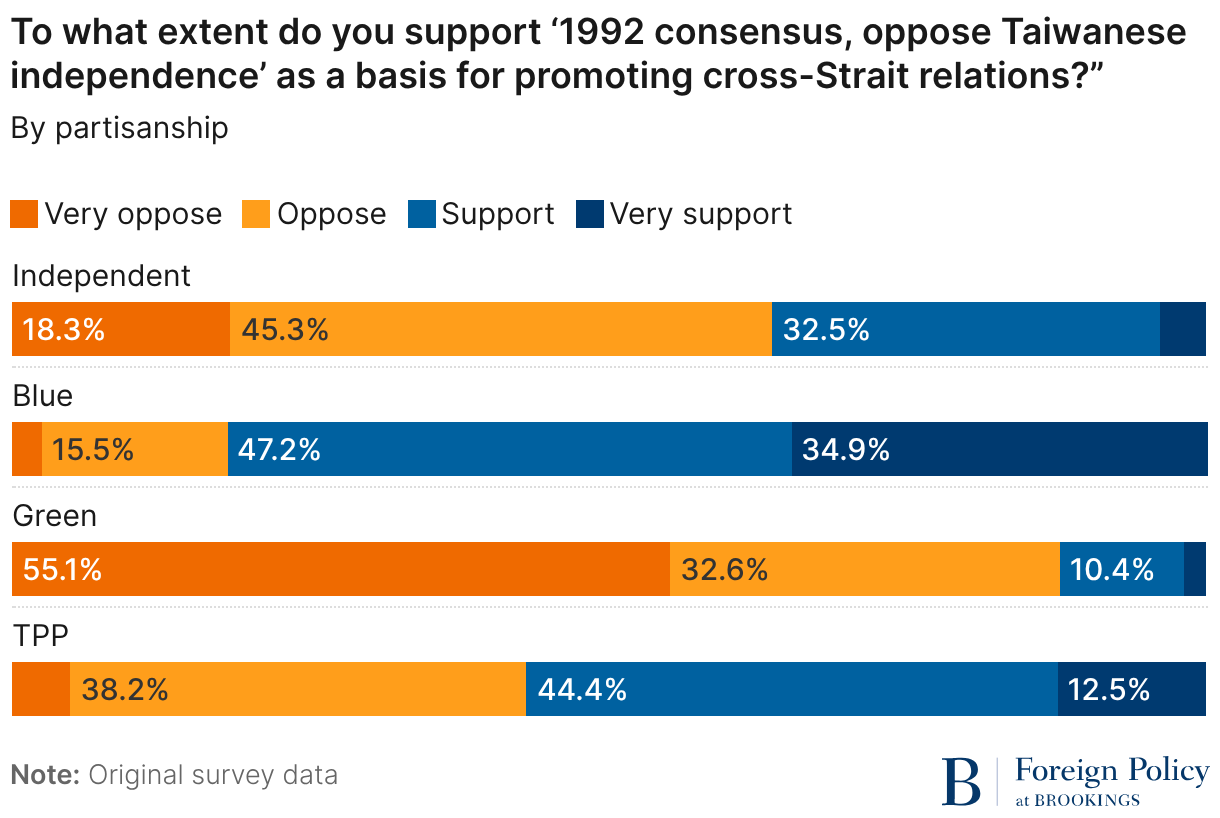
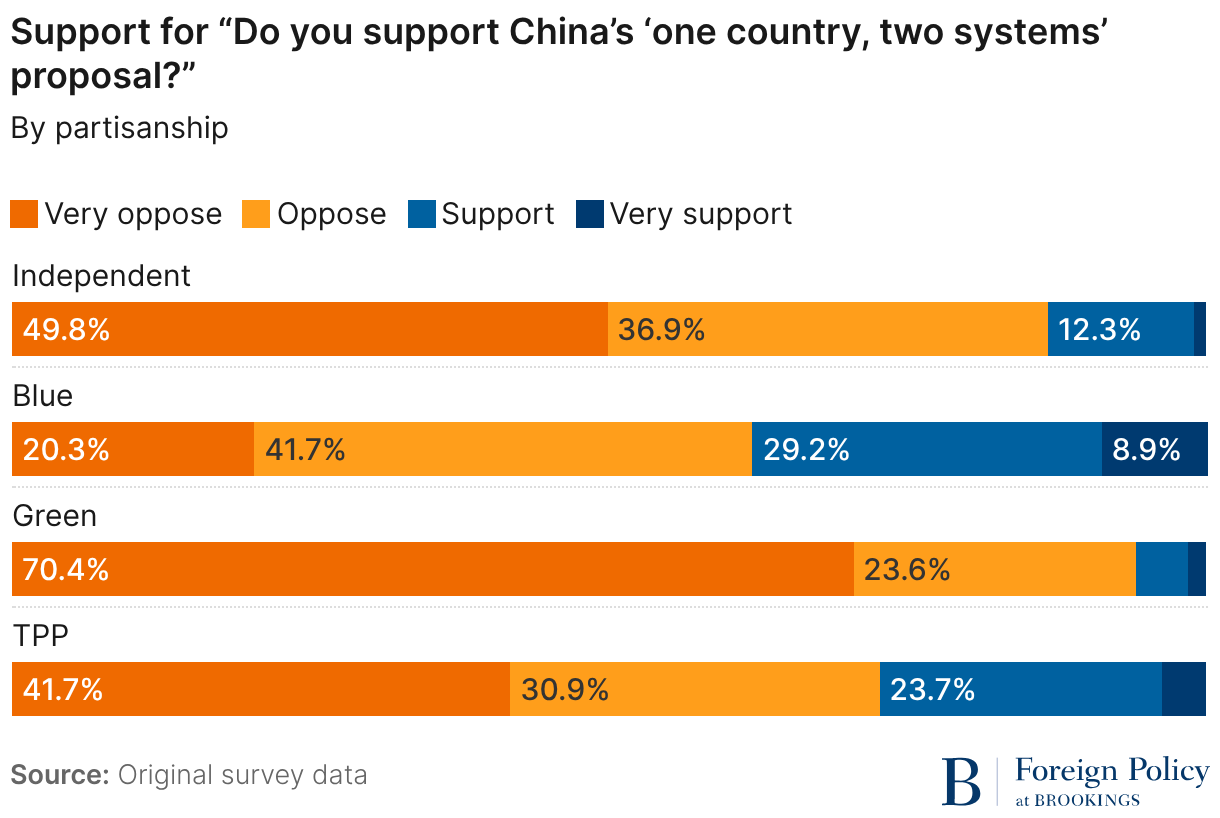
We were subsequently interested in learning how people saw Cheng’s use of the slogan, “1992 Consensus, oppose Taiwan independence,” compared to how they saw “one country, two systems.” What we find is that while many non-DPP-aligned green voters support Cheng’s language, it does not carry over to “one country, two systems.” Beginning with KMT-aligned blue voters, we see that 80% support Cheng’s slogan, but less than 40% support “one country, two systems.” For TPP voters, nearly 60% support Cheng’s slogan, but again, less than 30% support “one country, two systems.” Independent voters largely oppose Cheng’s slogan; despite expressing generally positive views of the trip (see our previous article), only 13% support “one country, two systems.” Overall, 18% of respondents express favorable views toward “one country, two systems.”
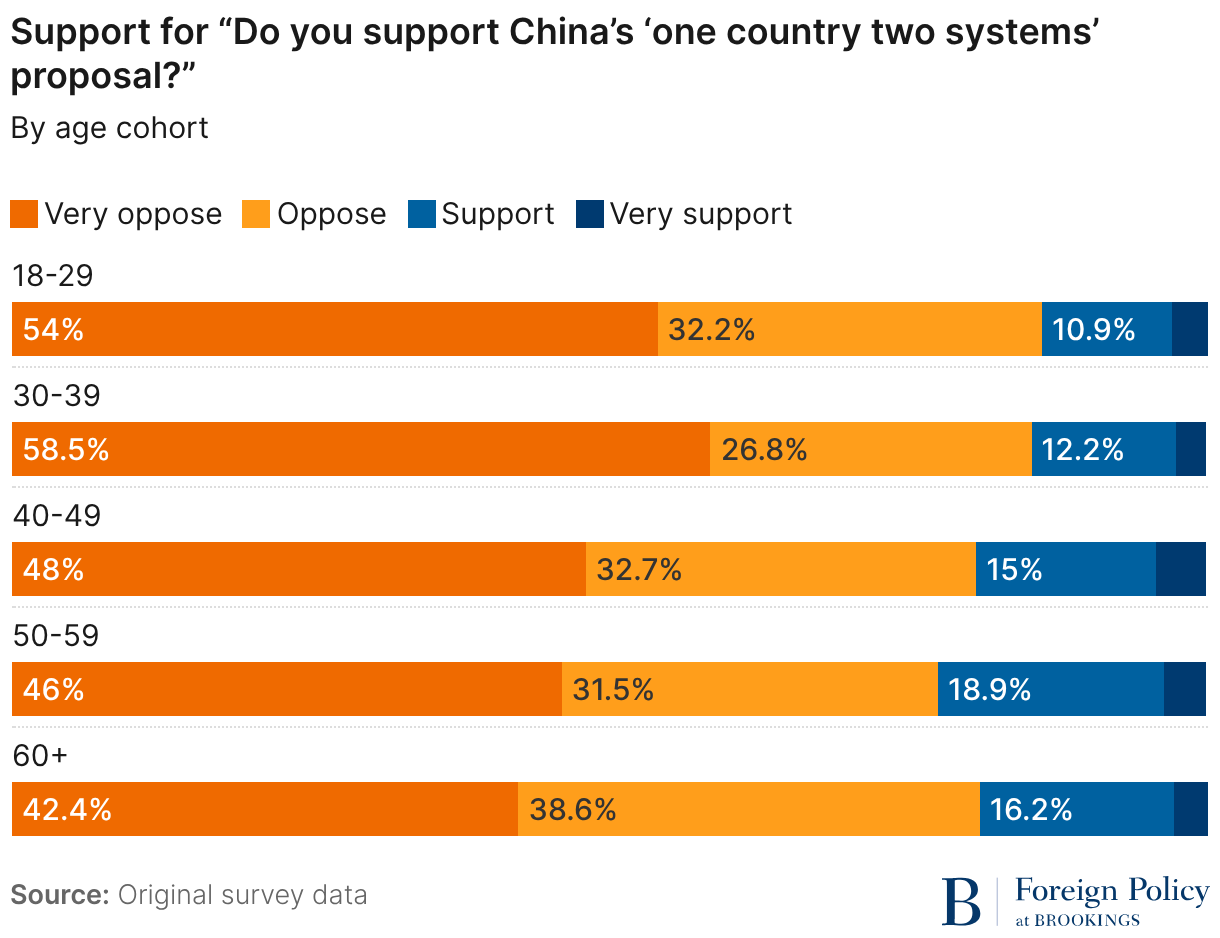
Age is also a critical factor in gauging support for both the “1992 Consensus” and “one country, two systems.” For both slogans, support comes predominantly from those 50 years old and older. The younger the respondents are, the more they oppose both the “1992 Consensus, oppose Taiwanese independence” and the “one country, two systems” slogans. While some observers find data to suggest younger cohorts may be more pro-China, our findings here show that the majority currently reject “one country, two systems” more than all other age groups.
What is clear is that Taiwanese voters see these two concepts as separate. Taiwanese voters may endorse the 1992 Consensus because they see it as a pathway for meaningful engagement with the PRC. Since there is no formal, agreed-upon consensus, the 1992 Consensus offers flexibility and ambiguity in creating ties with the PRC. “One country, two systems,” however, is not ambiguous or imaginative, especially in light of what happened to Hong Kong, which Taiwanese voters closely followed.
For Beijing, however, these two concepts are connected, and Xi himself has explicitly linked them together. Here, we want to highlight a risk of potential misinterpretation. Although Taiwanese voters largely reject “one country, two systems,” many still express support for the 1992 Consensus. Yet in international discourse, Beijing largely controls the framing of the 1992 Consensus and continues to present it as inseparable from “one country, two systems.” Beijing may try to push a narrative that by accepting the 1992 Consensus, Taiwanese will also accept the “one country, two systems” framework. We find that this would be empirically incorrect.
Conclusion
For DPP-aligned green voters, both the 1992 Consensus and “one country, two systems” are dead in the water. For KMT-aligned blue voters, however, the 1992 Consensus, and specifically Cheng’s framing of the consensus and opposition to Taiwanese independence, is overall seen positively. Independent voters again show the most novel finding: a majority reject Cheng’s rhetoric, but also perceive her trip to Beijing positively. Thus, independent voters paradoxically reject Cheng’s framing but see symbolic value in engagement with the PRC. Why is this the case? We believe that independent voters do not want Taiwan to unify with the PRC, but they may see engagement as a meaningful way to maintain the island’s status quo.
However, our findings also present a second and more important contradiction: KMT-aligned blue voters and TPP voters (and those independents who endorse Cheng’s language) overwhelmingly reject “one country, two systems” despite supporting Cheng’s slogan. The inconsistency lies in how Xi connects the two slogans. For Xi, the slogan “1992 consensus, oppose independence” is a precursor to “one country, two systems.” Yet, blue voters in Taiwan do not support Xi’s eventual goal.
A potential problem is that blue voters may see Cheng’s rhetoric as a way to maintain the status quo, thinking that endorsing this kind of policy platform will support cross-Strait relations by creating space for cross-Strait dialogue. But from the PRC’s perspective, this rhetoric is not about maintaining the relationship but changing it, so that “one country, two systems” can eventually be introduced to Taiwan. In other words, supporters of Cheng’s slogan may see the 1992 Consensus as a way to buy time and protect the status quo, but Beijing does not share that aim. While blue voters may continue to support Cheng and her slogan, the disconnect between how Cheng and the KMT frame this slogan domestically and how Xi and Beijing interpret it may have meaningful implications for the future of KMT relations with the Chinese Communist Party, and for cross-Strait relations if or when a KMT politician is elected to lead Taiwan.
Authors


Related Content


The Brookings Institution is committed to quality, independence, and impact.
We are supported by a diverse array of funders. In line with our values and policies, each Brookings publication represents the sole views of its author(s).

Commentary
Will Taiwanese accept Xi Jinping’s version of ‘One China’?
May 19, 2026