Question 1
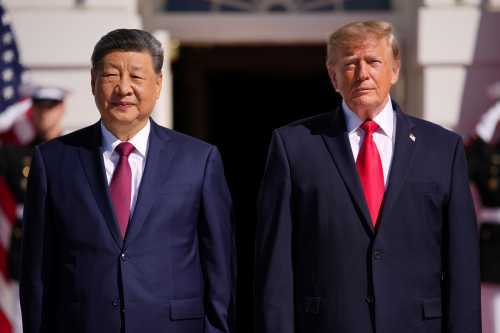
The 33rd Asia-Pacific Economic Cooperation (APEC) Leaders’ Meeting will take place in Shenzhen, China, on November 18-19, 2026. With another interaction likely between Presidents Donald Trump and Xi Jinping on the margins of this summit, what are the major outcomes expected? What will the two leaders seek to accomplish with their third interaction of this calendar year? Can meaningful U.S.-China progress be achieved on artificial intelligence (AI), trade, and other security issues?
Starting small on AI risks
AI is an increasingly central issue in the U.S.-China relationship. Both countries see AI as a powerful, strategic technology with the potential to reshape geopolitics and the global economy. Both countries also increasingly see AI not just as an opportunity but also as a growing source of risk that needs to be managed. Chinese and American AI models have both been misused to carry out cyberattacks or have acted far beyond the intentions of human users.
On the sidelines of APEC, the United States and China have a chance to begin the long, uncertain road to jointly mitigating these risks. The first step is to establish an incident notification mechanism, which both sides have agreed to in principle. The goal should be to develop not a rigid protocol for comprehensive disclosure but an open communication channel through which each side can share nonsensitive technical information as they feel comfortable. Such information might include which AI models or harnesses were involved, how these tools were misused or misbehaved, and what safeguards or corrective measures proved effective.
In general, expectations for U.S.-China discussions about AI should remain low, and the focus should be on selective communication. Many worry that the United States and China will move too slowly in the face of growing AI risks and rapid improvements in capabilities. But equally worrying is the risk that official U.S.-China AI talks might get derailed at the outset as mounting expectations collide with deep mutual distrust between the two countries. Starting to share limited information at a pace and level that each side feels is appropriate will be a critical early step toward potential future progress on addressing AI risks.
All thunder, no rain
“All thunder, no rain.” This Chinese aphorism has been an apt description of the last two summits between Trump and Xi—and thus far, it seems likely to apply to this next summit as well. For a long time, in the run-up to such meetings, U.S. diplomats and policymakers would “trade optics for substance”—making concessions to China on protocol in exchange for substantive concessions. Now, both sides appear content to prioritize optics over any substance. The result is pantomime diplomacy.
Theoretically, there is much for the two leaders to discuss—everything from the risks of AI to global hotspots—but it seems more likely than not that these two leaders will miss the moment, again. Instead of engaging constructively, Beijing is capitalizing on its tactical truce with Washington to fortify itself at home and intensify pressure on U.S. allies in the region. Notably, the day after Trump and Xi’s last summit, China’s Southern Theater Command announced a military exercise around Scarborough Shoal—a disputed feature in the South China Sea claimed by both China and the Philippines, a U.S. treaty ally. Tellingly, the move elicited no discernible response from Washington, though the American ambassador to the Philippines did protest.
Xi is likely already looking past Trump and thinking about how the fallout from the U.S. midterm election will affect China policy in the next administration—and whether the United States will revert to a more competitive posture toward China. Xi will host Trump fresh from a major Chinese Communist Party meeting, which fortified Xi’s iron grip on the party and laid the groundwork for his next five-year term, which will begin late next year. Xi’s goal in the meantime remains to do as little as possible to mollify Trump.
The bigger question right now is what will backstop the bilateral relationship in the coming year. The two leaders are supposed to meet one more time in December on the margins of the G20 summit in Doral, Florida, but after that, no meetings are scheduled. And Xi will be increasingly preoccupied with the preparations for next year’s Party Congress as we approach the second half of the year, which will limit his time and bandwidth for another engagement with Trump. In the absence of direct engagement by the top leaders, it remains an open question which force prevails: the inertia of Trump and Xi’s gentleman’s agreement to halt the trade war, or the entropy of the two superpowers’ competitive dynamic.
Staying the course
Typically, when the leaders of the United States and China meet, it is a major global news event. The planned meeting between Trump and Xi on the margins of APEC may be an exception. The meeting will occur in the aftermath of a resounding reckoning for Trump in the U.S. midterm elections and in the shadow of an expected trilateral meeting between Trump, Xi, and Russian President Vladimir Putin. This will be the third in-person encounter between Trump and Xi of the calendar year. Neither side is preparing ambitious deliverables for this meeting.
Even so, the two leaders will have plenty to discuss. The headline issue will be whether the two leaders agree to extend their trade truce past its current deadline in January. Since Trump and Xi plan to meet again on the margins of the G20 this December in Florida, they may not feel pressure to finalize any trade truce extension at APEC.
The two leaders will be expected to endorse progress on institutionalizing coordination on AI, including through the launch of a bilateral AI dialogue and a bilateral incident reporting channel. Efforts in this space will likely be more focused on agenda-setting and establishing processes and expectations than on any breakthroughs or major deliverables.
Trump and Xi may also use their meeting to announce progress on strengthening military crisis communication, including in the nuclear domain.
The Chinese side likely will use the meeting to amplify the shared definition both leaders have endorsed for the relationship: constructive strategic stability based on fairness, reciprocity, and mutual respect. Beijing values this shared definition as a symbol of both leaders’ investment in preserving bilateral stability and avoiding crises. Although Trump has shown less enthusiasm for the definition, he similarly appears to value keeping the U.S.-China relationship on a relatively stable track for the foreseeable future.
This will be the second consecutive year when Trump will meet Xi on the margins of the APEC economic leaders meeting. Last year, Trump never set foot in the venue where the APEC economic leaders meeting was held. It would not be surprising if Trump skips the summit proceedings this year as well. Trump’s focus will be on meeting other leaders on the summit’s margins, as opposed to the details of the summit meeting itself.
Europe has a stake in the Trump-Xi summit
Not being Pacific Rim nations, the countries of Europe do not have a seat at the table at the APEC meetings. (Despite its Pacific territories of French Polynesia, New Caledonia, Wallis and Futuna, and Clipperton Island, France is not a member.) Yet they will be watching the discussions in Shenzhen with sharp interest. Europe and China’s relationship has undergone drastic change recently, driven not least by Berlin’s volte-face on China trade; the German analyst Thorsten Benner even calls it a second Zeitenwende (historic turn) following the first one on Russia after its full-scale invasion of Ukraine in 2022.
Despite Germany’s exploding trade deficit with China and growing concern about China’s aggressive behavior in Europe and its support for Russia against Ukraine, Berlin had long opposed tougher trade measures by the European Union (EU). But in early October, German Chancellor Friedrich Merz, together with French President Emmanuel Macron, wrote a strongly worded letter to European Commission President Ursula von der Leyen to demand the commission’s decisive action against unfair trade practices, as well as a new EU instrument to counter coercion. It gave the bloc’s trade commissioner, Maroš Šefčović, decisive backing for a trip to Beijing last month. The trade chief managed to avert a full-blown trade war by getting China to agree to restrictions on hybrid car exports.
But as Benner points out, this is only “the beginning of a long, arduous, and risky path to strengthen German and European industry vis-à-vis China.” To work, he argues, it must be flanked by vigorous investment and innovation at home, and a resilient network of partnerships in Asia. Hence, a recent flurry of European leaders traveling to Asia—in the second half of October, Poland’s Prime Minister Donald Tusk went to India and Vietnam, while Merz traveled to Singapore, Japan, and South Korea. The larger backdrop for these trips is a massive EU drive for diversification of its Asian partnerships since the Russian invasion—accompanied by a substantive shift from trade, market access, and development to geopolitics, security, and economic resilience. New negotiations were begun with: Singapore (concluded May 2025), Indonesia (concluded September 2025), India (concluded January 2026) and the Philippines (concluded September 2026); negotiations that had been paused for more than a decade were resumed with Thailand (September 2023) and Malaysia (January 2025).
Watching Shenzhen, Europeans will hope for a stabilization of the U.S.-China economic relationship that could benefit them as well. But they also fear a bilateral bargain that redirects Chinese overcapacity to Europe—or one that presumes to set international trade rules for the rest of the world.
The real work happens below the summit
Compared to Trump and Xi’s Beijing summit in May and Washington summit in September, the APEC summit in Shenzhen will be a multilateral occasion. Any potential side meeting between Trump and Xi will be significantly shorter in duration, which means any negotiations over concrete issues will also be limited. Before the Washington summit, it was announced that the two countries’ trade truce would be extended by two months until January 2027. This also alleviates the pressure on the two presidents to deliver major outcomes during their potential bilateral meeting in Shenzhen.
In terms of military security, the two countries have made considerable progress this year. For example, both countries participated in the Indo-Pacific Chiefs of Defense Conference in Canada in late August to early September, where U.S. Pacific Command chief Admiral Samuel Paparo met with the Chinese General Yang Zhibin, the commander of China’s Eastern Theater Command. References to a memorandum of understanding on crisis prevention and communication were also made during the Washington summit. More military-to-military communications could be in the pipeline for 2027. As such, another leadership summit at APEC will be politically significant, and concrete deliverables and meaningful progress on functional issues are more likely to be generated at the working level.
Question 2
There is speculation of a trilateral meeting between Trump, Xi, and Putin on the margins of the APEC summit. What are the implications of this meeting if it occurs? Will it impact the future trajectory of the Russia-Ukraine war? What message will it send to America’s erstwhile allies and partners?
A three-way meeting with two winners
It is difficult to envisage a scenario in which a meeting among Trump, Xi, and Putin has a happy outcome for the United States and its interests. The visual from such a meeting alone would be an unsettling imitation of the “Big Three” meeting at Yalta in the midst of World War II. Although this meeting will be more photo op than substance, like the original Yalta, this meeting could pave the way for a carving up of Eastern Europe to accommodate Russian interests. That is a worst-case and perhaps unlikely scenario. But if these three men emerge elated from this meeting, it would likely bode ill for Ukraine—and more importantly, for European security. Last century, an America buffered by two oceans had to learn the hard way that its interests are in fact bound up with the security of Europe and East Asia—yet we seem to periodically need a remedial reeducation in the realities of geopolitics.
Alternatively, if each of these men finds himself frustrated, that is also a potentially dangerous outcome. Acrimony among heads of state is no mere spat—a personal contretemps can have enduring and dangerous consequences, inflaming rather than assuaging the many points of tension and divergence between these leaders.
While Xi and Putin are more likely to humor than to humiliate Trump, even that outcome is a poor one for the United States. It will bait Trump further down his current path of trying to conciliate rather than counter these two strongmen. And, ironically, Trump’s very willingness to participate in such a meeting with so little time to prepare will only make his nominal objective of ending the war in Ukraine even more elusive. Trump has already demonstrated that he has little appetite or wherewithal to avail himself of the leverage he might have over either leader if he were to work in tandem with American allies and partners. And both men know Trump’s time is expiring even more quickly than his leverage—and that he will be irrelevant in a mere 26 months. That is a pittance for two leaders who can measure their tenures in decades, not years. Why would either man make a deal with a leader whose time and leverage are waning? They will only do it if they think they can pilfer more from Trump diplomatically than they will be able to gain from the next American president.
More downside risk than upside potential for the U.S.
The risk/reward calculation for all three leaders is different.
For Russia, this meeting offers major upside. By sitting down with the leaders of the world’s two most powerful countries in a trilateral format, Putin will be recognized as a major player on the world stage rather than a pariah. He will have achieved his return to the top table in global diplomacy without making any significant concessions on Ukraine or elsewhere.
For China, the meeting will be mixed. On the one hand, Xi will bask in the glow of China serving as the convener and agenda-setter for how China, Russia, and the United States will relate to each other. The meeting will highlight Xi’s statesmanship and China’s centrality in the international system. On the other hand, Beijing will bear the burden of setting an agenda, ensuring a productive exchange, and holding some responsibility for follow-through on any outcomes the meeting generates. Xi typically avoids owning responsibility for high-profile diplomatic events with uncertain outcomes, so this event will stretch the Chinese side’s comfort zone.
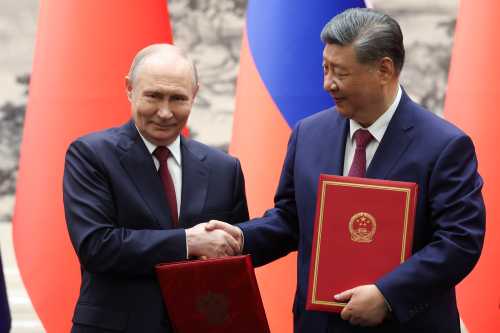
For Trump, the meeting will pose greater downside risks than upside potential. Trump will face the risk of being outmaneuvered by more prepared and more cunning leaders. In this triangle, the closest and warmest relationship among the three leaders is between Xi and Putin, who have met over 40 times since 2013 and share a desire to diminish American leadership on the world stage. The meeting’s optics will also send a chill to America’s allies and partners, who will fear Trump is prioritizing his relations with Xi and Putin over their interests and concerns. This chill will be felt most acutely in Ukraine and Taiwan.
Ultimately, symbolism may prove more enduring than the substance of this meeting. It is unlikely that there will be any breakthroughs on Ukraine or on launching trilateral arms control efforts, Trump’s putative focus for this meeting. Beijing has long been unwilling to enter arms control negotiations until it is closer to reaching parity in nuclear capabilities with the United States and Russia. Beijing is concerned that doing so could lock China into a permanently subordinate position that could expose China to risk. At best, the three leaders could find common principles to endorse, such as maintaining open sea lines of communication, reaffirming that nuclear wars can never be won and should never be fought, and affirming an interest in an end to war in Ukraine, while leaving the terms of such an end ambiguous.
A once-unthinkable alignment
Much has been made of Trump’s apparent rapport with the leaders of Russia and China, long regarded as America’s foremost adversaries. But a trilateral summit with Putin and Xi in Shenzhen would go well beyond bonhomie. It would dramatically signal that Washington is prepared to trade the liberal international order it built after 1945 for a concert of authoritarian-nationalist great powers.
The White House has framed the meeting around the legitimate goal of advancing nuclear arms control. But the meeting has broader implications. Holding a three-way meeting with Russia, just as Moscow says it will resume talks with Washington and Kyiv, represents Ukraine’s worst fear: the image of the war being settled among great powers, over Kyiv’s head. Beijing, too, would benefit from being portrayed as a would-be peacemaker, rather than as an enabler for sustaining Russia’s war economy.
The summit may also preview a broader convergence of interests. The Wall Street Journal reports that the Trump administration has encouraged former Hungarian Prime Minister Viktor Orbán to run for U.N. secretary-general as a joint U.S.-Russia-China candidate. Meanwhile, Beijing reportedly considered a bid to host the 2028 U.N. climate conference, the annual meeting of parties to the U.N. Framework Convention on Climate Change, a treaty from which the United States will formally withdraw in February 2027. Washington is not merely leaving a gap in multilateral leadership. In the Orbán case, it appears to be working with Moscow and Beijing to reshape the multilateral system.
For America’s allies, the message is stark. A trilateral meeting in Shenzhen will reinforce European concerns that their security is negotiable. In Asia, partners such as Japan and Taiwan will wonder whether their own U.S. security commitments are up for negotiation. The result could be that many will hedge, toward Beijing, toward strategic autonomy, or both.
If the summit goes ahead, it will symbolize a once-unthinkable alignment between the United States and the world’s foremost authoritarian powers. It will also speed up the fracturing of Western alliances that Moscow and Beijing have long sought and make it even more difficult to tackle shared challenges and provide global public goods.
No decisions about Europe without Europe
At the time of writing, a Trump-Xi-Putin meeting was still just a Russian proposal, confirmed by the United States but not by China. Even so, it precisely encapsulates what appears to be an emerging political dynamic: Moscow attempting to set a worldwide great-power agenda, Washington appearing to acquiesce, and Beijing hesitating to commit either way. And the mere suggestion of such a “21st-century Yalta”—a tripartite meeting that would presumably decide the future of Ukraine and Europe over the heads of both—has a symbolic impact of its own, even if it never comes to pass.
The timing of this push is significant. Russia, bogged down at Ukraine’s eastern front, is trying to bludgeon Ukrainian resilience with its relentless and indiscriminate bombardments of energy infrastructure and civilian targets, all while losing huge numbers of soldiers. At the same time, it is waging what The Economist calls “a phoney peace … a war of sorts”—increasingly reckless acts of sabotage, assassination attempts, and other dirty tricks—in Europe, in the hopes of undermining its will to defend Ukraine.
The Trump administration, for its part, has just been dealt devastating results in the U.S. midterm elections, with affordability and the unfinished war on Iran topping the list of voter grievances. All the more important, then, to end this other war in Europe, and, based on his recent actions, the president appears to believe that it is best brought to a conclusion by siding with Russia. Trump has praised Russia (“Russia, frankly, has been fine on Ukraine”), authorized Russian-origin diesel purchases, waived the Graham Act sanctions, and—according to media reports—is considering relief for a Russian state investment fund which the Biden administration had sanctioned, calling it Putin’s “slush fund.”
But—as Michael Kimmage, director of the Kennan Institute, recently pointed out—Europe in 2026 is not the Europe of 1945, when Josef Stalin, Winston Churchill, and Franklin D. Roosevelt met to hash out the shape of the postwar continent. Protests and political differences notwithstanding, today’s Europe has arms, wealth, institutions, allies, and agency. There can be no lasting and legitimate settlement without Ukraine and Europe at the table. To signal otherwise would only cause yet more damage to the transatlantic alliance.
China wants the spotlight, not arms control
Russia has been the primary driver of a potential trilateral summit during APEC, with Moscow circulating the possibility as early as this past summer. The Chinese are not necessarily actively driving such a summit. However, if the United States and Russia clearly call for it, there are few reasons why China would not embrace such an event. In recent weeks, the United States has engaged in active Track 2 diplomacy and dialogue with China and Russia. The Chinese enthusiasm is obvious, despite the struggle over the deliverables and substance of such a summit. Some Chinese officials have suggested that some in China are viewing the trilateral summit as “the most significant meeting in the history of international relations since the end of World War II.” If it happens, China will be presenting itself as the peer of the United States and Russia and playing a pivotal role in U.S.-Russia relations at a historical moment to end the Ukraine war. That is not an opportunity that Beijing would like to miss. In addition, according to Chinese and Russian interlocutors, Russia has made a genuine plea for China to host the trilateral summit. Beijing will have to develop a really strong and convincing argument about why it would refuse to do its Russian partner a solid.
Beijing is likely concerned by Trump’s and Secretary of State Marco Rubio’s references to such a summit containing a trilateral dialogue on arms control and nuclear weapons. China has consistently rejected the concept of U.S.-China-Russia trilateral arms control and nuclear dialogue, citing its significantly smaller nuclear arsenal. The Chinese do not seem to see the Ukraine war as coming to an end so soon. By the time of the APEC summit, the U.S. midterm elections will already be over, and Trump will have lost the motivation to use peace in Ukraine to boost the Republican Party’s popularity. Therefore, a trilateral summit will be unlikely to end the war in Ukraine anyway.
Authors






Related Content

The Brookings Institution is committed to quality, independence, and impact.
We are supported by a diverse array of funders. In line with our values and policies, each Brookings publication represents the sole views of its author(s).
Commentary
Trump, Xi, and Putin: What to expect from the APEC summit
November 12, 2026