



The Ukraine war, shifting American foreign policy priorities under President Trump, and increased global instability have shifted the balance in the China-Russia relationship, one of the world’s most consequential relationships. On this episode of The Beijing Brief, Jon Czin is joined by Fiona Hill and Patirica Kim to examine the convergences and divergences in Beijing and Moscow’s strategic interests and personal relations.
- Listen to The Beijing Brief on Apple, Spotify, or wherever you like to get podcasts.
- Watch episodes on YouTube.
- Learn about other Brookings podcasts from the Brookings Podcast Network.
- Sign up for the podcasts newsletter for occasional updates on featured episodes and new shows.
- Send feedback email to [email protected].
Transcript
HILL: I think for China, as you’ve just said, Jon, Russia’s kind of like their attack dog. You know, they go out there and they kind of bite at everybody and they savage everything. And then China sees how everyone reacts and from there, what do they need to do?
KIM: At the most basic level, China and Russia view each other as their most important strategic partners in countering pressure from the United States and its allies. They’re brought together by a shared perception that the world is too heavily shaped by American power, and they want to push back against that. They want greater freedom of action, and a larger voice in regional and global affairs.
[music]
CZIN: Hello. You’re listening to The Beijing Brief from the John L. Thornton China Center here at the Brookings Institution, part of the Brookings Podcast Network. I’m Jon Czin, the Michael Armacost Chair and Fellow at the China Center. The Beijing Brief is a biweekly podcast focused on unpacking the forces shaping U.S.-China relations and China’s political, economic, and technological ambitions.
So I’m delighted today we are talking about the relationship with China and Russia, which is actually how I originally got the China bug and spent a lot of time on the NSC working on these issues, so I’m thrilled to have our colleague Fiona Hill, who of course is one of the country’s leading Russia experts join us today. Fiona, thanks so much for taking the time to join us today.
HILL: Thanks, Jon
CZIN: And, we are also joined by my colleague Pattie Kim at the China Center. Pattie, thanks so much for joining us.
KIM: Thanks for having me.
CZIN: And Pattie, of course, has written extensively on the relationship with China and Russia, and it will feature prominently in her forthcoming book as well, coming out later this fall.
[1:29]
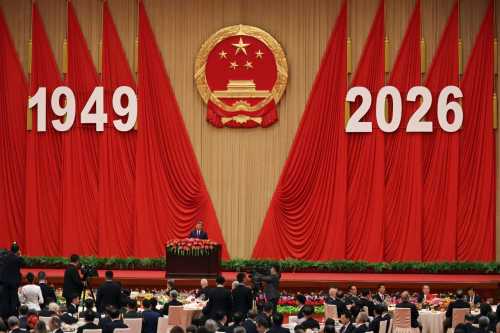
Okay. So let’s get right into it. Russian President Putin and Chinese President Xi Jinping have described their country’s ties as ‘a partnership without limits.’ The two leaders have met more than 40 times since Xi has been in power. And in recent news, Putin traveled to Beijing right after Trump finished his summit there in early May. With regular photo ops, the two leaders project an image of solidarity despite a long history of animosity and mistrust between the two sides.
After years of Western sanctions and as the Ukraine war continues, Russia has become more and more dependent on China, and the relationship is increasingly uneven. How do both countries see the current status of their relationship, and how close are they really, especially with Russia’s reliance on China? And where is the relationship going?
Just to give our listeners a sense of how you assess this relationship, and I know this is kind of a casual heuristic, if you had to grade how threatening is this entente between China and Russia to the United States and our interests on a scale of one to 10, what what numerical value would you assign it?
[2:28]
HILL: I’d put it around a seven or an eight. I think in, you know, different times we might have had a different assessment. And of course, you know, as far as this current administration is concerned, you know, they’re part of much of a break themselves with past practice, of the United States. Perhaps they don’t see it, you know, quite so threatening.
But I put that in the context of having looked at this relationship for a very long time. And it actually is moving in a direction that I would not have previously anticipated. And that direction has been driven very much by the mutual antipathy of China and Russia towards the United States. So it actually it is a relationship that’s been fused by all of the kind of negative assessments and reactions to the United States. So in that way, of course, it’s threatening.
CZIN: So even if, and I don’t want to put words in your mouth, Fiona, so even if the perception currently in Washington or in the administration is that it’s not that threatening, you objectively think that the reality is that this is, this is a real challenge for us.
HILL: Yeah, because in the case of China and Russia, they’re definitely out to counter us. They may not be always out to get us, as the, you know, the idea always goes, but they’re definitely out to counter us and to try to check the United States on as many fronts as they can.
[3:41]
CZIN: Pattie, what numerical grade would you assign this in terms of how worrisome this is?
[3:45]
KIM: Actually right in line with Fiona, where I would put it somewhere around eight. The China-Russia strategic partnership is not a formal alliance. There are real limits, asymmetries, and mistrust between the two capitals.
But having said that, it is a highly consequential partnership, as Fiona outlined. It brings together two great powers that are aligned in a shared desire to weaken American influence and U.S. alliances while they want to reshape the international order that is in a way that is more favorable to themselves
[4:15]
CZIN: And one other point just to level set at the, at the top. There’s a lot of chatter about this relationship, right, in the commentariat. But I often fear, especially with this relationship, because you’re dealing with two opaque polities, that the content-to-knowledge ratio is quite high. Right? So as you look at the public commentary about this, what would you each say are, is one of the chief misconceptions about this relationship that you would want to rectify?
HILL: Well, look, I know from my own experience that you have to be extraordinarily careful for all the reasons that you say that it’s not always clear what is driving and motivating any relationship, frankly. And I, you know, more than sort of 10, 15 years ago, before really President Xi consolidated his power in China, would not have actually predicted that this relationship would be that close. In fact, I didn’t.
And in fact, I’m on the record, along with another colleague, Bobo Lo, a British Australian writer and former diplomat who, you know, is quite steeped in Asian affairs. You know, we wrote an article basically saying that we thought that the contradictions that you played out at the very beginning, Jon, would be more of an obstacle to the closeness of the relationship that we see today because we had not bet on all of these external circumstances. We didn’t think that the United States itself would mishandle these relationships to such an extent— and I think the U.S. has done quite a bit of mishandling that it would push China and Russia together.
And also, it’s the emergence of President Xi, the consolidation of his power, and his move to make the Chinese presidency look much more like a Russian presidency or an American presidency, rather than being someone rooted in the Communist Party, the Politburo. He’s moved China and Chinese leadership in a different direction. So he and Putin look more alike structurally than they would have done before.
CZIN: Yeah, that’s a great point. And as a former intelligence analyst, I appreciate your analytic humility and candor about, you know, where we get it wrong. Right?
HILL: Totally know why we got it wrong as well, because I play that back over time. Thought, Well, we didn’t see this. We made that assumption. We looked at a certain kind of trend. We didn’t factor in the fact things could change. And also, we all have to know that there’s lots of things that we don’t know about the various dynamics.
[6:19]
CZIN: Yeah. Pattie, what about you?
[6:21]
KIM: So I think the biggest misconception is that Beijing and Moscow are either inseparable partners or they are inevitable rivals that are on the brink of a split. I think the reality is that this partnership is stronger than it ever has been in decades, certainly since the post-Cold War period.
And again, this is a partnership that’s underpinned by very powerful incentives to align against U.S. pressure with very real economic, diplomatic, and even military cooperation that has significant consequences for U.S. interests.
Now, having said that, I think it’s very important to realize, as Fiona pointed out, that there’s deep mistrust, competing interests, and a strong desire on both sides to preserve their strategic autonomy, and I think that puts real limits on how far the partnership can go.
[7:09]
CZIN: Yeah, I think that’s great. I mean, it’s a very textured response. Right? It’s not so black and white or binary in this dynamic.
Okay, so of course the the two leaders met recently as we talked about at the outset, and there has been a regular cadence of meetings between Xi and Putin for quite some time. Right? I think they’ve met close to 50 times now, and I believe this was Putin’s 25th visit to Beijing. So what do you think was… well, what is the purpose of this kind of meeting? And, and what do you think is consequential about it at at this point in time in the relationship? Pattie, you want to go first?
[7:38]
KIM: Sure. Well, so, Jon, as you said, this was Putin’s 25th visit to Beijing, and compare that to Trump’s second visit, this came four days later, which was, you know, in some ways very surprising that they would stagger it so closely. And in many ways, I think the substance of the visit was less important than the fact that, you know, that it, this is really about sort of showcasing this regular cadence of high-level exchanges between Xi and Putin, and to to cultivate this image of closeness between the two leaders.
And I think the optics really matter. So Putin received the same kind of treatment that Trump received with the cheering schoolchildren and the honor guard. And again, this was just four days after Trump’s visit to Beijing.
And the two leaders used the summit to reaffirm very familiar themes, like their joint opposition to what they call U.S. hegemony. Their belief that uh that there should be a more multipolar international order, a greater voice for the Global South, of course, for China and Russia on on top of that, and and continued coordination on major international issues.
So again, none of this was really new or striking, but that’s besides the point. It was really to show the continuity in the relationship.
[8:54]
CZIN: Yeah, it’s kind of a classic bit of Chinese statecraft. Right? The meeting is the objective. Right? Fiona, what were your main takeaways from from watching this most recent summit?
[9:02]
HILL: Well, I think it’s the same piece of tradecraft for Russia, that the meeting is the objective, but I say that with a caveat. Because at this particular juncture, Russia needs that relationship with China for all kinds of economic and strategic reasons that probably are not as high up the pecking order for China in terms of thinking about where Russia fits into the broader scheme of its foreign policy.
And I’d be very interested in, you know, your own reactions about that because, and I know we’re gonna talk about this, that the war in Ukraine has really shifted the balance in that relationship I would say in Beijing’s favor. Because as Russia has found itself sanctioned, and it’s not just since 2022, when, of course Russia launched the full-scale invasion of Ukraine, it goes back much further to interference in the U.S. elections in 2016, the annexation, you know, of Crimea prior to that in 2014.
A whole kind of cascade of events and actions by Russia that have led to some kind of counter-reaction from the United States and also from Europe, have forced Russia into kind of rethinking the whole patterns of its trade and economic and political relationships.
And Putin has, as you’ve pointed out, visited Beijing 25 times. He’s also visited a lot of his neighbors in Kazakhstan and Kyrgyzstan and the Central Asian countries, of course, but China as well. And Russia’s longest border is with China, but Central Asian states, formerly part of the Soviet Union, are a very important part of this landscape as well.
And you can see there that Putin is really prioritizing the relationships that bring goods in and out of the country. And the Central Asian states, obviously not major investors in Russia, but they’re major conduits and thoroughfares, including for goods from China.
[10:48]
And so, for Russia, that relationship with Beijing is pretty critical because China is still providing Russia, admittedly at a pretty high cost, the kinds of goods that it can’t get from other places. The Gulf has been another important entrepot for Russia, Turkey, the Caucasus states, places like Armenia, for example. But China has really dominated now, and it’s become the most probably important of Russia’s trading partners where it wasn’t before.
And what Putin hoped to get out of Beijing was some major contracts. He hoped to get China to agree to buy more Russian energy, you know, particularly gas, and that’s been on the agenda for decades now.
And I think, you know, we’d all agree that he didn’t quite get what he wanted because, as you said, for Xi, the meeting was the point. It wasn’t necessarily signing a whole host of agreements that are perhaps not as essential for Beijing.
[11:41]
CZIN: Yeah. And I think that’s a great segue to my next question, too, which was what is driving this relationship, right, beyond this particular moment? I think, Fiona, that’s a great lay down for, for our listeners.
Pattie, do you want to intervene and share, you know, how this looks from Beijing’s perspective? What’s driving the closeness in the relationship? Because it, it’s really striking listening to it that there’s this cascade of decisions from Moscow in particular that feeds the cycle of reaction and counter-reaction that leads them to rely more on on Beijing. But you know, what is driving it in your assessment from Beijing’s side?
[12:12]
KIM: I mean, I think it’s a combination of factors. Right? But shared strategic interests are the most important. At the most basic level, China and Russia view each other as their most important strategic partners in countering pressure from the United States and its allies. They’re brought together by a shared perception that the world is too heavily shaped by American power, and they want to push back against that. They want greater freedom of action, and a larger voice in regional and global affairs.
And they have a shared interest in pushing back on Western sanctions, the promotion of of universal norms and values, which they say are essentially tools for Western interference in their own domestic affairs.
And so there, you know, there’s definitely an ideological component to this relationship. I think trade and economics are significant, but they’re best seen as strengthening and sustaining the partnership rather than serving as its primary foundation.
And China, as Fiona mentioned, has become a crucial economic lifeline for Russia, especially since the invasion of Ukraine. It’s a major market for Russian energy exports, a key source of technology, of manufactured goods, dual-use goods. And Russia provides China with raw materials, with energy and certain military and strategic technologies. ,
So there’s definitely, you know, there’s a shared interest there. Having said that, I think it’s important to point out that the two countries do not have identical goals. Russia is generally more willing to use military force and accept risk in pursuit of revisionist objectives, whereas China, I think traditionally or today, is certainly more cautious because it’s more integrated into the global economy. It has much more to lose from prolonged instability and therefore there’s, you know, there’s a different outlook, a strategic outlook between the two countries that we do need to recognize.
[14:03]
CZIN: That’s interesting. I’m I’m struck in listening to both of your answers how much this seems to rest on material and structural factors kind of driving the two countries together. But of course, a lot has been made about the so-called bromance between Xi and Putin.
So, you know, kidding aside, I mean, objectively, how do you assess how important the the idiosyncrasies of these two leaders who are almost exactly the same age, you know, – there are some interesting similarities in their backgrounds. How important do you think that is? I mean, is, are we kind of landing somewhere where, you know, if Xi and Putin didn’t exist, they would have to be invented in some ways? Or is this more driven just by their own personalities and dispositions?
[14:38]
HILL: I think it does have a lot to do with that personal interaction. And now China has become more of a personalized system as well. You know, as I said in the past I don’t think that relationship had quite the foundation because Russia had got rid of the Communist Party, it had got rid of the Politburo, it had got rid of any kind of institutional structures outside of the presidency.
And although China obviously has not moved completely in the direction yet of a totally personalized power, I mean, it certainly has a lot of the attributes. And that nature of the, what the Russians call the vertical of power, I mean, both Putin and Xi are right at the top of it. Now, you know, we know that our own President Trump would like to be, you know, part of that vertical as well on the pinnacle with them, but, you know, that’s a much more complex relationship for all kinds of different reasons.
And I I do think that Xi and Putin share something of a similar outlook. Age really does matter. Of course, I mean, you can tell me more from Chinese culture about the way people will parse that, but also from Putin, he’s much more comfortable with his own age cohort, Because they have a shared worldview from the same, what was then communist system. And he’s familiar with China from that context.
And in that context, of course, in China, there was a lot of translation of Russian culture. And it’s well known that President Xi’s very fond of Russian culture. Well, so is Putin. He’s not, however, known for his delving into the history and culture of other countries, but at least on a superficial level, you know, Putin finds China extremely interesting.
And as somebody who’s very much motivated by understanding the kind of history, you can be sure that Putin has probably done his own deep dive into understanding the long thread of relations between Beijing and Moscow, you know, going back to the tsarist eras as well. And I think that also means that they, they have a kind of shared understanding of where this relationship has been, and where it could go again if they’re not careful.
[16:37]
And for Putin, you know, he’s almost said that it’s almost a necessity, it’s essential that Russia and China don’t exacerbate those stressors that are already there, the historical stressors, the seizure of territory that Russia basically appropriated from China in the 1860s, along with every other European empire and colonial power.
Putin’s well aware that Chinese nationalists are still looking at that territory. And as somebody who likes to regain, retake territory of the Russian Empire, you know, he he understands all of that.
And so he is being, you know, very careful in the way that he manages that relationship, but he’s definitely approaching it all from the top down. I don’t think, you know, we really see in Russia writ large a lot of ballast, you know, for this relationship outside of the economic sectors. You know, you’re not seeing a mass transfer of Russian elites to go to study. You see some, but not to the scale that, you know, people would, you know, see in other settings. There’s still a kind of preference for Russian elites, you know, to go to Europe if they can or out to the Gulf. You know, they’re not all setting up shop in Shanghai or places like that, although, you know, some are. But I think it’s really that relationship and the fact that, that the two leaders see the world in very similar ways.
[17:47]
CZIN: Yeah. And I’m always very bemused when I see some of these readouts from past years where it talks about Xi burning the midnight oil when he’s a sent-down youth, reading Pushkin, right, and other great Russian authors.
Pattie, what what’s your assessment when you look at this from Xi’s perspective? How important is the Xi factor in all this?
[18:02]
KIM: Well, Xi has certainly said literally that Putin is his best and most intimate friend. And I think the two leaders certainly want the world to believe that they are best friends. So by, I think, standards of international politics this is clearly a close personal relationship, and it matters, as as Fiona laid out.
But just to kind of argue the other side of the coin, I think it’s important not to overstate what that means. At its core, this is, again, a relationship that I think is built on cold, strategic interests and calculations far more than personal loyalty. And as much as Xi and Putin have projected this image of friendship and strategic alignment, I think at the end of the day, neither are going to risk their own political fortunes to come to the other’s aid. And I think the good, a very good example is the Wagner rebellion in 2023, which was presumably the the greatest, or arguably the greatest threat to Putin’s rule since he came to power. And if there was ever a moment where Xi could step up, you know, for his best friend, that was it. But we didn’t really see that happen.
We did not see Xi make a public statement supporting Putin. Notably, when the Chinese Foreign Ministry spoke out about the incident, it was, like, a very short two-line statement that essentially called for stability in Russia. And so that’s very different from coming out and saying, you know, ‘We support Putin.’
And so I think, you know, the fact that Xi’s instinct was not to come to Putin’s personal defense, but to preserve flexibility, and to avoid tying his country’s fortune too closely to one leader, just really shows that this is a relationship, again, that’s guided by strategic interests rather than personal loyalty. Although I would say that this personal relationship matters, we shouldn’t downplay it.
CZIN: Yeah.
KIM: But there are limits.
CZIN: So, so maybe more of what the kids call a situationship than a true romance.
HILL: That’s good.
[19:56]
CZIN: Yeah. I mean, I think that’s really interesting because, you know, I think there’s a tendency sometimes for people to say, Well, this is just about their aligned interest, right, and there’s not real amity there. But I, you know, from my perspective, as somebody who’s looked at Xi in particular for a long time, and having read some of your work, Fiona, about Putin, in some ways that’s a more durable basis for guys like this, I think, that they just have shared interests than if they really like each other and get along with each other.
And I’m always mindful of this as somebody who looks at Chinese elite politics. Right? Like, there’s plenty of people that Xi likes or had relationships with, and he kind of throws them overboard when their interests no longer converge, right, and they become an inconvenience. And we got a big dose of that earlier this year. Right? So I feel like as long as there is that strategic dynamic pushing them together, in some ways, that’s more compelling, too, to guys with this kind of psychology.
We’ve touched a number of times in this conversation on the differences that bedevil this relationship, and some of the divergences. And Pattie, I know we’ve talked a lot in the past, you and I, about, you know, the debate that seems to be ongoing in China about the relationship between the two sides. So could you talk a little bit about, you know, what you’ve seen of that debate from the Chinese side, and what you see as kind of the key points of friction between Russia and China from China’s perspective?
[21:06]
KIM: So there is indeed a debate among Chinese scholars and policy analysts about whether Russia is a strategic asset or a burden to Beijing. The partnership has damaged in many ways China’s image in Europe, around the world. It’s helped foster coordination between NATO and America’s Asian allies. It’s increased attention on the Taiwan Strait and sort of, you know, Taiwan being the potential next Ukraine. And so in many ways, there have been costs.
But I think what matters is how Xi and the senior leadership view the relationship. And I think the evidence is very clear that they see Russia, they see Putin as as a very important strategic partner; they’re not gonna alienate them.
Now, this raises the question, why aren’t they closer, or why aren’t they even more aligned in that case? And I think China and Russia are not allies today because neither side wants to be official allies. I think uh they both see sort of a formal alliance as reducing their strategic flexibility that both governments value, and this could create obligations that neither side wants to assume.
And I think part of this is historical. So the Sino-Soviet alliance of the 1950s was in many way, I think, an exception rather than the norm. For much of the 20th century or even hundreds of years, if you go back, the Sino-Russian relationship was characterized a lot more by rivalry and suspicion and mistrust. And since the founding, the CCP has always been mistrustful of of Moscow and wary of Russian influence and interference and subversion in Chinese, what China considers its frontier regions, like in Manchuria and in in Xinjiang, as well as in areas like, adjacent areas like the Korean Peninsula and Indochina.
In fact, you know, if you think about the last actual major war that the PLA was involved in, which is Vietnam in 1979, this was driven in large part by Beijing’s determination to push back what it saw as Soviet-backed Vietnamese expansionism along its traditional sphere of influence. And so there there’s a lot of history there.
[23:11]
Today, the balance of power has shifted decisively in China’s favor and there’s a lot of uneasiness, as Fiona talked about, in Moscow about China’s growing influence compared to Russia, and China’s influence in Central Asia and the Russian Far East.
In fact, there have been reports about Russian intelligence talking about China as the enemy. And so that’s, that is a far cry from sort of best friends, strategic partners. And again, this is based on concerns about Chinese espionage, as well as Chinese potential to encroach upon Russian frontier areas. And so there, there’s a lot of differences there.
And finally, what I would say is that while China wants to reshape the international system to its favor, I don’t think it wants to blow up the current order. It, it is the world’s second largest economy. It is the largest trading state. And so again, I think Beijing has a real stake in global stability, because that’s what’s going to advance its interests, whereas Moscow is much more willing to engage in sort of risks and violent revisionism.
And so there’s a big difference there. So these are two countries that are close strategic partners, but they don’t trust each other enough or need each other enough to become formal allies.
[24:25]
CZIN: That’s great. That’s really helpful. And on your last point about, you know, how prone to violence Moscow can be, I have always wondered if this is, maybe makes Russia a useful foil in some ways for China. Like, it’s, it’s not quite good cop, bad cop. Maybe it’s bad cop, worse cop, right, for the international system.
But Fiona, how does, how does this look from Moscow’s perspective. Right? What are, what are the key points of friction, and how how attuned are they or sensitive are they about this growing power imbalance and their their increasing dependency on China?
[24:54]
HILL: I think they’re definitely attuned to it, which is why Putin is spending so much time trying to cultivate and manage, I would say, Xi, and through Xi, China, because Russia is very nervous for all of the reasons that Pattie’s just laid out there.
I mean, I think for China, as you’ve just said, Jon, Russia’s kind of like their attack dog. You know, they go out there and they kind of bite at everybody and they savage everything. And then China sees how everyone reacts and, you know, from there, you know, what, what do they need to do?
And I think as Pattie’s already laid out, I mean, China’s not particularly thrilled, as as you are all are saying, with what Russia’s done in Ukraine and elsewhere because they have damaged China’s relationships with Europe.
And I think from the Russian perspective, they needed to have China’s support in Ukraine, and North Korea’s and Iran’s.
[25:46] And they weren’t necessarily thinking that they were creating a whole new global landscape. They were wanting to pull everything down in any case. As, Pattie is saying, Russia’s the kind of person who wants to come into a club to burn the clubhouse down. Because they, they don’t get to get a veto or they don’t get to kind of set the rules.
And so, you know, it’s it’s basically then, okay, then we’re just gonna change everything. It’s a very, you know, reductionist, rather destructive kind of approach to things. At least under Putin. That wasn’t, you know, necessarily how, you know, things were before. And it was all through the prism of how Russia saw the relationship with the United States. And I think that’s the same thing for China.
[26:25]
What Russia wasn’t banking on when it’s courting China was the United States kind of goes off-piste completely, off kilter, off, you know, direction that they would never intend. I mean, it’s no good being the attack dog if there’s a whole pack of other dogs, you know, running out there, you know, tearing around, and that’s how the United States has started to be viewed.
I think from the perspective of Russia and elsewhere, that all the uncertainty and unpredictability now in the system is emanating from the United States. And when you’re Russia and you’ve basically as Vladimir Putin, you’ve cultivated this image of recklessness and of the person who throws all caution to the wind and, really, it’s not just the kind of madman theory, it’s the ruthless man theory, who could absolutely do anything, which of course he has, I mean, presiding over the mass slaughter of many of his own citizens, not just of Ukrainians and others.
You’re kind of reliant on the rest of the world being somewhat predictable. And China and the U.S. was a predictable relationship. Yeah. And I think what’s happening now for Russia is they’ve invested so much in China to the detriment of their own room for maneuver because they thought they were all fighting in the same direction against the United States.
Well, that’s really not the case. I mean, Trump has proven to be the actual Trump card, the surprise card, the wild card, turning everything on its head. And Russia is now having to confront the fact that all of the traditional allies of the United States that he saw as vassal states or shadows of the great U.S. empire, are now also reassessing, and will have their own agency and their own views of what Russia is doing, and now increasingly their own desire to push back.
And that, I think, will start to change the nature of the relationship between Russia and China. Because if Russia was China’s attack dog against the United States, what if it’s just the kind of now the crazy dog that’s biting absolutely everybody in the international system at a time when you don’t want that to happen?
[28:16]
CZIN: That is a really interesting point, Fiona, about how the the U.S. factors into all this and and upsets Putin’s expectations. But given the the fluidity, right, for lack of a better word, that the Trump administration is engendering in the international system, does that create space for what some people in the administration or adjacent to the administration were talking about last year, some kind of wedge or reverse Kissinger, reverse Nixon moment, or not really?
[28:41]
HILL: I don’t think it does for the United States, to be frank, because the United States is all over the place. But it does perhaps for Europe and for other interlocutors of both China and Russia. That could include India, Japan, South Korea. Because the world has actually become multipolar, perhaps in spite of, not because of Russia and China’s efforts, you know, to work together.
It’s really been the U.S. just casting everything aside and behaving in a way that no one anticipated for the last year, 80 years, no longer the benign hegemon, now some kind of malign, unpredictable force that has changed everything. And I think both China and Russia are gonna have to recalculate.
And as a result of that, I mean, it’s not just about their own relationship, but of how they interact with others. And there might become more pressure on both of them from different angles to rethink the closeness of this relationship in different contexts.
So I think, you know, we want to inspect that to say that this relationship was very much forged by their own views and assessments of the United States and the behavior of the United States. But when the United States shifts, if that was the fulcrum, you know, the pivot for their relationship, they’re gonna find themselves in a very different place than where they were before
[29:54]
CZIN: Pattie, what’s your thought on the wedge issue?
[29:55]
KIM: So I think it’s definitely possible to exploit tensions in the China-Russia relationship, but is there an imminent opportunity to pull off a reverse Kissinger? I don’t think so, not quite. I think the strategic context today is very different from the Nixon and Kissinger era in the 1960s and early ’70s when China and the Soviet Union were literally engaged in active border clashes and had a bitter, bitter rivalry over leadership in the international communist movement. And so it’s a very different time from there.
I think China and Russia, again, still view the United States and the broader Western-led order as their principal strategic challenge, and so they’re united there. And as long as that remains true, I think the incentives that are pulling them together are going to outweigh the forces that are pulling them apart.
Now, having said that, I think it’s important that we don’t ignore the tensions that exist. And as we discussed throughout the podcast Beijing is very, you know, uneasy about some of Moscow’s risk-taking, and while Russia is very uncomfortable with the growing imbalance of power in the relationship.
And so I think the more realistic objective is not necessarily to drive a wedge or split them apart tomorrow, but to think about how do we prevent these two powers from growing even closer together? How do we exploit the areas that already exist, the divisions that already exist, and avoid unnecessary moves that are gonna, again, push them closer together? I think that’s, that’s where we should be putting the focus.
[31:26]
CZIN: I feel that’s a great way to put it. And I remember last year, you know, about a year ago this time when people were talking about a reverse Nixon, I kept thinking, Well, reverse Nixon’s when we get outmaneuvered by the Russians and not the other way around. Right? That’s how we’re gonna reverse this.
All right. Let’s be a little bit forward-looking now that we’re at the end of the show. Fiona, I want you to, you know, pretend you’re back in the role of national intelligence officer again for this part of the world. If you had to prognosticate and look forward at this relationship five, 10 years down the line, how would you see it developing, right, and what would you say are are going to be the key variables that determine the trajectory? Especially since, you know, even though Putin and Xi seem to think they’re middle-aged men based on that hot mic comment last year, right, they are in fact both 73 years old, and the actuarial table will start to take its toll at some point, presumably.
[32:11]
HILL: Well, I think the first thing, Jon, is to really recognize where we might have had faulty assumptions or made mistakes and learn lessons from those. And as I said at, you know, the beginning of the podcast, I learned lessons from my own projection out of, you know, where things were at a particular period in time and, you know, thinking always about the weight of history because there are often discontinuities. I mean, there are major things that change things.
But I think we’ve learned, you know, very much over this last 10, 15 years that things can take unexpected turns. I think one thing to really bear in mind is that Russia has really depleted its power and its perception of power I would say on the part of Beijing and everywhere else by what’s happened in Ukraine. Russia has bogged itself down. There’s no good way out for Putin. He hasn’t achieved any of the goals that he set out to do with his special military operation. I mean, I think we could say the same about the United States, you know, in the in the Gulf at this particular moment.
And the relationship between Xi and Putin was first forged where it was more of a pinnacle of power. I mean, there’s always challenges. Russia’s never as strong as it looks or as weak as it looks. But it was definitely a different place before 2022, February 2022. When Putin and Xi met on the sidelines of the Beijing Olympics just before Putin launched the invasion, perhaps that was kind of the pinnacle of the relationship in many respects.
Because after that it has been downhill for Putin in Ukraine. He’s had to draw China much more into a conflict that it didn’t want to be in because China didn’t have a beef with Ukraine at all, or any particular tensions with Europe. It was kind of looking at this in a very different way. And what Russia has done is basically become the system-changing event through that war for the whole of European security and perhaps of a different global system.
[34:00]
And it’s also spent itself as a as a military force. Despite all of the innovation and, you know, the emphasis on the military, you’ve had 375,000 people killed in Russia. That’s phenomenal. It’s the largest land war since World War II. Russia’s now fought in Ukraine longer than it fought Nazi Germany. The Soviet Union fought Nazi Germany when Ukraine was part of that in World War II, and this has now gone on longer than World War I.
That was another milestone that we we passed recently. If you’re sitting looking at this from anywhere, including Beijing, you start to wonder what the heck has happened here with Russia.
Now, this isn’t to say that Russia could not regain its footing at, you know, some other point. But at this particular point, it looks more like a a spent force, in the way that one would’ve anticipated in February of 2022 when it looked like Putin would just go in there, take charge of Ukraine in a way that Xi and China might have expected of a way that they might deal with a problem on their borders. And this has become something much more than that.
And so when I’d put on that national intelligence officer hat, I’d have to say, Well, what else could happen here? As you say, you know, they’re in their 70s. Putin’s birthday will be in October. He’ll be 74. I mean, Botox and all kinds of other things he’s had done have made him look, you know, pretty much immovable actually in many respects. I mean, this is a man without any facial expression at this particular point.
But, as we know, I mean, things happen. And what would happen in Russia, is that you would have a succession crisis, which I think gets back to Pattie’s very good point about Xi’s reluctance to throw in his whole lot with Putin. Because Putin, like everybody, will come and go. And Xi is, you know, well aware of that, you know, in his own circumstances.
And there’s more there there in China. You still do have a Chinese system. But Russia under Putin has been hollowed out in terms of a a a system that would provide a path to succession. And Xi’s gonna have to keep his options open as the rest of us are going to do as well.
And he’s probably thinking about what does Russia look like without Putin and beyond Putin, as we all should be. And how would one reengage? And Russia’s become a a dilemma for European security, and for China, that means that their pathway back to, you know, reasonable relationships with Europe, not with the United States, but really goes about how they handle their relationship with Russia over the longer term.
[36:28]
CZIN: That’s really interesting. I’m glad I can go back to this part of the podcast and re-listen to it after we’ve published. Pattie, what are you looking at and thinking about as we look five to 10 years out in this relationship and how it might develop?
[36:38]
KIM: Yeah. I think barring a major geopolitical shock, China and Russia will continue to remain aligned over the next five to 10 years. But of course, there’s this question, what happens when either Xi or Putin exit the stage? And without knowing what kind of leaders are ultimately gonna take over and succeed them, you know, I would expect, at least based on what we see now, that the partnership will endure beyond either man, as long as the strategic incentives that are underlying the partnership are still there.
Having said that, you know, I think personal dynamics do matter, and what we saw during the early Cold War was that despite Mao’s immense respect for Stalin, for instance, when Khrushchev came to the scene, there was this, there was this immediate rivalry, and Mao saw Khrushchev as not worthy of the same type of respect that he accorded to Stalin. And on the, on the flip side, Khrushchev saw Mao as erratic and reckless, and a counterpart that could potentially drag the Soviet Union into a war with the United States over Taiwan, or perhaps into even a nuclear confrontation.
And so again, I think the structural foundations of this relationship are likely to endure beyond Xi and Putin, but the personalities of future leaders could actually matter in how the two sides manage their relationship and how far they can sustain cooperation over time.
[38:03]
Of course, the other element we need to look at is what happens with the United States’ relationships with China and Russia. You know, there could be a significant rapprochement between Washington and Moscow, or between Washington and Beijing, that could alter the strategic calculus in those two capitals, and revive longstanding anxieties about the other pursuing accommodation with the United States behind , you know, behind its back. And historically, it was these kinds of fears that drove the Sino-Soviet split.
And so I don’t see this resurfacing any time in the immediate future. I don’t think the Trump administration is likely to engineer this kind of outcome in the next two to three years before it exits the scene.
But you know, I think we do need to think about if there is sort of a fundamental reordering of the post-war, you know, World War II international order, what is this gonna mean for the China-Russia relationship? It’s certainly gonna expose, I think, more of the conflicts that are there, the underlying tensions that we talked about.
And, and, and so it … this could lead to a change, but I don’t think we’re anywhere close to that point yet, despite the disruptions that we’ve seen.
[39:13]
CZIN: Yeah. That’s really interesting. And, you know, your comments, Pattie, too, make me think of just, you know, how how important accidents are in shaping history. Right? The contingent factor. Like, it seems like it would make a big difference, you know, given that analog with the Khrushchev and Mao dynamic after Stalin’s death, it might matter a lot who ends up passing away or leaving the scene first. Right? Because you could easily see a dynamic where somebody comes to power in Russia or in China, and they look like a whippersnapper to either Xi or to Putin, and that starts to, starts to unravel the relationship in the same way. So that’s very interesting.
Well, thank you both so much for joining us today and walking us through the ins and outs of this really consequential relationship.
For more in-depth analysis from our team, please visit the China Center on the Brookings website at Brookings dot edu slash ChinaCenter. You can also subscribe to our monthly newsletter, the China Bulletin, for the latest updates.
[music]
On behalf of the team at the John L. Thornton China Center, thank you for listening to The Beijing Brief. This podcast is produced by the Brookings Podcast Network.
Our thanks to the production team, including supervising producer Ike Blake; senior producer Fred Dews; producer Allie Matthias; audio engineer Gastón Reboredo; and video producers Daniel Morales and Teddy Wansink. Rachel Slattery designed the show’s artwork. Also, thank you to our colleagues in the John L. Thornton China Center, Foreign Policy, and Office of Communications at Brookings for their support.
To learn more about our research, visit us at Brookings dot edu slash China Center, and to learn more about this podcast, go to Brookings dot edu slash The Beijing Brief or wherever you like to get podcasts.
Participants
Guests


Host

The Brookings Institution is committed to quality, independence, and impact.
We are supported by a diverse array of funders. In line with our values and policies, each Brookings publication represents the sole views of its author(s).
Commentary
PodcastNo limits? Testing the China-Russia relationship
Listen on
The Beijing Brief
July 7, 2026