This piece is part of the Taiwan-U.S. Quarterly Analysis series, which features the original writings of experts with the goal of providing a range of perspectives on developments relating to Taiwan.
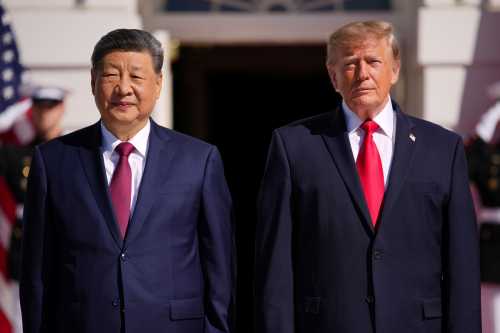
Kuomintang (KMT) Chairwoman Cheng Li-wun’s April 2026 visit to Beijing, which culminated in a landmark summit with Chinese President Xi Jinping, has profoundly reshaped Taiwan’s political landscape and the trajectory of cross-Strait relations. The engagement’s timing was particularly significant, occurring just one month prior to Xi’s summit with U.S. President Donald Trump and amidst a critical domestic window—seven months before Taiwan’s November 2026 local elections and 20 months before the 2028 general elections. Through a series of addresses delivered in Nanjing, at the Sun Yat-sen Mausoleum, at the Port of Shanghai, and during the summit itself, Cheng articulated a new strategic framework toward Beijing, which I characterize as Cheng’s “alternative approach” or “path” (鄭麗文路線).
Tactical successes and cross-Strait de-escalation
For Cheng, the summit constitutes a definitive personal and political triumph. Since assuming leadership in November 2025, Cheng—an unconventional KMT figure who began her career as a Democratic Progressive Party (DPP) activist—has contended with persistent intraparty skepticism regarding her unorthodox background and lack of a traditional political lineage. However, her direct engagement with Xi, a feat unparalleled by any KMT leader since 2016, has effectively neutralized her detractors. Empirical data indicates that her public standing improved across the Taiwanese electorate and saw a particularly sharp ascent among KMT supporters following her return from Beijing.
From a tactical standpoint, the visit underscores the success of the KMT’s transition to “1992 Consensus and opposition to Taiwan independence” as the operative political framework in the Taiwan Strait, effectively superseding the traditional “one China, different interpretations” formula. Notably, Beijing demonstrated significant diplomatic restraint throughout Cheng’s itinerary. Xi and other Chinese Communist Party (CCP) officials deliberately eschewed provocative terminology such as “One China,” “Chinese unification,” or “one country, two systems.”
This calculated omission suggests a high-level mutual understanding, with both parties adopting a recalibrated foundation as a prerequisite for the summit and future bilateral cooperation. According to a TVBS Poll released on April 23, 66% of the Taiwanese electorate favors expanded engagement with the mainland, though opinions remain fractured regarding whether this détente will yield a durable peace. Support for such engagement reaches a resounding 90% among opposition party supporters.
To date, the Cheng-Xi summit has exerted a negligible influence on the ruling DPP. According to a My Formosa Poll released on April 28, favorability ratings for both the DPP and President Lai Ching-te have remained stable. Far from recalibrating its platform, the DPP appears intent on emphasizing the dichotomy between Chinese and Taiwanese identities in the impending November 2026 local elections. This strategy is most evident in its nomination of Puma Shen—a DPP legislator whom Beijing has labeled a hardliner separatist—as the party’s candidate for the Taipei mayoral race.
For the Taiwanese public, the Cheng-Xi summit’s most significant immediate consequence has been a perceptible de-escalation of cross-Strait tensions, albeit perhaps temporarily. By restoring high-level communication channels between the KMT and the CCP, the visit has effectively halted the “vicious cycle of mutual antagonism” that previously characterized bilateral relations. This shift appears to have been reflected on social media: China’s Global Times newspaper claimed that online discourse in China became less polarized following Cheng’s visit, and an analysis conducted by Gemini of writing by leading influencers on Weibo showed similar results.1 A majority of Taiwanese have also acknowledged a genuine preference for peace with the mainland populace. In the summit’s wake, Beijing’s announcement of 10 “preferential policies” toward Taiwan—though largely symbolic—served to consolidate this nascent period of détente. According to the same My Formosa Poll, about 22% of Taiwanese now say they could “accept” peaceful unification with the mainland. This was never higher than 10% before.
For Xi and the CCP, the summit advanced three primary strategic objectives. First, it reinforced a nationalist narrative for the mainland audience by asserting that a majority of the Taiwanese electorate opposes Taiwan independence. In the summit’s immediate wake, CCP media framed Xi’s “four denials” (no separation, disturbance, disintegration, or fault lines) as Beijing’s nonnegotiable red lines in the Taiwan Strait. Second, the engagement sought to reiterate the “divide and rule” strategy within Taiwan, rewarding cooperative actors while further marginalizing hostile factions, most notably the ruling DPP. Finally, the summit strengthened Xi’s leverage ahead of his mid-May meeting with Trump, allowing him to challenge U.S. assertions by citing the KMT’s engagement as evidence that American assessments do not align with the will of the Taiwanese majority.
Cheng’s doctrine: An alternative paradigm
A series of orchestrated addresses in the mainland
Prior to her departure, Cheng personally authored her addresses for Nanjing, Shanghai, and Beijing, intending to unveil a transformative approach to China and a novel cross-Strait narrative. At the welcome dinner in Nanjing on April 7, she reaffirmed the KMT’s commitment to the “1992 Consensus and opposition to Taiwan independence” framework as the bedrock of a consensual political foundation. On April 8, at the Sun Yat-sen Mausoleum, Cheng invoked a sweeping historical arc: the founding of the Republic of China (ROC), Taiwanese collective mourning of Sun’s passing in 1925 during the Japanese colonial era, and the painful separations of 1895 and 1949. By highlighting the reconciliation that began in the mid-1980s, she emphasized a shared brotherhood that transcends the upheavals of the 20th century. Notably, she signed her remarks using the 115th year of the ROC, adhering to Taiwan’s official calendar, rather than the Gregorian calendar year of 2026.
At the Port of Shanghai, Cheng bridged historical traumas—such as the Opium War, the 1937 invasion, and the 1949 evacuation—with the economic integration of the 1990s to reinforce a sense of “common destiny.” During the summit, she strategically adopted CCP nomenclature, including terms like “national rejuvenation” and “a community with a shared future,” to align with her host’s rhetoric. Simultaneously, she situated her mission within the lineage of KMT-CCP peace initiatives dating back to Lien Chan’s 2005 visit, expressing a firm resolution to institutionalize bilateral cooperation. She concluded the summit by extending a historic invitation for Xi to visit Taiwan in an “appropriate context,” stating, “Let me be your host in Taiwan.”
A counterpoint to the DPP position
Cheng’s visit and subsequent discourses highlight a burgeoning “alternative” approach, positioned as a direct challenge to the DPP’s established doctrine. According to the DPP thesis, Taiwan already exists as a sovereign and independent nation under the official name “Republic of China (Taiwan),” with its future status to be determined solely by its citizenry. Within this framework, the ROC and the People’s Republic of China (PRC) have operated as two mutually independent states since 1949. Consequently, the DPP rejects any “one China” formulation and dismisses the 1992 Consensus as a thinly veiled version of such a mandate. To safeguard this independence, the DPP advocates for a systematic decoupling of political, economic, and social ties with the mainland, alongside a comprehensive “de-Sinicization” of Taiwanese society.
Under Cheng’s “alternative” framework, Taiwan should leverage its shared Chinese identity and compatible historical narratives to mitigate the prevailing clash between “Taiwanese” and “Chinese” identities. By arguing that populations on both sides of the Taiwan Strait belong to a singular Chinese lineage with a “shared destiny”—notably as common victims of Japanese imperial expansion between 1895 and 1945—Cheng seeks to foster a sense of kinship.
This approach posits that the KMT must consolidate the ROC’s legitimacy rather than diminish it, as the DPP has done. Within this paradigm, the ROC functions as both a cultural bridge to a broader Chinese identity and a structural bulwark against de jure independence. Maintaining this status allows Beijing, Taipei, and Washington to operate under a “one China” framework, now recalibrated as the “1992 Consensus and opposition to Taiwan independence.” Consequently, Cheng asserts that the ROC was founded in 1912—challenging the DPP’s “1949” narrative—and maintains that while the nation has been divided since 1949, the ROC retains sovereign governance over Taiwan and its outlying islands, whereas the PRC governs the mainland.
By leveraging a shared identity, Taiwan seeks to prioritize the “triple pillars” of peace, progress, and prosperity within cross-Strait relations, while strategically deprioritizing normative values—such as democracy, human rights, and individual liberty—that the PRC often perceives as points of friction. While Taiwan remains defined by its vibrant democracy and market economy, this approach advocates for a pragmatic respect toward the mainland’s “socialist market economy with Chinese characteristics.” Such mutual recognition of their respective systems is intended to facilitate institutionalized cooperation, thereby establishing the groundwork for a durable and sustainable peace.
The strategic logic of Cheng’s alternative
Cheng’s “alternative” approach is predicated on the following strategic premise: that the PRC, under Xi’s leadership, maintains a preference for peaceful resolution over military coercion to achieve national unification. Cheng contends that Taiwan must seize this current window of opportunity to de-escalate regional tensions, cultivate mutual trust, and broaden the scope of integrated interests across all sectors. This multifaceted engagement is designed to diminish the incentives for mainland leadership—and the broader populace—to resort to force.
Central to this logic is the recognition that while Taiwan must bolster its self-defense and maintain its de facto alliance with the United States, military hardware alone is insufficient to deter a full-scale assault. Regardless of procurement levels or personnel mobilization, Taiwan cannot realistically prevail in an isolated conflict against the PRC. Furthermore, even with American military assistance under the Taiwan Relations Act, the island’s survival would likely come at the cost of catastrophic domestic ruin.
Consequently, the leadership in Taipei must prioritize mitigating the rise of exclusionary Chinese nationalism by leveraging a shared identity and transforming cross-Strait hostility into a framework of “shared destiny.” By institutionalizing cooperation and fostering deep-seated economic and social interdependence, the “alternative” path seeks to fundamentally alter Beijing’s strategic calculus, making the cost of war prohibitive and its motivation increasingly negligible.
This diplomatic détente—and potential entente—would provide Taiwan with a vital strategic reprieve, securing the necessary time to pursue a peaceful long-term resolution. During this interim period, Taiwan could focus on domestic reconciliation and comprehensive internal reforms, while the PRC might undertake structural economic, societal, and potentially political transformations. Ultimately, a more prosperous and self-assured Taiwan and the mainland could collaborate to achieve a mutually acceptable resolution that preserves their respective domestic systems.
Furthermore, according to Cheng, this approach aligns with the strategic interests of the United States and the broader international community, particularly given Washington’s desire to avoid a direct confrontation with Beijing. The persistent escalation of cross-Strait tensions has previously strained the American political appetite for engagement in the Taiwan Strait, as explained by Trump himself. Paradoxically, a measured de-escalation may serve to bolster the credibility of the U.S. commitment to Taiwan’s self-defense, as a stabilized environment provides a more sustainable framework for security assistance.
Domestic challenges and international skepticism
Despite the visit’s immediate successes, it has introduced substantial electoral liabilities for the KMT. While polling indicates a public preference for de-escalation, a Taiwanese consensus on Cheng’s identity-based discourse remains elusive. Consequently, numerous KMT candidates have maintained a strategic distance from her specific doctrines to avoid alienating more centrist voters in the impending local elections. Moreover, the new paradigm’s sustainability is highly contingent on Beijing’s restraint; a resurgence of PRC military provocations in the Taiwan Strait would likely render Cheng’s “alternative” path untenable.
Critically, the visit has heightened anxieties in Washington. While the American Institute in Taiwan maintains a public stance favoring cross-Strait dialogue, it has underscored the necessity for Beijing to engage with all political stakeholders, including the ruling DPP. Privately, U.S. policymakers view the KMT’s outreach—coupled with its scrutiny of Taiwan’s defense budget—as a potential pivot toward strategic neutrality. Cheng’s Foreign Affairs article, “Taiwan Doesn’t Have to Choose,” has further fueled perceptions that the KMT is distancing itself from its historic role as a core U.S. partner.
Ultimately, if the KMT fails to secure the dual confidence of the Taiwanese electorate and the United States, it risks eroding its leverage with Beijing and its viability in the 2026 and 2028 elections. Reassuring Washington of the KMT’s strategic alignment has emerged as the most pressing challenge for Cheng following her return from Beijing. It remains to be seen if she will accomplish this during her visit to the United States in June.
Author
Related Content

-
Footnotes
- Gemini’s analysis of the discourse on Weibo on the Taiwan Strait between April 1 and April 10, exactly before, during, and after Cheng’s visit to the mainland. The influencers include: 司馬南 (Sima Nan), 孤煙暮蟬 (Guyanmuchan), and 盧克文 (Lu Kewen).
The Brookings Institution is committed to quality, independence, and impact.
We are supported by a diverse array of funders. In line with our values and policies, each Brookings publication represents the sole views of its author(s).
Commentary
The consequences of KMT Chairwoman Cheng Li-wun’s alternative approach
June 2, 2026