This piece is part of the Taiwan-U.S. Quarterly Analysis series, which features the original writings of experts with the goal of providing a range of perspectives on developments relating to Taiwan.
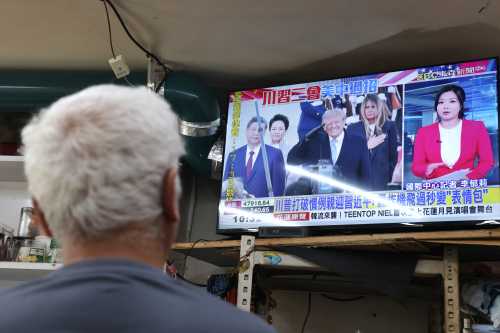
U.S. President Donald Trump visited Beijing from May 14-15. His visit was closely watched in Taipei for signs of how Trump would approach cross-Strait relations during his summit with Chinese President Xi Jinping. Following Trump’s return to the United States, Brookings Institution Koo Chair in Taiwan Studies Ryan Hass reached out to former Brookings visiting fellow Stephen Tan for an on-the-ground perspective from Taipei on the implications of Trump’s trip for Taiwan’s interests. Their written exchange follows:
Ryan Hass:
In terms of public attention to Trump’s visit in Taiwan, on a scale of one to 10, with one being a non-issue and 10 being a topic everyone is talking about, how much attention did Trump’s visit garner in Taiwan? Why?
Stephen Tan:
I would give it a nine. The Taiwan-U.S. relationship is the most consequential relationship for Taiwan. Trump’s “unconventional” way of engaging in diplomacy makes his China trip matter even more to Taiwanese people.
Ryan Hass:
How will the results of Trump’s visit impact Taiwan’s internal politics? Will it help or hurt any of the major political parties?
Stephen Tan:
Taiwan’s internal politics continues to be polarized, particularly in this election year, but I don’t think Trump’s China trip will give any political party a boost. (Note: Taiwan will hold local elections November 28, 2026.) Neither the ruling Democratic Progressive Party (DPP) or the opposition Kuomintang (KMT) appears to advocate for anything other than maintaining the status quo. The DPP is not pursuing a declaration of independence, and the KMT does not seek unification with China, at least not openly.
While Beijing continues its annexation agenda, Washington’s long-standing policy of strategic ambiguity remains intact, and the U.S. double deterrence effect of discouraging China from initiating an attack and Taiwan from making formal declarations of independence seems to be working well. Some may argue that there’s growing anxiety in Taiwan, and that the KMT is trying to capitalize on it with a narrative about seeking dialogue with China. It remains to be seen, however, how the KMT could possibly circumvent Beijing’s terms on its “One China” principle, which clearly states that Taiwan is part of the People’s Republic of China (PRC), to engage in political talks. The ruling party, on the other hand, advocates for peace through strength, and promotes a constructive cross-Strait dialogue without undue coercion or political precondition. No evidence suggests that the outcome of Trump’s visit has changed the political landscape in Taiwan.
Ryan Hass:
“America skepticism” has long been a feature in Taiwan politics, the intensity of which goes up or down depending upon events. Do you think Trump’s trip to China will have any lasting effect on feelings of “America skepticism” in Taiwan?
Stephen Tan:
Indeed, “America skepticism” is not something new, and it is not a Taiwan-only phenomenon. When a sitting U.S. president says that the arms sales to Taiwan could be a bargaining chip with China, no doubt the skepticism expands. Now, we need to watch very closely what action (or inaction) Washington takes. Anything that is perceived to deviate from the preexisting policy on Taiwan will surely create fertile ground for American skepticism to grow in Taiwan.
The lack of credible assurances on the continuity of America’s long-standing policy on Taiwan will not only be detrimental to Taiwan’s interests but also to the interests of the United States and Taiwan’s neighboring countries, such as Japan and the Philippines. If Taiwanese people and elected leaders believe that Taiwan could be negotiated away, hedging strategies and tactics will become more appealing to the constituents across all political parties in Taiwan.
Ryan Hass:
Trump described U.S. arms sales to Taiwan as a potential source of leverage for Washington with Beijing. How is this comment being interpreted in Taipei? Do you think Trump’s comments will have any impact on Taiwan’s future defense planning and funding decisions?
Stephen Tan:
Taiwan’s Legislative Yuan in May this year passed a $25 billion special defense bill, which was substantially pared down from the Lai administration’s original proposal of $40 billion. Any delay in approving the arms sales in Washington will make the next defense expenditure bill in the Legislative Yuan even more difficult to pass as proposed. The current test is whether and when the $14 billion arms sales package will be approved. While President Lai Ching-te advances his agenda to increase the defense budget to 5% of GDP, the DPP will face significant challenges from the opposition in future fundings if the procurement approval is in limbo.
The bottom line here is that arms sales to Taiwan are the product of a heavily regulated, long-standing policy, and they have not been a subject of trade with Beijing. Even if Trump considers a “packaged” deal with China, I’m not sure his counterpart in Beijing is interested in the bargain. From the PRC’s perspective, arms sales already are regulated in the third U.S.-PRC joint communique from 1982.
Ryan Hass:
In Trump’s comments at the conclusion of his trip, he seemed to show sympathy for Xi’s framing of cross-Strait relations. Trump’s advisors, meanwhile, insisted that there had not been any change to long-standing American policy on Taiwan. What do you think? Have Trump’s comments signaled a shift in U.S. posture or not, when viewed from Taipei?
Stephen Tan:
It may be too early to tell. I’d like to see if this is a consistent pattern to shift the narrative on cross-Strait relations. U.S. Ambassador to China David Perdue’s post-summit statement that U.S. policy remains unchanged is loud and clear, and I have not heard anything that contradicts his statement. Taipei should continue to reiterate that maintaining the peace and stability of the Taiwan Strait is the common denominator in the region, and that Beijing (and not Taipei) is the party maneuvering to change the status quo. Any shift in posture by Washington may push away Taiwan and alter the delicate equilibrium.
Authors


Related Content
The Brookings Institution is committed to quality, independence, and impact.
We are supported by a diverse array of funders. In line with our values and policies, each Brookings publication represents the sole views of its author(s).
Commentary
A view from Taiwan on Trump’s China visit
June 9, 2026