This piece is part of the States of Affordability report series from Brookings’ Center for Community Uplift. Read the introductory report here.
On May 12 of this year, the Department of Health and Human Services (HHS) issued revised policies governing the administration of its Child Care and Development Fund (CCDF), the federal government’s leading source of investment in childcare for low-income families with young children. Through these revisions, the federal government rescinded four Biden administration policies issued in 2024, including the requirement that states administering the CCDF program limit working families’ co-payments to 7% of their total income. While states are still permitted to adhere to the 2024 guidelines, HHS will no longer enforce them.
Such a policy shift comes at a time when childcare costs are skyrocketing at a rate faster than inflation; by some estimates, families can now expect to pay more for childcare than they would for a college degree. Families with children are increasingly citing the cost of childcare as one of their top affordability concerns. For many families, the decision to enroll their children in childcare is inextricably linked to their ability to afford housing, food, healthcare, transportation, and other basic necessities (what this report series refers to as “making ends meet”). The casualty of this crisis is well documented: mothers, who are often forced out of the workforce as childcare costs become unmanageable.
For this second entry in Brookings’ States of Affordability series, we examine the impact of childcare costs on the economic well-being of American families, aiming to support policymakers at all levels of government in developing urgently needed strategies for addressing this crisis. Our research confirms several sobering truths about the state of childcare affordability in the United States:
- Families with young children are nearly a third less likely to be able to make ends meet than families without them (40.8% versus 58.2%).
- More than 4 million families with young children that struggle to make ends meet are pushed into this financial instability by their childcare costs.
- Capping childcare costs at equitable, affordable thresholds would enable up to 3.7 million more families to make ends meet, which they would be unable to do if they were paying the market price for childcare.
- Capping childcare costs to these thresholds would allow an additional 1.3 million parents of young children to participate in the labor force.
Related Content

More than 4 million families with young children struggle to make ends meet because of childcare costs
Before the current administration rescinded it, HHS’s implementation of a co-payment cap in 2024 was a response to cascading market failures plaguing the U.S. childcare system. Despite childcare employees consistently ranking among the lowest-paid workers in the country, the majority of childcare providers operate on a profit margin of less than 1%, meaning they often have no choice but to raise prices to remain solvent amid rising demand. As a result, families with young children left to shoulder these costs have significantly more pressure on their budgets than the typical household: An average married couple living in the United States can expect to pay $20,200 more for necessities each year when they decide to have one child, with half of these costs attributable to childcare alone.

For many families, these costs are simply unmanageable. The margins between income and costs in the United States are already extremely thin, with the typical household earning just $3,400 more than the cost of their basic necessities each year. Because childcare alone can cost a family more than $15,000 annually, it is often the single expense that pushes families over the edge. Of the nation’s 27.9 million families with children age 12 and under, nearly 16.6 million (59%) struggled to make ends meet in 2024. For 4 million of those families, it was childcare costs that pushed them into financial insecurity.
For the most part, the geography of affordability for families with children is highly similar to the overall population. Families are disproportionately likely to struggle in high-cost coastal states such as California, New York, Oregon, and Hawaii, as well as in economically distressed states such as West Virginia. The District of Columbia is the most significant outlier to this trend, ranking third out of all states on its overall household budget sufficiency rate (i.e., the share of all households able to afford the cost of basic necessities), but ranking in the bottom 10 of all states on its budget sufficiency rate for families with young children. This is attributable to severe income inequality and racial disparities in the District of Columbia, where families of color are less than half as likely as white families to be able to afford basic necessities.
Without subsidization, there are no US states where childcare costs meet federal affordability standards
While the current childcare affordability crisis has ramped up exponentially in recent years, the problem is far from new. The federal government has provided support for low-income families with children for nearly 90 years, starting with the establishment of the Aid to Families with Dependent Children (AFDC) program in 1935. While the AFDC and several subsequent needs-based programs created over the next half-century indirectly funded childcare as part of their broader cash assistance scope, these funding streams were strictly welfare-based, locking most working families out of access to federal support.
In response to demand for better support for working families, Congress passed the Child Care and Development Block Grant Act of 1990 (CCDBG), through which states now provide direct portable subsidies (“vouchers”) to families, or contract with providers to provide care at a below-market rates in exchange for reimbursement. Discretionary funding from the CCDBG is combined with mandatory entitlements authorized under 1996 welfare reform legislation to create today’s Child Care and Development Fund (CCDF), through which more than 994,000 families and 1.6 million young children currently receive support.
While the creation of the CCDF constituted a monumental shift in the scope of federal investment in childcare, it did not itself set distinct, quantitative guardrails around affordability. Prior to the publication of the 2024 cap on co-payments (fees families pay out of pocket to their childcare provider to cover the portion of care costs not met by the subsidy), states administering CCDF funding were given significant flexibility in setting their own sliding scale co-payment rates under the purview of federal law dictating that this type of cost sharing “should not be a barrier that prevents a family from receiving assistance.” While the federal government has recommended the 7% income cap on co-payments since 2016, only 15 states adopted this recommendation before 2024, and co-payment rates for many of the lowest-income families receiving subsidies reached as high as 27% of income for a two-person family in some states.
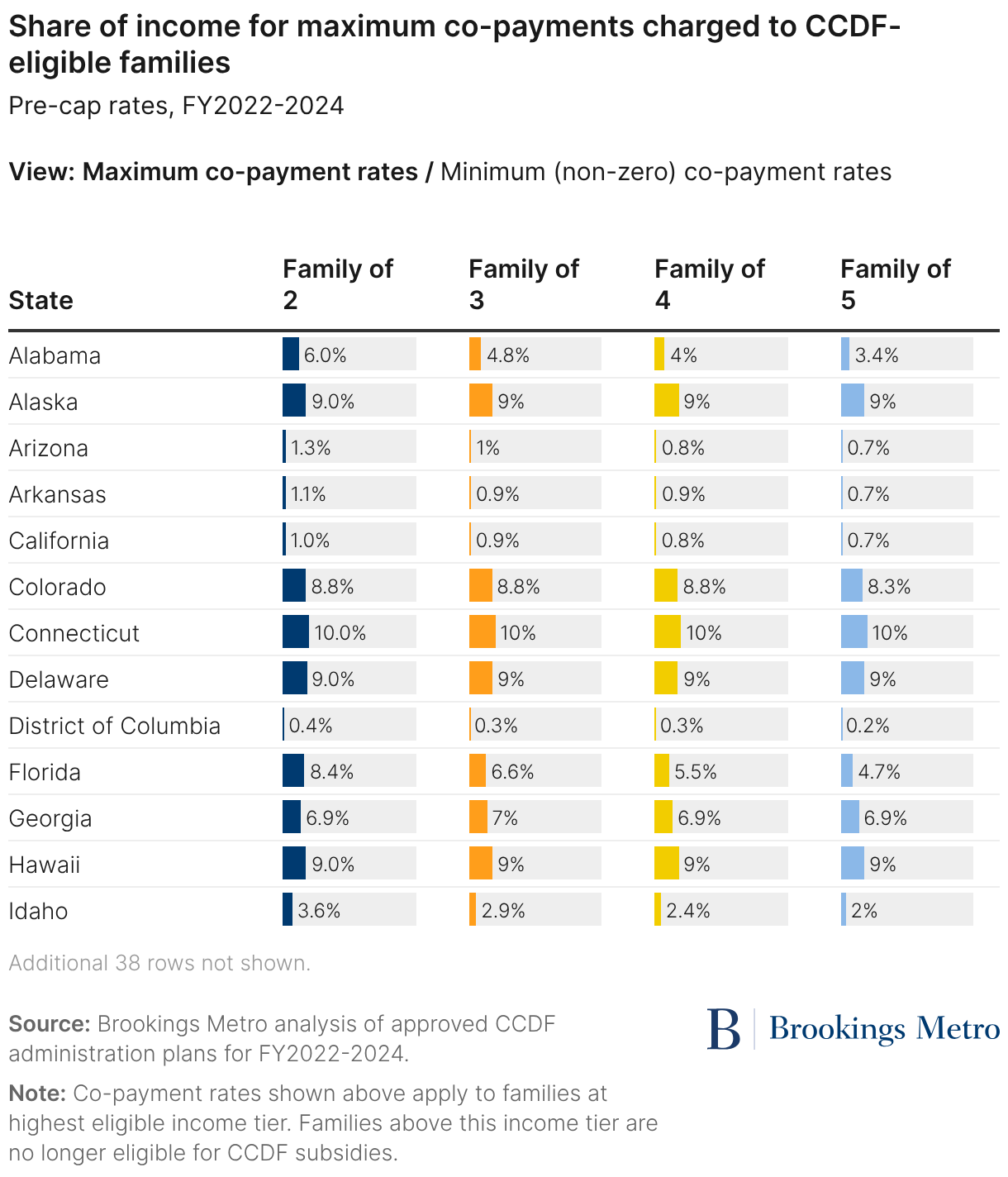
While states still have wide latitude in how they administer the CCDF, HHS’s 2024 co-payment cap prohibited states from setting sliding scale co-payment rates above 7% of a family’s pretax income, regardless of family size. By setting this limit, the federal government acknowledged that a decentralized approach to childcare affordability is insufficient for addressing a crisis that is national in scale. Absent federal subsidies, families with children under age 12 could expect to spend more than 15% of their income on childcare in 2024—a level more than double what HHS would proceed to establish as an affordable threshold, and one that is completely prohibitive to low-income families under pre-cap co-payment rates.
Capping childcare costs at affordable levels would close the cost-of-living gap for nearly 3.7 million families
The fact that there is no U.S. state that meets HHS’s affordability standard for childcare demonstrates that the need for federal relief is both widespread and severe. At the same time, the 7% co-payment cap was never intended as a comprehensive, data-derived estimate of what American families can truly afford to pay for childcare; rather, its use since 2016 has been driven by a Census Bureau report identifying that figure as the average share of income families paid for childcare nationwide between 1997 and 2011.
Additionally, like many of its predecessors, the CCDF is designed to serve primarily low-income households, despite the fact that childcare costs have become completely out of reach for the middle class as well. A typical U.S. family would need to earn more than $218,000 before taxes for their expected childcare costs to be considered “affordable,” which is more than double what the median U.S. family with young children currently earns. The CCDF exclusively serves families earning below 85% of their state’s median income, with many states imposing even stricter income and employment eligibility restrictions in an effort to preserve limited federal resources. As a result of these resource limitations, the vast majority of children eligible for childcare subsidies through programs such as the CCDF do not ultimately receive them, creating financial hardships and labor market strains for the same families the program is designed to help.
In sum, the potential benefits of federal childcare subsidization are being hamstrung by three main factors: insufficient funding, prohibitive eligibility standards, and misaligned affordability thresholds. Through our States of Affordability dataset, we estimate what the potential benefits of federal childcare subsidization would be for the financial stability of U.S. families if the CCDF were funded at a level sufficient to meet national need, and if program eligibility were primarily set based on federal affordability standards rather than family income. These benefits are measured across six scenarios, crossing three different assumptions of eligibility restrictions on family employment and two different methods of establishing affordability caps, based on an adaption of existing CCDF criteria and criteria Congress proposed in the Child Care for Working Families Act (CCWFA) last year.
Family employment conditions
- Max employment eligibility (CCDF)*: Families with all parents working at a combined average of 20-plus hours per week (or attending school) are eligible for capped childcare costs.
- Partial employment eligibility (CCWFA): Families with at least one working parent are eligible for capped childcare costs.
- Universal eligibility: All families with young children are eligible for capped childcare costs.
Affordability threshold conditions
- 7% fixed (CCDF): Families eligible for capped childcare costs pay no more than 7% of their pretax income on childcare.
- Sliding scale (CCWFA): Families with incomes below 85% of state median income are not charged a co-payment; all other eligible families are charged on a sliding scale between 0% and 7% of their pretax income.
*Note: While federal law requires states to impose a work requirement on families receiving CCDF subsidies, states have broad authority in setting eligibility minimums on number of hours worked and defining eligible work activities. Criteria used in this analysis represent an illustrative average of state-level requirements rather than exact CCDF criteria. See here for more information on state-level variation in CCDF work requirements.
Using these scenarios, we find that nearly 3.7 million more families would be able to make ends meet if federal subsidies were based on a universal sliding scale—significantly above the 1.9 million family increase at a fixed 7% cap. In practice, this means that a universally applied sliding scale subsidy for childcare would provide financial stability to over 9 in 10 of the 4 million families currently being pushed into a budget deficit by their childcare costs. More than 95% of these families already have at least one parent working or attending school (a majority of whom are doing so full time), indicating that their financial constraints could not have been solved simply by bringing more members of the household into the labor force to fill budget shortfalls.
The findings above are consistent with extensive research from the Center for American Progress into both the strengths and shortfalls of the CCDF’s program design as well as the potential damage of HHS’s recent changes to its affordability thresholds. While fixed caps are clearly useful in bringing costs down and closing budget shortfalls for middle-class families in aggregate, sliding-scale structures are even more effective because they provide incremental, needs-based support to families at lower ends of the income spectrum, who often have higher birth rates and are disproportionately impacted by rising childcare costs. Even so, all scenarios point to the benefits of childcare cost caps for family budget sufficiency rates—and to the risks that removing such caps may pose for families’ ability to support themselves financially.
Rising childcare costs push mothers of young children out of the labor force
Childcare unaffordability matters for more than just the immediate ability of families to afford basic necessities—it has long-term consequences for how parents of young children interact with the labor market.
Recent Census Bureau research has found that rising childcare costs have particularly adverse effects on labor market participation rates for mothers of young children, especially in low-income households. Last year, nearly half a million women left the labor force, predominately citing childcare difficulties and caregiving responsibilities as their primary motivation. While costs are just one component of these challenges, BabyCenter’s most recent State of Childcare in the U.S. Study found that 13% of mothers had already left the labor force due to rising costs, while an additional 45% were considering quitting or scaling back their work hours to save money. In other words, skyrocketing childcare costs force many mothers of young children to leave their jobs out of necessity that they perform unpaid labor as caregivers to their children.
If rising childcare costs pull mothers of young children out of the labor force, the reverse is also true: Mothers are more likely to reenter or remain in the labor force when costs are capped at affordable levels. Our analysis finds that capping childcare costs on a sliding scale would allow an additional 1.3 million parents of young children to participate in the labor force, with benefits disproportionately concentrated among both married and single mothers. These cost caps have negligible impacts on fathers of young children, who already participate in the labor force at disproportionately high rates.
Still, costs are not the only factor shaping maternal labor market participation. Prior Brookings research has found that increases in flexible working conditions during the COVID-19 recovery period were a key driver of post-pandemic labor market gains among prime-age women, particularly for mothers of children ages zero to five. Additional research from the Federal Reserve Bank of Chicago found that these gains were also partially driven by increased access to unpaid help with childrearing from relatives, particularly in places with a lower supply of center-based care.
This analysis, taken alongside existing literature, therefore suggests some fragility in the labor market gains prime-age women have made in recent years—fragility that rising childcare costs may exacerbate. For middle-class parents, particularly in two-parent households, full-time work may represent a time pressure with diminishing returns for women who shoulder the majority of their household’s domestic responsibilities, as childcare costs rise faster than wages. Lower-income parents with less access to remote work and informal caregiving networks may drop out of the labor force as formal care becomes increasingly out of reach. Left unchecked, these pressures risk reducing lifetime earnings and economic mobility for affected families, creating a long-term drag on regional labor markets and the U.S. economy writ large.
States need to address childcare costs to make life more affordable for families with young children
The findings above do not suggest that HHS’s now-rescinded 7% cap on CCDF co-payments was a gold standard for childcare affordability benchmarking, or that the CCDF program itself has been fully sufficient for delivering affordable childcare to low-income families. What is evident, however, is the dire need for intervention in the U.S. childcare market—including but not limited to affordability cost caps such as the one HHS repealed in May. State policymakers looking to improve economic outcomes for their constituents should strongly consider retaining the 7% cap on CCDF co-payments in the short term even absent federal requirements, while also working toward more comprehensive solutions for childcare affordability outside of federally funded subsidization.
Some promising state models are already in action. New Mexico, for instance, passed a constitutional amendment guaranteeing universal, no-cost childcare to working families by leveraging revenue through the state’s Land Grant Permanent Fund. In Vermont, the state has authorized collection of a new Child Care Contribution payroll tax, which is estimated to fund affordable childcare for more than 7,450 families. For other states looking to build out new childcare affordability strategies, the Century Foundation and Center for American Progress have already developed a policy blueprint focused on meaningful affordability thresholds, universal access, and guaranteed public financing.
As federal guardrails expire, states should expect to adopt a larger role in ensuring childcare affordability for families with young children. And with the 2026 midterm elections approaching, meaningful conversations about childcare should remain central to any affordability strategies proposed by candidates seeking elected office.
Author

The Brookings Institution is committed to quality, independence, and impact.
We are supported by a diverse array of funders. In line with our values and policies, each Brookings publication represents the sole views of its author(s).