This piece has been updated to reflect new results as the research continues with an expanded sample. Previous findings related to data center effects on employment, wages, and home prices have been revised. The brief summarizes findings from “Data Centers and Local Labor Markets” by Dany Bahar and Greg Wright. The full paper is available from the authors.
The data center debate
On March 25, 2026, Senator Bernie Sanders and Representative Alexandria Ocasio-Cortez introduced the AI Data Center Moratorium Act, a bill that would pause all new large-scale AI data center construction until Congress passes legislation addressing AI safety, worker protections, and environmental standards. The bill reflects a sharp turn in the national conversation. Five years ago, data centers were ribbon-cutting events. Today, more than 100 local communities have enacted moratoriums, more than 300 state data-center bills were filed in the first six weeks of 2026, and several states that once competed to offer the largest tax incentives—Virginia, Georgia, and Oklahoma—are now reconsidering those programs entirely.
The backlash is not hard to understand. Data centers consume enormous amounts of electricity and water. In the PJM grid region, which serves 65 million people across 13 states, power supply costs jumped from $2.2 billion to $14.7 billion in a single year, with data centers accounting for nearly two-thirds of the increase. Residential electricity rates nationally rose about 32% between July 2020 and July 2025. Communities near proposed facilities face noise, strained infrastructure, and the loss of farmland, costs that are immediate and visible.
The trade-offs
Proponents counter that data centers bring high-paying jobs, construction activity, and tax revenue. A single hyperscale campus, such as those built by Amazon, Google, and Microsoft, can become one of a county’s largest taxpayers. Supporters also argue that the United States cannot cede AI infrastructure to geopolitical competitors, and that pausing construction amounts to surrendering technological leadership.
Critics respond that these benefits are overstated, in part because data centers are among the least labor-intensive structures in the economy. For instance, large data center projects often promise only dozens to a few hundred permanent workers while the associated construction jobs are temporary. And the tax incentives are costly: In Virginia alone, the data-center sales-tax exemption cost an estimated $1.6 billion in fiscal year 2025. These incentives may simply be subsidizing investments that would have happened anyway.
What the evidence says about jobs
What has been largely missing from this debate is rigorous evidence on the economic effects that data centers actually produce. To this end, we assembled a dataset of approximately 1,500 U.S. data center facilities along with 52 announced-but-canceled projects and we linked these to county-level employment and wage data from the Bureau of Labor Statistics (2003-2024).1
We estimate the impact of the data centers on jobs by comparing labor markets with built facilities to labor markets with announced-but-canceled facilities, which controls for the fact that data center sites are chosen with specific characteristics in mind (availability of cheap land, power, fiber, and recent economic growth). This approach is important because before the facilities arrived, data center counties were growing faster than other counties. As a result, a naive comparison of treated and control counties, as some industry-sponsored reports have done, would overstate the impact on jobs.
We find that data centers do create local jobs, with caveats. Labor markets that receive their first large data center see employment rise in the data processing sector by 56% over the first decade of operations. Telecommunications, a key sector in data center operations, jumps 43%. Wages were unchanged, and we find a modest increase in home prices of 2%-5%. At a typical treated county, these estimates imply roughly 100-200 jobs, depending on facility type. (Figure 1 shows the yearly estimates, which are noisier than the average for the whole period.)
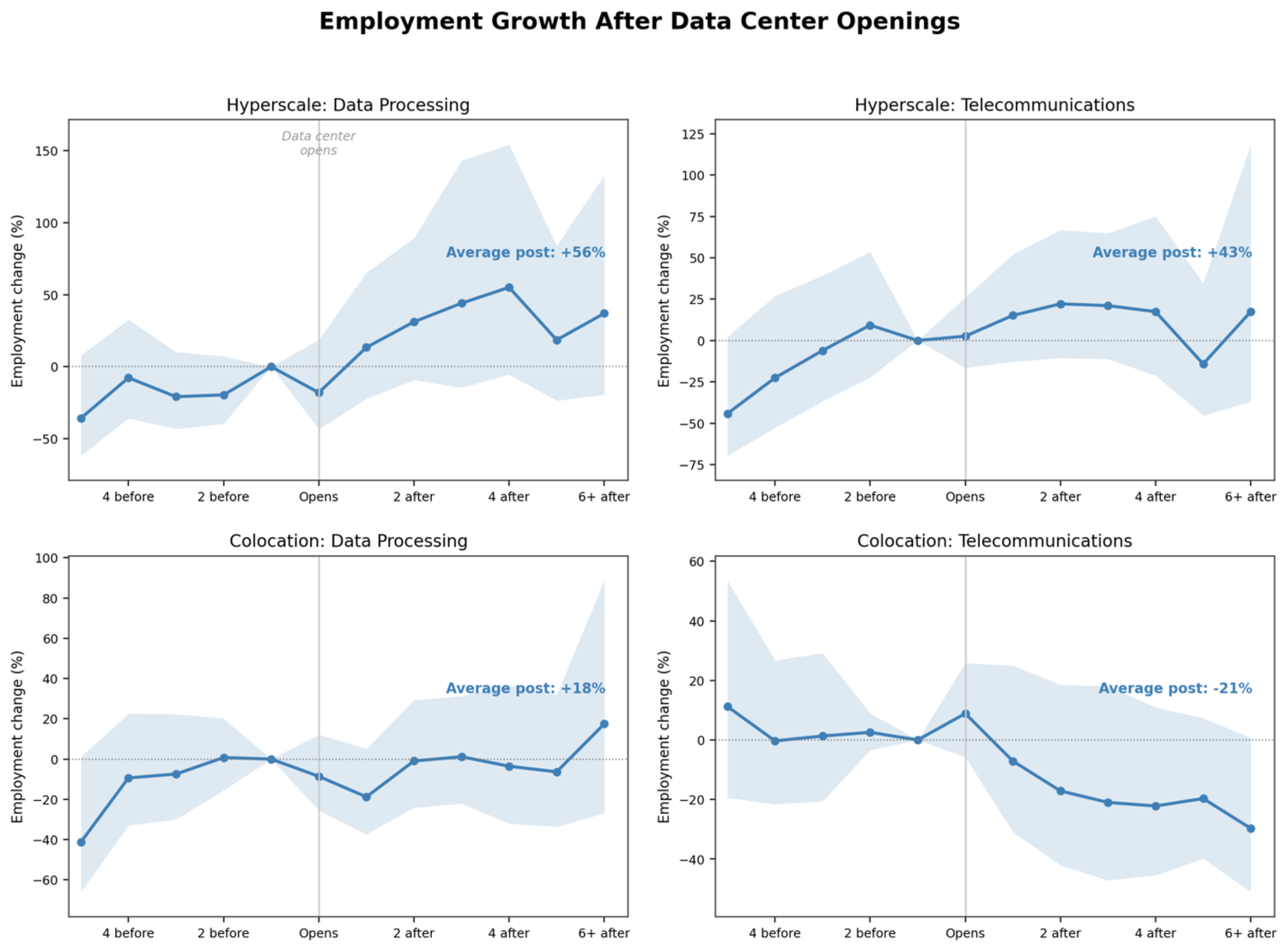
Note: Each panel plots the average gap between treated markets and their control markets, with confidence intervals. Event time 0 corresponds to the year of first large data center opening. The three sector panels share a common y-axis.
Not all data centers are the same
One policy-relevant finding is that the employment effects depend on facility type. We classify facilities into two types: hyperscale (built by cloud and AI companies—Amazon, Google, Microsoft, Meta—to run their own workloads) and colocation (built by data center landlords—Equinix, Digital Realty, CyrusOne—who lease space to remote tenants). This distinction, absent from prior research and current policy, turns out to be critical.
We see in Figure 1 that both types of data centers see growth in the data processing sector. However, hyperscale counties also see telecommunications sector gains while colocation counties do not. This is because a hyperscale campus creates demand for high-capacity fiber connections and network operations centers whereas a colocation facility leases space to remote tenants who may have no local operational presence.
Takeaways
Communities have legitimate concerns about energy costs, water use, and environmental impact, and those concerns deserve evidence-based answers of their own. But the labor market dimension of this debate has been conducted largely without data, and our findings suggest several things policymakers should know:
- Data centers do create local jobs, though fewer than industry advocates claim. Naive estimates that fail to account for preexisting growth trends overstate the effect.
- Not all data centers are equal. The telecommunications ecosystem effects that distinguish data centers from warehouses are concentrated in hyperscale investment. Colocation facilities generate construction activity and modest operational employment.
- Workers see little gain. Wages are unaffected by data center builds while home prices rise 2%-5%.
- Incentives may be poorly targeted. Overall, state incentives are small relative to private investment. In hyperscale counties, incentives represent about 2% of total construction investment. Location decisions for these facilities are driven by power availability, land, and fiber infrastructure, not by tax breaks. In colocation counties, incentives represent a much larger share of total investment (62%), meaning subsidies may matter more for precisely the facilities that generate the smallest employment benefits.
The data center debate is moving fast, but the evidence base has not kept pace. Whether the question is a federal moratorium, a state incentive program, or a local zoning decision, policymakers will require rigorous evidence in order to make these types of decisions.
Related Content
Authors


-
Acknowledgements and disclosures
During the preparation of this work, the authors used Claude Code, an Anthropic generative AI tool, to assist with data analysis, code development, and manuscript preparation. The output was reviewed and revised for factual accuracy and checked for plagiarism by the authors prior to publication. The AI tool did not contribute any original ideas to the brief.
Amazon, Google, Meta, and Microsoft are general, unrestricted donors to the Brookings Institution. The findings, interpretations, and conclusions posted in this piece are solely those of the authors and are not influenced by any donation.
-
Footnotes
- We combine the Department of Energy’s IM3 Data Center Atlas with opening dates derived from OpenStreetMap building edit histories, state incentive registries, and press reports.
The Brookings Institution is committed to quality, independence, and impact.
We are supported by a diverse array of funders. In line with our values and policies, each Brookings publication represents the sole views of its author(s).