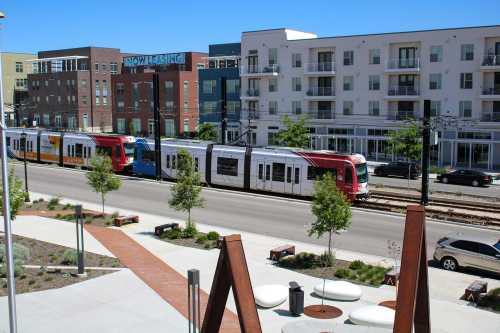

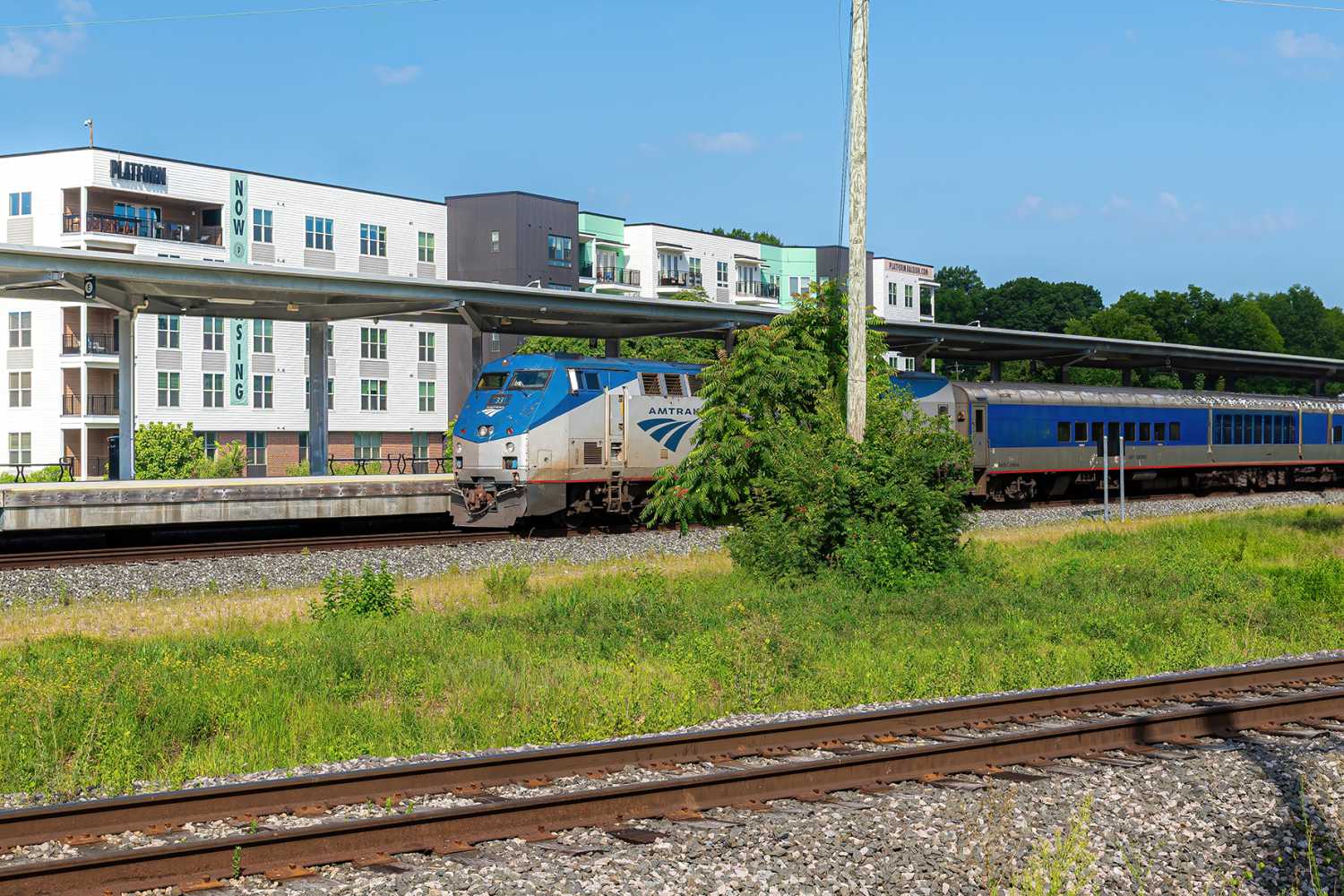
This report is one component of a three-part series studying the barriers to transit-oriented development (TOD) in U.S. metropolitan areas. It’s accompanied by a statistical survey of over 70,000 roadway corridors owned by state governments and a report on how business groups can advance TOD in their regions.
There is a broad recognition among state leaders that they need to build more housing. The nation’s housing shortage is a key driver of the current affordability crisis, and state government’s fiscal and regulatory authority directly shapes development. States play a crucial role in determining whether and where housing is built, and many are looking to transit-oriented development (TOD) as they consider how to tackle their housing shortage.
TOD is a strategy that involves building more housing—as well as shops, schools, and offices—near transit stations. By building near transit, places can deliver housing units while also capturing co-benefits such as making life more affordable and lowering government costs per capita. State officials have responded to this opportunity by taking multiple steps to help their local partners accelerate TOD. For example, Texas state law lets the Dallas transit agency enter TOD public-private partnerships. Lawmakers in Utah allow localities to set up tax increment financing districts, which are able to generate revenue that can be reinvested in TOD. In Maryland, Governor Wes Moore issued an executive order creating a housing ombudsperson to streamline permitting for localities, meaning those places can realize TOD projects faster.
But there’s another tool that’s rarely been deployed: state-level TOD offices and programs. Few states have established designated offices or programs specifically designed to implement TOD policy and leverage state governments’ unique capabilities to advance TOD. Research on the states that have taken this step is just as rare, leaving motivated state leaders with little guidance.
For states that want to lead on TOD, there’s a script. We’ve learned that successful states often take similar and specific steps, which form a playbook any stakeholder can reference.1
- Build the case for TOD internally and publicly.
- Create or designate a TOD office and put it where it’s most likely to succeed.
- Deploy the full suite of financial and regulatory tools at states’ disposal to accelerate TOD.
- Share the success of TOD efforts early and often.
By centralizing knowledge and streamlining operational decisions, TOD offices and programs can expand the impact of related legislation and executive orders, enabling the state to more directly facilitate TOD projects. State leaders who want to accelerate TOD should look at these established offices and programs for inspiration.
Transit-oriented development helps cities, businesses, and people thrive
Transit-oriented development is a relatively straightforward real estate concept, although there are specific variations in the definition. At its core, TOD refers to land development around transit lines that is walkable and compact, includes a mix of real estate uses, and offers higher population and job densities than regional averages. Formal definitions often limit TOD’s extent to a quarter- or half-mile surrounding a transit station, but entire neighborhoods could still qualify as TOD across many square miles. Critically, TOD offers residents greater transportation choices to reach destinations, whether by transit, biking, walking, or driving.
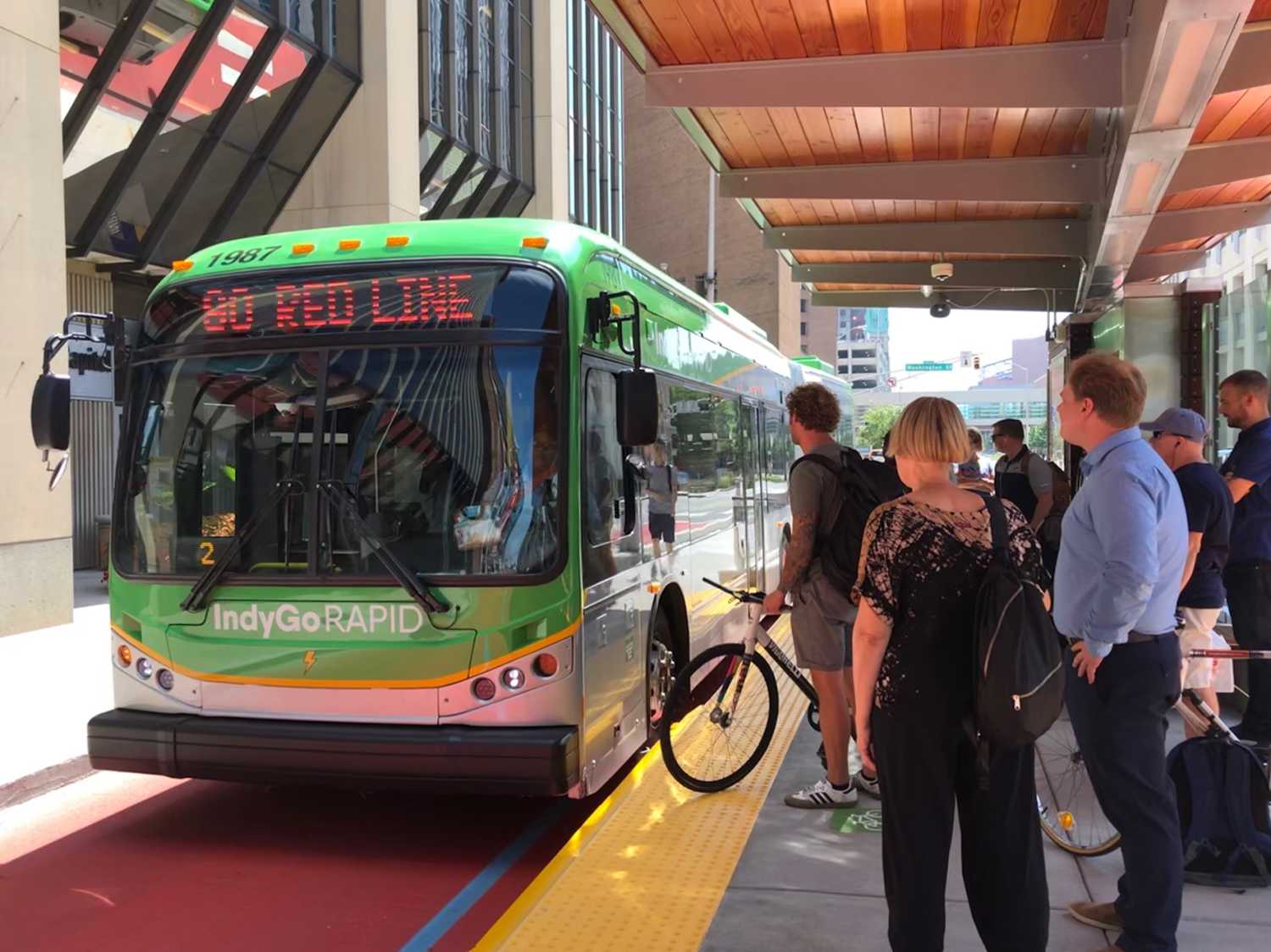
Riders wait as an IndyGo Red Line bus arrives at Statehouse station in downtown Indianapolis.
Photo credit: Momoneymoproblemz / Wikimedia Commons
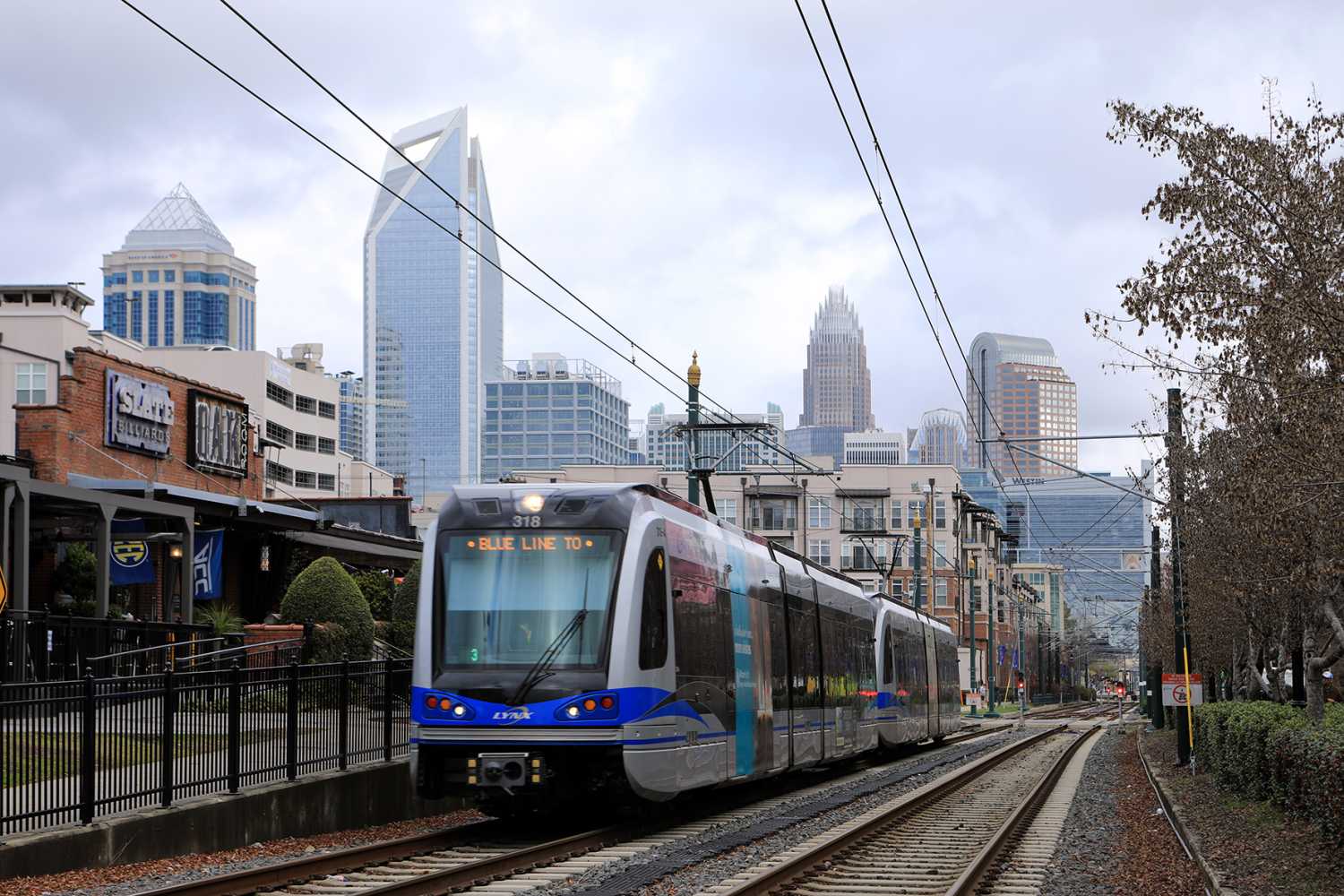
A Rapid Transit vehicle in Charlotte, North Carolina.
Photo credit: Harold Stiver / Shutterstock.com
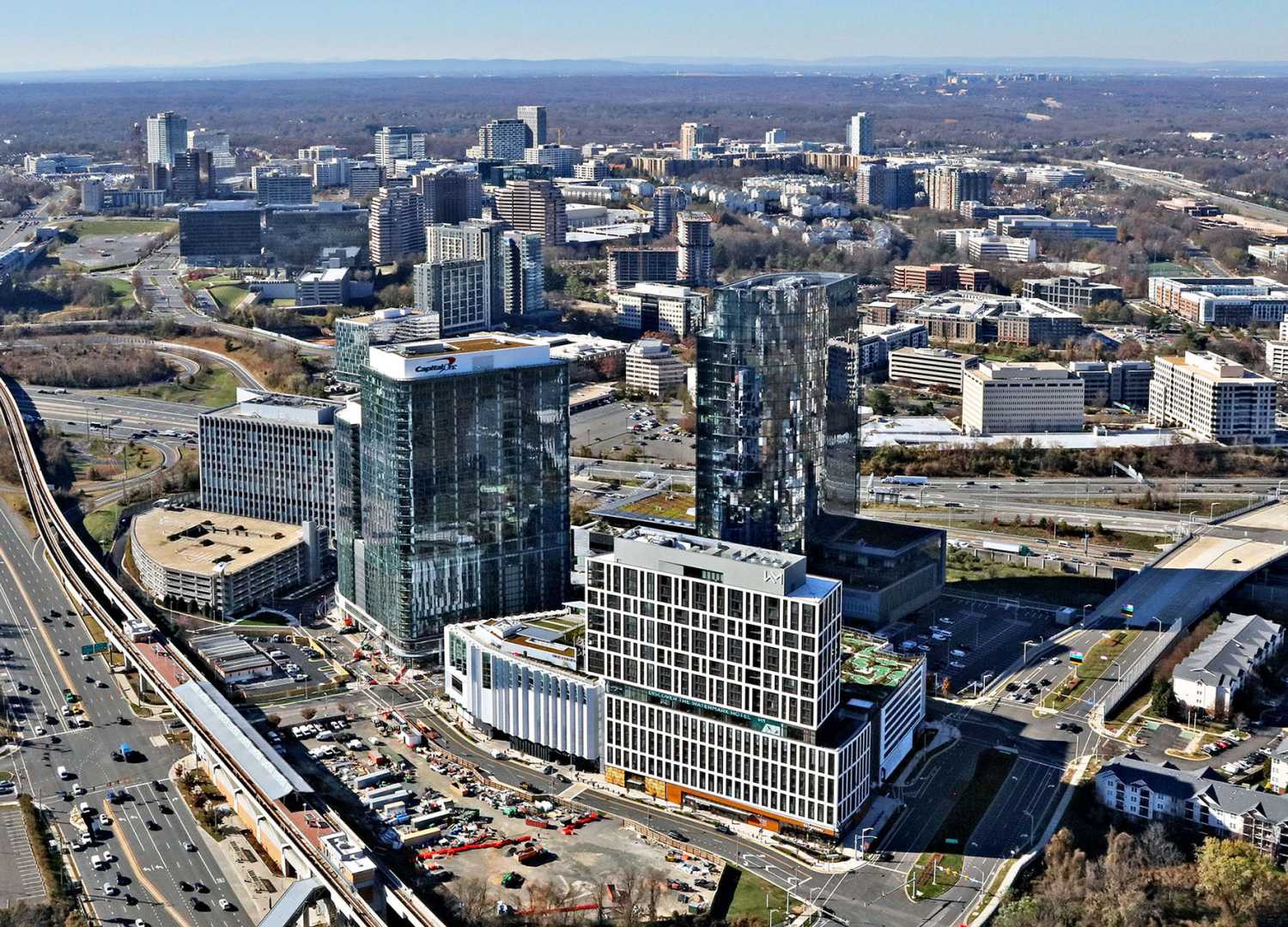
Capital One Center in Tysons, Virginia, beside the Silver Line’s McLean station.
Photo credit: Duane Lempke / Wikimedia Commons
While exact definitions vary, what’s less variable are the types of benefits TOD can deliver:
- TOD can support housing capacity at scale. The blocks surrounding transit stops are ideal for larger, multifamily residential developments. Recent evidence demonstrates numerous metro areas have built many new housing units near rail stations over the last few decades.
- TOD promotes a more affordable cost of living. Overall affordability often does not come from reducing housing costs, but more so by enabling households to travel shorter distances and making it easier to own fewer vehicles.
- TOD promotes lower costs for local and state governments. Greater density allows more people to use the same number of sidewalks, roadways, water pipes, and parks, effectively lowering service costs per capita.
- TOD boosts transit ridership. Putting more households and businesses close to transit increases ridership demand, and those extra riders help cover greater shares of a transit agency’s operating costs.
- TOD increases tax returns per developed acre. The more people who live and work in a given acre, the greater the number of tax returns and total revenues generated in that place. This is a well-established benefit of more compact development.
- TOD promotes greater accessibility, which itself is an economic accelerant. Concentrating more people and jobs in various nodes—which TOD can do across cities and metro areas—increases job accessibility by transit, biking, walking, and even automobiles. That’s a benefit to businesses of all sizes that need their workers to be able to reliably get to work, and for residents who can access more job opportunities and other amenities. Such accessibility gains are a key feature of agglomeration, or the economic benefits derived from geographic proximity.
Why states should govern TOD themselves instead of just empowering their partners
While it’s true that land use and transit are mostly controlled by local governments, nearly every state (48 of 50) owns land near transit. The Center for Geospatial Solutions at the Lincoln Institute of Land Policy estimates that state-owned acreage within a quarter-mile of a transit station is over 33,500.2 Florida and Massachusetts top the list with 3,367 and 2,656 acres, respectively, and 14 states own more than 1,000 buildable acres. In general, states in the West, Mid-Atlantic, and New England tend to own more land near transit than states elsewhere.

State-owned land has significant development potential. Under fairly conservative TOD density assumptions (7 units per acre), state-owned land near transit could deliver more than 235,000 housing units. Make those developments medium- or high-density (15 and 25 units per acre, respectively), and the estimates rise to more than 500,000 and 840,000 units, respectively.
In many states, that’s a huge opportunity. Take Massachusetts: Assuming a density of 15 units per acre, the state could build more than 39,800 units near transit just on its own land. High-density development could yield roughly 66,400 units. For reference, Massachusetts built only 34,500 units in 2025, and the state’s goal is to build 220,000 units by 2035; building new homes only on the state’s own land and only near transit could achieve 18% of that goal at a medium density and over 30% at a high density. Fewer acres may be available in other states, but the opportunity is still real. For example, medium-density development on state-owned land in Pennsylvania could reach 6% of the state’s goal of 450,000 new homes by 2035.
Several states also directly control transit agencies in their states, which can be a potent starting point for state-led TOD efforts (Map 2). Of those states, eight actively operate their own service and another seven appoint all or most of the leadership of a regional transit agency.3 CT Transit, for example, runs buses across all of Connecticut. Though the Massachusetts Bay Transportation Authority (MBTA) is a quasi-separate entity with trains and buses that serve 177 cities and towns (of 351 total across the whole state), it is technically a division of the state department of transportation (DOT). State leaders are responsible for governance and oversight of regional agencies in Indiana, Minnesota, New York, Oregon, Pennsylvania, Rhode Island, and Utah. For example, the Utah Transit Authority’s board and CEO are appointed by the governor and legislature, while TriMet in Portland, Ore., and Metro Transit in Minneapolis both have boards appointed by state officials.

Even more states run limited transit services, which are not displayed in Map 2.4 Many states operate some level of ferry service, including sophisticated systems such as those in Washington and Alaska. Others have intercity buses, such as Bustang in Colorado and Breeze in Virginia. Qualifying transit services don’t neatly fit into simple categorization, but the broader point is that multiple states directly operate transit services.
Even in states that don’t own transit and own relatively little land near stations, a TOD office or program can still effectively serve local partners. Such an entity can implement state laws regulating and incentivizing TOD at the local level, and the entity can better leverage state resources to provide technical assistance. A TOD office or program may also be effective at coordinating applications for federal funding from localities and regions.
Some states already have TOD offices or programs, especially those with their own transit service
Most states have no office or program dedicated to TOD; in fact, only 13 have set one up. What these offices are named, what they do, and where they’re situated within the broader organizational chart are all unique to each state.5
TOD offices and programs usually sit within state DOTs, state transit agencies, or agencies that implement housing policy. Connecticut, Maryland, and New Jersey all run TOD through their state DOT. State-owned transit agencies and state-controlled regional agencies in Massachusetts, Minnesota, New York, Oregon, and Utah also host TOD programs and offices. In New Jersey, NJ Transit complements the work of the state’s DOT. In three more states—California, Rhode Island, and Washington—TOD is managed by staff that implement housing policy. In Colorado and Hawaii, unique structures have taken on state-level TOD efforts.

It may be easiest to establish state TOD offices where states control transit. Nine of the 13 states with a TOD office operate sizable transit service or control a regional agency. The fact that so many of the states with state-controlled transit systems have also adopted TOD offices underscores how interwoven these governance responsibilities can be in accelerating TOD—something experts routinely confirmed in interviews.6
Where states establish a TOD office or program depends on priorities and existing staff capacity. The Washington State Department of Commerce implements the state’s housing policy, so the TOD program landed there after legislation focused on housing supply was put into law. Hawaii took a collaborative approach, convening many state agencies in a concerted effort to meet the state’s housing goals. Maryland assigned the state DOT secretary’s office responsibility for TOD, since that staff already managed real estate responsibilities; the TOD office at the MBTA emerged from a similar organizational structure.7
The structure of these offices and programs affects the functions they perform. In Colorado, HB 24-1313 saw lawmakers apply specific requirements that some cities meet housing opportunity goals; the Colorado Department of Local Affairs is naturally situated to provide the technical assistance municipalities need to reach those goals and administer associated grants. Connecticut’s DOT owns many parcels of land near transit stations; putting the TOD office there lets the state more easily pursue its development goals.
How state governments can organize themselves to deliver TOD
Every state can accelerate transit-oriented development. Their fiscal and regulatory authorities affect the speed, quality, and cost of real estate development. Almost all own sizable amounts of developable land near transit, and some own and manage transit agencies too. Channeling those capabilities to accelerate TOD, however, requires multiple actions that most states have not yet begun.
Based on a series of expert interviews and background research, there are common steps that every state should consider to better support TOD within their borders.
|
Understand the TOD opportunity |
|||
|
Define TOD in state law, including what modes it applies to, and solicit stakeholder input. |
Survey state-owned land near transit. |
||
|
Create or designate the TOD office |
|||
|
Keep open and consistent communication across TOD implementers. |
Release a request for information (RFI) to involve the developer community and build early interest. |
Adequately fund the new TOD office or program. |
Select a natural landing place for TOD implementation in state government. |
|
Leverage the unique position of the TOD office or program to accelerate TOD |
|||
|
If not yet done, survey state-owned land. |
Pursue value capture and joint development. |
Let the TOD office or program implement new TOD-supportive incentives and regulations. |
Communicate the successes of TOD. |
Understand the transit-oriented development opportunity
States need to start by understanding the potential of TOD. Some states may use TOD to boost transit ridership, while others will focus on increasing housing supply to address the affordability crisis. In either case, state officials should seek to learn what assets are at their disposal.
State agencies in charge of transportation, housing, and commerce should survey state-owned land near transit. When Hawaii leaders did so, they learned they had 1,900 acres near the Skyline rail line. In Maryland, staff identified 134 acres of land in the Baltimore region alone that could generate over $1.4 billion; the state owns 300 developable acres statewide. For reference, that’s nearly as much as Maryland spends operating transit for an entire year: roughly $1.6 billion split across the Washington Metropolitan Area Transit Authority (WMATA) and the Maryland Transit Administration.8 Just having these numbers on hand can be crucial in building support for TOD. Top-line numbers may persuade the public, while more detailed estimates can act as the basis for conversations with developers.
Legislators, meanwhile, can immediately move to codify TOD in law. That includes deciding what kinds of transit the state will prioritize TOD near. For example, Washington state lawmakers used HB 1491 to help define development near transit stations. Those kinds of distinctions are an invaluable reference point for other decisions, such as permitting rules and qualifications for state-led housing incentives. Critically, legislators should solicit input from developers, state agencies, and regional and local officials; defining TOD right the first time can save agency staff from implementing foreseeable changes to those definitions down the line, and it can make projects successful by clarifying expectations and aligning stakeholders.
Create or designate a TOD office
Once state leaders have built a rationale for pursuing TOD and laid the groundwork for supporting it, they must decide what their approach to TOD will be and who should execute it. Those activities should be consolidated within a TOD office.
From the start, it’s up to governors to make sure lines of communication across state agencies stay open and let staff know that TOD is an executive priority. The TOD office should receive formal guidance to convene officials across multiple agencies and include touchpoints with the private sector. Then, it’s incumbent on TOD office leadership to regularly gather agency executives in a “council” format and meet frequently with the private sector. Experts said this may mean formal meetings with peers at other agencies, but they explained that a standing coffee or lunch with a counterpart can be just as valuable.9
The TOD office should also have clear responsibilities and goals. For example, it should manage a database of publicly developable land and have access to information around privately owned parcels.10 It should issue a request-for-information (RFI) or request-for-proposal (RFP), in part to build early interest among developers and to forge public-private relationships. The office can publish materials to make the case for the benefits of TOD and report on statewide progress. (The next subsection details more specific responsibilities that the legislature and governors would have to authorize.)
While state government staff ready themselves to accelerate TOD, legislators must appropriate administrative funds to support their work. Funding amounts should be closely aligned to agency capacity—and if it’s the legislature itself assigning state staff to pursue TOD, they should make sure that new legislation is accompanied by funding to support its implementation. Appropriators should fund technical assistance whenever possible, especially for smaller municipalities that may lack the capacity to interpret new legislation and execute new regulations and incentives around TOD.
Then, state leaders will have to choose which agency should lead the state’s TOD efforts. They may find the following questions useful:
- Does the state own and operate its own transit?
- Could any existing offices easily become a TOD office, such as the real estate arm of a department of transportation or commerce?
- Does anyone in state government already do TOD work?
In states where a TOD office already exists, these questions have been decisive. That was true for all three questions in Massachusetts: The MBTA runs transit, and it had a real estate office already staffed, which state leaders helped transform into the agency’s TOD office.11 That office benefits from natural synergies between their work and the Office of Real Estate and Economic Development at the state DOT.
Hawaii, on the other hand, had no state-run transit and no office that could naturally rebrand to an “Office of TOD.” So, the state created an interagency TOD Council, co-chaired by the Office of Planning and Sustainable Development and the state housing authority, to align its membership on accelerating mixed-use development and boosting transit ridership.
Maryland runs its own transit agency, but leadership chose to convert the state DOT real estate office into its TOD office. Agency leaders knew that the staff’s land development expertise was crucial to executing TOD well, and the office’s central role in the DOT let it coordinate across modes and with other state agencies.
Maryland’s history illustrates a broader trend. Across the country, experts agreed: Offices managing state-owned land, those with relationships with developers, and those with experience implementing housing and land use legislation were best set up to excel as TOD offices.12
Leverage the unique position of the TOD office or program to accelerate TOD
States don’t need to own their own transit to accelerate TOD. Almost every state owns land near transit, but the value of those parcels is often unrealized. Surfacing parking lots near rail stations, for example, are often economically underproductive. For states that want to reap the benefits of TOD on their own land, these three strategies are key: understanding what the state owns, lifting regulatory barriers, and closing financing gaps.
In an ideal world, state agencies would have inventoried and prioritized their transit-adjacent land before a TOD office was set up. For those that haven’t, it’s a crucial first step. States can’t communicate the scale of opportunity to developers if they themselves don’t know what they own. And they can’t make targeted changes to regulations, nor spend funds effectively, without this knowledge. Leaders trying to figure out how to get started might look to California, where a 2019 executive order instructed two state departments to identify state-owned land available for housing development, or Massachusetts’ State Land for Homes program.
Once the state TOD office or program understands the state’s assets, it has two distinct responsibilities. First, the office or program should tackle value capture and joint development. Second, the office or program should take responsibility for implementing new TOD-supporting legislation and gubernatorial orders.
On the first responsibility, state TOD offices should pursue value capture and joint development policies. Value capture, which includes tools such as tax increment financing, can reinvest some of the taxable value developers generate through TOD into the system itself. Joint development is the private sector partnering with government to pay part of the cost of a transportation improvement while a complementary real estate development occurs. In the TOD context, the public entity usually owns the land and finds a private partner to develop it. Adopting formal guidelines around both practices can help incentivize TOD, and states should reach out to municipal officials who may have prior experience with both techniques.
Massachusetts has leveraged both strategies. The MBTA owns considerable land in the 177 communities it serves, and its real estate office is charged with using that land to generate non-fare revenue.13 The agency has taken a unique approach near major hubs such as South Station and Back Bay, where it leases air rights and ground space to private developers. The MBTA keeps the land and collects rent on it too.
Connecticut similarly focuses on building near state-run transit. The state DOT owns the vast majority of its bus service and a commuter line, and operates intercity rail. Taking a proactive approach, the DOT created a TOD officer role and scored almost 20 state-owned parcels along fixed rail and bus routes. The department is now executing joint development on those parcels: One of several new apartment buildings anchoring mixed-use development near Meriden station was on a state-owned parking lot, and there are plans underway to take on similar efforts at stations in New Haven and Stamford. All of this means that private developers have new, high-value land available to them, and the state has extra capital for station infrastructure improvements.
Aside from value capture strategies, the state TOD office or program should also implement new laws and gubernatorial orders.
Some states have sought to reduce regulatory barriers to building housing. That might include lifting statewide parking minimums and reducing curb set-back distances, or even preempting local zoning near transit stations. Zoning is a consistent sticking point between state and local officials, which means state leaders should be extra thoughtful before they take that step. If they pursue any such reforms, the TOD office or program should be responsible for assisting localities with their implementation and enforcing state implementation.
Other states are figuring out how to make development more likely to pencil out. Though developers have typically borne the cost of infrastructure supporting new developments, those costs are increasingly preventing projects from happening at all. State TOD offices and programs can examine this issue in their state, such as in Hawaii, where the TOD office showed how costly required infrastructure upgrades are. Brookings research has found that a statewide fund to pay for that infrastructure in infill locations—including TOD-ready areas—would help spur development. If such a fund is implemented, the state TOD office or program should administer it.
Though state offices and programs most aggressively pursuing TOD have found success by first using these strategies on their own land, many could also be applied to land they don’t own. This is especially important in states that don’t own lots of land near transit or where land ownership is so disparate across state agencies that it’s too difficult to assemble for development. Here, the state TOD office or program can play a crucial coordinating role between different land-owning agencies, private landholders, and private developers.
Communicate the successes of transit-oriented development
TOD projects can take years, if not decades, to deliver results. State leaders and local constituents, however, usually want to see benefits long before a ribbon is cut. To that end, TOD offices and programs should be thoughtful about how they measure their impact in the long and short term. For example, states may prioritize finishing a signature project to boost the visibility of TOD and garner goodwill, while measuring total units produced in the long term. In Connecticut, leaders are doing precisely that by focusing on the Stamford rail station and adjacent TOD corridor—particularly given its connection to neighboring New York City—to help build support for their TOD efforts.14
At the same time, state legislators and executives must understand how long implementation by a TOD office or program can take. Experts in some states reported that their legislature responded to slow progress, even in the first year or two after a TOD law was passed, by passing more legislation.15 In some cases, the added burden of interpreting and administering those new laws slowed delivery of the initial legislation.
The next generation of governors, legislators, and agency leaders must advance TOD at the state level
TOD can help add hundreds of thousands of housing units and address a host of challenges Americans and their governments face. State leaders know it too—over the coming years, even more states will pass laws and issue executive orders designed to accelerate TOD.
Before they do, they should take the step of setting up a TOD office or program in state government. That kind of entity can make sure that all future laws and executive orders have a place to land, staff to execute them, and a name associated with their implementation. As states experiment with the most cutting-edge strategies for accelerating TOD, something as basic as a TOD office or program will ensure their success.
Authors
-
Acknowledgements and disclosures
The authors thank Michael Gaynor for editing, Nick Mourtoupalas for web design, and the rest of the Brookings Metro communications team for their support. The authors extend personal thanks to the officials working in state government who sat for interviews during the research stage of this project and provided invaluable feedback on early drafts of this report. They especially thank Tracy Loh for her feedback on drafts of this report. The authors are solely responsible for all remaining errors and omissions.
The Brookings Institution would like to thank Arnold Ventures and TransitCenter for their generous support of this research. The views expressed in this report are solely those of its authors and do not represent the views of the Brookings Institution and its donors, their officers, or employees.
-
Footnotes
- We interviewed 16 officials across five states. Interviews involved a semi-structured conversation exploring TOD governance and policy at the state level. All were held under the Chatham House Rule.
- Transit-accessible areas are defined as census block groups with at least one transit stop within a quarter-mile and at least one active transit trip per hour during the evening rush hour.
- We include large regional systems with leadership primarily set by state officials, such as TriMet in Portland, Ore., and Metro Transit in Minneapolis. We do not include a regional agency simply because it is chartered in or authorized by state law. We exclude some modes with limited development potential, such as intercity bus service and ferry systems, and as well as intercity rail, such as the Alaska Railroad.
- We also don’t include Amtrak stations in this analysis, though there are emerging opportunities to execute TOD near them, which state DOTs may play a role in.
- The wide variation between these offices and programs across states makes categorizing them difficult. When considering marginal cases, we err toward including offices and programs.
- Source: Brookings’ expert interviews.
- Source: Brookings’ expert interviews.
- Maryland pays $677 million and $900 million in annual operating expenses to WMATA and the MTA, respectively.
- Source: Brookings’ expert interviews.
- Past Brookings research has explored the tractability of such a dataset and explained its potential in various use cases.
- Source: Brookings’ expert interviews.
- Source: Brookings’ expert interviews.
- Source: Brookings’ expert interviews.
- Source: Brookings’ expert interviews.
- Source: Brookings’ expert interviews.
The Brookings Institution is committed to quality, independence, and impact.
We are supported by a diverse array of funders. In line with our values and policies, each Brookings publication represents the sole views of its author(s).