This is a Nov. 2026 update to a paper originally published in Sept. 2025, on state requirements for transparency around EV chargers.
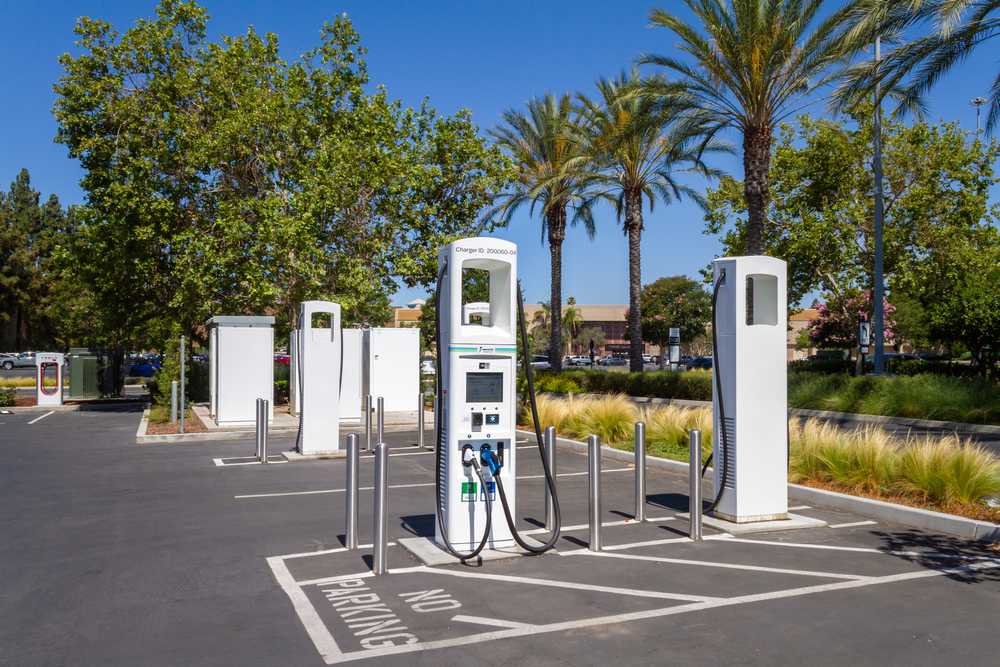
Range anxiety—the fear that an EV driver won’t find a working charger along the highway on a long drive—is holding back EV sales, surveys show.
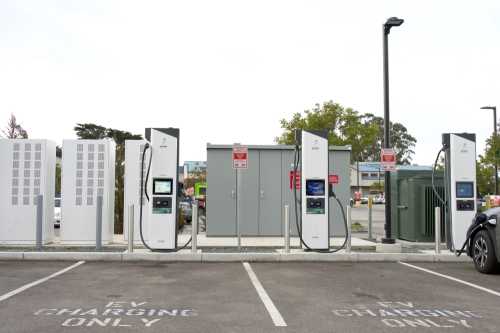
Several colleagues and I published a paper at the Hutchins Center and the American Enterprise Institute in 2025 proposing that states enact laws requiring fast chargers report real-time status and pricing that any EV mapping app can access and make available to drivers. We’re talking information like whether the charger is working or broken, and how much it costs to charge—the electric equivalent of dollars per gallon. The 2021 Bipartisan Infrastructure Law set that requirement for chargers it funded on major interstates—$5 billion designated to create a highway network any EV driver could use. We proposed to broaden the requirement.
When our paper was published in September 2025, only Massachusetts required real-time data, and only for new chargers receiving public funding.
Since then, California and Vermont have put in place real-time data requirements. California did it by regulations; Vermont did it by law.
Real-time data enables EV drivers to confidently and reliably navigate to a working charger. This is particularly important in Vermont, with a state average 86.9 reliability rating from Paren based on charging success on the first and second try, failed attempts, and downtime. Of the 50 states, only Oklahoma had a worse rating. Reliability scores are generally rising over time. But the trend is not straight up. Paren reports that reliability fell in 29 of 52 states and territories over the past year.
On top of wanting chargers to work, EV drivers want to avoid price surprises.
Gas stations are very clear about their pricing. They post pricing on big signs that you can easily read as you’re approaching on the road—and in some cases, tall signs enable drivers to read prices from the highway before deciding whether to exit. Prominent gas station signs are a standard practice by convention, not by law. While gas stations often change their prices daily, they’re not more expensive at rush hour.
Contrast that with charging stations. In June 2026, 32% of fast charging stations nationally had prices that varied by time of day, based on our analysis of Paren data. Because those tended to be larger stations, the rates at 52% of charging ports nationally changed throughout the day.
At most stations where charging rates vary, they do so according to a pre-set schedule—cheaper overnight, most expensive during the business day. So, in theory, local users could learn the schedule at a station they visit repeatedly. Price-sensitive road trippers, though, would want to check pricing before deciding where to exit and charge.
The variation can be big; for example, at one Los Angeles station with scheduled pricing, prices ranged from $0.48 to $0.72 per kWh—a $0.24 gap. Depending on how you look at it, that’s a 50% daytime hike over the overnight rate, or a one-third overnight discount off the daytime rate. Nationally, over 1,300 fast charging stations with scheduled pricing have a high-low range of more than $0.20.
Another 4% of stations and 13% of ports nationally have Uber- and Lyft-style dynamic pricing. That means local and road-tripping users want to check the current price before deciding where to fast charge.
Data transparency can help the charging station companies as well.
Fast charging providers would also benefit if real-time data helped the EV market grow faster—and we estimate it would. By 2030, the policy we recommend, if adopted nationally, would put 3.5 million more EVs on the road, 15% more than without real-time data, as our paper found. More EVs means more charging sessions, enabling charging providers to pay off their investments faster.
State action matters and can lead to transparency behind their boundaries. Weeks after California approved its regulations, both Tesla and Electrify America, the two largest fast-charger networks, made their status data available for free via Google Maps. That’s progress, but the job is not done. That’s only one app, albeit a very widely used one; Google Maps lacks pricing information; and without rules in place, the companies could withdraw that status information.
The case for state action is straightforward. Left alone, the market won’t do this. Requiring EV charging companies to provide more information is not only a convenience to EV drivers, but it removes an obstacle to the spread of EVs, which are an essential element of any response to the threat posed by climate change. As we note in our original paper: “This would raise the EV share of new vehicle sales from 40% to 46% in 2030, increasing the 2030 EV fleet by 3.5 million EVs and reducing carbon emissions by 15 million metric tons in 2030 alone.”
Author

Related Content
The Brookings Institution is committed to quality, independence, and impact.
We are supported by a diverse array of funders. In line with our values and policies, each Brookings publication represents the sole views of its author(s).