This report is one component of a three-part series studying the barriers to transit-oriented development (TOD) in U.S. metropolitan areas. It’s accompanied by a statistical survey of over 70,000 roadway corridors owned by state governments and a report on emerging models for state-led TOD governance.
Introduction
Regional business groups are one of the country’s most effective champions for greater public investment in transportation systems. Their diverse membership, topical expertise, and external networks make these civic organizations particularly good at educating lawmakers and the public about the return on investment from new and improved infrastructure.
Their success is particularly clear when it comes to driving investment in mass transit systems. As more metro areas turn to ballot measures to fund significant network expansions and modernization efforts, regional business groups often stump to help earn voter support. And when transit issues are debated in city halls and state legislatures, their leadership is equally adept at working directly with policymakers; for example, the recent instance of fund swapping in Pennsylvania to aid Philadelphia-area transit.
With much of metropolitan America now confronting the interwoven challenges of limited housing supply, rising living costs, and tight public budgets, regions need solutions that can address all three structural challenges at once. Transit-oriented development (TOD) offers one such solution. By building relatively large numbers of housing units in neighborhoods that are pre-developed and transit-served, TOD can bring down housing costs, shorten people’s trips, enhance access to amenities, and save governments money. It’s an ideal issue for business groups to champion.
But delivering TOD at scale will require reforms. Most regions face numerous market and policy barriers to TOD, including complex project financing rules, zoning restrictions, and uncertainty around who pays for necessary infrastructure upgrades. Overcoming such barriers requires the right combination of well-designed policy interventions and consensus-building. Regional business groups are especially well suited to contribute to both civic roles.
Using a mix of desk research and interviews with experts inside and outside business groups, this report builds the case for why regional business groups can help catalyze TOD, and how to bring them into coordinated action at the regional and state level.1 It begins by summarizing TOD-related research, including the established benefits of coalitional advocacy and the limited examination of business groups’ specific roles. The report then turns to how business group leaders should approach building internal support for TOD and what external activities best match business groups’ unique advantages. It concludes with opportunities for other TOD stakeholders to build relationships with business groups and the knock-on impacts for broader network activities.
Transit-oriented development helps cities, businesses, and people thrive
Transit-oriented development is a relatively straightforward real estate concept, although there are specific variations in the definition. At its core, TOD refers to land development around transit lines that is walkable and compact, includes a mix of real estate uses, and offers higher population and job densities than regional averages. Formal definitions often limit TOD’s extent to a quarter- or half-mile surrounding a transit station, but entire neighborhoods could still qualify as TOD across many square miles. Critically, TOD offers residents greater transportation choices to reach destinations, whether by transit, biking, walking, or driving.
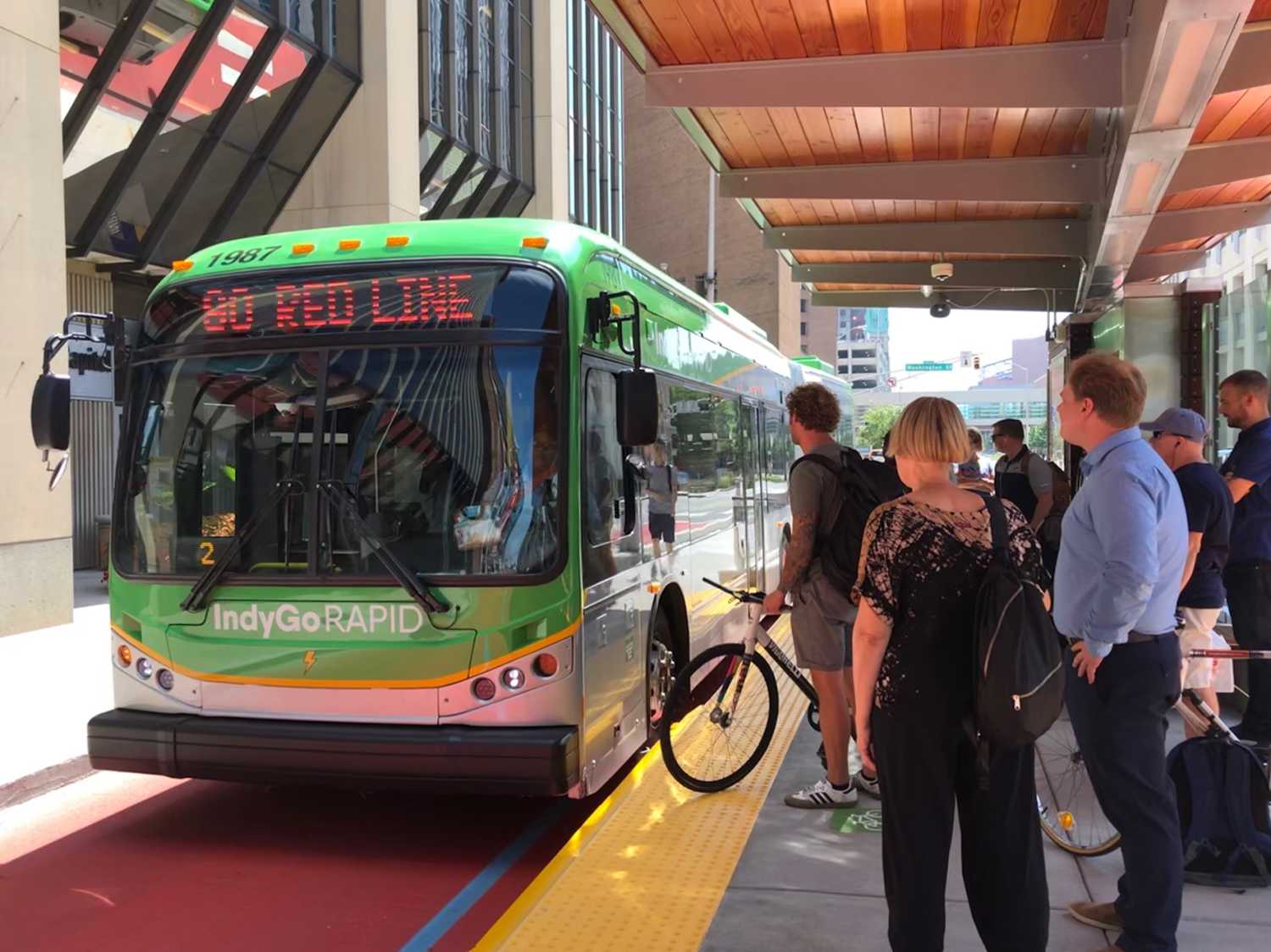
Riders wait as an IndyGo Red Line bus arrives at Statehouse station in downtown Indianapolis.
Photo credit: Momoneymoproblemz / Wikimedia Commons
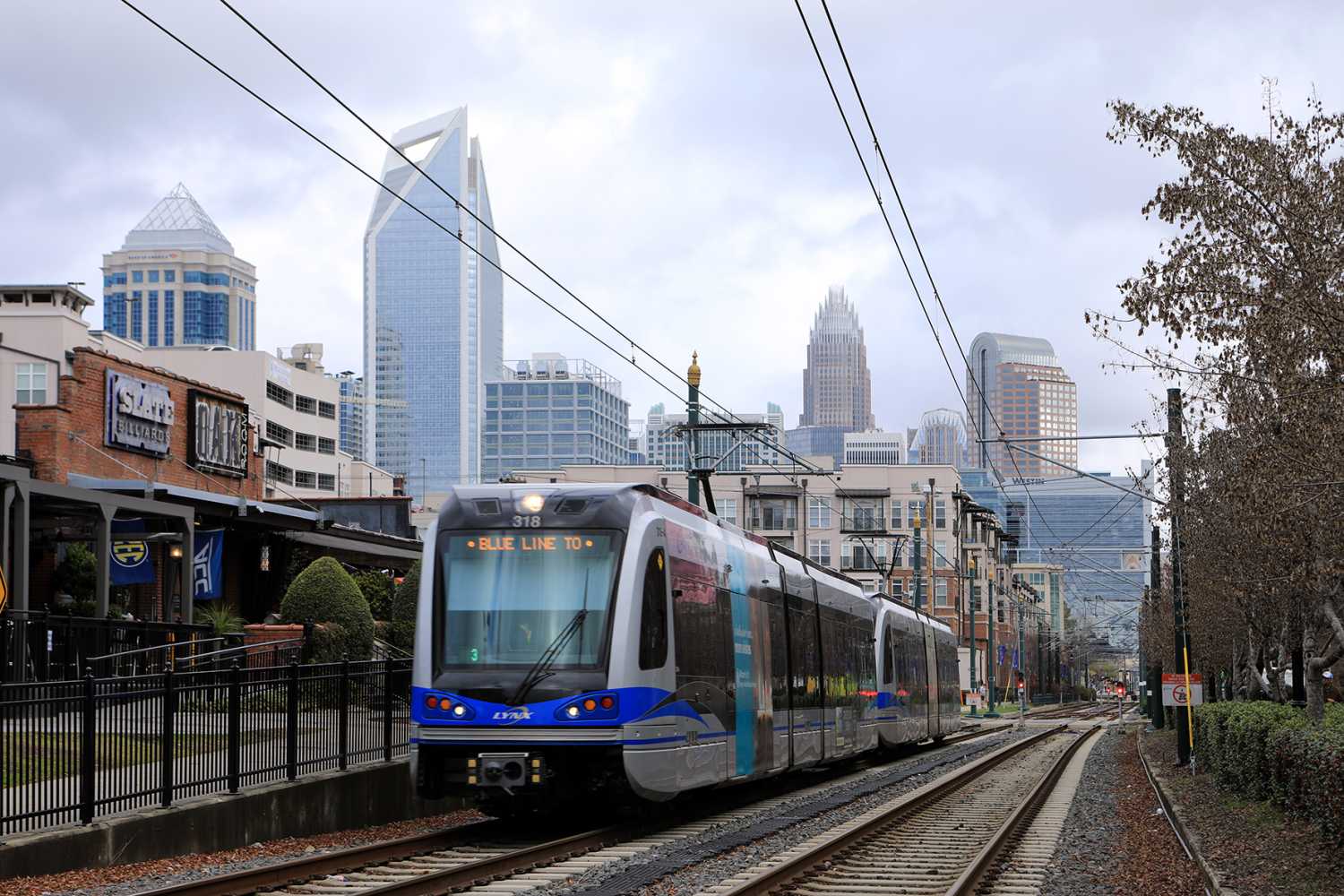
A Rapid Transit vehicle in Charlotte, North Carolina.
Photo credit: Harold Stiver / Shutterstock.com
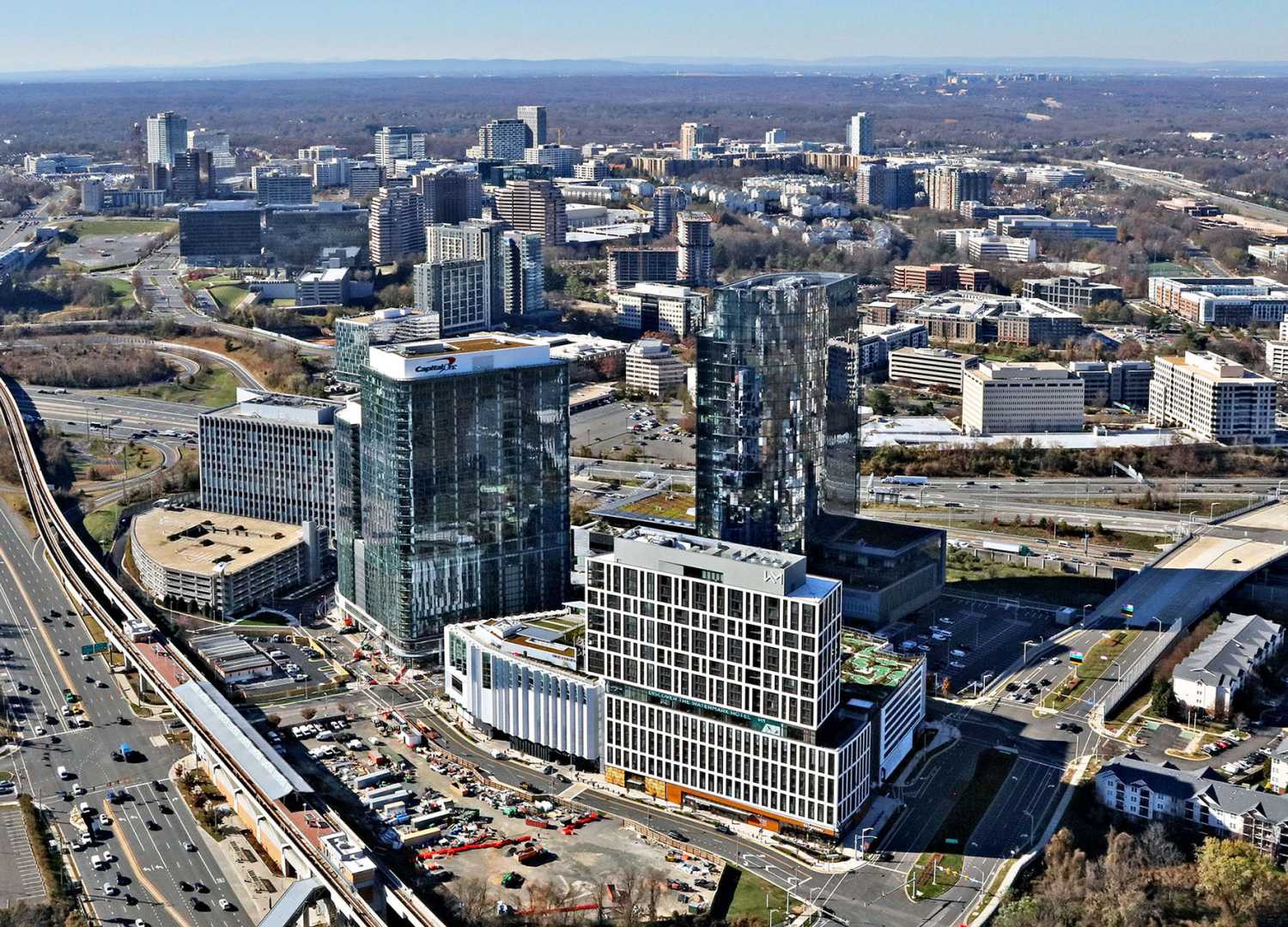
Capital One Center in Tysons, Virginia, beside the Silver Line’s McLean station.
Photo credit: Duane Lempke / Wikimedia Commons
While exact definitions vary, what’s less variable are the types of benefits TOD can deliver:
- TOD can support housing capacity at scale. The blocks surrounding transit stops are ideal for larger, multifamily residential developments. Recent evidence demonstrates numerous metro areas have built many new housing units near rail stations over the last few decades.
- TOD promotes a more affordable cost of living. Overall affordability often does not come from reducing housing costs, but more so by enabling households to travel shorter distances and making it easier to own fewer vehicles.
- TOD promotes lower costs for local and state governments. Greater density allows more people to use the same number of sidewalks, roadways, water pipes, and parks, effectively lowering service costs per capita.
- TOD boosts transit ridership. Putting more households and businesses close to transit increases ridership demand, and those extra riders help cover greater shares of a transit agency’s operating costs.
- TOD increases tax returns per developed acre. The more people who live and work in a given acre, the greater the number of tax returns and total revenues generated in that place. This is a well-established benefit of more compact development.
- TOD promotes greater accessibility, which itself is an economic accelerant. Concentrating more people and jobs in various nodes—which TOD can do across cities and metro areas—increases job accessibility by transit, biking, walking, and even automobiles. That’s a benefit to businesses of all sizes that need their workers to be able to reliably get to work, and for residents who can access more job opportunities and other amenities. Such accessibility gains are a key feature of agglomeration, or the economic benefits derived from geographic proximity.
Coalitional politics can address barriers to TOD, but the role of regional business groups in supporting TOD is understudied
Even though it promises an impressive set of benefits, actually delivering TOD runs into significant barriers in most metro areas. Local zoning laws can limit development surrounding rail stations and along bus-served corridors, and residents may speak out against changes to those laws. It’s often expensive to upgrade infrastructure such as water and power lines to support larger buildings, and it’s not always clear how much of the investment burden should fall on private developers versus local and state governments. Larger real estate projects often require more complex financing to start with, and public policies—from affordable housing requirements to more typical taxes and fees—can make projects even tougher to pencil out. Even worse: The specific barriers vary from region to region. For one example, see this Urban Institute piece by Yonah Freemark and colleagues summarizing the high land costs, affordable housing requirements, and fee structures in Washington.
Overcoming these kinds of barriers requires deep developmental expertise, strong political communication, and coalitional alignment to persuade policymakers. Fortunately, such dynamics are a rich area of study among researchers. Many studies find that a greater number and variety of stakeholders supporting growth management—or public policies to manage the location and form of physical growth—is associated with the adoption of more reforms in those places. Other studies focus on the ability of developers to effect policy adoption through broader coalitional actions. Some researchers demonstrate the negative effects when external stakeholders don’t align their agendas.
Put simply: While barriers vary across places, coalitions consistently make a positive impact.
While there is a relatively strong record of research into coalitions, there is strikingly little mention of the role of regional business groups. The closest exceptions are mentions of generalized “business interests,” such as in cases from Atlanta and Los Angeles. But even there, the focus is on developers involved directly in TOD, which is different than civic business interests who could mobilize to support it.
That knowledge gap comes at a real expense: limiting the ability of regional business groups to design their engagements based on lessons from their peers, including what kinds of background planning and political engagement tactics work best. Business group executives may wonder how best to invest their operational funds into polling and political communication to reach voters—the literature gives no guidance. The knowledge gap also touches other civic organizations that may want to work with regional business groups. Those stakeholders won’t know whether to engage business groups or, if they do, which activities business groups are best suited to take on. The knowledge gap could especially affect individuals and organizations with a negative perception of business groups.
Regional business groups continue to actively engage in TOD-related activities
Even if there is little published research to date into how regional business groups work within TOD coalitions, several groups around the country have in fact played an active role in supporting TOD in their regions. Their public-facing advocacy tends to split into two common activities.
One is a case-making role. Some regional business groups have published reports and other materials making the case that TOD is beneficial to their region. A common theme is to argue for higher density around transit stations, as evidenced by the San Diego Regional Chamber of Commerce, Austin Chamber in Texas, and the Greater Washington Partnership. Some have done deep dives at specific locations, including reports published with the Urban Land Institute or by business groups representing specific neighborhoods (see this example from Lincoln Square and Ravenswood in Chicago). Some reports are shorter and accessible; some, such as station plans, can be quite detailed.
The other common activity is issuing public statements of support for TOD-related reforms. These are often written endorsements for legislative proposals or related rulemaking, such as those by the Central Maryland Chamber of Commerce, Greater Baltimore Committee, and Austin Chamber. Some efforts involve place-specific reforms, such as those in Charleston, S.C.; Omaha, Neb.; San Diego; and Oakland, Calif. At the state level, California’s CalChamber advocated for statewide upzoning around transit stations, while Chamber of Commerce Hawaii supported a revolving infrastructure fund to support TOD.
The benefits of these activities were reinforced by our conversations with regional business groups. Experts consistently explained that published materials help educate their members and reach other target audiences. Likewise, public statements of support for policy proposals offer elected officials the air cover they may need, or can even sway uncertain ones.
And while correlation isn’t causation, many of these advocacy efforts are associated with tangible policy change. Metro areas such as Austin, Texas; Baltimore; Cincinnati; Salt Lake City; San Diego; and San Francisco have all adopted reforms following outspoken support from a regional business group.
Yet public activities only represent a slice of what regional business groups can do to support TOD. There is still a tremendous amount of internal coordination with members and other outside business interests, private coalition-building with other TOD stakeholders, and networking with policymakers to make all this work more effective. In other words: It’s the private groundwork that makes public impact possible.
How business groups can garner support from their members
While some regional business groups have made major public commitments to support TOD, they are the exception.2 Yet with more metro areas confronting a housing supply crunch, a high cost of living, and tight public budgets, TOD is a natural strategy for business groups to champion.
Making TOD a genuine organizational priority, though, requires thoughtful internal planning. Leaders of regional business groups can’t pursue regional TOD reforms without first gaining the support of their members. TOD and its benefits are intuitive, but many individuals don’t have experience with the topic. This may be particularly true in places where transit systems are nascent, service is relatively limited, there’s been limited recent development of denser neighborhoods, or any combination. As many experts explained, members’ understanding of TOD and transit directly reflects the maturity of the region’s transit system.
If there ever comes a time when a business group’s entire membership will be asked to support regionwide TOD efforts, organizational leaders should expect to have to do some internal educating. Based on expert interviews, we heard the following recommendations for whipping support for TOD among members:
-
Use accessible topics to educate membership. While business group members tend to have strong business acumen, relatively few specialize in real estate and infrastructure economics. Concepts such as tax revenue generated by developmental acre, real estate development costs, transit agency fiscal affairs, and household travel demand may present a significant learning curve. Additionally, many members don’t operate their businesses or personally reside in TOD-ready locations, which creates an experiential gap.
Business group staff should prioritize more common economic concerns when explaining TOD. Housing scarcity and living expenses are highly resonant and should be priority topics in any internal discussions. Job access for their employees should be well understood among membership and is another area to start. The safety crisis on streets could resonate with some members, especially in health care.
Finally, “NIMBYism” should be addressed thoughtfully. Some members won’t like the idea of converting the neighborhoods where they reside using TOD, but it can be framed differently. One interviewee recommended telling members, “We know you don’t want certain new construction in your neighborhood, so supporting it elsewhere relieves some of that pressure.” Likewise, certain stigmas such as preferring rail-served corridors over bus-served corridors should not be avoided, especially since bus service can anchor TOD. Overall, we consistently heard that members could be persuaded to support TOD based on its merits.
- Identify internal champions. Experts told us staff within regional business groups usually rely on a small set of members to externally lead on priority issue areas, and TOD is no exception. Those champions will be among the most knowledgeable actors, making them natural leaders for internal education efforts. Staff should plan their internal activities alongside those members, including which leaders should talk to which members. Multiple experts said that fellow members are the most convincing advocates for reticent members.
- Draft compelling, concise materials. Experts frequently noted there is no need to overwhelm members. It likely won’t take considerable time to earn their support, either. Focus on creating polished materials with streamlined messaging and simple facts. One- or two-page fact sheets are ideal and can easily be repurposed for public audiences later.
- Don’t just tell—show. Members are likely to gain immense experience from seeing TOD in action. Regional business groups should consider bringing their members to peer markets to see visually impressive TOD projects. These can be coordinated with domestic and international trade missions or during annual fly-in trips to Washington, D.C. Physical, three-dimensional models can have a similar effect, and many developers and governments may be willing to produce such models to demonstrate how station areas and corridors could transform.
How regional business groups can best support TOD coalitions
Once a regional business group’s membership lines up behind TOD, questions about how it can most effectively support overall advocacy naturally emerge. Fortunately, regional business groups offer many strategic advantages for TOD-supportive coalitions. Experts noted multiple areas where business groups can lend their expertise:
- Be adaptable to internal and external roles. There’s no question that a business group’s economic knowledge, established networks, and political communication resources can all be useful. But business leaders won’t always be the most known or trusted voice with all constituencies. That includes their potential coalitional partners as well as the lawmakers and public audiences they eventually want to reach. As a first step, business group leadership should feel confident enough to initiate conversations with prospective allies, introduce themselves if necessary, and build a rapport of trust and shared understanding. Once complete, the strength of those coalitional relationships can help business groups decide with whom and when they should be a public communicator (whether as the entire business organization or as members in their individual capacities), versus when to serve as a background orchestrator.
Similarly, business groups’ experience with consensus building is instrumental to design strategies that can win politically. Experts frequently noted that business group members have experience with finding compromise—specifically on how transactional asks can help land bigger, shared prizes. For example, what kinds of infrastructure projects could suburban districts receive so there are more votes to support TOD projects closer to the urban core?
- Address economic-oriented knowledge gaps. Any issue-focused political campaign can benefit from highlighting salient economic facts and debunking myths. Business groups have the expertise to answer challenging economic questions, including on how to demonstrate that TOD offers strong return on investment and affordability benefits. These groups also often have funds to help pay for targeted studies.
Short-term job creation should be one argument. Established interests that back highway construction and single-family neighborhood development typically circulate estimates of the number of construction jobs created for every public dollar invested. TOD supporters should have similar figures to make direct comparisons. Specific jobs estimates for unionized workers in the skilled trades are especially valuable.
Accessibility data is a natural area for business groups to lead. Every employer thinks about catchment areas, or how many potential workers or customers can reach their locations within a certain amount of time. Access rates measure that for entire neighborhoods, making them a key data point to show how new TOD could grow the number of people able to reach key destinations, whether it’s a place of work or a place to shop, eat, and meet friends. Business groups could extend the data too, noting that greater multimodal access rates have the potential to attract new talent to specific neighborhoods and the region overall.
Fiscal impacts are well suited for business group involvement too. Policymakers may have limited knowledge about how certain development densities impact tax revenues and future liabilities, which creates an opening for business leaders to educate them. Likewise, demonstrating how TOD can boost transit demand and reduce public subsidies could be especially resonant for lawmakers.
- Lead polling of the public and targeted stakeholders. Experts noted that business groups are usually quite experienced with polling. They frequently use different techniques to better understand their target audiences, whether it’s the public or a small set of policymakers. Many business groups will already have connections to regional, statewide, or national pollsters—and if they don’t, their members will. Members are likely to support spending on polling, and the business group could easily pool funds from other coalition members to improve a poll’s design. Once complete, business groups could also socialize the polling results with their peers in other markets.
Multiple experts noted that polling lawmakers about what their districts want most is essential to designing comprehensive investment strategies. For example, a city council member may reveal that their ward only wants new sidewalks and upgraded traffic lights—and that if they receive funds for those purposes, they would be more likely to greenlight funding that could help underwrite TOD or construct new transit lines in other neighborhoods.
- Lead study trips. When major public campaigns are starting to approach an inflection point (for example, a referendum vote or major legislative action), business groups are the ideal organization to take elected officials to other markets doing TOD well. Business groups can often cover travel costs, and they have the in-house expertise to design and staff successful study trips. Domestic and international TOD locations are both powerful, though international examples can be more impactful even if significantly more expensive.
Transit advocates, labor groups, and public officials should help to integrate regional business groups into broader coalition activities
Bringing regional business groups into larger coalitions requires more than purposeful action on the part of business leaders. Other coalition members should adjust their own activities to take advantage of the coalition’s new array of topical knowledge, established networks, and public reputations. Examples include:
- Transit advocacy organizations. Many metro areas are served by at least one nonprofit organization that does transit advocacy. Policymakers and other stakeholders typically consider these organizations trusted intermediaries to represent the interests of transit riders. Transit advocacy organizations are invariably major supporters of TOD as well.
Even if their core constituencies are different, transit advocacy organizations should form strategic partnerships with regional business groups. The partnerships may already exist in some regions from past ballot referenda or other regionwide transit debates, but if not, they shouldn’t be difficult to start. Experts stressed the need for regular check-in meetings at the executive level. They also noted that coordinating strategic communications should be the top priority, as the two core groups can each reach different audiences.
- Seniors and student advocates. Both of these demographic groups can offer powerful engagement around TOD issues. In terms of benefits, each would directly benefit from more infill housing that lowers costs and reduces the need to drive long distances or at all. Each group is also relatively well organized beyond traditional political parties, from local universities for students to a mix of social groups and AARP chapters for seniors. They should each find ways to engage with business groups to help align strategy and find ways to make their voices heard in key debates.
- Labor groups. Due to the direct impact on construction jobs, unions representing the skilled trades are already key participants in most regional and state debates regarding infrastructure and real estate policies. Yet labor groups aren’t monolithic; different unions often support different sides of an issue depending on the perceived benefits to their members. Labor politics also vary in every region and state, which makes it impossible to suggest one-size-fits-all solutions.
This is another area where aligning strategic communications with regional business groups is important. Labor groups are also a vital consumer of job-related data. If business groups can confirm which unions will benefit the most from TOD construction, it should be presented to that union’s leadership.
- Elected officials. Regional business groups and elected officials already tend to be in close communication. TOD offers a new area where their interests align, yet it’s likely that elected officials who represent TOD-ready districts will benefit most from working closely with their business leadership.
Elected officials have multiple unique tools to help animate business support. Revenue-related instruments such as targeted tax relief and direct investment in new infrastructure will increase the likelihood of business support. As one expert noted, “No business group wants to leave money on the table.” Mayors and governors are especially valuable advocates on the stump; the more they’re willing to argue for TOD-supportive policies—including taking and responding to critiques from TOD opponents—the more business groups will be motivated to wade into debates. Finally, elected officials don’t always need to engage the business community publicly, but they should ensure that they at least maintain back-channel communications, especially if the regional business group could be seen as misaligned with other key constituents.
Turning TOD’s potential into regional action
The case for transit-oriented development is increasingly clear. What’s more difficult is turning that potential into action. Regional business groups can play an important role in a civic-led reform process, but they should not lead every campaign or speak to every audience. Their greatest value will often come from providing economic analysis, convening unlikely partners, testing messages, and giving elected officials the confidence to act.
Business groups’ unique capacities are assets to build around. The next step is for business leaders, transit advocates, labor groups, public officials, and other civic organizations to identify the barriers holding TOD back in their own region, and then build coalitions that maximize the strengths of such diverse membership.
Authors


-
Acknowledgements and disclosures
The authors thank Michael Gaynor for editing, Nick Mourtoupalas for web design, and the rest of the Brookings Metro communications team for their support. The authors extend personal thanks to the executives at regional business groups who sat for interviews during the research stage of this project and provided invaluable feedback on early drafts of this report. They especially thank Tracy Loh for her feedback on drafts of this report. The authors are solely responsible for all remaining errors and omissions.
The Brookings Institution would like to thank Arnold Ventures and TransitCenter for their generous support of this research. The views expressed in this report are solely those of its authors and do not represent the views of the Brookings Institution and its donors, their officers, or employees.
-
Footnotes
- Our research process included direct engagement with 13 executives from regional business groups spread across 10 unique regions. That engagement included a mix of private interviews and a group workshop, with four individuals contributing to both formats. We recruited all experts via email or other personal outreach. All of the interviews and workshop were conducted under the Chatham House Rule.
- The research included a national scan of organization’s websites and public engagement related to TOD.
The Brookings Institution is committed to quality, independence, and impact.
We are supported by a diverse array of funders. In line with our values and policies, each Brookings publication represents the sole views of its author(s).