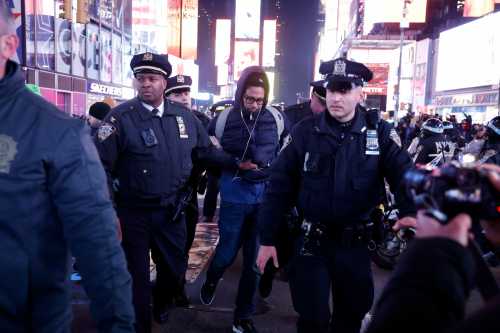
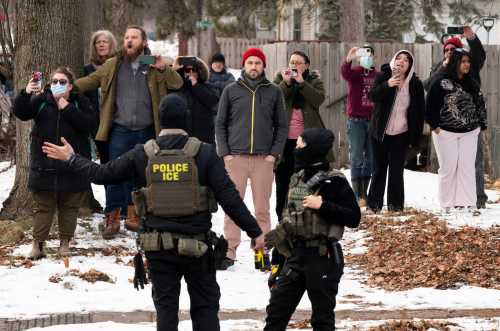
The violence perpetrated against white Americans during federal crackdowns on immigration in cities earlier this year can create a pathway to confronting the lived reality Black communities have endured for generations. When federal immigration enforcement officers fatally shot two unarmed white Americans in January during Minneapolis’ immigration operations, it led to legislative hearings that have not occurred when similar incidents unfolded in communities of color across the nation.
As of early April, about 60,000 people were held in ICE detention at any one time across a rapidly expanding network of more than 200 facilities. Nearly three-quarters of those detained had no criminal convictions, and only a small fraction had violent records.
Long before Minneapolis, poor and working-class whites were already paying a price for the politics they embraced. Policies marketed as “law and order” and as protections for white communities, including more guns, less health care, and thinner social services, helped shorten life expectancy and drive so-called “deaths of despair,” including suicides, overdoses, and alcohol-related deaths.
What distinguishes these cases from decades of police and immigration enforcement violence in communities of color is not the brutality itself, but the growing willingness of white Americans to recognize that the architecture of state control, built to manage Black and Brown populations and long felt in poor white communities, now ultimately threatens everyone. During the protests against ICE enforcement in Minneapolis, the deaths of two white Americans, Renée Good and Alex Pretti, triggered congressional accountability hearings. Yet they were not the only victims of this crackdown, as there were 32 reported deaths in ICE custody since 2025, many involving people of color. Keith Porter Jr., a Black man from Los Angeles, was shot by an off-duty ICE officer, but there has been little transparency or accountability afforded to his case. It’s not just a flaw in the political system when only white victims can have justice, but rather it reveals the surveillance state’s selective visibility.
Police violence became the primary lens through which Americans understood this broader system of injustice. For decades, public discourse centered on disparity statistics emphasizing how much more likely Black people are to suffer at the hands of the state. In 2024, Black Americans were killed by police at a rate of almost 6 per million compared with 2 per million for white Americans—nearly three times the per-capita risk. Leading with these ratios ensured that the public learned to view police violence as a Black problem rather than a feature of governance that happens to fall hardest on Black communities.
The raw numbers tell a very different story. In 2024, police killed 396 white Americans, 254 Black Americans, and 177 Hispanic Americans. Emphasizing rates over counts turned white deaths into statistical noise. The political system largely ignored the fact that hundreds of white families were also losing loved ones to police bullets. Recognizing those lives as part of the same crisis expands the coalition for change rather than diluting the case for justice.
The disparity framing that dominated the discourse on police violence created blind spots that obscured this reality. Racial justice advocates’ success in documenting disparities inadvertently implied the harm was uniquely theirs, and police supporters quickly exploited this by countering critiques with the claim that “more whites than Blacks are killed,” as if that absolved rather than condemned the system. Recent federal enforcement operations are shattering that illusion in ways that demand attention. From September 2025 to February 2026, ICE and Border Patrol agents have shot at least 14 people during immigration operations. The Senate has held hearings on ICE accountability, yet federal prosecution remains virtually nonexistent. This supports what communities of color have long understood: When the state abuses its power to use lethal force, no one is outside its reach.
The accountability vacuum persists because meaningful reform has lacked political urgency. If white Americans begin to understand and accept that they face state violence, they may vote differently. Reforms dismissed as special pleading from a protected class suddenly become achievable when white voters see themselves at risk, a damning pattern that repeats throughout American history. Murders of white victims trigger harsher penalties than identical crimes against Black victims. The opioid crisis became about treatment and public health intervention when white families became addicted, not when crack devastated Black communities. School shootings in mostly white suburbs transformed federal school safety funding.
Evidence-based accountability measures are needed: state laws that enable prosecutors to investigate federal agents who use lethal force, as Colorado and New Mexico have enacted; ending qualified immunity; executive orders mandating body cameras; funding appropriations conditioned on use-of-force reporting; and subjecting federal agents to civilian oversight with subpoena power. These reforms would begin to help build coalitions across communities, actualizing what organizers have demanded for decades.
It’s important to note that no group is a monolith. There are marked instances of white people’s involvement in progressive movements, such as during the Civil Rights Movement, and more recently in protests for racial equity and against the Trump administration. Research indicates that in 2020, young white people made up the largest share of protesters against racism, and in October of 2025, at the No Kings protest in D.C., 86% of attendees were white people, with Trump and immigration as the top issues driving their participation. While there is an upward trajectory of white people supporting these movements, having sympathy is different from implicitly perceiving the same systemic conditions. In the 1960s, during the height of the Civil Rights Movement, even white Northerners who were initially more supportive of the movement didn’t want Black people to gain rights at the expense of their privilege.
White Americans, for the most part, are still not grasping the depths of systemic injustice in our institutions. For instance, there are large differences among racial groups in the belief that Black people are treated unfairly in society: 54% of white Americans believe Black people are treated less fairly when dealing with police, while a large majority of Black Americans (77%) believe this. There are also large percentage-point gaps between white and Black respondents in beliefs about being treated less fairly in jobs (30% of white respondents compared with 59% of Black respondents) and health care (34% of white respondents versus 59% of Black respondents). In each sub-question, white respondents had the lowest belief rate that Black people were treated less fairly in those situations. The recent immigration enforcement crackdown and the resulting backlash are the perfect catalyst to bring more acknowledgement and accountability forward.
The Minneapolis killings exposed the gap between constitutional promise and structural reality. The 14th Amendment guaranteed equal protection in 1868, yet legal doctrines developed over the next century and a half resulted in insufficient justice for civilians killed by law enforcement. Qualified immunity, established through Supreme Court precedent rather than legislation, shields officers from accountability when they claim reasonable fear. Use-of-force standards grant discretion so broad that perceived resistance, real or imagined, justifies lethal response. These doctrines were refined through cases involving Black victims, then applied universally. The result is a system where federal agents shoot 14 civilians during immigration enforcement operations with zero prosecutions, where local police kill nearly 1,400 Americans annually while imposing $22.7 billion in economic costs, and where the political system responds with more media attention, hearings, and condemnations only when white deaths force recognition of what Black communities documented for generations.
When all Americans recognize they are vulnerable to violence at the hands of law enforcement, it may begin to create the political conditions for structural reform that advocacy alone has been unable to achieve. A historical pattern of selective responsiveness is not a defense of how accountability should work, but an indictment of how it actually operates. The policy question is whether that recognition translates into body cameras, civilian oversight boards with subpoena authority, federal prosecution, and elimination of qualified immunity—all of which evidence suggests are necessary—or whether violence continues until the Constitution’s equal protection guarantee becomes universally enforceable rather than aspirational for most.
Related Content

Author

The Brookings Institution is committed to quality, independence, and impact.
We are supported by a diverse array of funders. In line with our values and policies, each Brookings publication represents the sole views of its author(s).
Commentary
Shared vulnerability to state violence could unite reform efforts
July 10, 2026