Executive summary
After rising for more than 40 years, the number of U.S. drug overdose deaths began to fall in mid-2023, declining from a 12-month rate of about 110,000 in June 2023 to about 72,000 in August 2025, primarily as a result of a decline in the number of deaths involving fentanyl. Many factors have been suggested to explain that unanticipated decline: some focused on supply and some on people who use illicit drugs, including widespread adoption of several harm reduction measures. This essay examines five different potential sources of decline. Two are specific policy interventions aimed at reducing demand or mortality risk; for neither intervention do we assess the effects as likely to be substantial. Two sources are characteristics of the supply that may have changed to reduce mortality; both may have played a role. The fifth is purely epidemiological, and we are unable to assess its impact. The brief concludes with recommendations for strengthening monitoring systems to improve policy.
The sudden decline in overdose deaths
Between late-2021 and June 2023, the United States attained a truly catastrophic peak level of overdose mortality, averaging nearly 10,000 deaths per month. This plateau was six times the figure for 2000 and represented a continuation of a 40-year increase. The sudden and substantial downturn that followed was unforeseen and broad-based: It accelerated the declines in states that were hit first by fentanyl and were already past their peaks and flipped the trajectory of states where deaths had still been rising. The sustained pace of decline was also remarkable. Over the next two years, the national number of deaths involving fentanyl was cut in half. The figure below highlights key components of that dynamic among fentanyl-linked overdose deaths:
- The peak in opioid overdose deaths where fentanyl was detected occurred at the beginning of the COVID-19 pandemic, then remained steady for three years before falling precipitously.
- Fentanyl overdose deaths involving an illegal stimulant (i.e., cocaine or methamphetamine) continued to grow until mid-2023 but followed the same downward trajectory thereafter.
- Fatal overdoses that do not involve fentanyl have remained remarkably stable at a roughly 21,000-22,000 deaths per year since 2018, but within that trend, stimulant deaths grew steadily while non-fentanyl opioid deaths declined commensurately.
Furthermore, while the decline was not exactly the same size in all states, it was broad and better thought of as a nationwide, not merely a regional, phenomenon. These separate trajectories hint at some dynamics that may help explain the overall decline. The fact that stimulant without fentanyl overdose deaths have been essentially flat suggests that the forces driving the decline are specific to the fentanyl market—whether those forces act on the supply of fentanyl, on how people use it, or on the likelihood that a given fentanyl exposure becomes fatal.

Explaining why this happened is a major challenge. Nabarun DasGupta has identified eight possible factors, and it is not difficult to add still others to his list. Vanda Felbab-Brown, in another Brookings report, has also considered a variety of sources. In a recent Science article, one of us and five other authors presented an analysis that strongly suggested that a supply shock was a major factor. It also proposed, less certainly, that Chinese actions against precursor producers were responsible. That second suggestion has attracted more criticism, including from Felbab-Brown; critics doubt that China did take effective actions before June 2023. However, the U.S. Drug Enforcement Administration (DEA) provides a counterpoint in its annual National Drug Threat Assessment that was released in April 2025: “Fentanyl purity declined throughout 2024, consistent with indicators that many Mexico-based fentanyl cooks are having difficulty obtaining some key precursor chemicals.”
In this essay, we focus here on four factors DasGupta names that have received prominent attention in policy discussions. First, we consider interventions focused on consumption that scaled up rapidly around the same time as the downturn: a harm reduction initiative expanding naloxone access and a treatment initiative expanding buprenorphine prescribing. We also discuss two changes in the characteristics of the drug supply: increasing xylazine adulteration and greater consistency of counterfeit pills. These, by contrast, were more gradual but may have independently altered overdose risk at the individual level. Together, these four factors provide some clues about how much of the decline can be attributed to deliberate public health action versus shifts in market conditions. We also consider a purely epidemiological factor that has also been advanced, namely “depletion of the susceptibles,” the hypothesis that overdose deaths so far outpaced fentanyl initiation that the population of people who use fentanyl has substantially declined. Our goal is to identify factors that might explain a sudden and very large decline, as distinct from interventions that may have reduced fatal overdoses somewhat in successive years.
Harm reduction and medication-assisted treatment expansion
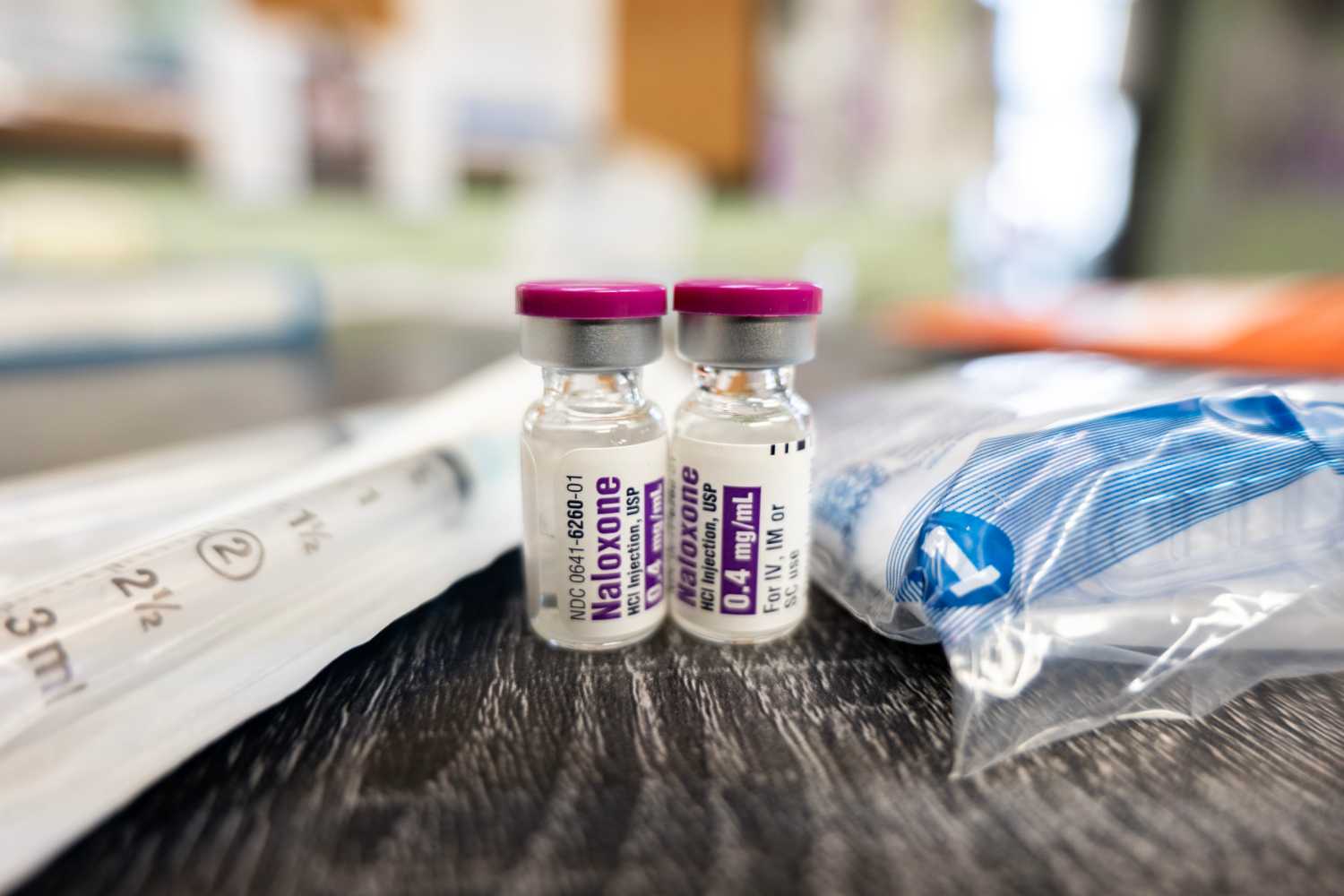
Making naloxone an over-the-counter medication. Naloxone is a medication that can reverse the effects of an opioid overdose; in March 2023, it became available over the counter. Naloxone could have had a major effect on fatal overdoses if used more regularly, but an early study found that only about 9% of pharmacies chose to stock it. Data from the National Emergency Medical Services Information System provided to us by Andrew Thompson offer useful context for evaluating naloxone’s role. The total number of naloxone-related emergency medical service (EMS) activations fell substantially over this period, from roughly 32,000-37,000 per month in 2022 to approximately 23,000-26,000 per month by 2025, a decline of around 25% to 30%. Notably, the share of activations in which naloxone had been administered before EMS arrival rose only modestly, from about 16% in early 2022 to about 20% by early 2025. Much of that shift appears to reflect improved documentation rather than a meaningful increase in bystander naloxone use because the share of cases in which naloxone was definitively not administered before EMS arrival remained essentially flat throughout the period. Taken together, these patterns suggest that the decline in EMS overdose activations reflects fewer overdose events occurring overall, rather than a growing share being intercepted upstream by bystanders with naloxone. Further circumstantial evidence comes from Canada, which made the overdose reversal drug available seven years earlier in 2016 yet experienced a parallel decline in opioid overdose deaths at generally the same time. Though increased access to naloxone may well have saved lives, it is not clear that it made a large contribution to the observed decline.
Elimination of the buprenorphine X-waiver. Buprenorphine has become an important alternative to methadone in recent years, largely because it is less prone to misuse and overdose and generally requires fewer clinic visits. In 2021, the Department of Health and Human Services removed the eight-hour training requirement for physicians prescribing buprenorphine to up to 30 patients, lifting a significant barrier to access. Then, in January 2023, the Consolidated Appropriations Act eliminated the so-called “X-waiver” entirely, allowing any DEA-registered provider with Schedule III authority to prescribe buprenorphine without additional registration or patient caps. The question then is whether substantially more patients received buprenorphine after these reforms. The Centers for Disease Control and Prevention reports that “The overall national buprenorphine dispensing rate remained relatively stable from 2019 to 2024, with the rate in 2024 at 4.5 buprenorphine prescriptions dispensed per 100 persons (a total of more than 15 million buprenorphine prescriptions).”
A study published in the New England Journal of Medicine examining the first year after X-waiver elimination found that the number of buprenorphine prescribers increased substantially—from about 42,000 to nearly 54,000 per month—but the total number of patients receiving buprenorphine changed little. Initiation of new patients increased only modestly. As the study’s authors note, the removal of the X-waiver may simply have been insufficient to overcome other barriers, including cost sharing, stigma, and the unraveling of COVID-era Medicaid coverage. In short, expanded prescribing authority has not yet translated into a meaningful surge in treatment uptake, making it an unlikely driver of the overdose decline. The minimal impact of removing the X-waiver was correctly predicted by Erin J. Stringfellow and colleagues, who noted that half of doctors with a waiver were not prescribing.
Characteristics of the supply
Over time, there have been important changes in the characteristics of the drugs sold as opioids that may affect the associated mortality.
Introduction of xylazine in the opioid supply. Xylazine is a veterinary tranquilizer, which started to show up in the autopsies of fentanyl overdoses in quantity in 2018. If people who use opioids prefer opioids without xylazine, people may adopt safer use practices when xylazine is known to be in what is being sold on the street. A recent study interviewing people with recent opioid overdose reversal experience in two Midwestern cities found that 46 of the 52 interviewees reported “using less, changing route of administration, or abstaining entirely.” Since the share of fentanyl powder showing xylazine has increased sharply from about 20% in the first quarter of 2022 to almost 40% within two years, that might have led to a reduction in overdose deaths. Most of the evidence available is qualitative. Participants reported using less opioid in amount or frequency, seeking treatment, switching from injection to smoking, and avoiding dealers known to carry xylazine-adulterated product. Motivations included fear of necrotic skin wounds, loss of functionality, and the failure of xylazine-laced drugs to produce the expected opioid high. Further, because xylazine is not an opioid, its sedative effects are not reversed by naloxone, adding to user anxiety. Notably, the geographic spread of xylazine has followed a broadly east-to-west pattern—mirroring the geographic pattern of overdose declines, with eastern states declining earlier than western ones. This geographic concordance lends additional plausibility to the xylazine hypothesis, though the evidence remains largely qualitative and the causal link is far from proven.
Greater consistency in the composition of counterfeit pills. A major source of risk is that a pill contains more fentanyl than expected. There is some evidence that pills manufactured in Mexico have more consistent composition than those produced locally in the United States from imported fentanyl powder. DasGupta’s Street Drug Analysis Lab at the University of North Carolina at Chapel Hill, which has analyzed over 23,000 samples from 42 states as of early August 2026, emphasizes that it is fluctuation in fentanyl content—not average potency—that drives overdose risk: a user calibrated to weak product who encounters a hot batch is in acute danger. In that light, greater consistency of Mexican-manufactured pills (even at somewhat lower average potency) could reduce the variance that kills. Against this, DasGupta has argued that the decline in overdose deaths started well before 2024, when the pill-consistency phenomenon was first widely reported, and that most illicit fentanyl consumed nationally is still in powder form rather than pills. Thus, while this factor may have contributed at the margin, it is unlikely to account for a large share of the decline on its own.
What might contribute to the decline: Epidemiological factors
Finally, there is a potentially important epidemiological change.
Depletion of susceptibles. This takes two forms. One simply refers to a decline in the number of individuals taking fentanyl. After all, there were 403,000 deaths from fentanyl related overdoses in the period 2015-2023. If one were, naively, to believe the official estimates of the number of opioid users based on the National Survey of Drug Use and Health (NSDUH), the total number of individuals who used fentanyl in the past 12 months in 2023 was only 816,000. The error bands around the NSDUH estimates are so broad that no one-year change is statistically significant. However, if something on the order of 70,000 fentanyl-involved overdose deaths in 2022 occurred among less than a million estimated people at risk, it is not a leap to reason that the number of people at risk of fatal overdose is declining.
We think that the NSDUH estimate is a vast underestimate, as it is for heroin. One reason for that is that even in 2023, many of those using fentanyl were unaware. Most fentanyl overdoses in recent years have been associated with stimulant use. Many of those who purchase methamphetamine that has been adulterated with fentanyl do not know that. Hence, if they do participate in the survey, they provide honest but inaccurate negative responses to the question of whether they have used fentanyl.
The second form of “depletion of susceptibles” is more subtle. Increasing potency in the opioid being consumed can lead to a rise in the number of fatal overdoses, as users are slow to adjust to the new situation. Over time, if potency stabilizes, the users become less “susceptible” to an overdose. The apparent shift from powder to pills also leads to fewer instances of doses larger than anticipated. Fentanyl has spread slowly across the states, from east to west. States such as Washington saw major increases in fentanyl mortality between 2019 and 2021, as fentanyl entered the stimulant supply and displaced heroin. Perhaps by mid-2023, West Coast users had adjusted to the new reality of a much more potent opioid supply.
However, the experience of eastern states that were hit by fentanyl early on provides a source of skepticism. New York City, already badly hit in 2019 with 1,497 drug deaths, saw a doubling over the next three years; of its 3,026 fatal overdoses in 2022, 81% involved fentanyl.
Concluding comments
This short brief leaves much unexplained. Treatment expansion other than the buprenorphine X-waiver has not been discussed as a factor, simply because there was no increase in the number of persons admitted for treatment with opioids as the principal problem. There is insufficient evidence to explain contributions to the decline from among the remaining plausible candidates. The factors examined here are not mutually exclusive, and the true explanation is almost certainly some combination of supply-side changes, demand-side adaptation, and the hard-to-quantify effects of community organizations doing the daily work of harm reduction. For example, the one modeling effort that did predict a decline in fatal opioid overdoses forecasted a decline from 80,000 in 2022 to 60,000 in 2032 through harm reduction strategies, naloxone distribution, and recovery support; the actual 2024 figure was already below 60,000, throwing the modeling parameters into question. The sharp decline remains, in that sense, largely a puzzle, and one whose solution has serious implications for how we allocate scarce public health resources going forward.
Neither expanded naloxone access nor the elimination of the X-waiver for buprenorphine prescribing produced changes of the magnitude needed to explain an approximately 50% reduction in fentanyl-involved deaths. Both policies deserve continued support—they almost certainly saved individual lives. But overall, there is little evidence that active demand-side interventions alone can explain a major downturn in opioid overdoses. On the contrary, the findings from one major effort, the HEALing Communities Study, fly in the face of many theories to explain the ongoing decline. That massive investment in a coordinated treatment, education, and harm reduction strategy suggests we still have much to learn about harm reduction service delivery.
The two forms of “depletion of susceptibles,” purely epidemiologic explanations, also lack supporting evidence. However, changes in the characteristics of the supply (more xylazine, more consistent composition of pills) may have been important contributing factors.
The supply-side story is more intriguing. The proliferation of xylazine may have paradoxically induced safer behaviors among people who use opioids, while greater consistency in counterfeit pill composition may have reduced the variance in fentanyl dosing that is especially lethal. These supply-side changes are also consistent with the aforementioned finding published in a Science article that a supply shock—possibly linked to Chinese precursor chemical regulation—played a central role. Whatever the precise mechanism, the pattern in the data is clear: the decline has been concentrated almost entirely in fentanyl-involved deaths, while stimulant-only overdose mortality has been remarkably stable.
Policy recommendations
The systems for monitoring the nation’s drug problems are totally inadequate to the task. Moreover, during a period in which those problems have become very much worse, the monitoring systems have actually become weaker. We identify three systems whose restoration, in an improved version, would significantly strengthen the government’s ability to respond effectively and in a timely fashion to changing drug problems.
STRIDE. From about 1981 to 2017, the DEA provided data on the price and purity of drugs seized or purchased undercover; the system was called System to Retrieve Information from Drug Evidence. These data were regularly used by researchers and the Office of National Drug Control Policy (ONDCP) to monitor changes in the purity and prices of the major drugs. In 2017, the DEA stopped providing detailed data to outside analysts, and the analytic value of its simplified replacement that is now publicly available is limited. STRIDE had well-known limitations but still provided essential insights into markets.
ADAM. Starting in the 1990s, the National Institute of Justice operated a program that collected data about drug markets from interviews with arrestees in a sample of local jails. The system was called Arrestee Drug Abuse Monitoring. Arrestees include many individuals with extensive drug purchase experiences. ADAM allowed researchers to estimate expenditures and drug use prevalence among a segment of the population that is not covered well by other sources but who account for a large share of the demand, thus providing important insights about the market not captured in just purity and price. The program gradually declined in scope starting around 2005 and ended in 2013. A version of this needs to be restarted.
DAWN. The Drug Abuse Warning Network collected data from emergency departments in a large sample of hospitals from 1980 to 2010. DAWN provided important data on new drugs that were showing up on entry to emergency departments and on the characteristics of those who were suffering adverse consequences. It was paused for a few years and then returned in a much-shrunken form. It needs to be resuscitated in a robust manner that provides useful information at both the national and regional levels.
In addition to restoring these programs, the federal government should invest in new monitoring systems.
Wastewater testing. Drug use is reflected in wastewater systems. Many European countries have developed sampling programs that provide estimates of quantities consumed in individual cities or metropolitan areas on an almost real-time basis and at very modest cost. The United States has lagged in developing such programs. However, ONDCP recently moved to close that gap by funding a six-site study along the southwest border and lists a national wastewater monitoring system among its priorities in the 2026 National Drug Control Strategy.
Social media. In the Science article pointing to a supply shock as a major source of the downturn in deaths, analysis of Reddit comments and questions about the state of the fentanyl market played an important role. As social media becomes an increasingly important mode of communication and expression, systematic analysis can serve to provide important information about changes in use patterns and risk factors.
The overdose crisis, which has claimed hundreds of thousands of American lives over the past decade, is a public health catastrophe with few modern parallels. Understanding what finally bent the curve is not merely an academic exercise: getting the answer wrong risks repeating the mistakes that caused it.
Authors


-
Acknowledgements and disclosures
The authors would like to thank Jonathan Caulkins and Beau Kilmer for their helpful comments.
This work was supported by a National Science Foundation grant (2146230) to Peter Reuter and the University of Maryland, and by the Brookings Institution.
The Brookings Institution is committed to quality, independence, and impact.
We are supported by a diverse array of funders. In line with our values and policies, each Brookings publication represents the sole views of its author(s).