The following is a summary of the 51st session of the Congressional Study Group on Foreign Relations and National Security, a program for congressional staff focused on critically engaging the legal and policy factors that define the role that Congress plays in various aspects of U.S. foreign relations and national security policy.
On June 18, 2026, the Congressional Study Group on Foreign Relations and National Security convened in-person on Capitol Hill to discuss how the legal landscape governing domestic military deployments has changed in the wake of the Supreme Court’s decision in Trump v. Illinois. Over the past year, the Trump administration repeatedly deployed U.S. armed forces on domestic missions in support of immigration and other federal law enforcement efforts. In its late December decision in Trump v. Illinois, the court invalidated the legal theory the administration had relied upon to federalize state National Guard personnel for some of its most controversial deployments, including those in Chicago, Los Angeles, and Portland. But other domestic deployments have continued on the basis of other legal authorities, as have the related legal challenges—and Trump v. Illinois did little to clarify how its holding might bear on those deployments or on the range of legal authorities the executive branch might yet invoke, including the much-discussed but rarely invoked Insurrection Act. This session took a close look at how the legal terrain surrounding domestic deployments has shifted as well as how other relevant authorities are being used or may yet be used in the future.
For the session, the study group was joined by three leading experts, whom coordinator Scott R. Anderson led in an initial discussion:
- Marty Lederman, a professor at the Georgetown University Law Center who has twice served as deputy assistant attorney general in the Justice Department’s Office of Legal Counsel and authored the amicus brief in Trump v. Illinois that advanced the legal theory on which the Supreme Court ultimately resolved the case;
- Chris Mirasola, a professor at the University of Houston Law Center who previously served as an attorney-adviser at the U.S. Department of Defense working on domestic deployment issues; and
- Loren Voss of the German Marshall Fund, who previously worked on domestic deployment issues as director of defense policy and strategy at the National Security Council, among other positions in government.
The panelists opened by outlining Trump v. Illinois and the deployments that gave rise to it, describing how the administration had responded to immigration enforcement protests in Los Angeles by sending Marines and federalized California National Guard personnel to protect federal buildings, relying on Section 12406 of Title 10—the statute that permits the president to call National Guard personnel into federal service under certain conditions, including when the president is “unable with the regular forces to execute the laws of the United States.” One expert explained that the court had effectively cut that theory off at the knees, holding that the statute could not be invoked where regular forces were already available to address the situation, and observed that the National Guard functions on this reading as something of a bulwark against resort to the regular military rather than a first option.
Importantly, the panelists noted, the court declined to resolve the harder questions lurking beneath the case. It did not decide whether or when the president may deploy the regular military domestically—an issue the justices appeared reluctant to reach—and it said nothing about when the president may or may not invoke the Insurrection Act. The panelists then walked through the theory the majority adopted, noting that the question of when the regular military may be used remains open and that press reporting had indicated the administration internally debated invoking the Insurrection Act. The Court’s silence on the administration’s alternative arguments left considerable uncertainty about how future determinations would be scrutinized.
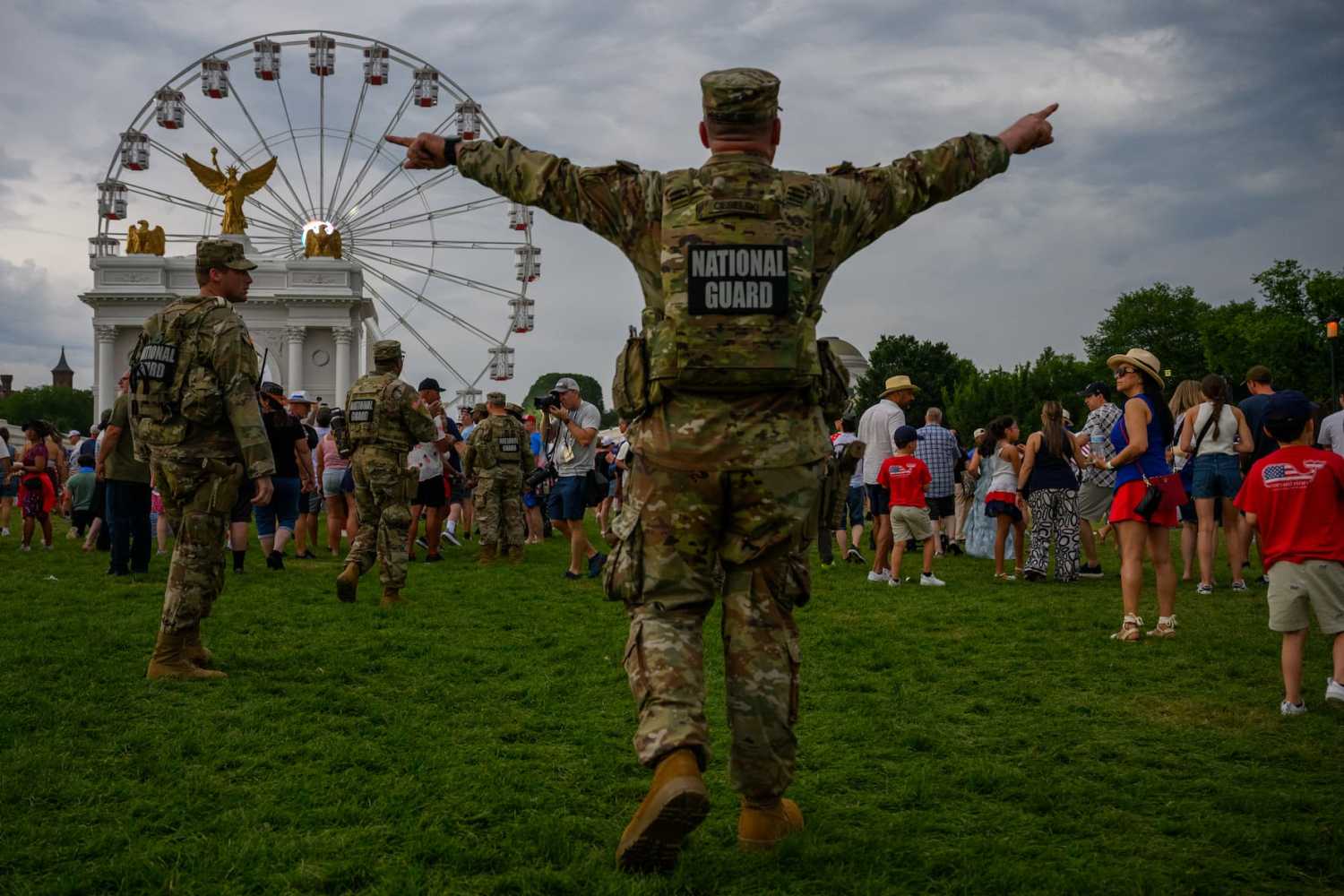
From there, the panel turned to the deployments that continue notwithstanding Trump v. Illinois. Beyond the high-profile deployments in Democratic-led states, they described National Guard personnel supporting Immigration and Customs Enforcement missions in the background, as well as missions in Memphis and New Orleans that proceed with the support of Republican governors and are focused on crime. Because those governors are willing partners, the relevant personnel can be deployed in a state-controlled capacity under Section 502(f) of Title 32, which avoids the federalization questions at the heart of the Los Angeles litigation. The deployment in Washington, D.C., meanwhile, presents a distinct set of issues given the president’s unusual authority over the D.C. National Guard, and the government has used the D.C. litigation to advance progressively broader arguments as National Guard personnel move further into law enforcement activities.
The conversation then examined the legal theories on which continued deployments rest and the constraints that bound them. The speakers discussed the president’s asserted “protective power”—the theory that the president possesses inherent authority to use the military to protect federal property, personnel, and functions—and observed that the administration has stretched the concept of “function” well beyond its established contours. Any such theory, they noted, must contend with the Posse Comitatus Act, which generally prohibits the use of the military to execute domestic law. The panelists characterized the act’s exceptions as something of a wild west and canvassed difficult questions about how it constrains the executive branch, whether its status as a criminal statute matters, and even whether it might be vulnerable to constitutional challenge.
The panelists next considered the administration’s apparent reluctance to invoke the Insurrection Act. They traced a tradition of institutional restraint, including a 1960s Office of Legal Counsel opinion associated with then-Deputy Attorney General Nicholas Katzenbach, under which the act has been understood to be available only in narrow circumstances—such as when a state is overwhelmed and requests assistance, or to enforce judicial orders—despite the statute’s sweeping text. The speakers cautioned that the act is extraordinarily broad, likening it to a kind of nuclear option in terms of the expansive presidential authority it grants, and observed that a reviewing court might be reluctant to second-guess a presidential determination given the difficulty of overcoming the statute’s textualist reading. One panelist suggested that Congress might reinforce and amplify the Katzenbach interpretation legislatively.
Finally, the group turned to the prospect of military involvement around elections. The panelists highlighted the statute barring troops at the polls, which prohibits bringing troops or armed men to polling places except to repel armed enemies of the United States. One flagged concerns that the administration might attempt to exploit foreign-interference or terrorism rationales to work around both that prohibition and the Posse Comitatus Act, also noting how the polling statute could be interpreted as saying that no official other than the president may order such a presence. Throughout, the speakers underscored that there is at present very little oversight of these deployments, and discussed the legislative tools Congress might use to restrain them, such as clarifying existing law or writing new rules.
The session then concluded with an open discussion wherein attendees were invited to ask questions or present their own views on some of the issues raised. As with all sessions of the study group, the discussion was conducted under the Chatham House Rule, meaning that statements made there are not for attribution without the permission of the speaker.
The Brookings Institution is committed to quality, independence, and impact.
We are supported by a diverse array of funders. In line with our values and policies, each Brookings publication represents the sole views of its author(s).