Many years ago, as a little boy, my son would often ask: “Please tell me a different story, Mãe. I’ve heard that one before.” Little did I know this simple request would come to frame my work not just as an author, but also as an education practitioner and researcher bridging grassroots innovation and systems change in Mozambique.
The last national literacy assessment officially published in Mozambique revealed that only 5 in 100 students could read at the expected level after three years of schooling (INDE 2017). Whether exploring narrative practices with children or co-designing Mozambique’s national in-school mentorship program, I’ve witnessed this reality across the country: Many students finish primary school, and some even secondary school, unable to read or write. It would seem an entire generation is doomed to fail. Or so the story goes.
But when I step outside the school grounds, I see a different picture, one that is vibrant and filled with hope: youth caring for younger siblings and helping them with homework or preparing for national exams; adolescent girls selling badjia or braiding hair to support their families; young boys crafting toys out of rags, tins, and flip-flops; children in markets counting change off the top of their heads.
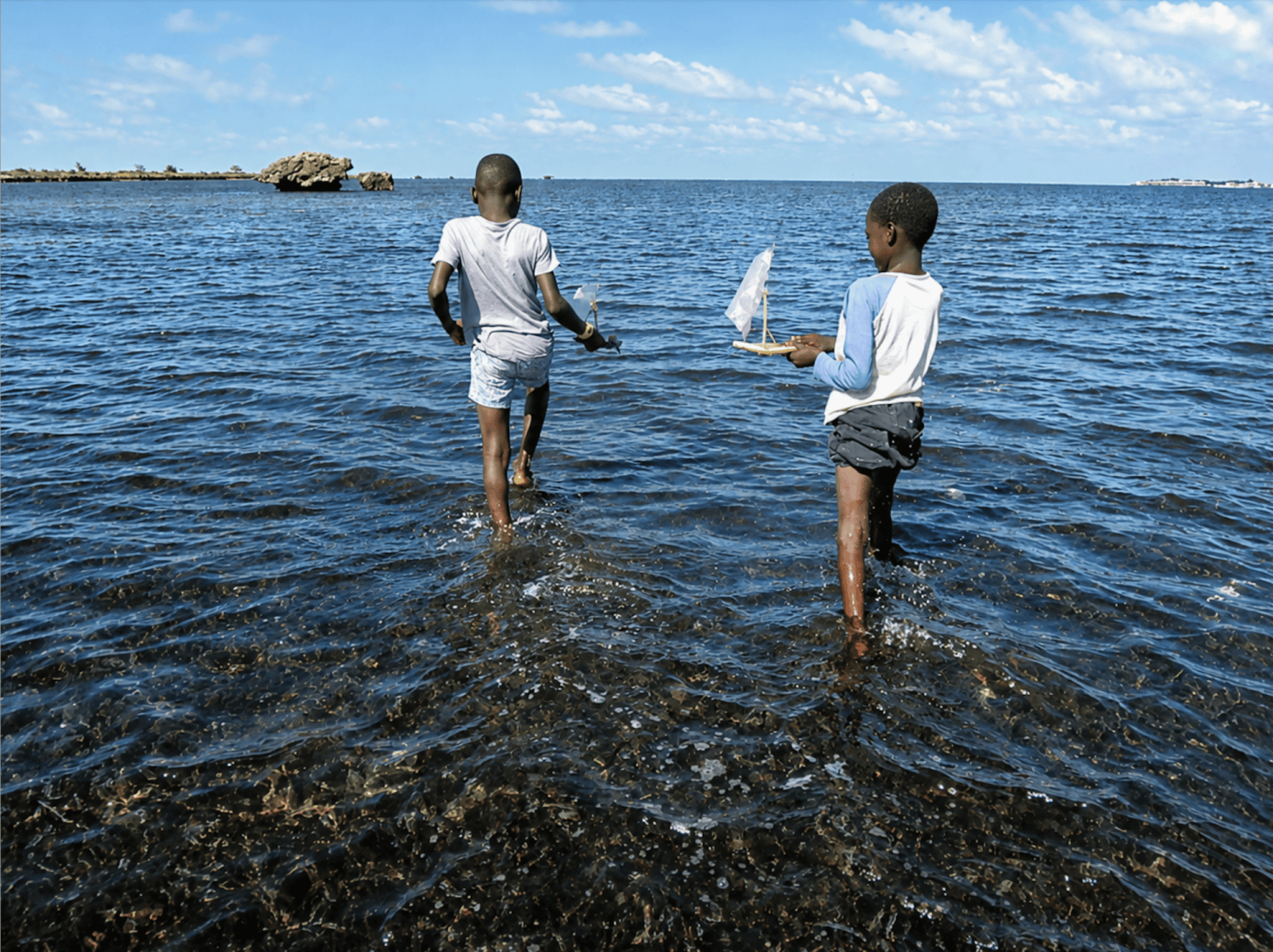
Two boys from Cabaceira village, in Nampula Province, take to the sea to launch their self-made dhow boats. (Photo: C. Pereira Pinto, August 2026)
So how is formal education not tapping into these much-needed 21st-century skills, like empathetic leadership, critical thinking, problem-solving, entrepreneurship, or negotiation? Because the national assessment practice tends to privilege standardized measures, often reducing progress to externally defined metrics such as the number of words a child can read per minute.
Mozambique’s national primary curriculum acknowledges the mismatch between schooling and children’s lived realities and establishes bilingual education and a local curriculum component to bridge that gap. Yet mother-tongue instruction uses the same metric: how many letters can a child decode before the timer hits 60 seconds?
Reading and writing are, of course, fundamental skills that all children have a basic right to. But the dominant narrative that emerges from standardized assessments tells of a ‘learning crisis’, suggesting that children, teachers and governments are all failing and perpetuating a North-South power dynamic that stereotypes countries in Southern Africa as falling behind.
From a Global South perspective, the narrative needs to change and so do the metrics. Through Chimamanda Ngozi Adichie, we learned about the danger of a single story. My son would agree.
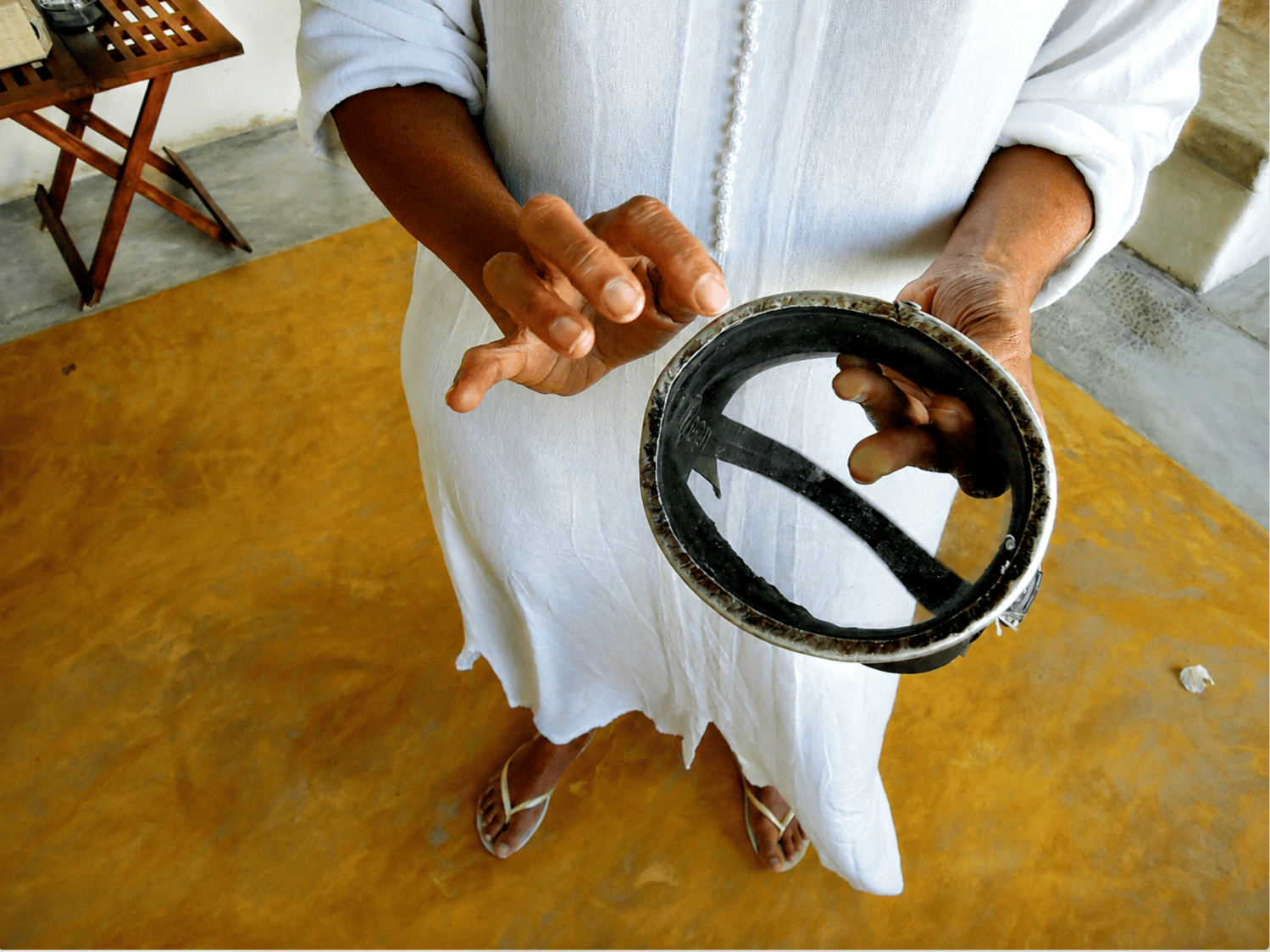
Education in Mozambique “needs a new lens,” says Y. as she holds up an artisanal dive mask at her home in Ilha de Moçambique, Nampula Province. (Photo: C. Pereira Pinto, July 2026)
If there’s something I’ve learned from many years of facilitating impact story workshops with young women leaders at Girl MOVE Academy, it’s that no two stories are alike; each voice brings a unique contribution. So, what I’m calling for isn’t a new narrative, but a space where multiple narratives can coexist and shape one another. And it starts with a simple question: whose voices are missing from the global conversation on foundational learning?
Despite their historically central roles in raising children, shaping values, and passing knowledge from one generation to the next, women’s perspectives have rarely been included in the global education debate. Decisions about what counts as learning are mostly informed by institutional, technical, and external forms of expertise, while those most intimately involved in raising children are seldom consulted. Successive reforms in Mozambique (2004-2020) have introduced changes to curriculum, language policy, and teacher practice, but they have yet to address whose knowledge should inform the who, how, and what for of education—in and beyond school.
Understanding how women define thriving and perceive the wider ecologies of learning offers an opportunity to expand whose knowledge matters and what counts as evidence in shaping educational policy. Otherwise, reforms risk being disconnected from the values, aspirations, relationships, and knowledge systems that children recognize as their own.
As an Echidna Scholar, I plan to explore how women in rural and peri-urban areas of Mozambique understand what girls and boys need to know, do, feel, and become in order to thrive, and how these understandings might inform culturally rooted, gender-transformative, and relational approaches to foundational learning. Through in-depth conversations, artifact-based elicitation, and visual mapping, I hope to bring women’s voices to the forefront of global education policy and integrate locally grounded understandings of what it means for girls and boys to grow, thrive, and contribute.
The deeply relational fabric of Mozambican society speaks to community and belonging. As I continue working to embed voice, agency and relational pedagogy within education systems, my hope is for a more comprehensive, rooted model for foundational learning to emerge through a collaborative intercultural approach—one that mirrors children’s lived realities and builds on abundance rather than crisis.
My son asked me for a different story. Today, I would respond: “Dearest Filho, maybe it’s not about a new story—maybe it’s about making room for more. Will you tell me yours?”
Author

References:
Adichie, Chimamanda Ngozi. “The Danger of a Single Story.” TED2009. Filmed July 2009 in Oxford, UK. Video, 18:33. https://youtu.be/D9Ihs241zeg.
Bashir, Sajitha, Marlaine Lockheed, Elizabeth Ninan, and Jee-Peng Tan. Facing Forward: Schooling for Learning in Africa. Africa Development Forum series. Washington, D.C.: World Bank, 2018. https://doi.org/10.1596/978-1-4648-1260-6.
Bassi, Marina; Medina Pedreira, Octavio; Nhampossa, Lucia Jose. Education Service Delivery in Mozambique: A Second Round of the Service Delivery Indicators Survey (English). Washington, D.C. : World Bank Group, 2019. http://documents.worldbank.org/curated/en/811891562864504006
Chimbutane, Feliciano. “Language, Education, and Society in Mozambique: Assimilation, Homogenisation, and Gestures towards Unity in Diversity.” Modern Languages Open 1, no. 15 (2022): 1–14. https://doi.org/10.3828/mlo.v0i0.374.
INDE (Instituto Nacional de Desenvolvimento de Educação). Relatório do 2º Estudo da Avaliação Nacional da 3ª Classe 2016 [Report of the 2nd Study of the 3rd Grade National Assessment]. Maputo: Ministério da Educação e Desenvolvimento Humano, 2017.
Mário, Mouzinho, Celso M. Monjane, and Ricardo Santos. “Schooling without Learning: Institutional Causes.” In Mozambique at a Fork in the Road: The Institutional Diagnostic Project, edited by António S. Cruz, Ines A. Ferreira, Johnny Flentø, and Finn Tarp, 114–35. Cambridge: Cambridge University Press, 2023. https://doi.org/10.1017/9781009265799.009.
Matengu, Marika, Riitta-Liisa Korkeamäki, and Ailie Cleghorn. “Conceptualizing Meaningful Education: The Voices of Indigenous Parents of Young Children.” Learning, Culture and Social Interaction 22 (2019): 100242. https://doi.org/10.1016/j.lcsi.2018.05.007.
Ministério da Educação e Desenvolvimento Humano (MINEDH). Plano Curricular do Ensino Primário. Maputo: Instituto Nacional do Desenvolvimento da Educação, 2020.
https://mept.org.mz/wp-content/uploads/2020/07/PCEP_Maio_2020_Final_1.pdf
Nsamenang, A. Bame. “Human Ontogenesis: An Indigenous African View on Development and Intelligence.” International Journal of Psychology 41, no. 4 (2006): 293–97. https://doi.org/10.1080/00207590544000077.
Santos, Íris, and Iveta Silova. “From Finland to the World: Interrogating the Global Learning Crisis.” Discourse: Studies in the Cultural Politics of Education (2025): 1–13. https://doi.org/10.1080/01596306.2025.2567656.
Further reading:
Alapo, Remi, and Isaiah Z. Chabala. (2025). Knowledge Production Beyond Coloniality: Epistemic Sovereignty in African and Afro-Diasporic Institutions. Philosophy Study, July-Aug. 2025, Vol. 15, No. 4, 176-186.
Bacchi, Carol. Analysing Policy: What’s the Problem Represented to Be? Frenchs Forest, NSW: Pearson Education, 2009.
Chilisa, Bagele, and Gabo Ntseane. 2010. “Resisting Dominant Discourses: Implications of Indigenous, African Feminist Theory and Methods for Gender and Education Research.” Gender and Education 22 (6): 617–32. doi:10.1080/09540253.2010.519578.
Kalman, Judy, Laura Eisner, Patricia Valdivia, Citlalli López Rendón, and María del Carmen Lorenzatti. Teaching Reading With Social Justice: What the Evidence Also Shows. Language on the Move, July 15, 2026. https://languageonthemove.com/teaching-reading-with-social-justice/
Lawson, Laté, Stephen Acquah, Thierno Diallo, Samuel Asare, and Pauline Essah. Mapping Foundational Literacy and Numeracy Research in Four Sub-Saharan African Countries: Lessons from Country-Level Searches. Education Sub Saharan Africa (ESSA) and Research for Equitable Access and Learning (REAL) Centre, University of Cambridge, 2024.
https://www.educ.cam.ac.uk/centres/real/researchprojects/ongoing/mapping-education-sub-saharan-africa/FLN_cross_country_report.pdf
Mário, Mouzinho, Celso M. Monjane, and Ricardo Santos. “The Education Sector in Mozambique: From Access to Epistemic Quality in Primary Education.” WIDER Working Paper 2020/130. Helsinki: United Nations University World Institute for Development Economics Research (UNU-WIDER), 2020. https://doi.org/10.35188/UNU-WIDER/2020/887-0.
Ngũgĩ wa Thiong’o. Decolonising the Mind: The Politics of Language in African Literature. London: James Currey; Nairobi: Heinemann Kenya, 1986.
Serpell, Robert. The Significance of Schooling: Life-Journeys in an African Society. Cambridge: Cambridge University Press, 1993.
Tikly, Leon. “Education and the New Imperialism.” Comparative Education 40, no. 2 (2004): 173–98. https://doi.org/10.1080/0305006042000231347.
UNESCO, Association for the Development of Education in Africa and Osuwela. Spotlight on Basic Education Completion and Foundational Learning in Mozambique 2023. Paris: UNESCO, 2023. https://doi.org/10.54676/HHUM6161.
World Bank. Ending Learning Poverty in Mozambique (P172657): Project Information Document (PID). Washington, DC: World Bank, 2020.
https://documents1.worldbank.org/curated/en/643311587477692049/pdf/Concept-Project-Information-Document-PID-Ending-Learning-Poverty-in-Mozambique-P172657.pdf
Related Content
The Brookings Institution is committed to quality, independence, and impact.
We are supported by a diverse array of funders. In line with our values and policies, each Brookings publication represents the sole views of its author(s).


Commentary
Whose voices are missing: Reframing Mozambique’s ‘learning crisis’
September 18, 2026