



In this episode of Embedding Equality in Education, hosts Jenn O’Donoghue and Edem Ossai continue their “Moving into Action” conversation with a look at co-construction: how girls, families, and communities build a shared understanding of what agency means and what stands in its way. They also take on the question of backlash and the claim that gender equality is imposed from outside, making the case for an inside-out approach built on trust and on the strengths communities already have.
Related Episodes
TRANSCRIPT
O’DONOGHUE: Please note, this episode contains mention of child sexual abuse.
[music; girls singing]
That’s the sound of a group of girls in the Karamoja region on the border of Kenya and Uganda warming up before a community dialogue. Our colleague Mary Otieno suggested we dance or play a game as a warmup, and this is what happened.
[singing continues]
Completely spontaneous, one girl stood to sing, and within seconds the others had joined her.
[singing continues]
And I still sing that song now almost a year and a half later. I’m not religious, but the words are, “When Jesus says yes, nobody can say no.” And every time I hear it, I think about how much those girls had brought into that room before any of us had asked them a single question.
[music]
Welcome to the Embedding Equality in Education podcast. I’m Jenn O’Donoghue.
OSSAI: And I’m Edem Ossai, an education leader in Nigeria and a member of the Learning in Action Alliance for Girls Agency.
[1:12]
O’DONOGHUE: Edem, one idea keeps coming back to me across this season. How we define something really shapes what we do about it. If we get the definition wrong, we get the action wrong.
[1:22]
OSSAI: Absolutely, Jenn. And in our last episode, we spent a lot of time on what agency actually is. We landed on the idea that agency is multidimensional and dynamic. It’s not one thing, and it doesn’t stand still. It shifts across a girl’s life, across relationships, across the spaces she moves through.
[1:43]
O’DONOGHUE: Right. And if agency looks different everywhere, if it’s shaped by who a girl is, where she lives, who she lives with, what’s possible around her, then we can’t understand it from the outside. We have to understand it within each context.
[1:56]
OSSAI: Which brings us to today. This is part two of our Moving into Action conversation, and we’re going deeper into what we call co-construction. How do girls, their families, and their communities build a shared understanding of what agency means, and what’s getting in the way of what they can do about it?
[2:16]
O’DONOGHUE: Yeah, and I’ll say upfront here, to everyone listening, there are no universals here. We won’t be saying, “Agency means this, and so this is what we do to strengthen it in every context.”
Instead, we’ll offer up and talk through processes that have emerged in our work with LAAGA to build understandings and identify challenges and solutions that support these multiple dimensions of girls’ agency within their local settings.
So, let’s start with that word “local.” Within global education, global development, “localization” is a frequently used term. But Edem, let’s unpack that a little bit. When when we talk about localization in LAAGA, what do we mean?
[2:53]
OSSAI: That’s a very important question, Jenn. So, for me, there are two ideas inside localization. The first is contextualizing, and that is, understanding agency within the specific sociocultural realities of a place.
And the second meaning for me is, which we can never forget, is centering girls’ own understanding in that process. So, localization without centering girls isn’t really localizing.
[3:20]
O’DONOGHUE: So, it’s not just like, “Let’s adapt this for the local context”?
[3:24]
OSSAI: No, not at all. It’s grounding agency in girls’ lived experiences and in their own languages. You know, that’s also very important, because if agency is contextual and relational, as we’ve said many times in previous episodes, if it’s shaped by the people and the systems around girls, then the meaning has to be developed by the people who are actually living it, girls themselves.
[3:49]
O’DONOGHUE: Exactly, and and language matters so much here. Right? So, sometimes there isn’t a direct translation for this word “agency” at all.
[3:57]
OSSAI: Precisely, which is exactly why girls have to name it themselves. Across all the contexts we’ve worked in, we’ve engaged girls to name this concept of agency using local languages, local words or phrases. So, let’s take a listen, in one of our communities where we did our work as one of the girls explains this from the Karamoja region.
[4:23]
KARAMOJA GIRL: In my own language, I can say agency is a girl being brave, being able to understand her problems, and also to come up with solution so that she can help herself and the problems around her.
MARY OTIENO: Is there, a mother tongue word that means the same as agency?
KARAMOJA GIRL: The one that I can recall it is akemkem.
[4:50]
O’DONOGHUE: Being brave, understanding problems, coming up with solutions, all of that in one word.
[4:56]
OSSAI: Yeah, and you know, the meaning girls give to agency shifts from place to place. Let’s also listen to Pami Mhongera, another member of the Learning and Action Alliance for Girls’ Agency, who led our research in Zimbabwe. She’s describing how girls in her context defined it.
[5:15]
MHONGERA: So, they defined the word “agency” as kurongeka. In that context, kurongeka would combine being organized. It means having your priorities right, thinking, self-assertiveness, being streetwise, knowing the community, and more more importantly, having good relationships and being responsible, someone who is able to plant back to the family and to the community.
[5:50]
OSSAI: Notice there that kurongeka goes beyond the individual. So, in that clip you just heard, it’s the term kurongeka, it’s relational. So, it covers your relationships, your responsibility to your family and community. That’s a very different emphasis from simply, you know, definitions of agency that only center the self.
[6:13]
O’DONOGHUE: And that connects to how carefully we’ve talked about marginalization in this work. Right?
[6:18]
OSSAI: Exactly. Exactly. People use a lot of words interchangeably. They use terms like “disadvantaged,” “vulnerable,” “hard to reach.” But for us in LAAGA, and as we’ve talked about this extensively in episode two, marginalization is about inequality tied to power imbalances. This is very important. It’s the outcome of structural inequities created by power dynamics in each context and resulting, you know, in exclusion and even the denial of basic rights.
In the next clip which you’ll listen to, our colleague Armene has some thoughts around this.
[6:59]
MODI: Well, the reason I feel it’s important to focus on girls in marginalized contexts is undoubtedly they face some of the biggest challenges to their agency, including gender discrimination, restrictive patriarchal social norms, limited access to education and health care, et cetera.
And while contexts differ in different countries, many of the barriers to girls’ agency are remarkably similar. What is more, these barriers often reinforce each other, and they can severely restrict the opportunities and choices that adolescent girls in marginalized contexts face.
[7:46]
OSSAI: Armene Modi, in that clip you just listened to, named something very important here. The barriers can look remarkably similar from place to place, but once you put localization and marginalization together, now what stands out in how girls define agency is going to be distinct community by community, because the structures behind those barriers are usually different.
So, for example, take South Punjab in Pakistan. Historically, structural imbalances there have been tied to feudal relations, which have shaped, you know, who has gotten in the past access to resources. Now, certain people have been excluded from resource allocation for generations, and that has resulted in deep poverty and forced underdevelopment.
Now, you want to compare that to a context like Nigeria, where structural imbalances may have more to do with particular interpretations of religion that shape systems of marriages, including dispositions towards child marriage. So, imagine girls in these contexts defining agency. Some of these girls might emphasize decisions about their bodies, their sexual and reproductive rights, or their right to keep learning.
Others might tie agency to moving beyond the barest minimum of survival to the pursuit of goals, you know, livelihoods, whether in terms of access to capital, businesses to start, starting a family, and it goes on from there. But the picture is very different given their realities in these two contexts.
[9:25]
O’DONOGHUE: So, similar systemic challenges. Right? But really shaped by very different histories and structures.
[9:30]
OSSAI: Exactly, Jenn. And here’s what I find immensely powerful. So, when you take a localized lens on agency, it becomes an entry point into a much broader understanding of how that society is structured. The girls may not know that they’re naming these structures. Right? But by defining agency in certain ways, and if you’re listening, immediately you begin to see the pillars that hold up their society.
[9:56]
O’DONOGHUE: Right, and that’s why also, you know, grounding this work locally is what makes the work we’re doing in in LAAGA and others who are doing this type of grounded work more relevant, more sustainable. It’s really owned by the people that are directly affected.
And maybe that is the perfect setup for the other side of this. So, not just what localization is, but why it matters so much right now. And this came up a lot when we presented our LAAGA research at a recent Around the World symposium that the Center for Universal Education did with some of our partners around the world, and people were really asking, you know, when we presented this LAAGA work and what we’d seen changing and with communities, and they would say, “But don’t communities push back or reject these ideas of girls’ agency?”
And it’s a very valid question. Right? We’re living in a moment where there is a real backlash against gender equality and gender equality work, and and there exists this sort of narrative globally that says, “Oh, you’re imposing gender equality on communities. Outsiders are coming in and forcing change.”
[10:59]
OSSAI: Yeah. Yeah, that’s true. And and that narrative has its own problems, you see, because, you know, it treats cultures as though they are monoliths, as if communities don’t have their own internal debates and their own, you know, shifting aspirations within themselves.
[11:13]
O’DONOGHUE: Exactly. Right? And and certainly this does happen when outside ideas are are placed upon communities.
But for me, a key lesson from our work in LAAGA has been, has been this, right, that localization shifts ownership and shifts legitimacy. The community is discussing this and deciding what it wants. It’s not an outside perspective coming in and saying, “Here’s what gender equality means. Here’s how girls’ agency relates to it, and here’s everything you are doing wrong,” right? “And here’s what you need to do.”
[11:41]
OSSAI: Precisely. So, it’s, you know, the outside in approach. Here are your problems.
[11:48]
O’DONOGHUE: Right. Right. And and what we’ve been doing with LAAGA is an inside out approach. Right? These are the realities we live. We all know this from our own lives. It’s very different to say, “These are the problems we have,” versus someone else coming in and telling us, “Let me tell you about your problems.”
[12:05]
OSSAI: Yeah. Nobody, nobody likes that second version.
[12:08]
O’DONOGHUE: Nobody. And this is exactly the question I put to our colleague, Sumbul Naveed, who leads LAAGA’s work in Pakistan, and her answer is one I told her I wish I could hand out at every global education meeting.
[12:20]
NAVEED: Whether it is about agency or any other social change that we want to have, it is always important to bring them on board right from the beginning. Because if we don’t bring them in as a part of the planning, then communities always have a feeling that there is some imposition. Somebody is imposing something as a foreign concept, and especially when when an organization from the West is engaged.
I mean, there is a common understanding here in Pakistan that if something is coming from the West, regardless of whether it was created here in Pakistan or not, it is something being imposed from outside.
We need to start with the mutual understanding of what they think agency is so far, how they have been supporting and promoting agency. Because while working with communities, we had seen that some of the parents were really supporting agency without even knowing that it is agency.
So, I think we need to really recognize them as the agents of change, as people who are the advocates of agency, and recognize them and say, like, this is something we need to promote. This is something we need to expand on.
And I think having local examples, engaging local people, local champions who are already working on agency really makes it more indigenous as compared to, you know, a concept coming from outside and teaching them. So, you know, as we say in education, asking is more important than telling. So, I think we should ask and not tell.
[13:49]
O’DONOGHUE: So, the first step is engaging girls to develop meaning grounded in their lived realities and in their own languages. Girls talk about their aspirations and their dreams, and then they bring those to their communities, to their families, teachers, local leaders.
Of course, their communities want to support their dreams. And girls understand this terrain. They are navigating gender norms and power dynamics every single day of their lives, so who better than girls to open up this space and this conversation?
[14:18]
OSSAI: And, you know, what’s equally fascinating is that when it comes from inside, people can be more honest.
[14:24]
O’DONOGHUE: Yes. Localization understood as building with communities, right, creates that space for honesty, creates space for vulnerability to talk about things that would be much harder to raise if it were an outsider asking.
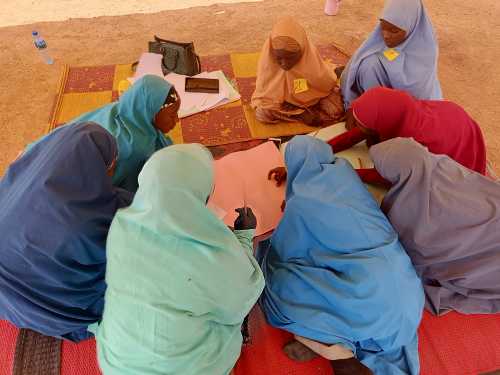
Of course, it’s still difficult. It’s still painful. I think a lot about the community dialogue that was held in Karamoja, where the girls and their mothers raised sexual abuse by police in their community as one of their key challenges, and the police commissioner was sitting right in the room.
And so, the bravery, the strength that it took, you know, for these girls and and women to stand up and and talk about these things was a very difficult conversation. But it was possible because it was of the community. It was community-led. It was grounded in trust. They were the ones that were making it happen. We never asked them to go and share these stories.
[15:15]
OSSAI: Yeah, and Jenn, now that you raised that incident, the truth is, you know, it’s important to stress that trust isn’t something you can bring in from the outside. You see, it’s it’s already there. It’s it’s in the relationships that people have with each other, as we saw in the Karamoja region.
[15:31]
O’DONOGHUE: Which is exactly where we want to go next, so thank you for bringing up that great segue, Edem, because co-construction, this building with community, isn’t only about defining agency and naming challenges. It’s it’s really about solutions, too.
One thing that distinguishes this work from a lot of development programs and development initiatives is that in every community that we were working in with LAAGA, and again, a reminder, we were working intentionally in, in highly marginalized communities, there was always a starting point. There was always something the community could point to and say, “This is where we can start. These are the resources we have. This is what we’re doing now that we could do slightly differently. This is what we could shift. We don’t have to wait for something to come from outside.”
[16:14]
OSSAI: Yeah, very true. And, you know, that’s not to say that the community is saying they do it alone.
[16:19]
O’DONOGHUE: No, never. But it’s a recognition, right, of their own agency, of of the community’s agency. They have relationships, they have power dynamics, they have local resources to build on. And and so instead of adding new structures, what we did with LAAGA was build on the existing ones and really ask, what are we doing already? And how can this support girls’ agency? Or how can this better support girls’ agency?
And our colleague, Adefunke Akine, really saw this in Nigeria. She led LAAGA’s research with out-of-school girls in Iseyin in Oyo State. And as she told us, she was honestly surprised by who stepped forward when she asked these questions.
[16:58]
EKINE: And I remember one of the traditional ruler who actually opened the gate for us. We meet in his community center, which he opened for us. So, the community decided that they were going to form a support system for the girls. I was shocked that the man will be one of the supporters that we really have.
Then we have this other aspect of the market woman as the leader of the market because, you know, as I said, these girls are girls that are not going to school again. So, they are learning a trade, they are learning a skill. So, the market woman was really willing to support them and to encourage them to finish up with their skill acquisition and to make their, what we call here, their bosses or their trainer to support the girls instead of maltreating them.
So, the community was open to such. And so, for me, the man being the leader and being there, he came even for the community dialogue. He just says, “For you to be interested in our community, we will give you all the support that we can.”
[18:12]
O’DONOGHUE: So, a chief opening his community center, a market leader making sure the girls’ trainers treat them well. None of that was brought in from the outside. Those structures were already there, and the girls’ research helped people understand how to make them work more intentionally for girls and for girls’ agency.
[18:28]
OSSAI: And I think it’s important to really stress that, you know, the community dialogues are where that really comes together. So, now let’s hear from our colleagues Ellen Chigwanda and Nasrin Siddiqi, who organized LAAGA’s community dialogues in Zimbabwe and in Bangladesh.
[18:47]
CHINGWANDA: I’m Ellen Chingwanda. I’m from Zimbabwe. I’m an Echidna Global Scholar for 2016 and also a LAAGA member.
Co-constructing understandings of girls’ agency really involves providing an enabling environment for the girls themselves to kind of interrogate what agency means for them at different levels, individually and then collectively.
So, this includes, you know, whole families, their parents, their guardians, their caregivers. But we also go beyond the family to talk to other stakeholders, community leaders, traditional leaders, government stakeholders, so that everyone is coming in and contributing their perspectives.
And also, actually seeking to understand where girls are coming from, and understanding the challenges that they face, whether to exercise agency or to be able to collectively push through the agenda of girls’ empowerment.
[19:49]
SIDDIQI: I’m Nasrin Siddiqa from Bangladesh, and I’m the executive director of NGO ECS, Education and Cultural Society.
So, we started our community dialogue, and we sometimes say policy cafe, policy dialogue. So, with the community people, community leaders, journalists, policymakers, the teachers as we worked with the schools. So, teachers and students, student representative, and female role model.
So, we brought them in our room and to share their understanding and to learn from the girls that what they are thinking, what is their progress or where they are declining their progress and where they are facing challenges. So, ultimately it was a very good, shared dialogue.
[20:37]
O’DONOGHUE: I love that phrase Nasrin uses, “to learn from the girls.” The adults aren’t in that room to teach. They’re there to listen.”
[20:44]
OSSAI: Yes, very true. And and the work isn’t about convincing people. It’s really about inviting reflection and adaptation. I love how those, you know, reflections from our colleagues stress that because when change comes that way, it feels owned, it feels relevant, it feels achievable. Right?
So, next let’s take a listen to what our colleague Tran Tran in Vietnam also had to say around this very important theme.
[21:11]
TRAN: I think that in those community dialogue, what surprised me most is the confidence of the girls. And it, it’s very relevant to what they share with us during our research and during our follow-on case with them when they clearly described how how safe space matter to them. It is not just about the physical location, like the classroom, something familiar with them, but also about feeling emotionally safe where they are trusted and not judged by the people. And that is very important for the community space like that.
[21:51]
OSSAI: “Emotionally safe.” Wow, that’s a very important phrase here. So that’s the condition for everything else. Girls’ confidence doesn’t appear simply because we put them in a room or we put them on stage. And Tran emphasized that in her reflection.
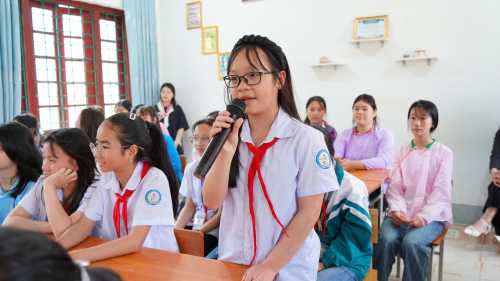
And it gets at something that I really want to highlight because when we say dialogue, I think there’s a tendency for us to often picture a girl standing up and speaking to a room full of adults. Right?
[22:23]
O’DONOGHUE: With a microphone, yeah, with a microphone in hand.
[22:26]
OSSAI: Exactly, with a microphone, with fluorescent lights, you know, a huge crowd staring at her. And in in our well-meaning intention to bring girls into the room, we can also jeopardize girls, you see, because now many of these girls, they’re adolescents. Let’s think back to our own selves as adolescents. Right? They’re in transition. They’re experiencing self-discovery. Their confidence is growing. So, sometimes they’re not ready for those very public spaces. Does that mean they don’t have things to say? No, they do.
So, we have to really expand what we mean by dialogue. Dialogue has to be broadened to the many different ways that girls express their innermost desires. So, it could be a song, it could be a poem, it could be a letter she wrote to her friend or to, you know, a relative. It could be an entry that she makes in her private journal, right, which she might be willing to share, or even a drawing, and girls tend to scribble a lot, right, when they’re daydreaming, or a conversation she recorded that, you know, she allows us to play back.
Now, in the Nigeria research, which another colleague of ours conducted, for example, girls used the BRIDGE model, maps and illustrations, and those images, you know, were the voice of girls. They were expressing the dreams and desires that girls have.
So, imagine if we curate them and make them an exhibit and allow the community to walk through that exhibit. Just imagine that.
[23:57]
O’DONOGHUE: Exactly. Right? And and that is, you know, what you’re pointing to is so important and is how our methodology really starts, too. We we don’t start by asking direct questions, you know, “What does agency mean to you? Where do you express agency more or less?” But really was more like, “Oh, you drew this picture. Tell me about it.”
[24:16]
OSSAI: Precisely. You know? And so, while she’s explaining her picture, she’s sharing far more than the picture. The picture becomes, comes alive. Right? You can’t necessarily ask her abstract questions about agency. That simply doesn’t work. It has to be, you know, something that’s easy for her to understand in her own reality, in her own everyday lived experience.
It could be something about her that her grandmother told her. It might be a verse that she recites every day that keeps her going, right, through difficult times. She might even say it in her language. So, you have to give her multiple entry points, pretty much what we’re saying.
[24:56]
O’DONOGHUE: Exactly, exactly. And and when we’re true to these principles, right, of really building meaning with girls, building meaning with communities, it takes us to depths and to layers that we didn’t imagine at the start, or that we didn’t, we didn’t recognize at the start.
And when space is created to really listen to the research, listen to the girls’ voices through the research, and in these community dialogue spaces, when the community is having the conversation with and of itself, it’s completely different from an outsider going in.
So, Edem, let’s try to get concrete on this. What actually changes when girls share their experiences this way?
[25:34]
OSSAI: Hmm, interesting question. So, a few things happen at once. I think first it validates girls’ agency. Their perspective is taken seriously, in their own words or we said earlier, in their own drawings, right, or their own songs, or their own poems, whatever. Right? And that changes how people see them.
Suddenly, members of communities begin to understand girls’ realities in a way they may never have stopped previously to consider. Tran saw it in those dialogues in Vietnam. Right? And what surprised her most was the girls’ confidence.
[26:09]
O’DONOGHUE: Exactly. And I think on the flip side of that, we see that validation from adults and that validation also comes with girls beginning to see new possibilities for themselves. Right? When a girl watches the adults around her take her dreams seriously, when she sees that adults have taken, you know, an hour-and-a-half, three hours, in some cases five hours out of their regular day and responsibilities to listen to girls and to focus on girls’ agency.
So, when they see this happening, the seriousness, right, with which this is taken, what she believes is possible starts to shift. And, you know, I want to be careful here because it isn’t always a dramatic overnight transformation.
[26:49]
OSSAI: No, it isn’t. Sometimes, and actually often, it’s it’s really small shifts.
[26:55]
O’DONOGHUE: Exactly, right? And those small shifts add up. They they start to add up. Right? They become changes in beliefs and changes in expectations, both of girls for themselves, but also of the adults around girls. Expectations for what girls can do, how they can be involved in decision-making, how they can be engaged in in shaping things like their own education, their family decisions, community actions, and so on.
And, you know, I think I’ll return to our colleague, Sumbal, who we heard from earlier, because she shared one story of how this happened, what this really looked like from Multan in South Punjab.
[27:30]
NAVEED: One of the girls really wanted to, you know, support her family because they were all really poor. The girl really was committed, and I think mutually because of all of this conversation, the father also understood how important it is to support girls.
So, he started, you know, talking about restarting his work and also supporting his daughter in her goals and her dreams so that, you know, mutually they can do something.
So, I think that girl’s dream became a spark, a light for even the parents. So, this is just a small example of how a girl’s dream could even become a hope for the family.
[28:11]
OSSAI: Yeah. Change is gradual and it is cumulative. And because the community, you know, has defined it for itself, the community is able to carry it forward.
[28:21]
O’DONOGHUE: Exactly. And what we’re seeing is that’s what really makes it it last. It isn’t a program that ends when the funding ends. Again, it isn’t something that comes from outside and and pays attention to a community for a few months or even a few years but then leaves.
This is really something that belongs to the people who built it, in this case belongs to the girls and their communities.
So, I think as we begin to wrap up I, you know, want to say if there’s one thing we want listeners to take from today, it’s that agency efforts need to be locally defined, collectively owned.
[28:55]
OSSAI: True that. And that girls are the experts here. This is very key. They’re already exercising agency every day. Our job is to make space for it to be seen and heard in whatever form works for girls.
[29:09]
O’DONOGHUE: Right. And to remember that communities, including the most marginalized communities, already have entry points. They already have things they’re doing that we can build off of, that they can build off of. They already have the potential for change, and that’s where we need to start.
[29:23]
OSSAI: Yes. So, no standard definition, no standard solution, but a lot of shared wisdom about how to get to definitions and solutions together.
[29:33]
O’DONOGHUE: Which leads us to next time. Girls don’t live in isolation. They’re surrounded by families, schools, communities, and a whole bunch of systems and structures. So, in episode six, we’re gonna talk about why strengthening that whole ecosystem around girls matters so much, and about how LAAGA has been working to strengthen those ecosystems for girls’ agency.
OSSAI: I’m already looking forward to that next conversation. Thank you guys for listening once again. I’m Edem Ossai from Nigeria, and it’s always a delight to have these conversations with you.
O’DONOGHUE: Thank you, Edem. It’s always wonderful to be in conversation with you.
[music]
I am Jenn O’Donoghue and thank you all for listening.
O’DONOGHUE: Thank you for listening to Embedding Equality in Education, a podcast from the Gender Equality in and through Education team in the Center for Universal Education at Brookings. Our sincere thanks to all the LAAGA members and others who contributed to this episode.
OSSAI: The show is produced and published by the Brookings Podcast Network. Thanks to the production team, including Ike Blake, supervising producer; Fred Dews, senior producer; Arushi Sharma, co-producer; Daniel Morales and Teddy Wansink, video producers; and Chris Chang, audio and video producer. Plus, thanks to Benji Aliaga and Madeline Chandler for their contributions to the show.
O’DONOGHUE: Daniel Morales also designed the show’s artwork. And a very big special thank you to our former senior project assistant and co-producer, Anya Kasubhai, who did so much to get this show launched.
Brookings gratefully acknowledges the support provided by Echidna Giving, Stone Family Foundation, and The LEGO Foundation in support of this work.
I am Jenn O’Donoghue.
OSSAI: And I am Edem Ossai.
O’DONOGHUE: Thank you for listening.
- Listen to Embedding Equality in Education on Apple, Spotify, or wherever you like to get podcasts.
- Watch episodes on YouTube.
- Learn about other Brookings podcasts from the Brookings Podcast Network.
- Sign up for the podcasts newsletter for occasional updates on featured episodes and new shows.
- Send feedback email to [email protected].
The Brookings Institution is committed to quality, independence, and impact.
We are supported by a diverse array of funders. In line with our values and policies, each Brookings publication represents the sole views of its author(s).
Commentary
PodcastLocalizing agency: Co-constructing meaning with girls and communities
Listen on
Embedding Equality in Education
November 4, 2026