



In this third episode of Embedding Equality in Education, Jenn O’Donoghue and Edem Ossai explore what happens when girls are centered in practice, not just as research participants but as co-creators of knowledge and drivers of change. They unpack the five ethical principles that guide the network’s work and introduce its girl-centered methodology, a “mosaic” of participatory methods refined across eight country contexts.
TRANSCRIPT
[music]
OSSAI: Hello, everyone. Welcome once again to the 3Es podcast, which is Embedding Equality in Education. Here, we focus on discussions around research and action for gender-just futures. My name is Edem Ossai, and I am an education leader based in Nigeria and also your co-host on this exceptional podcast.
We have been focusing in the last episodes on discussing lessons and amplifying the work of the Learning and Action Alliance for Girls’ Agency. In the first episode, we really delved into an introduction to this podcast, helping you to understand what we will be focusing on and what conversations will look like.
In the second episode, we went into a deeper exploration of the values driving the work of LAAGA. We really explored thinking through the focus on girls in marginalized contexts. So we unpacked the word “marginalization,” especially from girls’ perspectives.
And in today’s episode, we are going to be focusing on what actually happens when we center girls in practice, not just as participants, but really as co-creators of knowledge and as drivers of change.
If you’re familiar with this podcast, you will know already that I don’t speak alone. I have a co-host, and I will hand over now to my co-host to introduce herself and also what our conversation today will look like. Over to you, Jenn.
[1:33]
O’DONOGHUE: Thank you, Edem, and welcome everyone once again to the 3E Podcast. My name is Jennifer O’Donoghue, and I am a senior fellow here at Brookings and the deputy director of the Center for Universal Education, and a proud member and co-founder with Edem and and 23 other colleagues of the Learning and Action Alliance for Girls Agency.
And just so happy to be back with you again today. You know, I think today we’re discussing one of the topics that has been a part of my life since the last century. I think it was in the 1990s that I started working on on co-creation and really trying to think about what this term means, and and what it looks like in practice, and as a researcher, and working in policy spaces.
And so I’m so excited that we’re, you know, really delving into this topic of what is co-creation, what does it mean to co-create knowledge, and what does it mean to do that with girls, and girls in marginalized contexts in particular. And, co-creation is one of those words that has become a buzzword. You might hear it all around. But, you know, for us, we really want to unpack what this means for us and what this means in terms of of research and knowledge creation and, you know, that it’s that it’s really not just about changing who’s sort of in the room or who’s involved in the research, but really changing what and how you do the research itself.
And, you know, this means that we have to unlearn things that we have learned in the past as adults, you know, working with girls, that we have to get comfortable with with sharing power and that sharing power first and foremost in the definition of problems and in the definition of research questions.
[3:08]
You know, this co-creation research for us has really been a recognition that so many girls have been left out, left out of research, left out of defining what the problem is, and of course, therefore, left out of thinking about what the solutions might be.
And, and in particular, girls once again, who are, you know, living in marginalized contexts, Indigenous girls, girls with disabilities, you know, really thinking about how they haven’t been part of this.
And so for us, even this label of sort of hard to reach, right, young people, which really begs the question of hard to reach for whom. Right? The girls are there, it’s not hard for them to reach, reach that space or reach their community and their context.
And so for us, it’s again, unlearning these, these definitions of what we think about what it means to to be in collaboration with others, and really thinking differently about the research approach that we’re gonna use, and we’ll talk a bit more about that in a second.
But I think this piece to me, really starting with problem definition and how important it is that that is where you start the co-creation process and the thinking with girls.
[4:15]
OSSAI: Absolutely, Jenn. And, I think it’s a perfect point to really, you know, remind our listeners that one one of the things we emphasize in the Learning and Action Alliance for Girls’ Agency is including and centering girls.
Because really, after everything you’ve heard from Jenn, I think we can all agree that you cannot promote girls’ agency without including girls in meaning-making. And Jenn has talked about how, you know, even defining the problem is really the starting point.
And so when you think about meaning-making, when you think about just delving into girls’ everyday realities, what a day in a girl’s life looks like, understanding how she’s making her decisions, what her dreams look like, what empowers or constrains her to be able to act on those dreams, you realize that she’s central at every key point in in that, you know, examination or that exploration.
Without the girl, you really can’t pinpoint the problem accurately. Without her, you really can’t understand the structural world she lives in and and how it enables her or limits her. You know, she’s in the best position to explain how her world impacts her dreams.
How can we talk about promoting any person’s agency if they’re not included in the process? And that’s the key word. It’s a process. So it’s a cycle. And it takes you up to the point of even transformation, because remember, this is all about research and action for gender-just futures. So the idea is what you discover should help you transform your world.
What the girl discovers, should really position her to transform her world, to make it more desirable, and that centers her. So it’s not about us transforming the world for the girl. It’s about her really understanding the world in which she lives in.
[6:00]
And I think our early conversations within the network, we always talked about how we want to research for, with, and about agency. And so what does that mean? It means, you know, how does this look like? What’s the position of the girl in this kind of equation of researching for, with, and about agency?
She’s in the forefront, and that’s why Jen mentioned, you know, distributing the power. It changes the lens from which the researcher views things. You know? You can only understand this world through the girl’s lens. And this is a good point to really introduce the work that our colleague has been doing in the Lao Cai region in Vietnam, because I think Tran’s work really illustrates, you know, perfectly the centering and including of girls and essentially, you know, viewing the world through the girl’s lens.
[6:56]
TRAN: I’m Tran Tran. I’m based in Ho Chi Minh City, Vietnam. And I am working at the intersection of education, entrepreneurship, and development, making sure that no one will be left behind in their life.
We we always make sure that girls themself was at the center of each conversation. In our school visit, we used, simple and scenario-based activities to help girls talk about their everyday choices, and also their big life choices. And, and, and this make them to reflect and also bring the the research to feel more real. Not something, like, abstract and not just a concept.
[7:41]
OSSAI: And so co-creation isn’t just about changing who’s involved. It, it’s really about changing how we’re doing research itself, what the process, you know, looks like, how we are disrupting traditional forms of research. And it, I think it brings us to the ethical tension, which we discussed in in episode two, where in the bid to protect girls’ anonymity and confidentiality, ethical requirements have inadvertently excluded girls from the entire picture.
How do you problem solve without the girl who you’re hiding behind a veil of anonymity or who you claim you want to keep confidential? But she has to be center, she has to be a center piece in the whole spectrum of problem-solving. Her voice, her understandings, her insights are critical to the entire picture.
So, even though LAAGA has been very critical and sensitive to the girls in the different contexts and what their lives look like, we, for us, you know, don’t see any reason why that sensitivity should exclude the girl. In fact, it should do the reverse.
And so a focus on protecting marginalized girls we recognize has led to their erasure in the past and, or, you know, their silencing or their invisibility.
[9:01]
And so we are very intentional that protection doesn’t take us, you know, down that slippery slope also. Protection cannot be positive if it has the effect of excluding girls from participating as co-creators. They have to be in the room. They have to be part of the sense-making process. Don’t just go to them wherever you call them, hard to reach, and then extract information from them and take it somewhere and begin to make meaning and, you know, propose solutions.
No. They are part of the entire cycle from understanding the realities of their lives to analyzing what that, you know, means to problem-solving or basically arriving at recommendations or making proposals for a more just future.
The girl has to be integral throughout that cycle. This is something our work and the lessons from our colleagues around the Global South and the world really demonstrate. Ethical principles need to promote girls’ agency, their voice, and their ownership.
[10:04]
O’DONOGHUE: Yeah. You know, I think that I’ll pick up sort of from your last line there on, we’re not talking about sort of ignoring ethical principles in research. We’re really talking about how can we be intentional? How can we treat these ethical principles with care and in ways that promote, as you said, girls’ agency, girls’ voice, girls’ ownership of the research and of the outcomes of that research.
And, you know, I think that across LAAGA, I think we had the benefit, right, of of again 25 people who had been deeply engaged in different types of research and working with communities and working with girls, and so had those deep roots and you know, really drew from that deep connection to the girls and to their communities and their context to think about what are ethical principles that center girls as co-creators within research processes?
And so for us, what really came out of this was five principles, ethical principles that that guide our work with the girls. This is first centering girls and amplifying their voices, experiences, perspectives, ways of knowing. A second piece has really been about the relationships that we develop with girls and with communities, and that these, you know, are are truly characterized by respect, that they’re reciprocal, and that they are allowed to grow and develop throughout the research process. Right? And they’re renegotiated throughout the research process as well.
[11:23]
So the third principle for us was really around promoting systemic change through the research. And so for us, that meant really creating space with the research and through the research to challenge some of those structures that we talked about in our last episode that are really constraining agency for girls and keeping girls and their communities excluded.
The fourth was really around promoting ownership and how can we ensure that the research processes, the research outcomes are designed and really created so that they benefit the girls and the communities involved. This is not something that we as the researchers want to go in and say, “This is what we most want,” but how can we work with girls and communities to identify what they most want and what they most need and what they most prioritize through the research process.
And then the fifth is a process of being reflexive and how do we create opportunities to reflect on the work that we’re doing, on our relationships within the work, on what this means on some of the biases or assumptions that we might be bringing to this research. And we, you know, have tried to do this with girls, with other community members, and with one another.
[12:33]
And I think again, that points to the strengths of working in this global network across 15 different countries, is that we really are able to be in conversation with one another and and sort of check each other, right, on our interpretations of things, on the way that we’re approaching this, and hold one another accountable to these ethical principles.
I just listed a bunch. This is like a lot of heavy words and and heavy meaning within those five principles. So would again encourage you all to check them out. We have one report from LAAGA that is just on our girl-centered methodology and lays out these principles, and practices that go with them, for what it means to do this type of of ethical co-created research.
But I think importantly, you know, is, is we didn’t just focus on the principles, but we really tried to think about what does that look like in practice. So Edem, is there anything that stuck out for you about LAAGA’s work and, and how we’ve really tried to bring these principles into practice?
[13:33]
OSSAI: Yeah, absolutely. And, you know, when you mentioned how these principles were, we were very flexible, you know, and very, like, iterative, very, you know, adaptive. I think one of the clearest illustrations for me was the work of our colleague Jamila in Pakistan, where, you know, when girls were interacting with certain questions, you know, they took these questions home to their different families and and whatever their home home context looked like.
And the girls themselves became researchers. So they began to ask their mothers, their aunties, their grandparents these questions, these same set of questions that, you know, they had engaged and and reflected around. They took them back home, and they brought the responses, you know?
So it became, you know, a, sort of like a melting pot of intergenerational, views, worldviews, and girls were beginning to assess their lives through the lens of their mothers, their grandparents, seeing where they were coming from and why they were having the attitudes that they had, shaping the kind of world that, you know, they were shaping for the girls themselves.
So it it was very interesting to see this principle come alive when you distribute the power, when you are adaptive, when you allow, you know, girls coming from multiple entry points, like you you talked about.
And all of these ethical principles, as you said, were were observed, but in a way that enhanced girls’ participation rather than excluding or rendering them invisible.
[15:02]
O’DONOGHUE: We have actually some clips from Jamila where she talks about what this looked like, and , how she experienced this with girls on the ground in South Punjab in Pakistan.
[15:14]
RAZZAQ: I’m Jamila Razzaq and I work mostly in Pakistan. I’m from Pakistan. And I have been working on issues related to girls and women and gender related issues for a long time.
We saw different videos. And then we came to this question that what were those girls in those scenarios or in those videos were doing and how the participating girls would name those actions?
And then, we had discussions from different angles. We came back to these questions to better understand that what in the environment is supportive for girls to make their decisions and to dream about their futures, and then to take action to realize those dreams.
So I would say that action started soon, like, it was part of the research. It happened simultaneously. And, then it it didn’t stop there. The girls came back after two days and then they analyzed, they present. They didn’t report, they reported and analyzed. There were flip charts. There were, like, what are the people like? They themselves did analysis with us. It was a cyclical, like, process that we we couldn’t clearly differentiate that when research stopped and action started.
[16:44]
O’DONOGHUE: We also have a clip from one of our LAAGA members who he himself is from Nepal, but he has supported a number of the different cases, particularly the cases across different Asian contexts. And and I think that gives him a a great understanding and perspective of this piece about reflexivity and what it means to really reflect across different contexts. But let’s hear from Ganga Gautam about how important this ethical principle of reflection has been to him.
[17:13]
GAUTAM: My name is Ganga Gautam. I am from Nepal. My background is academic, as a university faculty. So, earlier, I used to have this blanket approach of understanding girls’ agency from top-down perspective. But as we continued our conversation in LAAGA with our colleagues around the world, we all agreed that that’s not possible. Let’s understand the girls as in see from their perspectives.
So it’s a kind of, I would say, self-transformation in my understanding and the shifting image of how I perceive agency now, and how I used to perceive agency before I joined this organization.
I mean, the kind of understanding about agency has been more crystallized and refined because of my conversation with LAAGA colleagues and our collective decision to approach agency with reference to the local ethos, local culture, local context, their upbringing.
[18:28]
O’DONOGHUE: So, you know, I think, too, that for me, one of the greatest learnings from this was when we when we look at this sort of package of ethical principles, you know, what comes out of this is that, again, girls are in the center, that it’s about relationships, that it’s about creating that space for them to think about systems and to challenge systems and to to become owners.
And when we thought about this across, you know, the different contexts that we work in, LAAGA has now done research in eight different country contexts. And, you know, where we landed in terms of the methodology was that we really needed to have multiple methods because an understanding that the same method wasn’t going to work in every in every space. The same method wasn’t gonna have the same meaning in every space.
And so we wanted to develop something that had sort of multiple methods that we could use in there, that involved creative modes of expression, that allowed for collective inquiry with girls, as you said. And, you know, for us, we worked, and and it sounds easy now on this side of it, but, you know, we developed this, what we call our GCM, or our girl-centered methodology, and this was really a mosaic, a mosaic approach. So it was sort of one methodology, one methodological approach with multiple methods and and a mosaic of methods that could be put together and used in different ways in different contexts.
[19:49]
And, you know, a starting point for us in the development of this GCM mosaic approach was really inspiration from another woman researcher who we all, Edem and I, and and others of us in LAAGA, have had such an amazing opportunity to be able to learn from her work, and that is Relebohile Moletšane from South Africa, Lebo, to us and affectionately.
And in particular that her partnership with a researcher from Canada, Claudia Mitchell. And, you know, they have really been working for for several decades now, or at least the past 15, 20 years to develop with others in the field, but a different approach to research that they call a girl method. And this really recognizes that girls are active agents in research, that they need to be. It also recognizes, as we’ve been talking about, that so many girls have been excluded from research. And so thinking about a a methodology that allows us to explore the diversity of experiences, the diversity of perspectives. Right?
Again, as we talked about in our last episode, you know, girls are not a monolith. Right? And so how do you really create methods that can uncover that, right, and and really make space for all of that diversity to to come through?
And then, you know, importantly, and this is one of, I think for me, has been one of my greatest learnings in this process, is how can we create a method for studying agency that moves us beyond allowed agency? So within the research on this topic, there’s an idea that, you know, as adults we come in with biases, we come in with prejudices, we come in with assumptions about what are, like, positive ways that young people and girls in particular can exercise agency. And again, agency is that power to dream, to decide, to take action.
[21:43]
And so many times adults decide, like, Oh, this is agency because, because girls are taking the kind of decisions that I think they should. Right? And so we really limit the space for girls to exercise their agency by having this idea of what’s acceptable and what’s not acceptable.
And so we wanted to think about, okay, how do we get beyond that? And this was really for us, this piece around creating a girl-centered methodology that weaves together multiple methods really meant to capture diverse experiences, support co-creation, again, and that, that this can happen across contexts. Right? And so, it it is meant to be something that is adapted as as we go along.
[22:24]
OSSAI: Absolutely. So as you were talking, I was just reflecting on some of the work of by our colleagues around the world and how this mosaic has really, you know, come alive through the approaches that they’ve used. It’s really this, you know, potpourri, this amazing blend or mosaic we call it, of really participatory methods, you know, that allow girls to come in from multiple entry points, that don’t impose any preconceived ideas, because Jenn mentioned that we operate from biases and prejudices even when they’re unconscious.
So how do we strip ourselves in this participatory, collaborative learning experience with girls of those notions? We had to be flexible, and this is some of the key features of this mosaic. We have to be iterative. We talked earlier a couple of minutes ago about being, you know, adaptive, allowing the process to unfold by itself, you know, girls leading the path.
So how do you, you know, allow for any kind of girl experiencing, having any kind of reality to still be part of this process, to still be able to share her reality, and explain what her agency looks like?
That, you know, requires creating multiple entryways, obviously. That also emphasizes on a very ongoing methodological framework. In other words, allow the framework to evolve.
So at the moment, you know, we have this wonderful mosaic, which is evolving, you know, but we’ve seen some of the participatory methods by our colleagues. Some of them include the bridge model, where we’ve seen girls, you know, visualize where they currently are, visualize where they hope to be, and then point to limitations on the path from this current world or reality to where they desire to be, and who’s an enabler or who’s, you know, a limitation or what is an enabler and what is… you know?
[24:11]
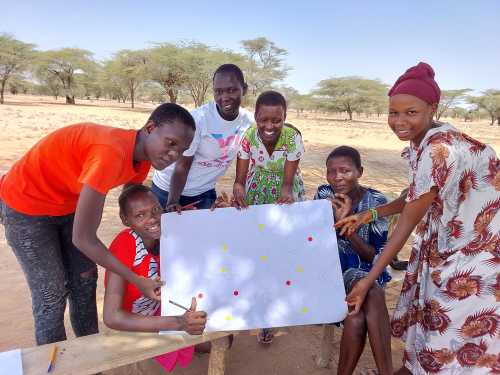
So that’s one example. We have girls engage in community mapping. And just by, you know, painting an image of their community, girls are able to point to safe spaces, empowering spaces in their community, or spaces that feel like a threat or spaces that confine or limit them, or shrink them. And so you get a sense of the world that they navigate every day.
Or even peer reflections. These are some examples of the mosaic methods. Like, sitting with their peers is so revealing. Conversations with peers, and we have an example, I think Jenn mentioned it in the last episode, where we had a hopscotch. I think it was in Pakistan, Jamila’s work with the girls in Pakistan, just, you know, presented this interesting worldview through this game.
It was almost like a bridge model but using the hopscotch imagery. So that’s that game that’s very popular in the U.S. and other parts of the Global North, right, Where kids, you know, jump loops to get to the end? But girls using that same imagery on the ground were able to, you know, peers through reflections, “Avoid this, don’t do that. No, don’t do this,” or, “Talk to this, talk to this, talk to that.” Right? So peer reflections are another very powerful, revealing methodology we’ve found in in our work and through our experience.
Also examining proverbs. So for instance with the work that was done in the Karamoja region in Kenya and Uganda, the use of proverbs and just analyzing what idiomatic expressions or typical expressions in everyday language look like ushered us into a world of, you know, meaning.
Of course, focus groups happen to be another way by which our colleagues have really, you know, worked with girls to do a lot of meaning-making. Moving from just, gaining insights into girls’ world, but also to, you know, analyzing those insights, coming to a clear understanding, a very relatable or practical understanding of how girls view the world around them. How girls, if they had a chance, you know, would problem solve their world to get to their desired outcomes.
So these key features, like I said, you know, translated into some of these amazing methods that have been employed, not only in the countries I have mentioned, but if you read our reports, again, the links are in the description, you will see our vast case studies of different work carried out by our colleagues around the world.
[26:34]
O’DONOGHUE: I think as as you can probably tell from listening to Edem and I, we get really excited about the girl-centered methodology. And, you know, I think that for us, we are sharing a bit of it here and encouraging folks to go to the publication because you will find in there a full appendix that really lists through, you know, what we wanted to do was to make this methodology available to everyone and to say, “This is how we did it.”
We even, some of them have, “We took this much time for this part of the activity and this much time for another.” But you can get a lot of other details through that for those of you who who really care about that type of of methodological approach and information.
And, you know, I also, Edem, wanted to pick up on one other piece that you mentioned, which is the sort of ongoing evolution of the of the methods, and that sort of refinement of the tools along the way.
And, you know, one thing I think worth mentioning here, too, is, you know, we have done this LAAGA research in eight different countries. We didn’t do it all at the same time, but we have rolled this out over the past several years. And so what this has meant was an opportunity for, for us to learn from each case, and from the methods that were used in that setting and, and that space.
[27:47]
And then to build on those as we moved forward. And so, you know, you mentioned, um, some of the work done in Pakistan of the bridge that they turned into this, like, physical game-like experience. And also in Pakistan, you know, our, our colleague Sumbal Naveed, who was leading that case study research there, developed this technique that that she called brain netting.
And, you know, this was really a way to more deeply engage girls in the analysis so that it’s not just sort of the co-construction of knowledge, but it’s really the the analytical process of that. And so that’s also explained, in more detail in in the report.
But, you know, it’s really about how do you create moments throughout the research process to pause with girls and say, “Okay, what are you hearing?” Right? We’re all sharing stories. We’re all sharing experiences. What do you hear here that matters? What what are the priorities? What are the the the similarities and the differences across this?
And so, really making that process more explicit with the girls so that they could be part of the analysis and the ongoing analysis and meaning-making, I think was was a really important refinement to the methodology that grew through there.
So anyways, I think probably, I don’t know, I feel that I’m having one of my moments where I’m kind of nerding out about how much I love the to talk about the methodology.
[29:08]
OSSAI: Yeah, absolutely, Jen. And I also, as you were talking, I was recalling the experience in Nigeria, for instance, where our colleagues building on the work done in Zimbabwe and, you know, in Uganda and Kenya, also employed community dialogues. You know, they employed community mapping, yes, but they also employed community dialogues up to the point of, you know, the girls and members of the communities formed a committee by themselves. Right?
And in that committee, girls were, like, , executives of the committee, pointing to problems in their schools, problems around hygiene, you know, sanitation, water problems, and literally, you know, demanding or expressing what they want in those committees.
The committee, I recall, also went through an iterative process where they had to change the name, because after consultations with all the different stakeholders, they discovered that the initial name they gave it came from a point of initial bias, and didn’t, you know, reflect that more empowering position or centering of the girl, but came from this, you know, preconceived idea of, “Well, we’re coming in to save the girl.”
So it’s interesting how even, you know, through earlier work and earlier experiences and and and research methods employed, newer case studies are building on that and having their own experiences. And I imagine future, you know, research will also take advantage, leverage these, you know, iterative work that’s happened and keep evolving from that.
I just, you know, recalled that as you were sharing, Jenn, and I was like, yeah, had a moment also to- Yeah … to fangirl on methods.
[30:40]
O’DONOGHUE: And I think you’ve done a great job, Edem, of of really driving home, you know, that this this sort of step in the research for us about centering girls as co-creators of knowledge comes with a second part, which we say is and drive the drivers of change. Right?
So girls are not only the co-creators of knowledge, but they’re also the drivers of change. And I think that example that you just shared is such a powerful one. And I look forward also, because we have an episode, I think a few down the road where we’ll really talk about what it meant to center sort of the the research that we had done with girls in these community spaces.
For now, we’ll, we’ll begin to sort of wrap up with this, hoping that you all have enjoyed this time with us to really think about what does it mean to be a co-creator of knowledge. What does that look like? What are the principles behind that, that when we talk about, you know, girl-centered research as a commitment to justice and to making space and sharing power, you know, that that we’ve tried to bring that to life so that those aren’t just words. Right? It’s not just discourse, not just things that we say, but really a commitment that we live and that that takes shape, right, and takes meaning by practice and in practice with others.
[31:49]
OSSAI: And and just, you know, adding to the core message that Jenn has summarized for us, I’ll also add that don’t forget, listeners, co-creation isn’t just about what we know. It’s also about how we know it. Like, the process is very critical.
And it’s also about what becomes possible, which covers the latter aspect of what Jenn talked about, which is that girls aren’t just co-creators of knowledge, they are drivers of change. So what do you do with what you know and after the how, what do you do with, you know, what becomes possible? Girls have to be very critical or integral in that, you know, emerging picture.
And so research, I think, I want to emphasize as we sort of wrap up that you have to share power. You have to be committed. If you’re committed to justice and a gender-just future, you have to be willing to distribute that power, to share it, you know, to invite the girl into your current power dynamic.
You have to center her lived experience. You have to center the lived experiences of the most excluded groups of people that you are trying to understand. Right? You have to enable action because at the end of the day, we seek to understand so we can transform our world and make it more gender just, more equitable for everyone. Right?
So that has to lead us to enabling action. And so I think I’d like you to have these central messages at the back of your mind as you contemplate everything else that we’ve discussed. Share the power, center lived experiences, and please enable action. Jenn, what can they look forward to in the next episode?
[33:23]
O’DONOGHUE: Yeah, well, I am really excited about the next episode because in the next episode, we’re gonna be going in depth into what we learned from the girls, with the girls about agency, what that means, what it looks like, how they live it in their everyday lives. You know, we’ve been talking a lot about setting it all up of, you know, what does marginalization mean and what do, how did we do this research?
But the next episode is really going to be a space where the girls’ voices will perhaps start to, to shine through more clearly. We’ll have girls talking about this experience, and talking about what they learned about agency through this process.
Thank you, Edem, so much, as always. I enjoy having this time scheduled in for you and I to be able to talk about our shared work. So thank you.
OSSAI: I’ve loved talking about this with you, Jenn. I thank you listeners, and I’ll be on the edge of my seat until the next episode when you’ll join us again. Bye.
O’DONOGHUE: Bye, everyone. Thank you.
[music]
Thank you for listening to Embedding Equality in Education, a podcast from the Gender Equality in and through Education team in the Center for Universal Education at Brookings. Our sincere thanks to all the LAAGA members and others who contributed to this episode.
OSSAI: The show is produced and published by the Brookings Podcast Network. Thanks to the production team, including Ike Blake, supervising producer; Fred Dews, senior producer; Arushi Sharma, co-producer; Daniel Morales and Teddy Wansink, video producers; and Chris Chang, audio and video producer. Plus, thanks to Benji Aliaga and Madeline Chandler for their contributions to the show.
O’DONOGHUE: Daniel Morales also designed the show’s artwork. And a very big special thank you to our former senior project assistant and co-producer, Anya Kasubhai, who did so much to get this show launched.
OSSAI: Finally, our thanks to the productions team in the Office of Communications at Brookings.
O’DONOGHUE: Brookings gratefully acknowledges the support provided by Echidna Giving, Stone Family Foundation, and The LEGO Foundation in support of this work.
I am Jenn O’Donoghue.
OSSAI: And I am Edem Ossai.
O’DONOGHUE: Thank you for listening.
- Listen to Embedding Equality in Education on Apple, Spotify, or wherever you like to get podcasts.
- Watch episodes on YouTube.
- Learn about other Brookings podcasts from the Brookings Podcast Network.
- Sign up for the podcasts newsletter for occasional updates on featured episodes and new shows.
- Send feedback email to [email protected].
The Brookings Institution is committed to quality, independence, and impact.
We are supported by a diverse array of funders. In line with our values and policies, each Brookings publication represents the sole views of its author(s).
Commentary
PodcastCentering girls in practice: Ethics, methods, and shared power in research
Listen on
Embedding Equality in Education
October 7, 2026