This paper was written for a May 5 Center on the United States and Europe virtual workshop on “Europe, the Middle East, and the Mediterranean” as part of Brookings’s Reimagining Europe’s security project, along with Philip H. Gordon’s “Can the United States and Europe still cooperate in the Middle East?”
The U.S.-Israel war against Iran, encompassing the Persian Gulf and Lebanon, has revealed Europe at its worst. Looking ahead, it could also see Europe at its best.
Europe’s initial miscalculation
Initially, most European leaders were silently supportive of the illegal U.S. and Israeli attack against Iran. Only a few voiced explicit backing, chief among them NATO Secretary General Mark Rutte. At the other extreme, Spanish Prime Minister Pedro Sánchez was a lone voice of principled opposition. The majority of European leaders stood somewhere in between, tilting more toward a tacit embrace of the war.
While positions varied in nuance—including over the use of military bases in Europe—a critical mass of European countries broadly agreed at the war’s beginning. Their wish to turn the page on the most acute phase of the transatlantic rupture—especially after the Greenland crisis—shaped their initial stance. So too did their fully justified disdain for the Islamic Republic of Iran, which is allied with Vladimir Putin’s Russia and brutal toward its own people. Together, these factors foolishly swayed them into hoping—and mistakenly believing—that a short war might bring about the Islamic Republic’s fall.
Iran’s asymmetric escalation
Things did not turn out as planned. Having learned the lessons from its relatively restrained response to the U.S.-Israeli attack in June 2025, Iran responded by regionalizing the war through asymmetric attacks against the Gulf countries. It did so knowing that relations with its Gulf neighbors would sour. But the regime in Tehran knew its survival was at stake. Given its military inferiority relative to the United States and Israel, Iran’s only hope was to respond by triangulating across multiple theaters. This included the Gulf as well as Lebanon, where war between Hezbollah and Israel resumed, enabling the destruction, evacuation, and occupation of large swathes of the country’s south.
Iran’s asymmetric strategy extended beyond geography to the global economy. By closing the Strait of Hormuz, Iran upended energy, food, and other commodity markets. While the war has not concluded, it is likely that it will be remembered as a strategic debacle for the United States. Whether “Hormuz 2026” will mark the end of U.S. hegemony in the Middle East, much as the 1956 Suez Crisis sealed the fate of Franco-British colonialism in the region 70 years before, remains to be seen.
Transatlantic strain and political realignment
As the catastrophic war has unfolded, Europe has shifted, with opposition growing louder by the day. Many European leaders had supported the illegal U.S.-Israeli attack, believing that a rapid success would deliver strategic gains for Europe. They now know it was a mistaken assumption. Instead of weakening Russia, the war against Iran has strengthened Moscow by increasing oil prices and boosting revenues for its war machine against Ukraine. The energy crisis is inflicting major costs on European economies, compounding pressures from the pandemic and the war in Ukraine. European leaders are being reminded that support for international law is not “just” a question of ethics and morality, but of interests too.
Making transatlantic matters worse is how U.S. President Donald Trump has used the war as an opportunity to lash out at Europe, rather than to criticize Russia and China, which have backed Iran. Trump has insulted European leaders, threatened to abandon NATO and suspend Spain’s membership of the alliance, and announced troop withdrawals from Germany. Even Europe’s far right feels uncomfortable, with some leaders seeking to distance themselves from him. This has been most strikingly evident in Italy, where Prime Minister Giorgia Meloni was defeated in a crucial constitutional referendum. Polling suggests this outcome was partly due to her closeness to Trump. She has since sought to distance herself from him, standing in defense of the pope in particular. Trump’s attacks on her in return, far from harming Meloni, may have helped her claw back some of her fast-fading appeal. Only Hungary’s Viktor Orbán remained unrepentantly close to Trump—and this may well have contributed to his resounding electoral defeat.
Toward a postwar architecture in the Gulf
If Europe reassesses its interests and draws its red lines, it may hope to carve out a role for itself in the Middle East. To do so, it would do well to revisit lessons from the past. The E3/EU+3 format1 to negotiate the Iranian nuclear issue was born from the ashes of the Iraq War and the profound European paralysis and transatlantic division that conflict caused. The diplomatic process initiated by the Europeans in 2002-2003 did not initially receive Washington’s embrace, but the Europeans proceeded while leaving the door open for the United States to step in. Toward the end of the second George W. Bush administration, and especially under President Barack Obama, Europe secured America’s participation, eventually sealing the Joint Comprehensive Plan of Action in 2015.
From nuclear diplomacy to regional stabilization
Today, the same virtuous dynamic could unfold: Europe’s stance against Iran may open the way to a multilateral initiative in the region once the war definitively ends. The proposal by a coalition of willing European, Gulf, and Asian countries to help ensure safe passage through the Strait of Hormuz was originally intended to appease Trump, but it could develop a life of its own. The U.K. and France are leading a 40-country effort to reopen the strait once the war ends—an initiative that would involve cooperation with Gulf countries and coordination with Iran.
There are many conditions that would need to be met, and plenty of reasons why this may never come about. In recent years, Europe has cynically recoiled from the Middle East. From Gaza to Lebanon and Syria, and indeed Iran, Europeans have chosen not to use—or to misuse—their limited and ever-shrinking leverage in the region. This may certainly happen again, all the more so if the war has no definitive end, giving Europeans good reasons to step back from the quagmire.
Yet there are also reasons why this time could be different. Europeans may have grown more cynical and less capable, but Ukraine demonstrates that when their vital interests are at stake, they will step up. While the Middle East is not as existential a threat as the war in Ukraine, a protracted closure—or even just sustained uncertainty—in the Strait of Hormuz strikes vital economic nerves across Europe. Likewise, while it is possible, and indeed probable, that the war will not end with a clear-cut agreement on the nuclear file—let alone on Iran’s missile program, its support for proxies, or the nature of an ever-hardening regime—some form of agreement on Hormuz seems likely at some point. The world economy, and therefore the United States itself, cannot do without it.
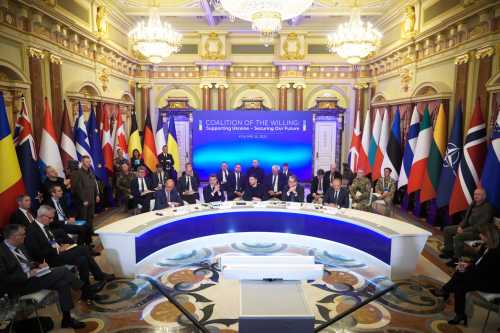
It is also possible that such an agreement might receive the U.N. Security Council’s blessing; China, for one, could well be in favor. While narrow, there is a political path that could set the conditions for a European-Asian coalition of the willing to oversee and guarantee a reopened strait. Just like the E3/EU+3 coalition over the Iran nuclear file involved countries like China and Russia, in this case too, a wider coalition would make it more likely to succeed. At a minimum, any such initiative should include those countries which have been directly affected and involved in the crisis—the Arab Gulf states and Iran—but also those like Pakistan, Egypt, and Turkey which have served as key facilitators. Moreover, it would extend further to the East, involving India and East Asian countries like Japan, South Korea, and Indonesia. Most valuable—but perhaps less likely—would be a direct Chinese role too. The coalition of the willing for Ukraine expanded its mandate from planning a hypothetical reassurance force in the event of a ceasefire to providing active support. A European-Asian coalition of the willing on the Strait of Hormuz could likewise tailor its mission to the precise agreement reached and its actual implementation.
The strategic convergence between Europe and the Gulf
At a more structural level, such a move could usher in a new season of cooperation between Europe and the Gulf countries. Both regions have for decades counted on the United States to guarantee their security. For different reasons and in different ways, the social contract binding them to Washington is changing profoundly and may be irreparably damaged. Whatever the future holds for the United States, it is hard to see how the transatlantic relationship can be restored to what it once was. Washington’s siding with Moscow over Ukraine, its shaky commitment to NATO, and above all, its threats over Greenland represent a genie that cannot be put back in the bottle. The same is true in the Gulf, where positions certainly vary—the United Arab Emirates, for example, is at loggerheads with Saudi Arabia, has left OPEC+, and is in an ever-more-open alliance with Israel. It still seems to harbor hopes that a new Middle East can be built in line with Trump and Israeli Prime Minister Benjamin Netanyahu’s vision for the region. Yet this increasingly seems to be a pipedream. In reality, the Gulf’s business model has been shaken to its core by the United States’ war of choice against Iran.
While both Europe and the Arab Gulf countries are bound to retain and reimagine their ties with the United States—and any multilateral initiative in the Gulf would need to keep the door open to Washington’s participation—both regions are drawing similar conclusions from their current strategic predicament. Europe and the Gulf countries know they need to invest in their own defenses and are doing exactly that. This creates an interesting connection that runs through Ukraine, given Kyiv’s innovation edge, particularly in drone production. President Volodymyr Zelenskyy has been quick to capitalize on this through a trip to the Gulf in the midst of the war. It would be better still if European leaders join him the next time he travels to the region.
Relatedly, both Europe and the Gulf are looking to diversify their security partnerships. The Gulf’s first port of call is not necessarily Europe, as relations deepen with Pakistan, Turkey, and China. However, such diversification does not exclude Europe. On the contrary, looking ahead, there is likely to be growing reciprocal interest between Europe and the Gulf, especially if Europeans end up playing a constructive postwar role in securing the reopening of the Strait of Hormuz.
The war in Iran is laying bare a long-standing reality: Europe’s attachment to multilateralism and international law has been rooted as much in interests as in idealism. If Europeans genuinely internalize this lesson, they must be willing to act on it in concert with Gulf and Asian partners in shaping the postwar order. This neither means decoupling nor closing the door to the United States. Rather, as multilateral initiatives are planned and hopefully implemented in the region, the door should remain open for the day Washington chooses to step in.
Author

Related Content
-
Footnotes
- The E3/EU+3 format consisted of France, Germany, and the U.K. as well as China, Russia, and the United States.
The Brookings Institution is committed to quality, independence, and impact.
We are supported by a diverse array of funders. In line with our values and policies, each Brookings publication represents the sole views of its author(s).
Commentary
How can Europe shape the Iran war’s aftermath?
May 20, 2026