Half a century ago, Washington occupied the pivotal position between Beijing and Moscow. Both China and the Soviet Union had strong reasons to seek better relations with the United States, giving American leaders leverage over them. Today, that triangle has been turned upside down. China and Russia have forged a close strategic partnership, limiting Washington’s ability to exploit differences between them, while the decline in American leadership in the international system has further weakened its ability to influence them.
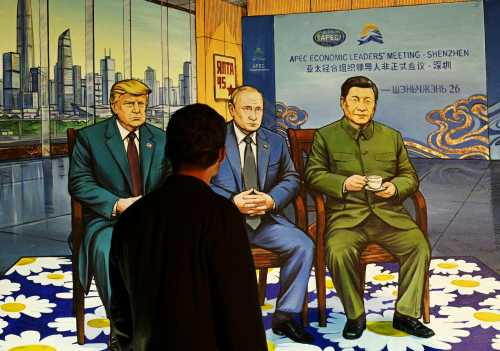
An unprecedented meeting among President Donald Trump, Chinese President Xi Jinping, and Russian President Vladimir Putin on the sidelines of the Asia-Pacific Economic Cooperation summit in Shenzhen is unlikely to produce major breakthroughs on arms control or the war in Ukraine. Instead, the meeting may reveal just how much America’s standing in the strategic triangle has changed.
The logic of triangular diplomacy
To understand this shift, consider what made triangular diplomacy effective in the first place. In the late 1960s, China’s leaders had an interest in welcoming U.S. President Richard Nixon’s overtures. The Sino-Soviet split had escalated into armed border clashes in 1969, and rapprochement with Washington offered Beijing an important counterweight to Soviet military pressure.
But the appeal of improved relations with the United States extended beyond just the Sino-Soviet rivalry. Beijing sought U.S. recognition of the People’s Republic of China (PRC) and progress toward acceptance of its sovereignty claims over Taiwan. For a China emerging from decades of relative international isolation, Washington offered a path toward broader diplomatic and economic engagement with the world’s most advanced economies, many of them American allies in Europe and Asia. In other words, Beijing found Washington appealing not only because of what the United States could offer bilaterally, but also because of Washington’s central position in the international system and the influence it exercised through its extensive network of alliances and partnerships.
The Nixon administration also presciently understood that rapprochement with China would provide Washington leverage in its dealings with Moscow. Presented with the likelihood of warming U.S.-China ties, Soviet leaders made their own moves toward détente with Washington. In 1972, the United States and the Soviet Union reached agreements through the Strategic Arms Limitation Talks that imposed important constraints on the nuclear arms race. Washington and Moscow continued arms control negotiations to build on these foundations, even as their bilateral competition persisted. Détente did not eliminate the Cold War’s dangers or prevent renewed confrontation in later years, but it demonstrated how high-level diplomacy, backed by strategic leverage and sustained negotiations, could produce tangible gains.
A strategic triangle turned upside down
Today, the strategic triangle has fundamentally changed.
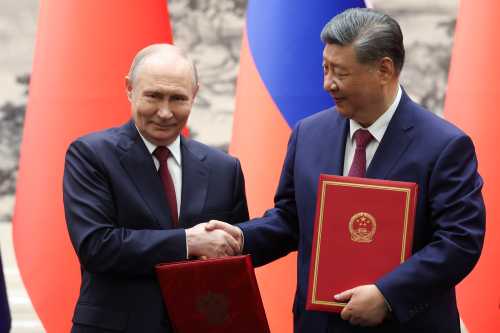
China and Russia no longer regard each other as their principal security threat. Instead, they have forged a close strategic partnership rooted in shared grievances and a common desire to challenge what they perceive as a Western-dominated international order. This convergence has been building since the end of the Cold War and is unlikely to be attenuated by American overtures. Nor is the PRC the isolated country it once was during the first half of the Cold War. Today, it has an extensive network of strategic partners, as I write about in my forthcoming book: “No Constraints: China’s Global Quest for Partners and Influence.” Russia has also cultivated alternative markets and partnerships to mitigate Western sanctions and isolation.
Yet the United States is hardly without leverage. China’s economy continues to be reliant on American markets, technology, and financial networks, and Beijing has compelling reasons to avoid a destabilizing confrontation with Washington. Moscow has shown little interest in winding down its war against Ukraine, but U.S. and European military assistance and diplomatic support for Kyiv are still critical to the war’s progression. Moreover, Western sanctions continue to squeeze Russia’s long-term economic prospects.
Although Washington’s expansive network of allies and partners should give it considerable leverage over Beijing and Moscow, the Trump administration is working against itself. Its transactional approach to allies, statements casting doubt on U.S. commitments to their defense, and willingness to impose tariffs on friends and rivals alike have resulted in Washington being less capable of marshalling collective strength toward common objectives. This has not only diminished the United States’ ability to respond to Chinese and Russian challenges but also positioned it as a less attractive negotiating partner.
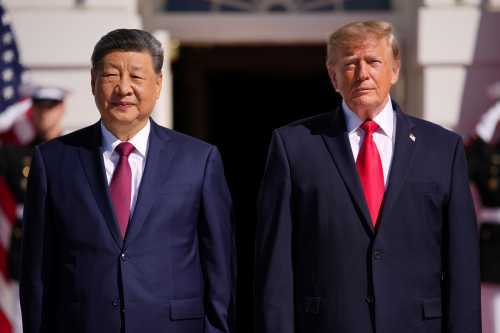
Meanwhile, Trump’s eagerness to secure diplomatic breakthroughs with Xi and Putin has further eroded Washington’s leverage. He has turned the screws on Ukraine and eased sanctions on Moscow without securing any corresponding concessions from Putin. While touting his personal relationship with Xi and focusing on sector-specific wins, such as China’s promises to purchase U.S. agricultural products and Boeing jets, Beijing has been given a pass on addressing long-standing structural economic disputes. Questioning U.S. commitments to Taiwan and suggesting that U.S. arms sales could be on the table during negotiations with Beijing have further weakened American credibility and bargaining power.
A summit with unequal benefits
Against this backdrop, a trilateral summit in Shenzhen would offer strikingly unequal benefits.
For Xi, hosting Putin and Trump for a trilateral meeting would represent a diplomatic victory, reinforcing Beijing’s image as a peacemaker and indispensable center of global diplomacy. For Putin, simply having the opportunity to appear alongside Trump and Xi would elevate his international standing and ease Moscow’s diplomatic isolation—all without having made a single meaningful concession on the war in Ukraine. For Trump, the gathering would offer a historic encounter. But what would the United States gain?
Trump and the White House have suggested that a trilateral summit could make necessary progress on nuclear arms control. As with some of Trump’s foreign policy instincts, the underlying idea of trilateral diplomacy is not inherently misguided. Considering that the New Strategic Arms Reduction Treaty, the last remaining U.S.-Russia strategic arms-control agreement, expired earlier this year, and China is in the middle of an unprecedented nuclear buildup, reviving arms control discussions would support U.S. interests. But successful negotiations require a strong strategic position and thorough working-level preparations. It’s difficult to see how a last-minute summit stage-managed by Beijing will set a solid foundation for the kind of breakthrough that Trump is seeking.
During the era of détente, American leaders understood that U.S. diplomacy was most effective when the United States could leverage the collective strength of its alliance networks and draw on its strategic advantages to shape its rivals’ calculations. While the trilateral in Shenzhen will surely be historic, instead of restoring the image of American power and preeminence that was evident during the Cold War, the meeting may only reveal how far Washington’s position has eroded since the triangular diplomacy of the 1970s.
Author

Related Content
The Brookings Institution is committed to quality, independence, and impact.
We are supported by a diverse array of funders. In line with our values and policies, each Brookings publication represents the sole views of its author(s).

Commentary
America’s lost advantage in the strategic triangle
November 17, 2026