This piece is part of the “Blowback: How the Iran war may change the world” series, which features original analyses and policy recommendations by experts on the immediate and prospective long-term fallout from the 2026 Iran war.
Summary
One lasting consequence of the Iran war may be an erosion of confidence that international markets will remain a reliable source of critical supplies during crises. The closure of the Strait of Hormuz tightened supplies of crude oil, liquefied natural gas (LNG), fertilizer, petrochemicals, and other industrial commodities, driving prices higher, increasing fear of shortages, and prompting some governments with available supplies to restrict exports in an attempt to protect their own domestic consumers and industry. Those restrictions may ease pressures at home, but they also reduce supplies available to world markets precisely when they are most needed.
The closure of the Strait of Hormuz illustrates an emerging challenge. Supply disruptions are increasingly resulting from deliberate efforts to deny access to critical goods or trade routes. If other countries respond by restricting their own exports, those efforts become even more disruptive. The immediate consequence of imposing export restrictions is greater scarcity, which is especially impactful for import-dependent countries. Yet the longer-term consequence may be equally important. If governments increasingly expect export restrictions to accompany major supply disruptions, they will become less confident that international markets can provide alternative sources of supply during crises. Governments are likely to respond by relying more heavily on stockpiles, domestic production incentives, and other measures to guarantee direct access to supply. Some of those interventions may be justified as geopolitical risks and supply disruptions become more frequent. But they are not free: they require public resources. This policy brief examines the tradeoffs inherent in these decisions. It argues that preserving international markets as a source of resilience can reduce how much governments ultimately need to provide domestically. Sustaining such confidence during periods of scarcity may become one of the lasting economic policy challenges highlighted by the Iran war.
Background
The closure of the Strait of Hormuz raised prices and led to local shortages of oil, LNG, aluminum, fertilizer, and other commodities around the world. One-fifth of the world’s oil, one-third of the world’s fertilizer, and 9% of the world’s aluminum transit the strait. The World Bank describes this disruption as the largest oil supply shock on record. More than 80% of the crude oil and LNG that transit the strait in normal times is sold to Asia, hitting the region hard. The Philippines, for instance, imposed a four-day work week for government offices and limited elevator and air conditioning use. Indonesia has capped the amount of gasoline and diesel drivers can purchase each day. Rising air fares are contributing to depressed tourism in the region and beyond, an important source of income. Across the globe, fertilizer prices—expected to be up 31% in 2026—and shortages threaten food supplies, particularly in African countries and others hit by higher fertilizer prices as they were entering the planting season.
As prices rapidly rose and fears of shortages intensified, 13 countries announced a total of 26 export restrictions on agriculture and energy goods linked to the conflict, including 21 restrictions in the energy sector. Thailand banned most exports of refined petroleum products. South Korea limited exports of refined products to last year’s levels and is considering further curbs. China enacted a swath of measures, including directing its large oil refiners not to sign new export contracts for refined products and to cancel existing contracts; banning exports of certain fertilizers; and joining Turkey in restricting sulfuric acid exports, which are important for fertilizer production, mining, and many other industrial processes. After the memorandum of understanding between the United States and Iran broke down and the Strait of Hormuz closed in July, China also banned exports of helium, a material that is essential for semiconductor manufacturing and therefore the artificial intelligence industry, even as it relaxed its earlier restrictions on refined fuel exports.
These measures reflect a broader pattern rather than a unique response to the Iran war. Access to critical supplies is increasingly becoming an instrument of geopolitical competition, and governments are responding by seeking to preserve domestic supplies in response to disruptions. Governments have repeatedly adopted similar measures following pandemics, poor harvests, and other supply disruptions. They proliferated during the food-price crises of 2007-08 and 2010-11 and again during the COVID-19 pandemic and following Russia’s invasion of Ukraine as governments sought to shield domestic consumers and industries from shortages and rising prices. In many cases, countries that might otherwise have helped ease global supply pressures instead restricted exports of their own, further reducing supplies available to international markets.
Recurring supply disruptions, intensifying geopolitical tensions, reduced cooperation among major powers, and concerns of increasingly severe climate-related shocks have increased the value governments place on assured access to critical supplies. A growing willingness to use export restrictions across a broader range of sectors is one manifestation of this shift (Figure 1).
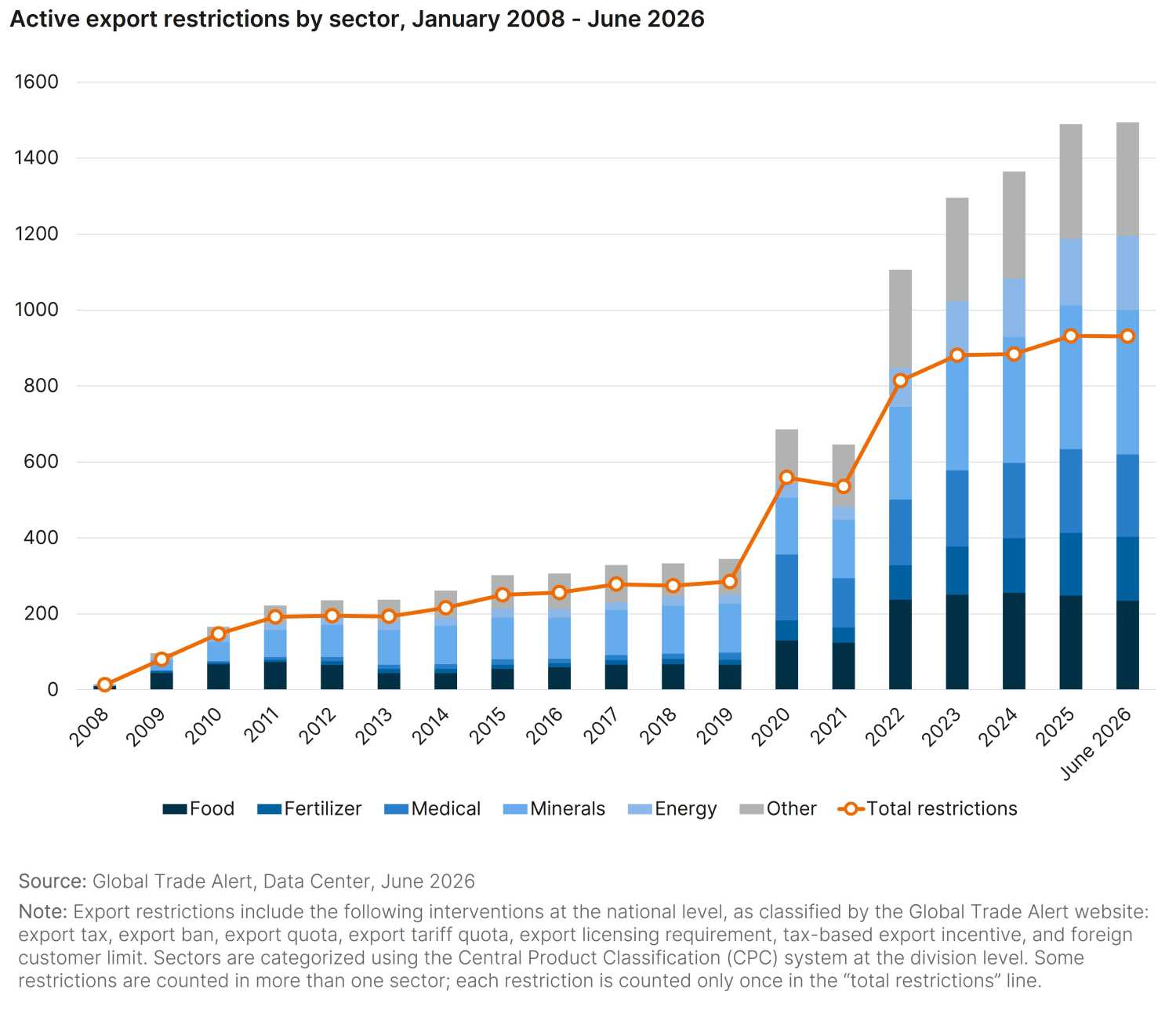
To be clear, governments impose export restrictions for reasons beyond preserving domestic access to critical supplies during disruptions. They may also seek to deny strategic capabilities to rivals or prevent militarily sensitive technologies from reaching them. The export restrictions depicted in Figure 1 may reflect one or both objectives. The United States and its partners, for example, have restricted exports of advanced semiconductors and related technologies to China because of concerns about their military applications. China has repeatedly imposed export licensing requirements on rare earth elements and rare earth magnets to exert leverage over supplies that are critical to manufacturers worldwide. Although these motivations increasingly coexist under the broader umbrella of economic security, they raise different policy questions. This policy brief focuses on export restrictions imposed in response to supply disruptions—regardless of whether those disruptions arise from natural disasters, conflict, or deliberate attempts by other governments to restrict access to critical supplies—and examines how these measures affect confidence in international markets as a source of resilience.
Analysis
One consequence of the Iran war may be an erosion of confidence that international markets can serve as the first line of resilience when supplies of critical goods are disrupted. Regardless of the cause of a supply disruption, governments face pressure to ensure that domestic consumers and industry are not left short. For countries with domestic supplies of these goods, export bans, quotas, licensing requirements, and taxes can offer a fast answer. They reserve more supply for the domestic market and signal that governments are protecting food security, public health, economic security, or national security. In periods of high prices, such measures can be politically difficult to resist.
Yet export restrictions don’t solve scarcity; they redistribute it. By reducing supply available to world markets—and by obscuring the signal that higher prices provide to encourage additional production—they can amplify global price increases and increase price volatility. During the 2006-08 food crisis, export restrictions and other policies that limited supplies reaching international markets were estimated to account for roughly 45% of the increase in world rice prices and nearly 30% of the increase in world wheat prices. They also encouraged further defensive responses, as governments moved to secure supplies of their own. Similar dynamics were evident during the COVID-19 pandemic, when export restrictions on personal protective equipment accelerated shortages, particularly in import-dependent countries, while causing scarce supplies to be retained domestically rather than distributed where they were most needed. These effects are particularly consequential for import-dependent countries, which have fewer alternatives when international supplies become less available.
The debate is often framed as a choice between vulnerable markets and government-guaranteed resilience. But that framing overlooks one of the strengths of market economies: governments do not have to provide all resilience directly. Firms respond to disruptions by diversifying suppliers, substituting inputs, drawing down inventories, rerouting shipments, conserving scarce inputs, and investing in new capacity. International trade is valuable not because it eliminates disruptions, but because it expands the range of adjustments firms can make when disruptions inevitably occur. In this sense, markets are not simply a source of efficiency—they are a source of resilience.
None of this means governments should refrain from intervening when critical supplies are at risk. Severe supply disruptions like those caused by the closure of the Strait of Hormuz can impose enormous economic and human costs, and measures such as stockpiles, redundant domestic production, and preferential supply arrangements may be appropriate in some circumstances. The point is different. Export restrictions reduce supplies reaching international markets and thus weaken one of the least resource-intensive ways economies adjust to shocks: drawing on global markets for alternative sources of supply. If governments conclude those markets will not remain available during future disruptions, they face greater pressure to guarantee resilience directly through public policy. Such measures may reduce exposure to shocks, but they also require resources. Export restrictions are often attractive precisely because they can preserve domestic supplies without requiring large public expenditures. Yet when many countries respond that way simultaneously, the result is less trade, fewer alternative sources of supply, and greater pressure for governments everywhere to rely on more costly forms of resilience. This burden disproportionately falls on poorer, import-dependent countries with the fewest resources to finance those alternatives.
The extent to which international markets can be a source of resilience during crises ultimately depends on cooperation from countries with exportable supplies. Yet cooperation has historically been difficult because governments often regard export controls as essential crisis-management tools for food security, emergency preparedness, and domestic supply stabilization. Indeed, the rules governing the international trade system under the World Trade Organization (WTO) explicitly permit governments to impose temporary export restrictions to prevent or relieve critical shortages of essential products. Growing geopolitical tensions make the prospects for cooperation to discipline their use at a global level even more distant.
Governments sometimes establish institutions designed to preserve confidence that markets will continue functioning during periods of stress. In another context, for example, U.S. Federal Reserve liquidity swap lines reassure markets that access to dollar liquidity will remain available outside of the United States when needed, reducing the need for countries to hold larger precautionary reserves of dollars. The mechanism differs, but the economic logic is similar: confidence in reliable access reduces the need for governments to provide resilience themselves. Export restrictions work in the opposite direction. The more governments come to expect that international markets will constrict during periods of scarcity, the less willing they are to rely on those markets as a source of resilience during future crises.
Policy options
If one lasting consequence of the Iran war is reduced willingness to rely on international markets during crises, the policy challenge is to preserve markets as a source of resilience. The objective is not to eliminate government intervention, as governments will continue to intervene when critical supplies are at risk. Rather, it is to preserve as much of international markets’ capacity to help economies adjust before governments must rely more heavily on direct and resource-intensive measures. That challenge becomes even more important if disruptions increasingly result from deliberate efforts to weaponize access to critical supplies rather than from natural disasters or market fluctuations alone.
Recommendation 1: Improve transparency in available supply and market capacity.
Governments often impose export restrictions because they fear shortages. Better information can reduce pressure to do so by giving policymakers a clearer picture of how severe a disruption actually is. During crises, policymakers may have limited visibility into available inventories, alternative suppliers, substitution possibilities, or the practical effect of restrictions imposed by other countries. The Agricultural Market Information System (AMIS), launched by the G20 ministers of agriculture following the 2007-08 and 2010 food crises to monitor markets for staple crops, is one example. By improving transparency, providing early warnings, and facilitating communication among governments, AMIS was designed to reduce the tendency to respond to uncertainty with export restrictions, hoarding, and other measures that can worsen scarcity.
Not every sector lends itself to a standing monitoring system like AMIS. Where products, suppliers, and vulnerabilities are less clearly defined, a more practical objective may be to ensure governments can rapidly collect and share information during crises before defensive policy responses become entrenched. Building that capacity will not be easy. Unlike agricultural markets, many critical supply chains lack established mechanisms for international information sharing, and governments will need to navigate challenges related to commercial confidentiality, analytical capacity, and the scope of cooperation. Efforts following COVID-19 and Russia’s invasion of Ukraine suggest that greater coordination is possible and could help reduce pressure for export restrictions during future disruptions. Even if comprehensive monitoring systems are not feasible across all sectors, improving governments’ ability to develop a shared picture of market conditions during crises could help preserve confidence that international markets remain a viable source of supply when disruptions occur.
Recommendation 2: Build commitments to maintain supply among trusted partners.
Governments can strengthen confidence that international markets will remain available during disruptions by making advance commitments not to impose export restrictions on critical goods. The New Zealand-Singapore Agreement on Trade in Essential Supplies (AOTES), negotiated in response to COVID-19 supply disruptions and signed after the disruption in the Strait of Hormuz, provides one example. Its key provision is an agreement not to invoke the WTO exception allowing export restrictions on covered essential goods traded between them. AOTES also establishes a playbook for responding to disruptions: the two governments commit to coordinate, share information, facilitate the movement of essential goods, and work together to keep essential supplies flowing during crises. As concerns about access to supply grow, similar arrangements among larger groups of countries could provide a foundation for cooperation in sectors where supply security concerns are becoming more acute.
Such arrangements are most likely to succeed where governments already share broader security relationships and have strong incentives to honor their commitments during crises. The challenge is not making commitments. It is making those commitments credible. During crises, governments face overwhelming domestic pressure to restrict exports. Such agreements may therefore need to include mechanisms that make commitments costly to violate—or otherwise create strong incentives to comply. Unless governments believe those commitments will hold when domestic political pressure is greatest, they are unlikely to preserve confidence in international markets during future crises.
Authors


Related Content
-
Acknowledgements and disclosures
The authors would like to thank the anonymous reviewer for their feedback, as well as Adriana Adames Acosta, Chesapeake Dowdy, and Toby Bushley for their assistance. They are also grateful to Adam Lammon for editing and Rachel Slattery for layout.
The Brookings Institution is committed to quality, independence, and impact.
We are supported by a diverse array of funders. In line with our values and policies, each Brookings publication represents the sole views of its author(s).