


A Partnership Between


The living systems that our economies and societies treat as a backdrop are, in fact, the foundation on which development rests. That claim is easy to state, but acting on it is much harder. This volume is about the relationship between nature, people, and prosperity, and why the way the world currently accounts for it is failing all three.
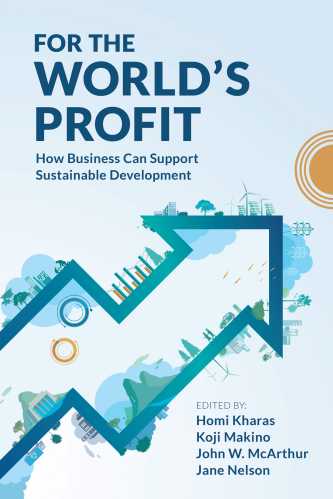
This co-edited volume brings together a cross-section of distinguished contributors working on nature finance, nature-based solutions, and nature governance. Three propositions run through the chapters:
- Nature and ecological integrity are not one sector of development among many, but a precondition for all of it.
- Our prevailing economic and financial system rewards the liquidation of nature and penalizes its protection.
- A credible post-2030 agenda will have to change institutions, incentives, and investments themselves, not simply bolt stronger conservation targets onto a framework that still treats nature as external to the economy.
This volume does not seek to provide a blueprint but to start a debate on two fundamental questions the post-2030 agenda should address: What should we protect, and how can we incentivize change and inspire action?
Contents
- Nature, people, and sustainable development: Why the next decade must be different
Homi Kharas, Julie McCarthy, and Ichiro Sato (editors)
Part I | What we should protect
- Nature as the foundation for sustainable development: Linking nature’s needs to sustainable development action
David Obura - Preserving watershed integrity for people and nature: Aligning governance with hydrological structure and time
Masahisa Nakamura - Mangrove ecosystem conservation as nature-based solutions for addressing global challenges
Noriaki Sakaguchi - Indigenous Peoples and new pathways for sustainability in Amazonia
David Cotacachi, Fany Kuiru, Tatiana Schor, and Verónica Tejerina
Part II | How to incentivize change
- Aligning nature, finance, and development: Innovations for the triple crisis
Arend Kulenkampff and Julie McCarthy - Nature’s black markets: How environmental crime undermines climate, capital, and sustainable development
Robert Muggah and Ilona Szabó de Carvalho - Rewiring food value chains for people, nature, and prosperity
Felipe Faria, Morgan Gillespy, and Guido Schmidt-Traub - The bioeconomy as the leapfrog imperative: Governing for equity as the key to unlock the transformative potential of a global bioeconomy
Monique Atouguia and Dorothy Maseke
Related Content

-
Acknowledgements and disclosures
Acknowledgements
The success of a book of this type hinges on the chapter authors. We, the editors, are deeply grateful to all the authors— Monique Atouguia, David Cotacachi, Felipe Faria, Morgan Gillespy, Fany Kuiru, Arend Kulenkampff, Dorothy Maseke, Robert Muggah, Masahisa Nakamura, David Obura, Noriaki Sakaguchi, Guido Schmidt-Traub, Tatiana Schor, Ilona Szabó de Carvalho, and Verónica Tejerina—for their generous contribution of time and expertise. Behind the authors, however, an enormous effort is needed to bring a book to life. We are so grateful to Clea McElwain at the Brookings Center for Sustainable Development for project management, quality assurance, chapter editing, proofing, and organization. We further thank Ayan Sarkar for fact-checking support; Junjie Ren for editorial management and communications planning; and Beth Walsh for visual layout. We would also like to thank John W. McArthur for his contributions to the initial conception of this volume. Brookings gratefully acknowledges project support provided by the JICA Ogata Sadako Research Institute for Peace and Development, and we thank Laura Goldman, Yukari Saito, Shiori Shimizu, Kaito Takeuchi, Tomoaki Tanaka, and Marika Tsugawa for making the collaboration between our two institutions so smooth.
The Brookings Institution is a nonprofit organization devoted to independent research and policy solutions. Brookings recognizes that the value it provides is in its commitment to quality, independence, and impact. Activities supported by its donors reflect this commitment. The conclusions and recommendations of any Brookings publication are solely those of its author(s), and do not reflect the views or policies of the Institution, its management, its other scholars, or the funders. Activities supported by its donors reflect this commitment. A full list of contributors to the Brookings Institution can be found in the Brookings Institution Annual Report at https://www.brookings.edu/about-us/annual-report/.
AI disclaimer
Copyediting and citation formatting for this volume were completed with the assistance of Claude, an Anthropic generative AI tool, in a project configured with the Brookings style and citation guidance. Its role was limited to grammar, punctuation, style, and consistency, and to formatting citations to “The Chicago Manual of Style” (18th edition), including retrieving missing bibliographic details from cited sources. It did not draft or rewrite substantive content. Every suggested copyedit was entered manually by Brookings staff as the first round of copyediting, and AI-assisted citations were reviewed and verified against source material by Brookings staff during fact-checking, in accordance with Brookings policies and AI use principles. The authors have certified that AI did not generate the substantive ideas, analysis, or judgments expressed in their chapters.
The Brookings Institution is committed to quality, independence, and impact.
We are supported by a diverse array of funders. In line with our values and policies, each Brookings publication represents the sole views of its author(s).