This piece is part of the Taiwan-U.S. Quarterly Analysis series, which features the original writings of experts with the goal of providing a range of perspectives on developments relating to Taiwan.
In our final piece, we delve into two of the most divisive issues in Taiwan today: the special defense budget and perceptions of the United States. We examine how Taiwanese voters feel about Taiwan President Lai Ching-te’s proposed $40 billion budget and whether they believe increased defense spending strengthens deterrence. We then explore Taiwanese attitudes toward the United States and U.S. President Donald Trump.
Defense spending and perceptions of the United States in Taiwan have become deeply partisan. Importantly, we find that support for increased defense spending is closely associated with beliefs about its deterrent value. We also show that Taiwanese voters, across partisan lines, are concerned that U.S. military involvement in the Middle East could negatively affect the United States’ ability to assist Taiwan. Finally, we show that Taiwanese support for the United States and Trump has remained relatively stable since last year, even as Taiwanese voters distinguish between support for the United States and support for Trump.
We completed our survey of Taiwanese voters (n=1,195) between April 16-22, two weeks before Trump met with Chinese President Xi Jinping in Beijing. While such a meeting could affect public opinion at the margins, we do not expect that it would radically change our findings. Since our results reveal that support for the United States and Trump varies greatly by partisanship, Trump and Xi’s meeting is more likely to have reinforced perceptions rather than changed them. While it is reasonable to hypothesize that support for the United States and for Trump may have dropped slightly since the meeting, we encourage readers to focus on the long-term trends that we show here.
How do Taiwanese voters view the special defense budget?
In total, 54% of respondents support the proposed defense budget, a positive sign for Lai and the Democratic Progressive Party (DPP). However, Taiwan’s stark partisan divide still plays a major role in understanding this support. About 87% of DPP voters support the budget, while only 27.4% of Kuomintang (KMT) voters support it. Independent voters are split; half (48%) support the policy, while less than half (41.3%) do not. Independent voters comprise the largest number of those who say they do not know if they support the policy. Our finding is consistent with other surveys that have documented a clear partisan divide in support for buying weapons from the United States since 2021, with DPP voters showing overwhelming support while other pockets of society are less supportive.
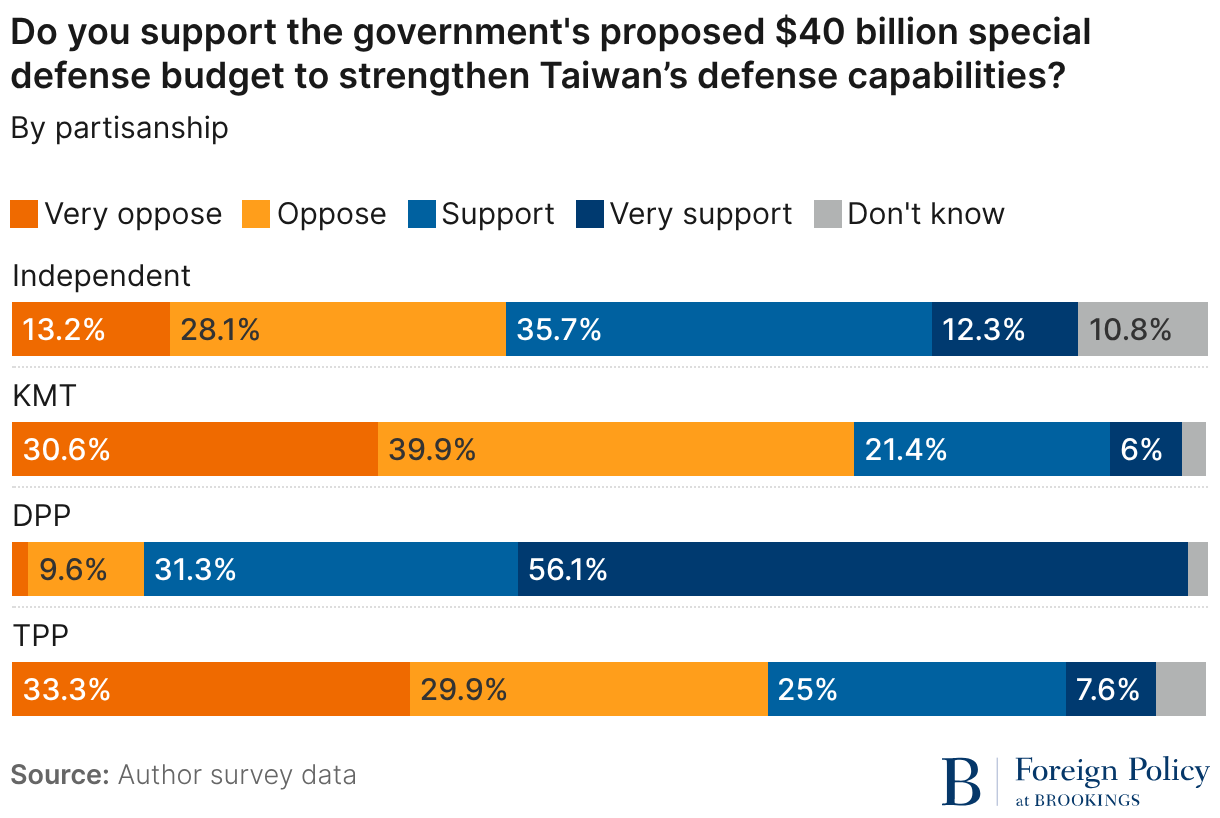
The story becomes more nuanced when we assess whether attitudes toward the defense budget are related to perceptions of how increasing defense spending impacts deterrence. We asked, “To what extent do you agree that increasing Taiwan’s defense budget reduces the probability of China taking military action against Taiwan?” Figure 2 shows the relationship between respondents’ support for defense spending and their belief in defense spending’s deterrent effect. Each horizontal bar represents respondents’ level of support for the defense budget (from “very oppose” to “very support” and “don’t know”). The percentages within each bar show the extent of the respondents’ agreement with the assertion that increasing Taiwan’s defense budget can deter China’s military aggression.

There is a clear correlation between support for increasing the defense budget and beliefs about deterrence. People who are more supportive of the special defense budget also have a stronger belief that such defense spending increases can deter China from attacking Taiwan. Respondents who are less supportive of the special defense budget are also less likely to believe that increased defense spending strengthens deterrence. Our survey reveals that DPP-aligned voters overwhelmingly support the special defense budget, while KMT-aligned voters overwhelmingly reject it. These results suggest a broader disagreement between DPP and KMT supporters over whether increased defense spending will really make Taiwan safer. In other words, Taiwanese perceptions of the link between defense capacity and deterrence appear closely associated with their support for increases in the defense budget.
Despite not passing Lai’s proposed budget, why would the KMT, in the end, still support increasing defense spending? Our data suggests that there is some support for increasing defense spending within the KMT, but more importantly, independent voters also support doing so. By ultimately passing a defense budget, even one that was reduced following Lai’s original proposal, the KMT will not isolate itself from independent voters who want to see increased defense spending but do not necessarily support Lai and the DPP. The final defense bill that was passed is missing many of the key components Lai advocated for. Future surveys may reveal whether independent voters are satisfied with it.
How do Taiwanese voters feel about the United States?
Attitudes toward the defense budget are also closely tied to perceptions of the United States. Since last year, the United States and its relationship to Taiwan have become an increasingly contested domestic issue within Taiwan. We find that Taiwanese voters who lean toward the DPP continue to express stronger support for the United States and defense spending, while those aligned with the KMT and Taiwan People’s Party (TPP) express more skepticism.
We first compare perceptions of the United States and China.


Breaking down support for the United States and China by partisanship shows two different sets of views toward these two superpowers. Almost 60% of DPP supporters see the United States positively, while only about 15% of KMT and about 18% of TPP supporters feel the same. Meanwhile, only about 8% of the DPP see the United States negatively, while about 53% of KMT and 47% of TPP voters have negative perceptions of the United States.
When it comes to China, however, DPP voters express nearly opposite perceptions: almost 85% see the People’s Republic of China (PRC) negatively. Yet, unlike with perceptions about the United States, where there was significant divergence in opinion based on partisan lines, KMT voters and TPP supporters do not hold significantly more positive views of China. Only about 26% of KMT voters and 18% of TPP voters see the PRC positively. Although KMT and TPP voters appear to be deeply skeptical of the United States, this does not translate into overwhelming positive sentiment for the PRC.
Independent voters consistently take middle-ground positions. Their views of the United States are less positive (22.6%) than those of DPP supporters (58.8%) but more favorable than those of KMT (14.5%) and TPP (17.9%) voters. On China, they are more negative (58.1%) than KMT (27.2%) and TPP (40.4%) voters, though not as strongly as the DPP base (84.8%). But in general, more independent voters hold negative views of China.
How have these attitudes changed over the last year? By comparing our 2026 survey data with our results from 2025, we show that there were no major changes for KMT or DPP voters overall. TPP voters, however, show a sharp 11.9 percentage point increase in positive perceptions of China and a decrease of 8.4 percentage points in positive perceptions of the United States.


Is America a trustworthy ally?
One of the most important questions political scientists ask Taiwanese voters about the United States is whether or not they see it as a trustworthy ally. We find that overall, only 24% of Taiwanese voters see the United States as a trustworthy ally. Even for DPP voters—the group that is most favorable toward the United States—less than 50% consider the United States as a trustworthy partner (45.3%). This finding should be concerning because it signals that even if Taiwanese voters see the United States positively, it does not necessarily translate into trust in the United States.
Over half of KMT voters (60%) do not find the United States to be trustworthy, while about 8% consider it trustworthy. For the TPP, about half (49%) of its cohort do not think the United States is trustworthy, and only about 12% think that it is. Although KMT and TPP voters also do not have overwhelmingly positive views of the PRC, these results suggest that their distrust of the United States may make them more open to engagement with China as a way to hedge against potential cross-Strait conflicts.

How have these attitudes changed over the last two years? We compared this data with the surveys we conducted in July 2024 (during the Biden administration) and in March 2025 (during the Trump administration). We find that across partisanship, Taiwanese perceptions of U.S. trustworthiness have continuously declined during Trump’s second term. Over the last two years, there has been a more significant decline in trust toward the United States among KMT, TPP, and independent voters, though attitudes have slightly improved in the last year, as shown in our most recent survey. However, while DPP voters report a more gradual decline in how much they trust the United States, their perception of U.S. trustworthiness is still declining. For DPP voters, perceptions of the United States as a trustworthy partner dropped about 5 percentage points every year between July 2024 and April 2026.

Taiwanese voters’ views of the United States as a trustworthy partner are linked to whether they believe the United States would aid Taiwan in the event of a military conflict.

Roughly 40% of respondents consider it unlikely that the United States would come to Taiwan’s aid in the event of a Chinese attack, while about 35% view such support as likely, and approximately 26% hold neutral views. Accounting for partisanship again paints a more complex picture. About 63% of KMT voters and 59% of TPP voters are skeptical that the United States would come to Taiwan’s aid in the event of a Chinese attack, while DPP voters are largely convinced (67%) that the United States would support Taiwan in the event of a war.
Additional analysis shows that people who are more interested in politics are more likely to believe in the U.S. commitment than those who pay little attention to politics. While 55% of politically attentive respondents believe the United States would come to Taiwan’s aid, only 21% of those who pay little attention to politics share this view. New political science research shows that independent voters, who usually are less politically engaged, are more likely to be swayed by pro-China media that cast doubt on the U.S. commitment to Taiwan. Their skepticism toward the U.S. commitment could reflect a combination of factors, including the media they consume, changes in U.S. foreign policy under Donald Trump, and Taiwan’s domestic debate over defense spending and relations with Washington.
We also asked Taiwanese voters whether they believe the United States’ ongoing war in the Middle East will affect its capacity to support Taiwan during a conflict in the Taiwan Strait. This is one of the only questions where there was no partisan variation: across the board, Taiwanese are concerned that the United States’ preoccupation in the Middle East will affect its commitments to Taiwan and East Asia.

Finally, we wanted to know how Taiwanese citizens see Donald Trump. We measure perceptions of Trump using two different questions. First, we asked a feeling thermometer to rate Trump, and second, we asked if Taiwanese voters believe Taiwan is safer now that Trump is president, questions we also asked in 2025. The majority of KMT (65.3%) and TPP (58.3%) voters think that Taiwan is less safe under Trump, while about 25% of DPP voters and 45% of independent voters hold this view.

In terms of perceptions of Trump as a person, no partisan group has a majority of respondents who feel positively toward him. About 21% of DPP voters express positive perceptions toward Trump—the largest level of any group—while an almost equally large bloc (32.7%) sees him in a neutral light. The majority of KMT (70.5%) and TPP (64.6%) voters see Trump negatively. Only about 9% of independent voters view Trump positively.

An important takeaway is that the majority of Taiwanese voters appear to distinguish between attitudes toward the United States and attitudes toward Trump himself (see figure 13). Support for the United States overall remains higher than for the president himself. This perhaps reflects Taiwanese perceptions of the United States and its institutions beyond the term of a single president.

Conclusion
We conclude this series with three key findings worth keeping in mind as Taiwan moves toward its next local elections in November 2026 and national elections in January 2028. First, public opinion within the KMT, on issues ranging from support for party leader Cheng Li-wun’s meeting with Xi Jinping to the defense budget, reflects a multiplicity of opinions within the party. Unlike the DPP, in which there is significant consensus on these issues, the KMT shows internal splits. Whether the party’s elites will be able to successfully unite the party, despite these disagreements, will play a major role in how effective it is at opposing Lai and the DPP in the future.
Second, independent voters are the most important voting bloc in Taiwan. Independents comprise a larger voting group and exhibit greater variation in political attitudes than those of the DPP and KMT partisans.
Finally, TPP voters are increasingly resembling KMT voters over time. While the TPP’s party elites continue to negotiate their relationship with the KMT, their base of support appears to be gradually buying into the KMT’s worldview. This calls into question the TPP’s viability to be part of a future 2028 presidential ticket, or if TPP voters will naturally support the KMT regardless of who is on the ballot.
In this series, we have shown through data how partisanship shapes almost every topic in contemporary Taiwanese politics, from cross-Strait relations to defense spending and perceptions of the United States. While Taiwan’s polarization problem has been widely discussed, our findings reveal how it actually affects public opinion, offering a much more dire outlook for the prospects of forging durable political compromises as part of Taiwan’s democratic processes.
Authors


Related Content
The Brookings Institution is committed to quality, independence, and impact.
We are supported by a diverse array of funders. In line with our values and policies, each Brookings publication represents the sole views of its author(s).
Commentary
How partisan is Taiwan’s security debate?
May 28, 2026