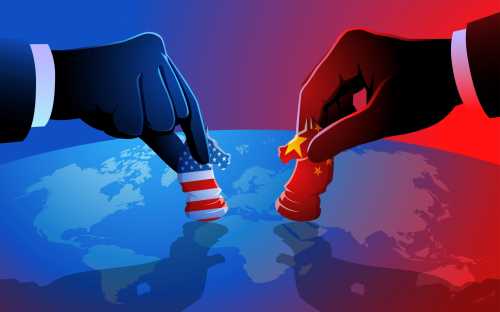
Brookings convened three experts with deep backgrounds in security studies to examine two central questions about the military competition between the United States and the People’s Republic of China (PRC). First, in light of China’s rapid military modernization, in what domains does the United States continue to maintain an absolute military advantage, and where—if at all—has China gained the upper hand? Second, in the event of a military conflict in the Western Pacific, which capability advantages would prove most consequential, and what other factors would shape the outcome?
The exchange below offers a diversity of perspectives on the evolving military balance between the United States and China. While the contributors differ in their assessments, they broadly agree that military advantages must be examined in the domain and operational context. They also broadly agree that the United States maintains significant advantages in key areas, such as undersea warfare, even as China has made substantial gains in other domains. They also underscore that military capabilities alone would not determine the course of a conflict, with a range of military, geographic, and experiential factors likely to shape the outcome of a potential U.S.-China confrontation.
Military advantages
In light of rapid PRC military advances, in what domains does the United States still maintain an absolute military edge over China? Where—if at all—does the PRC currently enjoy a military edge over U.S. capabilities?John Culver
In terms of weapons systems and demonstrated operational competence, the United States writ large still enjoys significant advantages in submarines and undersea warfare, aircraft carrier-based operations, overseas bases and alliances, missile defenses, and global logistics infrastructure for long-distance deployments, especially by air. Other domains have become more comparable in terms of newer generations of weapons and quantities: airpower, theater strike assets, space and counterspace operations, nuclear deterrence, and naval power projection.
China’s advantages seem more relevant if the comparison focuses on capabilities that are operationally relevant to a conflict over Taiwan, the South China Sea, or other potential flashpoints. The United States has global commitments, as the recent, ongoing war with Iran demonstrates, while China has been focused on potential conflict in its near abroad. More specifically, China’s most ambitious military modernization efforts appear designed to blunt the pillars of U.S. power projection to East Asia. China’s exceptionally large and capable precision-guided ballistic and cruise missile forces can strike every U.S. base, port, and airfield from Okinawa to beyond Guam and northern Australia, including Hawaii. Almost none of these U.S. facilities are hardened against precision attack munitions, while many of China’s are. The Chinese air force and integrated air defenses can extend air power well beyond Taiwan and contest U.S. air operations essential for any potential conflict over that island. Chinese air-to-air and long-range surface-to-air missiles are among the best in the world in terms of range, guidance, and counter-jamming. Chinese anti-ship ballistic and cruise missiles are considered the best currently, until newer U.S. counterparts come online in the 2030s.
The key factors for U.S. military success in the most likely scenarios of a war with China are the tyranny of distance for air and maritime operations in the Western Pacific, and the length and fragility of U.S. logistics lines to the theater. Many of the drone platforms that have demonstrated success in the Ukraine conflict will be irrelevant to a potential Taiwan conflict unless the People’s Liberation Army (PLA) is conducting large-scale operations on the island, which would be a worst-case scenario for Taipei. And China—the world’s dominant commercial drone maker—has developed many military drones with long-range capabilities.
The final key factor in which China probably has a durable advantage is the scale and modernity of its defense industrial base, especially ship and submarine construction, and in the large-scale production of advanced munitions of all kinds. If success in a war scenario hinges on not running out of key munitions first, the advantage almost certainly rests with China.
Bruce Jones
In most aspects of warfare, from the water’s surface to the troposphere, China has eroded America’s technological lead. Combined with the tyranny of distance, this would likely give Beijing the upper hand—or at least enable it to impose such high costs on U.S. forces that military action would become untenable and unsustainable. To be specific: inside the First Island Chain, China holds the upper hand in surface naval warfare and in air defense. Its advanced, long-range defensive missiles, radars, and targeting systems will materially erode the U.S. capacity to conduct the kind of devastation-at-distance campaign that it carried out against Iran in recent months.
The United States, however, retains critical advantages in two domains: undersea and in space. Together, these advantages equip the United States with significant means to weaken or limit China’s naval mass, air defense, and anti-ship missile capabilities. Maintaining the U.S. lead in these “contested commons” remains crucial.
China will attempt to interfere with U.S. space operations through cyber tools, increasingly enabled by artificial intelligence, and potentially through kinetic strikes. The United States will defend against these attacks and, in all likelihood, prevail. Meanwhile, in the undersea realm, China is investing heavily to close this large remaining gap in its anti-access/area-denial defenses (what Beijing terms its “counterinsurgency” strategy). This effort includes new classes of submarines, innovations in uncrewed vehicles, and suites of integrated sensors. In some of these areas, China is already outperforming the United States—for example, in large-format, multipurpose undersea drones.
Despite these advances, the overall U.S. undersea advantage is significant. Unless and until Beijing can further narrow the gap, any of its options for war can be materially weakened by the performance of the U.S. submarine force.
Michael E. O’Hanlon
To prevent war, over Taiwan or another matter, the United States and allies should strive to convince Beijing that it could not prevail in a conflict. That requires doubling down on some military investments (and on smart, sober, steadfast, yet also calming, diplomacy). It further requires making ourselves less vulnerable in the realm of economics and supply chains.
But it also behooves us not to give China the false sense that it is now ahead in the overall strategic competition. China is not ahead. It is not even close to parity. Yes, it has closed some gaps in recent years. But the United States, having continued to invest hundreds of billions of dollars a year in military acquisition and modernization for decades, benefiting from the best alliance system in history, and possessing the world’s most combat-tested force (even if some of its recent wars might have best been avoided), should never be underestimated.
John Culver, one of our country’s national treasures and great minds on the Chinese military, recently told Max Boot that the United States commands a considerable lead over China in the undersea competition—a point that our colleague Bruce Jones also drives home in much of his recent work.
I would submit that the United States is also ahead of the PLA in several more categories of modern military capabilities:
- Special operations, where U.S. forces excelled in the defeat of al-Qaida and ISIS, the killing of Osama bin Laden, and most recently, the snatching of President Nicolás Maduro in Venezuela.
- Combat experience writ large, given U.S. wars in Iraq and Afghanistan—difficult ventures with mediocre strategic outcomes to be sure, but militarily impressive in the rapid overthrows of Saddam Hussein and the Taliban—and the gradual but inexorable defeat of ISIS in Iraq and Syria over the last decade.
- Air-to-air combat, and complex air campaigns in general, as evidenced in the tactically remarkable (if strategically inconclusive) bombing missions of Iran this year.
- Long-range strike and stealth, as demonstrated in the one-day campaign against Iran’s nuclear facilities on June 22, 2025.
- Long-range logistics (admittedly, America needs it more than China does), as demonstrated in nearly all U.S. wars in the 20th and 21st centuries.
- Aircraft carrier operations, where the Chinese are trying hard to catch up but remain far behind by every measure.
- Integrated air and missile defense, where the United States has had lots of (indeed, too much) practice of late.
- Amphibious assault, even if this is becoming harder for everyone in the modern era.
- Combined-arms maneuver warfare on land, as in the two Iraq wars of modern times.
- Nuclear weapons, where the United States retains a huge edge over China, God forbid it ever comes to that.
China’s advantages are narrower, though still considerable. Beyond geography, they include its large missile forces—ballistic, cruise, and hypersonic—and some advantages in drone technology. China is also an equal or near-equal in most types of digital capability. It also has a numerically larger navy, a stronger shipbuilding industrial base, and a more powerful and deep manufacturing capability in general.
In the event of conflict
In the event of a U.S.-PRC conflict in the Western Pacific, which capability advantages would be most consequential? What other factors beyond capabilities would be critical factors?John Culver
For the United States, undersea dominance offers a critical advantage. It enables the United States to forward-deploy long-range strike weapons into the theater while remaining survivable after launch. It also provides a potent anti-ship capability to degrade Chinese naval and amphibious operations. But the United States’ advantage in this domain could decline quickly due to low submarine construction rates and the pending retirement of U.S. Los Angeles-class nuclear attack submarines that comprise almost half of the U.S. Navy’s 50-strong submarine fleet. The newest Los Angeles-class submarine was commissioned in 1996.
Moreover, China’s attack and ballistic missile submarine programs are advancing rapidly. The newest designs are under construction and are expected to approach U.S. standards in terms of quieting, range, weapons, and numbers. As in most categories of weapons production, China has a significant submarine construction capacity advantage over the United States, including three large new construction yards that have recently begun production. China is also investing heavily in anti-submarine warfare, including long-range maritime surveillance aircraft, undersea sensors, and autonomous undersea platforms.
Another key U.S. advantage demonstrated in recent conflicts is missile defenses, especially against short- and medium-range ballistic missiles. But it is unclear how these defenses would fare against an adversary with the density of launchers and missiles that China has, including the world’s largest inventory of hypersonic attack systems. In the event of a conflict, a priority target for initial Chinese missile attacks would be U.S. missile defenses in the theater. Moreover, it is unlikely that U.S. missile defenses would be able to defend Taiwan itself, aside from those that have been sold to Taiwan, principally Patriot missile systems.
A key factor that would be relevant to any conflict is the effect of corruption on actual Chinese combat capabilities, including the turmoil introduced to the entire PLA command chain due to Xi Jinping’s dismissal of at least 53% of all three- and four-star officers since 2024. There has also been significant corruption in China’s defense industrial base, which could have compromised the performance of some key weapons and munitions, and also undercut Chinese leaders’ confidence in the capacity of the force to contest an advanced adversary like the United States.
Another key factor is nuclear deterrence, along with deterrence in cyber and space operations. China is expanding its nuclear weapons inventory fivefold by 2035 and is already a formidable space/counterspace and cyber power. We should expect China to conduct deterrence operations early in a conflict by demonstrating readiness and potentially by detonating a nuclear weapon over an open-ocean area. Similar nondestructive operations should be anticipated in the counterspace and cyber domains, to erode U.S. confidence in its ability to freely conduct conventional operations and manage public opinion and support for war.
Finally, U.S. allies’ confidence in Washington’s security commitments could be a key factor in any significant conflict with China. This is particularly true for Japan, where the majority of U.S. military forces in East Asia are based. The defense of Taiwan is likely impossible for the United States without full access to Japanese air bases, naval ports, and other facilities. The same is true of the northern Philippines and northern Australia, but not to the same extent. All U.S. facilities in Japan are well within range of Chinese saturation attacks with precision-guided munitions. Public opinion in Japan and other key allied states could play a crucial role in the event of conflict, especially if doubts toward U.S. commitments are a consideration.
Bruce Jones
The most consequential domain in a U.S.-PRC conflict will be undersea. Before his untimely death, Owen Coté, one of the United States’ leading analysts, wrote that “Future battles between great powers for control of the surface of the sea and land will be decided in prior battles for control of the undersea and space.” The same holds true in the Western Pacific. In the event of a military conflict over Taiwan, the undersea realm becomes all the more important. If successfully prosecuted, an undersea campaign can pave the way for the rest of the joint force to advance through a weakened set of Chinese anti-access defenses.
But we should be clear-eyed: we are not talking here about a minor battle at sea. Any campaign, even if officially limited in its objectives—say, denial of a Chinese landing operation—risks rapid escalation into all-out systems warfare, with punishing costs. An effective undersea campaign—one that can open space for joint fires by other commands—would require sustained strikes on the Chinese mainland and devastating blows to the Chinese fleet, which in turn risks escalation. China has postured its forces, including its undersea forces, in ways that further increase the risk of nuclear escalation, creating additional dilemmas for U.S. decisionmakers.
Quite apart from loss of life and materiel, a U.S.-China conflict in the Western Pacific would roil the world economy to a far greater degree than even the medium-scale war in Iran we have just witnessed. Farther afield, in lower threshold operations, the United States also retains the option to impose a distant blockade of China’s vital imports, such as fuel and ferrous metals. To be effective, however, the blockade would have to be sustained over years, not months. The global economic consequences of such a conflict are ones for which the U.S. economy is not prepared.
Michael E. O’Hanlon
Many of America’s advantages in long-range logistics, global basing, and long-range strike will help compensate for the geographic disadvantages it would face in a conflict in the Western Pacific. That said, they could prove very important if the United States is able to expand a future conflict into a struggle for control of the sea lines of communication in Southeast Asia, the Indian Ocean, and the Persian Gulf.
I hope the American nuclear advantage, while real, is irrelevant, as it would be extremely perilous to invoke nuclear weapons in any future U.S.-China war. That said, the perception of American advantage—an accurate one, at least in terms of the size and quality of respective arsenals and associated delivery vehicles—might be one more factor to dissuade leaders in Beijing from beginning a war in the first place, or considering escalation if they see they are losing a conventional military fight.
Special operations might be more important than one would first guess. Sabotage of key military infrastructure on each other’s territory, for example, might prove to be a major locus of future combat.
American combat experience cannot be minimized. It has created a very tough and sober-minded American officer corps. Very unfortunately, Secretary of Defense Pete Hegseth’s purges have compromised this advantage to some extent, but it remains real. Mortal combat is such a difficult affair that most of us who have not experienced it (including me) would have little appreciation for the kinds of learning curves needed to respond well under the pressures of lethal military engagement. Of course, even the United States lacks combat experience against a peer foe, so in one sense, everyone would be learning. But the U.S. advantage here, after the wars of the 21st century, is quite considerable. It is sort of like imagining how good the Kansas City Chiefs might be at the start of their training camp in July with how good they often become by the time of the Super Bowl in February. Except in this case, the contrast between the United States and China is even more stark.
Most of the areas of combined-arms excellence noted above—air-to-air operations, amphibious assault, combined-arms operations on land, integrated air and missile defense—would be highly relevant to a U.S.-China fight over Taiwan. However, the exact significance would depend on whether the initial phase of the conflict was a Chinese attempted invasion of Taiwan, a blockade of Taiwan, or a series of air and missile attacks against Taiwan (all likely accompanied by cyberwar operations, of course).
This short analysis is not intended to declare some overwhelming American overall advantage against the PLA. China has big advantages too, particularly in its missile forces, including in hypersonic missiles. It also benefits from a single-minded focus on the Western Pacific and is likely at least the equal of the United States in the broader cyber domain. It has a larger navy by ship count (though only half as big as America’s by aggregate tonnage) and a much deeper industrial base (crucial for a long war and for withstanding the economic conflict that would likely go along with a kinetic fight). My goal is not to predict the winner of a U.S.-China war; in fact, in recent writings, I attempted to show that a blockade scenario in particular would be too close to call. But I also believe it is important that, in seeking to gin up its own sometimes lackluster response to China’s rise, that the United States does not talk itself down too much along the way.
Authors



Related Content

The Brookings Institution is committed to quality, independence, and impact.
We are supported by a diverse array of funders. In line with our values and policies, each Brookings publication represents the sole views of its author(s).
Commentary
Who holds the advantage? Three perspectives on the US-China military balance
July 14, 2026