




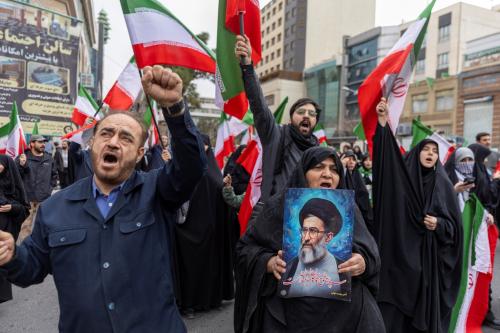
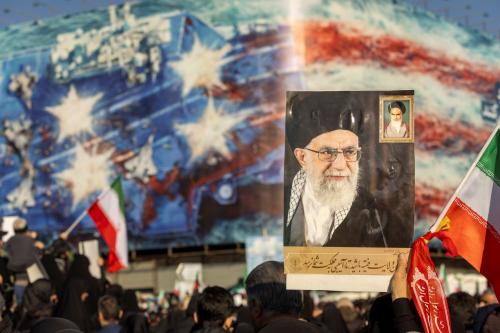
This week, Brookings experts convened to discuss the Iran war and its implications for Iran, the Middle East, and international security. This episode of The Current offers highlights from that event, moderated by Michael O’Hanlon, and including panelists Philip Gordon, Mara Karlin, Jeff Feltman, and Suzanne Maloney.
Related Content
2026
Transcript
GORDON: The relatively easy part is actually getting rid of the regime. The much, much harder part is filling the vacuum that you inevitably create, and I think that’s the great challenge that we’ve created for ourselves in Iran right now. So if you’re like really pressing me to sort of say what we would do now, I would say we do need to look for a sort of off-ramp.
[music]
DEWS: Welcome to The Current, part of the Brookings Podcast Network. I’m Fred Dews. In this episode, we’re bringing you highlights of a critical discussion recently held at Brookings on the escalating military conflict in Iran. As President Trump navigates what many are now calling a war of choice, the implications for global security, energy markets, and the Iranian people are profound.
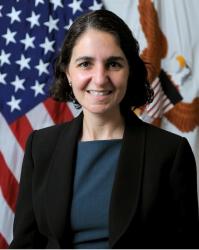
In this episode, you’ll hear from a panel of Brookings experts with deep experience in global security research and service at the highest levels of U.S. government. Michael O’Hanlon, director of research in Foreign Policy at Brookings moderates the talk that includes Phil Gordon, former national security advisor to Vice President Kamala Harris; Mara Karlin, former assistant secretary of defense during the Biden administration; Jeffrey Feltman, former undersecretary-general for political affairs at the UN; and Suzanne Maloney, vice president and director of Foreign Policy at Brookings and a leading expert on Iran.
We begin with Michael O’Hanlon asking Phil Gordon to help us understand the Trump administration’s shifting objectives.
[1:26]
O’HANLON: Phil, I wanted to begin with you and ask you to help us understand which of the missions that have been articulated by President Trump for what we’re trying to achieve. Which of the objectives are going well? Which are more realistic? Which may cause us some concern? We’ve been hearing about destroying the nuclear program and of course changing leadership and inducing a revolution. How do you feel about these various objectives? Looking forward to your thoughts, over to you.
[1:50] GORDON: Great, thank you, Mike, and good afternoon everybody. And Mike, I’m glad you started there with the missions and I’m kind of glad you gave us the big list too, because one of the striking things to me about this entire episode or war, because I agree we should call it a war, the administration has really struggled, I think, to provide a clear and consistent message about what this is all about.
It’s not to say you can’t have multiple missions at the same time, but it’s been a moving target. I mean, there’ve been times when this was almost exclusively about Iran’s nuclear program. But then at other moments, even a comprehensive nuclear deal wouldn’t be enough.
And then most important, I think, is is what you also flagged: regime change. You know, last summer the U.S. following Israel used significant military force to take out Iran’s nuclear program, and the president declared it obliterated. And it was only when Iranian protestors started to rise up in the early part of this year, and Trump in mid-January said, help is on the way, rise up and take your institutions– but they didn’t have the forces in place to back up that statement– that we sent the forces into place. So in that sense, providing an ability to support Iranian protestors was kind of the proximate cause of getting us where we are today.
So pinning this on an imminent threat to the United States seems least persuasive at all. And in that sense, this was entirely a war of choice by the president, which means that he owns the consequences even more than he otherwise would.
[3:16]
O’HANLON: Thank you, Phil. Mara, I’d like to go now to you with the question. We talk a little bit about the specifics of what’s happening now. And out of the mission set that you’ve seen delineated by the president, which of those strike you as more militarily attainable and realistic?
[3:29]
KARLIN: Thanks very much, Mike. I think Phil did a really nice job outlining the dim sum menu of reasons that have allegedly triggered this this conflict. What we have seen is the U.S. military, which really is the most capable military in the history of the world, doing the sort of thing it does best, which is a high-end, conventional conflict. It spent about 30 days setting the theater. That means it’s flowed a whole bunch of assets and platforms and people to the Middle East.
And then it has executed this massive, multi-domain effort going across cyber, space, maritime, air, you name it. And they’ve dropped tens of thousands of ordinance so far, hitting at least more than a thousand plus targets in line with the Israeli military.
Where I think this gets a little bit trickier is as we think about the next phase here and what else can actually happen. And that’s, frankly, drones. Drones are a whole lot harder to target because they’re really slow and they’re often small. If you saw the U.S. Embassy in Riyadh was hit yesterday, six U.S. troops so far have died because of drone attacks. We’ve seen a number of soft targets like airports, hotels all getting hit by by them as as well. So I think that piece is going to make this actually a much trickier situation going forward for the U.S. military.
There’s the potential that there may be a need for a non-combatant evacuation. So there’s hundreds of thousands of Americans in the Middle East. That’s a huge mission.
So effectively what the U.S. military has done in its first phase in many ways plays to its comparative advantages.
This second phase as this war continues does much, much less so and is going to get a bit trickier.
[5:15]
O’HANLON: Jeff, that leads me to you and to a discussion of broader dynamics in the Middle East. Do you have any thoughts about this changing evolution in how we think about targeting leadership around the world, but specifically within the Middle East?
[5:29]
FELTMAN: I’m sure it felt very good for Trump to be able to say Khamenei is dead. But what in the end did we accomplish? We created the martyr. This is not a Maduro, Venezuela thing because the system has a deep bench that goes far beyond Khamenei. So I felt, I felt like this was a gratuitously illegal act, but I don’t believe in the end that killing Khamenei was decisive in what’s going to happen in Iran.
And he’s had almost 37 years to embed layers of his supporters throughout the system. His whole identity and the identity of Islam Republic that he represented was wrapped up in enmity about the United States.
[6:08]
O’HANLON: That sets up naturally the conversation to go to you, Suzanne, and I’d welcome your thoughts on anything we’ve been discussing and everything, but specifically the future of Iranian politics, how you handicap the basic distribution of power and the dynamics of power within Iran right now.
[6:24]
MALONEY: Thanks Mike. I think we have to acknowledge that the killing of Ayatollah Ali Khamenei was received with great joy among many Iranians inside Iran and and of course many in the diaspora around the world as well. Khamenei was a brutal man. He had institutionalized his own power throughout his 37 years in office. The regime, as Mara and others have said in the past few moments, is deeply embedded. It is well armed. There is no political mobilization within the country that can really take up what President Trump said on Saturday, that Iranians should simply go and take over their over their government. That’s just not a a a a meaningful or realistic option given the brutality and the overwhelming dominance of this system.
And so we’re going to be left with some kind of bloodied, battered rump version of the Islamic Republic led by officials who are now even more determined to try to cling to power, and who are going to be more confident of the fact that they’re able to stay because they have withstood this terrible crisis.
[7:27]
O’HANLON: The real question I have for everyone, starting with Suzanne, and then I’ll just go back through the panel starting with Phil after that, if there is a refinement, adjustment, or change in strategy that you’d recommend to the United States right now, what might it be?
[7:38]
MALONEY: Because I think first and foremost, we’ve got to be really clear in articulating publicly to the American people, but also to our partners and allies in the region about precisely what it is we’re trying to accomplish. And if we’re not trying to accomplish regime change, we also have to acknowledge that it’s got to be clear to the American people what this is all for and what the end state that we’re trying to achieve might be.
I think the other important point is that we are going to be dealing with some version of this regime in the aftermath of this conflict. We can’t go back to status quo ante. The priority for the aftermath of this conflict has to be creating the incentive structure and that includes both the possibilities of openings, but also the real continuation of penalties to try to ensure that whomever is in charge in Tehran, in the Islamic Republic, when this all ends is going to be incentivized to build a different future for the Iranian people.
It’s possible that there are people within the system who in the past were sympathetic to at least some degree of reform. We are going to have to make that a top priority, not just an ancillary interest for the United States. If this conflict ends with the essentially the same regime in power, but much weaker, then I think we’re going to continue to be in a very dangerous position in the region.
[8:49]
O’HANLON: Phil?
[8:50]
GORDON: So if you’re, like, really pressing me to sort of say what we would do now, I would say we do need to look for a sort of off ramp. The relatively easy part is actually getting rid of the regime. The much, much harder part is filling the vacuum that you inevitably create, and I think that’s the great challenge that we’ve created for ourselves in Iran right now.
[9:10]
MALONEY: Over to you, Mara.
[9:11]
KARLIN: So I guess the three recommendations I would offer, the first is exactly what Suzanne highlighted. I think we need to explain to the American public what’s going on here. The administration owes it to the public. Americans are dying. If this continues, more Americans will die. We just need to understand what that’s for.
And then two, I would begin contracting a whole lot of commercial ships and getting them to the region. This is because you’re not going to be able to evacuate folks by air given obviously what’s happening with the missile and in particular the the drone threat. So it’s going to have to be ships and they’re not going to be military ships. So I start contracting commercial ships.
And then the last thing I would do is I would call up the Ukrainians and I would make sure that we are learning everything we can from them about how to counter uncrewed autonomous systems. So what can we learn from Ukraine along these lines?
[10:05]
O’HANLON: Jeff over to you.
[10:06]
FELTMAN: It is a complete dereliction of duty for President Trump and his administration to have been planning this war for the past month, however long it’s been since they’ve been moving assets, without planning for an evacuation of American citizens. But we’re talking now about the potential of of American citizens being trapped in 14 different countries when they could have been planning all along for how they were going to deal with this.
So my recommendation is very much focused as a former U.S. ambassador heading a U.S. embassy where your responsibility is to protect U.S. Citizens, get an evacuation plan in place now.
O’HANLON: We’ll stop there. I want to thank all of you for extremely cogent and incisive analysis, and thank everyone who’s joined us today on following this important topic, thinking it through. Obviously one of the most important national security moments in the United States in recent years for a period of time when the world’s been going fast all the time for a long time. But this still has to rise near the top of the list, I think, for all of us.
So on behalf of Brookings, thank you for joining us and signing off.
DEWS: That was Suzanne Maloney, Jeffrey Feltman, Mara Karlin, Phil Gordon, and Michael O’Hanlon discussing the volatile situation in Iran and the strategic uncertainty facing the United States.
[music]
To watch the full video of this event and read more expert analysis on the conflict, visit us Brookings dot edu. Thank you for listening to The Current.
Participants




More information:
- Listen to The Current on Apple, Spotify, YouTube, or wherever you like to get podcasts.
- Learn about other Brookings podcasts from the Brookings Podcast Network.
- Sign up for the podcasts newsletter for occasional updates on featured episodes and new shows.
- Send feedback email to [email protected].
The Brookings Institution is committed to quality, independence, and impact.
We are supported by a diverse array of funders. In line with our values and policies, each Brookings publication represents the sole views of its author(s).

Commentary
PodcastWhat’s next for the Iran war? Experts discuss.
Listen on
The Current Podcast
March 5, 2026