




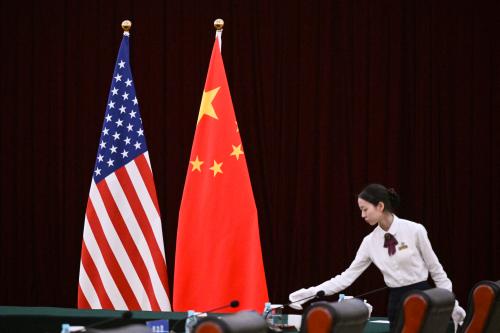
This episode of The Current features excerpts from a new Brookings podcast, The Beijing Brief, on which scholars from the China Center at Brookings discuss a range of issues in the U.S.-China relationship. On this episode, they focus on why the Trump-Xi summit was delayed and what the rescheduled summit could look like.
Related Content
Transcript
KIM: And it’ll be interesting to see when Trump goes to Beijing, how Xi will talk about these conflicts and whether he’ll be asking the U.S. to pay attention to Chinese interests.
HASS: And when the two leaders meet to discuss these issues, it will be a rather fresh conversation because thus far in the preparation for the president’s trip, the only channel that has been activated has been the economic channel. The absence of a strategic dialogue on a sustained basis while the rest of the world is literally blowing up has been a somewhat extraordinary event.
[music]
Hi, this is The Current, I’m Ryan Hass, the director of the China Center at Brookings.
CZIN: And I’m Jon Czin, fellow in the China Center here at Brookings. And together with our colleagues, Pattie Kim and Kyle Chan, we’ve just launched a new podcast at Brookings called The Beijing Brief.
HASS: On The Beijing Brief, we and our expert guests take listeners behind the scenes in Washington and Beijing to try to unpack the forces that are shaping U.S.-China relations, as well as China’s political, economic, and technological ambitions.
Episode one is out now where Jon, Pattie, Kyle, and I had a great conversation about what is going on in the U.S.-China relationship, how the Iran war is impacting it, why President Trump delayed his visit, and what we should expect when we understand now that he will visit on May 14th and 15th.
CZIN: On this episode of The Current, we’re bringing you an excerpt of our longer conversation from The Beijing Brief that focuses on the summit, its delay, and what we might expect from the now rescheduled meeting between the two leaders.
You can listen to the entire episode of the new podcast on our website, Brookings dot edu slash The Beijing Brief. But for now, take a listen.
[music]
[1:35]
HASS: Pattie, at the most basic level, in your view, why did President Trump decide to delay his meeting with President Xi?
[1:42]
KIM: Well, Ryan, in the president’s own word, he said that because of the ongoing war in Iran, he felt the need to stay in Washington rather than travel to Beijing. And what’s notable is that in an interview with the Financial Times, which first broke the news of a potential delay, it seemed like Trump was tying his trip to Beijing to a commitment by China to help out in the Strait of Hormuz, to help stabilize the Strait of Hormuz. And he specifically said that he’d like to know whether the Chinese would step up. And he implied that they should because they get a majority of their oil from the straits.
Now, since those initial comments, the administration has really gone out of the way to walk back those comments. So we heard from Scott Bessent in Paris and others who emphasized that the postponement was purely due to logistics; it was not a pressure tactic on Beijing. And at the same time we’ve heard U.S. officials emphasize that the trade talks went really well, that they were constructive, that the bilateral relationship is still on track.
And interestingly, the Chinese response has been pretty measured too. I mean, they’ve also repeated those words that the bilateral relationship is progressing, that leader to leader engagement is important and that they are in communication about whenever the summit is rescheduled for.
So I think the takeaway here is that Washington and Beijing are both signaling that the postponed summit shouldn’t be read as a major setback to the bilateral relationship, and that it’s really about logistics.
[3:13]
HASS: Do you all buy that explanation?
[3:15]
CZIN: I mean, I think there’s of course some validity to that with a war going on in the background, right, that makes sense that you would want to postpone. I’ve heard some people say that Beijing wasn’t necessarily interested in hosting President Trump, too, while a major conflict is underway and that that could be potentially awkward.
That’s not my sense, though, from what I’ve seen in Chinese sources. Right? It seems like that if the trip were going to go ahead, they would’ve been happy to welcome him.
My sense is probably big picture, this will end up being a blip for the bilateral relationship. But I think for the moment, I would be surprised if, behind closed doors, people in Beijing who were involved in orchestrating this visit were not frustrated, and there was plenty of reporting already that they were frustrated by the lack of detailed staff preparations going into this. And so I suspect that that’s probably bubbling just below the surface.
And I think there’s also an open question too, if this is just about logistics. Where are we going to be in the Iran War–this is a huge separate question–five, six weeks from now, as the president said? Or do we really think that operations are going to be wrapped up and this will have a bow on it? That seems unlikely as a non-Middle East expert at this point.
Ryan, what are your thoughts having been involved in so many of these kind of engagements before?
[4:18]
HASS: Well, I think that you and Pattie have covered it well. The only thing that I would add to it is that I’ve heard that the Chinese were deeply frustrated to learn through the media of President Trump’s plans to change the timing of his trip, which is very unorthodox and sort of reflects the manner by which the president relates to and approaches President Xi in China.
[4:39]
CZIN: Kyle, did you have thoughts you wanted to add?
[4:41]
CHAN: Overall, it’s very interesting to see that both Washington and Beijing are pulled to each other kind of like magnets right now. They both have strong reasons to want this summit to happen. I think from the U.S. side, President Trump wants a stable relationship with China, wants to be seen as making progress, especially on the trade front, and most importantly, doesn’t want any issues related to China to derail his many other activities, foreign and domestic.
On the Chinese side, I think they would also be keen to signal to the world, to their own domestic audiences that the two, in their view, world superpowers are nearly at the same level and are at least enjoying a moment of stability in the near term.
[5:24]
CZIN: That’s really interesting to hear you say that because whenever this meeting does happen, assuming it does happen, it really puts Beijing in the position of being a relative bright spot in Trump’s foreign policy. Right? He’s got a lot of metaphorical and actual fires to put out right now, and Beijing doesn’t seem like it’s one of them at the moment. Right? So there are some ways in which, you know, I think this really ends up playing to Beijing’s advantage.
And I think, we were having this conversation beforehand, too, I mean, as frustrated as Beijing might be, I wonder if one of the other advantages that they get is that they do seem like they are playing for time. And pushing this visit off. While they may be annoyed about it right now, it does kind of further build in that backstopping, right, and I think gives the administration real pause to advance any kind of competitive measures over the next five or six weeks or whatever the timelines ends up being in the run up to this meeting whenever it happens.
[6:10]
[music]
Okay, so that was some of our team’s discussion of the likely reasons for the Trump administration’s decision to delay the summit with President Xi. We continued the conversation with some insight about what the delay looks like from Beijing’s perspective and offered some insights throughout this session of The Beijing Brief.
Here’s what our colleague, Pattie Kim, had to say.
[music]
[6:33]
KIM: So I want to ask you, Jon and Kyle, going back to sort of how Beijing is reading this moment. You know, clearly, Jon, as you mentioned, even after the war broke out, Beijing was not going to cancel this summit. They realized that in order to manage the U.S.-China relationship, you really need to keep Trump happy. And he was talking about this trip for months and he still is, and so they weren’t going to pull it.
But having said that, they did have reservations about giving Trump sort of the grand reception that he was probably looking for at a moment when the United States is at war with one of China’s strategic partners, in a war that the Chinese have opposed.
And second, even before the military strikes, there were a lot of concerns that not enough working level engagement had happened to really set up the logistics or to set up concrete deliverables for this summit.
And so I’m just curious to hear from you both, maybe starting with you, Kyle, on sort of how you think Beijing is reading the postponement or the broader situation. Do they see this as a setback, maybe an American power play, or do they see this as a relief for something else?
[7:40]
CHAN: I think it’s probably a mix of relief and anxiety. On the one hand, I think that they had been hoping that the U.S. would prepare a bit more, that the talks would be more substantive, and they could put some real issues on the table. Maybe that wasn’t how the U.S. was going to approach it, but maybe that was the hope from the Chinese side. So to see the timing get pushed back a bit maybe would offer the U.S. some extra time to get ready for these discussions.
At the same time, though, there is maybe a tinge of anxiety here where the question is, it got pushed back once, can it get push backed again? How much further can this slide? And will an issue like the Iran war end up overtaking and kind of pushing out what China sees as its key priority, which is the U.S.-China relationship?
[8:25]
CZIN: It’s interesting. I have a slightly different take on it. I think it depends on what you think Beijing wants from these engagements. And my theory of this has been for a while is that they mostly want time. Right? There may be other things that they want or they try to get maybe additional U.S. investment, a rollback of some of our competitive measures. But I think mostly they’re playing from time.
And I feel like my theory of this has been that Beijing already thinks that it has a lot of leverage over Washington after last year and what they did with the rare earths, and they think that that leverage is actually going to increase as we approach the midterm elections.
And I think we’ve all heard this even before the current spike in oil prices, there was also kind of a mirror image of many assessments of China’s economy in the U.S. They can see the frailties in our own economy. Right? They can see the k-shaped economic growth, the problems in the labor market. Right? And they think that those two dynamics, the political calendar and our economic frailties, they thought they were going to compound anyway in the run up to the midterm elections and that that would give them more leverage.
So if the theory is that Beijing wants more time and they think they’re going to have more leverage over time, I could see them getting real benefit from the fact that this is delayed.
And my thought was, too, especially because the administration said that they wanted to do a series of engagements over the course of this year, that could actually diminish Beijing’s incentive to have a big deal in this meeting.
I mean, this is often the case with Chinese statecraft, right, the meeting is the objective. But I think that was going to be especially true for this meeting. So I know there was grumbling and grumpiness about not having more to offer, but I think we all agree there were going to be pretty low expectations in terms of this meeting. Right?
[9:52]
Pattie, I wanted to ask you one question, especially because you’ve written a book on this now about China’s partnership with Iran. I know there’s a school of thought in Washington that said that, you know, this is somehow an indirect move to compete with China, this is great power competition through another vector, and that the moves against Venezuela and Iran in particular are designed to box in China.
As somebody who’s really looked at this closely is, do you buy that? I mean, what do you think of that argument?
[10:15]
KIM: I think some people could spin it that way, but I don’t really see, I don’t really see it that way. I don’t really know how squeezing Venezuela or Iran is really giving us an upper hand, giving the United States an upper hand vis-à-vis China.
And of course there’s been interesting conversations in China as well about, you know, how are they going to manage these situations? Because the United States is going, taking out their partners. They’re not really doing much beyond sort of rhetorical positioning where they say, you know, we are for sovereignty and territorial integrity, we are against military action, and you know, the U.S. should return to the negotiating table to hammer out conflicts. But you don’t really see the Chinese stepping up to assist their partners. And I’m sure there’s questions about, should we be doing something more?
But the Chinese way of operating for decades has been, let’s just have very flexible strategic partnerships. We’re not going to be offering security guarantees or nuclear umbrellas or anything like that. When we are working with partners, we can dial down or dial up the relationship as needed.
And so I think for them it’s probably an interesting moment and it’ll be interesting to see when Trump goes to Beijing, how Xi will talk about these conflicts and whether he’ll be asking the U.S. to pay attention to Chinese interests or what conversations might come out on those topics.
[11:36]
HASS: And when the two leaders meet to discuss these issues, it will be a rather fresh conversation because thus far in the preparation for the president’s trip, the only channel that has been activated has been the economic channel. The absence of a strategic dialogue on a sustained basis while the rest of the world is literally blowing up has been a somewhat extraordinary event.
[music]
[11:55]
CZIN: The nature of this segment and how we planned for it just illustrates, you know, how hard it is to schedule things in this administration. Right? Like, it’s very hard to plan. You’re very easily going to be overtaken by events, even when it’s something like a summit that, as you and I both know from the many scars we we got from working on the National Security Council, usually takes months of sweating and preparation and meticulous planning about who’s going to stand where. It’s almost like planning a wedding. Right?
[12:19]
HASS: In a sense, yes, except you don’t have the satisfaction of a wedding cake at the end of it.
CZIN: Yeah, exactly.
[12:24]
HASS: But you know, as I I think about how Beijing is responding to events in the Middle East, I don’t think it’s necessarily all good or all bad for China. But on net, my sense is that it’s probably more good than bad.
CZIN: Yeah.
[12:36]
HASS: On one hand, you know, China is the largest trading partner in the world. And so less global demand for their products is not a good thing. China is also the world’s largest importer of oil. So higher oil prices are not a good thing.
But on the other hand, the thing that the Chinese most want is space, strategic space. And as they watch the United States send Marines from Japan, send a carrier strike group from Asia, send parts of the Terminal High Altitude Air Defense system from South Korea, pack up parts of Patriot defense missile systems from Asia and send them to the Middle East, what they are getting is space.
They’re also getting the opportunity to remind other countries in the region that depend upon the United States for their security, do you really want to depend upon the United States if the United States cannot handle a second rate regional power like Iran?
[13:22]
CZIN: Yeah, I think that’s exactly right, Ryan. I think Beijing would rather not have had all this happen. They’d rather not have another conflagration in the Middle East and delayed summit with President Trump. And I I’m sure they are not happy about the fact of it. Right? It’s just irritating to have something fall off the calendar like this.
But over the longer term, I think you’re right. This kind of plays to a lot of their advantages and all they have to do is kind of stay inert and accrue the benefits that that naturally will be the byproducts of this.
[13:48]
HASS: Yeah. So the the longer that the war drags on, the more that it is a war of attrition, the better it is for China, the worse it’s for the United States. Let’s all hope that things can wrap up soon and successfully, and that the United States can return to regenerating sources of strength to deal with the long-term challenge that China poses.
[14:02]
CZIN: You mean to pivot to Asia again?
HASS: It’s going to be great when it happens.
[music]
Well, that’s it for this episode of The Current. Thanks for listening. To listen to the entire conversation on our new podcast, please visit us at Brookings dot edu slash The Beijing Brief.
Participants




More information:
- Listen to The Current on Apple, Spotify, YouTube, or wherever you like to get podcasts.
- Learn about other Brookings podcasts from the Brookings Podcast Network.
- Sign up for the podcasts newsletter for occasional updates on featured episodes and new shows.
- Send feedback email to [email protected].
The Brookings Institution is committed to quality, independence, and impact.
We are supported by a diverse array of funders. In line with our values and policies, each Brookings publication represents the sole views of its author(s).
Commentary
PodcastWhat does China want from a Trump-Xi summit?
Listen on
The Current Podcast
April 1, 2026