Two hundred and fifty years ago, on July 4, 1776, the Second Continental Congress authorized the Declaration of Independence, calling for statehood and freedom from Great Britain and the monarchy. Central to that call was a founding principle iterated in the time-tested words: “We hold these truths to be self-evident, that all men are created equal, that they are endowed by their Creator with certain unalienable Rights, that among these are Life, Liberty and the pursuit of Happiness.” The “United States of America” would not officially take that name until September of that same year. However, the idea of the United States had been manifested—so too was the racial justice movement.
The opening of the declaration’s second paragraph, “We hold these truths,” signifies the ongoing commitment required to secure equality for all. As philosopher John Dewey observed, “Democracy has to be born anew every generation.” Each generation of racial justice advocates has returned to the declaration’s equality principles to win hard-fought legal victories for Black, Latino, and Asian Americans, demonstrating the strength of those principles.
The passage of the 13th, 14th, and 15th Amendments—the so-called “second founding”—as well as the Civil Rights Act of 1964 and 1968 can all be credited to racial justice advocates who leveraged the declaration to extend basic civic rights to all citizens.
But the declaration’s language, powerful and enduring as it has been, has a gap. It establishes the right to pursue happiness; it does not establish the economic conditions necessary to achieve it. That gap—measured today in a 6-to-1 racial wealth divide—is what racial justice leaders must address with the same relentlessness as the fight for civic forms of equality.
Even before the declaration, there had been petitions calling for an end to slavery, which was permitted in all 13 colonies. After the declaration was authorized, abolitionists turned the noble rhetoric of equality back on the very men who had written it, demanding the nation and its founders live up to their own words. That tradition of holding the country accountable to its equality principles has proven as durable as the principles themselves, and it has served the country well in the advancement of civil rights for all Americans.
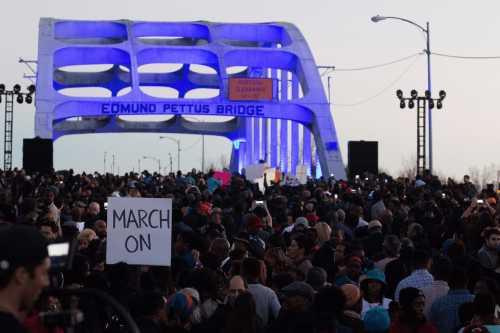
From Frederick Douglass to the marchers of the 21st century, civil rights leaders have returned again and again to the declaration as both indictment and demand. In 1852, Douglass used the Fourth of July to expose the contradiction at the nation’s core: a country that proclaimed liberty while enshrining slavery in law. More than a century later, Martin Luther King Jr. stood before the Lincoln Memorial and called the declaration a promissory note, one that guaranteed unalienable rights to every American but had been returned to Black citizens marked “insufficient funds.” A year later, Fannie Lou Hamer sat before the Democratic National Convention’s Credentials Committee and put a human face on what that broken promise looked like in practice, describing beatings, intimidation, and the systematic denial of the right to vote. In recent times, the demand inherent in the phrase “Black Lives Matter” carries forward the same moral logic: that the declaration’s guarantee of equal standing applies to all Americans.
Various movements for racial justice have paved the way for significant civil rights victories over the last 250 years, codifying Black personhood and citizenship. The Reconstruction Amendments—the 13th, 14th, and 15th—amounted to a “second founding,” abolishing slavery, establishing birthright citizenship, and guaranteeing the right to vote regardless of race. The Civil Rights Act of 1964 outlawed discrimination based on race, color, religion, sex, or national origin. The Fair Housing Act of 1968 banned housing discrimination. Cohorts of civil rights leaders continued to fight for Black personhood and citizenship across plantation fields, segregated rail cars, and sundown towns. Racial justice leaders fought through Jim Crow racism, convict leasing, and lynching. They demanded civil rights amid post-war inequities such as redlining, urban renewal, wage discrimination, and mass incarceration.
While civil rights were advanced, wealth was extracted from and denied to Black Americans, a disparity still reflected in wealth figures today. As of 2022, median wealth stood at about $45,000 for Black households and $62,000 for Latino households, compared to $285,000 for white households and $536,000 for Asian American households.
Slavery was never the only instrument of dispossession. After emancipation, a succession of federally sanctioned policies ensured that the wealth gap slavery created would persist across generations. The New Deal’s Social Security Act and labor protections excluded domestic workers and sharecroppers, categories that encompassed the majority of Black workers at the time. The GI Bill, which built the white middle class through low-cost mortgages, college tuition, and business loans, was administered locally in ways that systematically denied those benefits to Black veterans. Redlining, federally sanctioned through the Home Owners’ Loan Corporation, drew maps that concentrated Black families in neighborhoods starved of investment and locked out of the appreciation that built white intergenerational wealth. The results of these policies compound to this day.
Black wealth is growing; between 2019 and 2022, median wealth for Black households rose 61%, driven primarily by housing and business equity—a testament to the gains that Black people and civil rights leaders have made. But even fast growth from a suppressed base can’t keep pace with a much larger base that’s growing too. The illustration of that can be seen in stock equity: It accounts for nearly 30% of white wealth accumulation but only 4% of Black wealth accumulation. Because stock equity appreciates faster than housing equity, and because white families have historically held far more discretionary income to invest, the racial wealth gap has continued to widen even as Black wealth rises. The past is not past. It is compounding.
The salience of wealth can be found in its ability to predict most outcomes, from education to life expectancy to happiness itself.
Historian Arthur Schlesinger argued that Jefferson’s use of “pursuit” did not mean chasing happiness as a distant goal, but actually practicing happiness, the experience of it. Modern research allows us to measure how happy Americans are through the social science concept of well-being. Broadly defined, well-being comprises the social, economic, and political factors that influence how we subjectively answer the simple question: “How are you doing?” Gallup defines well-being more precisely as the sum of factors affecting how people experience their daily lives. By either definition, the data show a connection between wealth and well-being.
Our Brookings research tracking well-being across wealth quintiles finds that as wealth increases, so does the share of people who report thriving (the highest level of well-being), while the share who report struggling or suffering declines. Our research on an objective measure of well-being, life expectancy, shows that wealth factors are some of the most predictive of longevity, with homeownership, business ownership, and income being some of the most important indicators.
Wealth is infrastructure for happiness. If the pursuit of happiness is an unalienable right, wealth is its precondition.
In his 1944 State of the Union address, President Franklin D. Roosevelt argued that “political rights proved inadequate to assure us equality in the pursuit of happiness” and proposed an Economic Bill of Rights to remedy that inadequacy. It was never adopted. Economist Darrick Hamilton has made the moral case for why that unfinished work is the defining challenge of our time.
As Hamilton writes, “The right to vote when you are hungry is not freedom. The right to protest when you are unhoused is not justice. Political and civil rights without economic rights are not merely inadequate; they are a co-optation of the very ideas of freedom, justice, and rights.”
A person does not have to be in chains to be caged by society. This is a lesson those facing racism can understand. It should not be another 250 years before we fund the freedoms that the Declaration of Independence made a way for.
Related Content


Author

The Brookings Institution is committed to quality, independence, and impact.
We are supported by a diverse array of funders. In line with our values and policies, each Brookings publication represents the sole views of its author(s).


Commentary
The racial wealth gap undermines the declaration’s promise
July 6, 2026