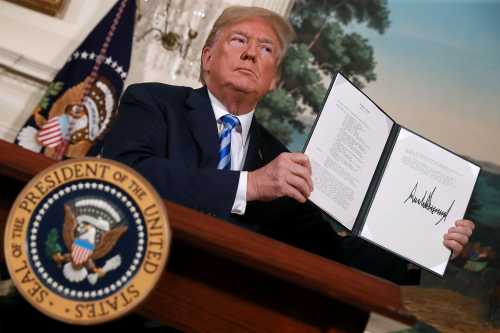
The Trump administration’s decision to declare an end to the New START treaty seems to reaffirm a growing recognition among American strategists that legacy arms control frameworks—designed for a bipolar U.S.-Russia strategic order—are poorly suited to the new nuclear landscape, increasingly shaped by China’s rise. Beyond these geopolitical shifts, the strategic environment is also being reshaped by technological change, including advancements in missile defense systems, the proliferation of drones, and the spread of shorter-range strike capabilities. With the New START treaty now defunct, it is time to rethink arms control from first principles.
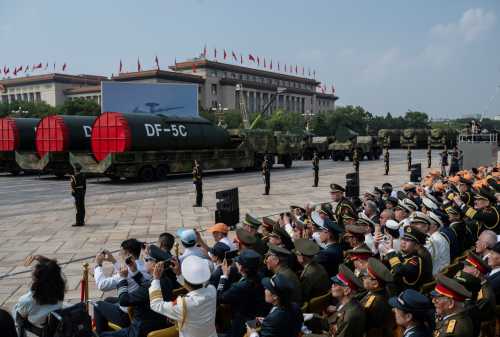
The traditional arms control model—designed to deter a first strike—rested on reciprocal, legally binding numerical limits between two near-equal nuclear superpowers. That structure assumed rough parity and a stable bargaining equilibrium. But binding ceilings make less sense in a world where China and Russia are strategically aligned, and China’s nuclear arsenal is growing quickly. According to the U.S. Department of Defense’s China Military Power Report, China had roughly 200 warheads in 2020, about 600 today, and could reach 1,000 by 2030. If many of those warheads are deployed on long-range delivery platforms like intercontinental ballistic missiles (ICBMs) capable of reaching the United States, the size of China’s strategic arsenal could approach that of Russia and the United States.
The limits of legacy arms control
The structural problem is straightforward: Washington cannot accept limits that allow Russia and China each to match U.S. levels, while Beijing and Moscow would not agree to limits that leave their combined totals capped below U.S. forces (plus those of the United Kingdom and France). In a three-actor system with shifting relative capabilities, a framework built on symmetrical numerical ceilings lacks a stable resting point.
This does not mean that quantitative restraint is irrelevant. Some have suggested aggregate warhead limits as an alternative to deployed strategic ceilings. But absent political alignment and verification conditions that do not currently exist, binding multilateral caps are unlikely to prove durable, or in America’s interest, given China and Russia’s modern strategic alignment. The more immediate task is to prevent worst-case planning from driving unrestrained competition.
Managing uncertainty, not counting warheads
A new framework should prioritize transparency over rigid numerical limits—not to rebuild trust, which is in short supply, but to stabilize interpretation and reduce incentives for unbounded arms racing. The objective is not to eliminate uncertainty—an impractical goal—but to manage it. Some forms of uncertainty cannot be removed, while others cannot be removed without intrusive verification that is unlikely to be negotiable. But it also reflects a strategic judgment: efforts to eliminate uncertainty can create false precision or incentivize worst-case hedging. A more stable approach is to bound and structure uncertainty—making capabilities and intentions legible enough to reduce worst-case fears—while preventing ambiguity from translating into arms racing or crisis instability.
Expanding scope and building norms
Because the emerging nuclear order is no longer confined to two roughly symmetrical arsenals, a revised approach must expand participation and scope. It should include not only the United States and Russia, but also China, the United Kingdom, and France, with pathways for the eventual inclusion of India, Pakistan, and Israel. This new approach should incorporate strategic forces alongside nonstrategic and shorter-range systems. It should also include missile, air, and counter-drone defenses in data exchanges, recognizing that contemporary deterrence stability is shaped by offense-defense interactions across domains, not nuclear numbers alone. A renewed political commitment not to resume nuclear explosive testing—building on the norm established by the Comprehensive Nuclear-Test Ban Treaty—would help preserve limits on qualitative competition and signal restraint even amid broader rivalry. It would also draw on an area where public opinion has historically been mobilized and remains a potentially meaningful source of constraint on renewed testing.
Implementing a transparency-first framework
Rather than legally binding ceilings, such a framework could establish politically endorsed aggregate benchmarks that discourage major expansions above current levels but do not ban some possible growth in offenses and/or defenses. Transparency measures might include data exchanges, declaratory statements about force-structure intentions, and monitoring mechanisms designed to assess consistency with declared plans rather than verify precise numbers. Where on-site inspections are politically infeasible, open-source intelligence and emerging monitoring technologies could supplement more traditional mechanisms.
The emphasis throughout would be on disciplined, purpose-specific disclosure: enough transparency to stabilize expectations and reduce worst-case assumptions, but not so much as to expose operational detail or create false precision around numbers that cannot be realistically capped. This is disciplined ambiguity applied to arms control architecture. The goal is to structure uncertainty so that it remains bounded and interpretable.
Absent an environment conducive to treaty-making, as appears to be the case at least in the short- to medium-term, such a framework could begin with coordinated political commitments and parallel declarations. It would not promise détente or eliminate rivalry. But it would shift the focus away from parity enforcement to uncertainty management—less about eliminating ambiguity than about stabilizing how it is understood. Disciplined ambiguity, if bounded and legible, can help prevent uncertainty from hardening into worst-case assumptions that drive competition. In that sense, managing uncertainty is not a retreat from arms control but a step toward its renewal: restoring enough predictability and restraint to support a future agreement. In the current environment, that may be the most realistic measure of success.
Authors


Related Content
2026
The Brookings Institution is committed to quality, independence, and impact.
We are supported by a diverse array of funders. In line with our values and policies, each Brookings publication represents the sole views of its author(s).

Commentary
The limits of nuclear arithmetic in a tripolar age
March 20, 2026